Stay up-to-date on the companies, people and issues that impact businesses in Syracuse, Central New York and beyond.
Leadership Greater Syracuse announces four new board members, elects new officers
DeWITT — Leadership Greater Syracuse (LGS), a local nonprofit offering a yearlong civic-engagement training program, announced that that four community leaders recently joined its board of directors. Elected to serve three-year terms on the board are: • Ocesa Keaton, director, Greater Syracuse Hope (LGS Class of 2017) • James Lloyd, bank at work representative, KeyBank (LGS Class […]
Become a Central New York Business Journal subscriber and get immediate access to all of our subscriber-only content and much more.
Click here to purchase a paywall bypass link for this article.
DeWITT — Leadership Greater Syracuse (LGS), a local nonprofit offering a yearlong civic-engagement training program, announced that that four community leaders recently joined its board of directors. Elected to serve three-year terms on the board are:
• Ocesa Keaton, director, Greater Syracuse Hope (LGS Class of 2017)
• James Lloyd, bank at work representative, KeyBank (LGS Class of 2014)
• Matthew McIntyre, director of sustainability and industry affairs, Dairy Farmers of America (LGS Class of 2011)
• Neil Webb, director of business development, O’Brien and Gere (LGS Class of 2015)
LGS also announced that four board members were elected as officers. They are:
• President: Jeannette Flowers, director of account management, UMR (LGS Class of 2008)
• Vice Chair: Kathleen Bennett, member, Bond Schoeneck & King (LGS Class of 2008)
• Treasurer: Amy Lawler, vice president of finance, CenterStateCEO (LGS Class of 2011)
• Secretary: Jennifer Smith, assistant general counsel, C&S Companies (LGS Class of 2013)
LGS recently started the program for its 2018 class. The participants will learn about community leadership, empowerment, group dynamics, community opportunities, and area trends.
Visions FCU names Strong community development manager
ENDICOTT, N.Y. — Visions Federal Credit Union announced it recently promoted Tim Strong to community development manager. It’s a new role designed to “ensure that Visions continues to devote time and resources into strengthening the communities” in which the credit union operates, Visions said in a news release. As community development manager, Strong will continue
Become a Central New York Business Journal subscriber and get immediate access to all of our subscriber-only content and much more.
Click here to purchase a paywall bypass link for this article.
ENDICOTT, N.Y. — Visions Federal Credit Union announced it recently promoted Tim Strong to community development manager. It’s a new role designed to “ensure that Visions continues to devote time and resources into strengthening the communities” in which the credit union operates, Visions said in a news release.
As community development manager, Strong will continue Visions’ involvement in and support of local community causes, starting with the “Visions Cares” program. Last year, Visions Cares allotted more than $1 million to support community events and programs across New York, New Jersey, and Pennsylvania.
Strong’s new role will assist Visions staff in continuing to “create a vibrant presence in every community” it services — monitoring and encouraging community involvement. He will also serve as the Visions liaison when collaborating with local elected officials to pass legislation that will strengthen the future of the communities in which Visions operates, the release stated.
With more than 10 years of experience working in credit unions, Strong most recently held the role of business development manager. He has a bachelor’s degree from Le Moyne College in Syracuse and serves on a number of charitable boards of directors, per Visions.
Visions Federal Credit Union, headquartered in Broome County, operates 47 branches in New York, Pennsylvania, and New Jersey. It has 190,000 members and more than 550 employees.
Two CNY companies receive NYS service-disabled veteran-owned business certifications
The New York Office of General Services (OGS) recently announced that the following businesses were recently certified as service-disabled veteran-owned businesses (SDVOBs) by the OGS Division of Service-Disabled Veterans’ Business Development (DSDVBD): • Empire Material USA LLC, of Liverpool, which distributes sheetrock and metal studs. • RWK Solutions Source Inc., of Syracuse, which supplies low and medium
Become a Central New York Business Journal subscriber and get immediate access to all of our subscriber-only content and much more.
Click here to purchase a paywall bypass link for this article.
The New York Office of General Services (OGS) recently announced that the following businesses were recently certified as service-disabled veteran-owned businesses (SDVOBs) by the OGS Division of Service-Disabled Veterans’ Business Development (DSDVBD):
• Empire Material USA LLC, of Liverpool, which distributes sheetrock and metal studs.
• RWK Solutions Source Inc., of Syracuse, which supplies low and medium voltage motors and pumps.
The DSDVBD was created by Gov. Andrew Cuomo in May 2014 with enactment of the Service-Disabled Veteran-Owned Business Act. As of Jan. 29, 2018, 427 businesses have been certified in the state.
The law promotes and encourages participation of SDVOBs in state public procurements of public works, commodities, services, and technology to promote economic development in the state. More information on the program and the certification process can be found at http://ogs.ny.gov/Core/SDVOBA.asp.

One of SU’s “single largest gifts” to help fund National Veterans Resource Center
SYRACUSE — Syracuse University (SU) describes it as “one of the single largest gifts” in its history, one that will benefit an upcoming addition to its campus. SU on Feb. 5 announced a $20 million donation from life trustee Daniel D’Aniello and his wife, Gayle, for the upcoming National Veterans Resource Center (NVRC). The donation
Become a Central New York Business Journal subscriber and get immediate access to all of our subscriber-only content and much more.
Click here to purchase a paywall bypass link for this article.
SYRACUSE — Syracuse University (SU) describes it as “one of the single largest gifts” in its history, one that will benefit an upcoming addition to its campus.
SU on Feb. 5 announced a $20 million donation from life trustee Daniel D’Aniello and his wife, Gayle, for the upcoming National Veterans Resource Center (NVRC).
The donation will help pay for the construction of the NVRC. The $62.5 million, 115,000-square-foot facility will open in the spring of 2020.
D’Aniello graduated from Syracuse University in 1968 and is a veteran of the U.S. Navy, SU said in a news release.
Once built, the NVRC will house the school’s Institute for Veterans and Military Families (IVMF). The IVMF is an academic institute focused on the concerns of the nation’s more than 20 million veterans and their families as well as other veteran-focused educational, vocational and community-engagement programs, according to SU.
D’Aniello also serves as co-chair of the IVMF advisory board, the school said.
Syracuse University Chancellor Kent Syverud describes the D’Aniello family’s donation as “profoundly transformative” and one that will allow Syracuse University to “fulfill its promise of being the best place for veterans.”
New York City–based SHoP Architects is designing the NVRC. SU in November chose Rochester–based LeChase Construction Services, LLC to lead construction-management efforts on the project.
About D’Aniello
Daniel D’Aniello is co-founder and chairman emeritus of the Carlyle Group (NASDAQ: CG), a Washington, D.C.–based investment firm.
He also served as a supply officer in the U.S. Navy from 1968 to 1971. He went on to earn a graduate degree at the Harvard Business School, where he was a Teagle Foundation Fellow.
D’Aniello in 2016 was awarded the U.S. Navy Memorial Foundation’s Lone Sailor Award for drawing upon his sea-service experience to achieve success in his personal and professional life while exemplifying the core values of honor, courage and commitment, per the release.
Since its founding in 2011, more than 90,000 transitioning service members, veterans and military family members have participated in IVMF programs. The IVMF has pledged to place 30,000 veterans, transitioning service members and military spouses into desirable jobs by 2022 through its veterans’ career-transition program called “onward to opportunity.”
“The work being done at Syracuse, specifically at the IVMF, is simply unrivaled,” D’Aniello said. “The fact is that unlike any other university, Syracuse understands and appreciates the significant contributions by and the great role veterans and military families play in our society. This new center will allow Syracuse University to help our nation not only respond to but anticipate the unique needs of this population by helping veterans more seamlessly transition to civilian life. To say this center is a game changer in the ongoing efforts to better the post-service lives of our veterans and their families is an understatement.”

Centolella Green Law merges with Virginia–based law firm
DeWITT — DeWitt–based law firm Centolella Green Law, P.C. has combined with a law firm based in the Richmond, Virginia area that focuses on health-care law. The firm’s merger with Glen Allen, Virginia–based Hancock, Daniel & Johnson, P.C. became effective Feb. 1, says Jason Centolella, a partner in and president of Centolella Green Law. The
Become a Central New York Business Journal subscriber and get immediate access to all of our subscriber-only content and much more.
Click here to purchase a paywall bypass link for this article.
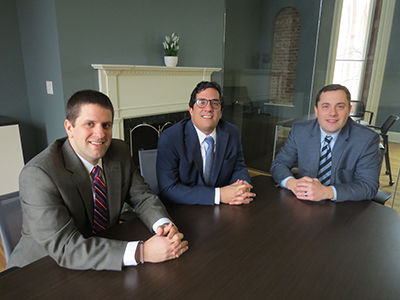
DeWITT — DeWitt–based law firm Centolella Green Law, P.C. has combined with a law firm based in the Richmond, Virginia area that focuses on health-care law.
The firm’s merger with Glen Allen, Virginia–based Hancock, Daniel & Johnson, P.C. became effective Feb. 1, says Jason Centolella, a partner in and president of Centolella Green Law.
The Virginia law firm markets itself as Hancock Daniel.
The local firm focuses on legal matters pertaining to health care, business, and taxes, says Centolella, who spoke with BJNN on Jan. 31 at its office at the Hamilton White House at 307 S. Townsend St. in Syracuse.
Following the merger, the former Centolella Green firm is maintaining both its Syracuse office and its main office at 6832 E. Genesee St. in DeWitt.
The firm is seeing “a lot of changes” in the health-care sector, says Centolella.
“The clients are getting bigger. The systems are getting larger. We felt that it would be the best way to serve our client by having a deeper bench,” he added. “In the health-care space, there’s no other or maybe only a handful of law firms that have as deep of a health-care bench as Hancock Daniel.”
With the merger, the local firm will no longer use the name Centolella Green Law, according to Centolella.
The local firm has four partners. Centolella and Dr. G. Randall Green are joining Hancock Daniel as directors, while Sam Burgess and Eric Bronstad will join the firm as associates.
Centolella says he was not allowed to discuss the financial terms or other transaction details of the deal.
On its own, Centolella Green had four attorneys and three support employees. With the combination, Hancock Daniel’s employee count increases to 127, including a total of 64 attorneys.
“Jason and his team have developed a very sophisticated health-law practice, which is not easy to do … and it’s a geographic region that’s interesting to us,” says Page Gravely, managing partner at Hancock Daniel. Gravely spoke with BJNN by phone during the interview at the Hamilton White House.
Centolella became familiar with Hancock Daniel while working with attorney James Daniel on legal matters pertaining to an accountable-care organization in 2012. Daniel is a senior partner and founder of the Hancock Daniel firm. The accountable-care organization is located in upstate New York, but Centolella declined to identify a specific location.
They stayed in contact, would share best practices, and their business relationship turned into a friendship. Over time, they started seeing “a lot of synergies” between their firms.
“One day, we were both in Washington, D.C., we raised the issue and it progressed from there,” says Centolella.
Daniel and Centolella had been considering the merger since October 2016. They finalized the deal last fall, according to Centolella.
“Sometimes my voice isn’t heard.” I have often heard this complaint from leaders at all levels — individual contributors, middle managers, and senior level executives. It’s a critical issue. When people don’t feel heard, they often believe they’re not being fully utilized for all they have to offer — and often, they’re not. They have something
Become a Central New York Business Journal subscriber and get immediate access to all of our subscriber-only content and much more.
Click here to purchase a paywall bypass link for this article.
“Sometimes my voice isn’t heard.” I have often heard this complaint from leaders at all levels — individual contributors, middle managers, and senior level executives. It’s a critical issue. When people don’t feel heard, they often believe they’re not being fully utilized for all they have to offer — and often, they’re not. They have something to give, perhaps in the form of an idea, and the team is missing out on it.
When people aren’t heard, it’s not only a problem for the person experiencing this, but also for the organization as a whole. The consequences tend to snowball. If people don’t feel heard, they may not be completely committing to organizational decisions. The company is therefore missing out on that commitment, and also then losing the opportunity to tap into all the people resources available to them. And, since speaking up is part of how one develops leadership presence and influence, not being heard causes people to feel disrespected and to lose confidence. This loss of confidence causes them to hesitate to try things outside their comfort zone, which is precisely how organizations nurture and grow their leaders. So, both growth and leadership suffer.
For the “unheard” individual, consider two questions:
Question 1 — Are you not being heard because you aren’t speaking up — due to either lack of confidence, lack of opportunity to connect with the right people, or because you are surrounded by a bunch of extraverts who just won’t shut up (or all of the above)?
Question 2 — Are you not being heard because what you’re saying doesn’t seem to be received, considered, or recognized?
Let’s tackle each scenario.
Lack of confidence
Next question: why? Why do you lack confidence? Reassess your qualifications, experience, and education. If you’ve got what it takes, say it. But perhaps to build up your confidence, you might need more practice. So, get more practice. Find opportunities to practice speaking up in low-risk situations. Practice sharing your ideas and opinions — especially if they differ — in an environment that feels somewhat easy. Then work your way up. If you truly believe in what you have to say, then say it. Don’t let the inner critic inside your head get the best of you. The more you speak up, the easier it will get.
Lack of opportunity
If you feel like you don’t have the opportunity to be heard by the right people, work on building rapport with those right people. Building relationships is part of one’s professional development. It’s how things get done. And if you want to be more influential, rapport is the first place to start. Connect with that someone in the lunch line or at the coffee machine, get on a committee that you know that someone is also on, or join that individual’s golf league. Find something you have in common with that person that will allow you to get to know him/her better. Think genuine bonding and rapport.
Surrounded by extraverts
Get used to it, my friend. The world is full of them. Here’s the funny thing: they’re wondering why you’re so quiet and why you won’t speak up more often. Start saying things like, “Hey, I’d like to jump in here.” Or “I’ve got something I’d like to share.” Whatever it takes to get their attention, say it. And if that doesn’t work, you can try, “Who wants a cookie?” It works with my puppy every time.
Message not received
This is where you need some feedback from others you trust. Could it be that the problem is with how you’re saying it (tone, pace, volume, message clarity)? Recruit some trusted colleagues to provide feedback on your interactions with others. Are you rambling when delivering a thought — saying too much to the point where the crux of your message is diluted? Thinking out loud isn’t the most effective way to deliver an important idea. Save that for brainstorming sessions. Make sure your message is clear and succinct, especially when it’s a higher priority idea or request.
Are you not saying enough? Sharing an idea is not enough. Sharing your idea and explaining why it’s important is critical. Don’t skip the part about how your idea will impact the bottom line, performance, employee engagement, or client relationships. Also, play around with prefacing your ideas with “From my experience…,” “Here’s what I’ve seen…,” “What my work has taught me is…” That will get listeners’ attention every time. If you’re thinking that what you have to say won’t make a difference, recognize this thought for what it is: an assumption. Don’t do it. Your idea just might spark yet a different thought that could be even more amazing than the first. Just put it out there. Some ideas are great, some good, some not so good. That’s what makes great ideas great.
Lastly, if someone else is controlling the conversation in such a way that it appears they are attempting to convince you to their point of view, hear them out. Then say, “that’s one approach. Would you be willing to consider another?”
One definition of leadership is “to influence an outcome.” If you are taking your leadership seriously, you must find the right way, the best way, to make your voice heard. Take some time to consider how you can best do so. Recognize that we may have to come at things multiple times, utilizing different approaches. Keep going. You will make a difference, and both you and the organization will benefit.
Keep speaking, so you can keep leading.
Cindy Masingill is a partner with Emergent, a leadership training and professional coaching company based in Baldwinsville, offering services and programs to improve the performance of individuals, teams, and organizations. Contact her at Cindy@GetEmergent.com

NexGen Power Systems receives $3 million in tax incentives from OCIDA
SYRACUSE — The $90 million building New York State built for California light-bulb maker Soraa, only to have the company pull out, moved a step closer to usefulness Feb. 6. The Onondaga County Industrial Development Agency (OCIDA) approved a 15-year, $3.1 million payment in lieu of taxes (PILOT) agreement with a different California firm to
Become a Central New York Business Journal subscriber and get immediate access to all of our subscriber-only content and much more.
Click here to purchase a paywall bypass link for this article.
SYRACUSE — The $90 million building New York State built for California light-bulb maker Soraa, only to have the company pull out, moved a step closer to usefulness Feb. 6.
The Onondaga County Industrial Development Agency (OCIDA) approved a 15-year, $3.1 million payment in lieu of taxes (PILOT) agreement with a different California firm to take over the empty space in DeWitt.
Following a brief phone discussion with Dinesh Ramanathan, president and CEO of NexGen Power Systems, the OCIDA board approved the PILOT for his company. But the vote didn’t come until after a discussion of what measures were in place to ensure the project went through.
Responding to questions from OCIDA board member Kevin Ryan, Ramanathan said there was wording in the agreement requiring the company to reach certain job-creation numbers. “There are clawbacks and other terms that essentially make sure what happened with Soraa doesn’t happen with us,” Ramanathan told the board. A clawback is the recovery of money already disbursed.
“We have clawbacks on everything,” OCIDA Executive Director Julie Cerio added.
The space NexGen is looking to occupy is an 82,000-square-foot building at 50 Collamer Crossing Parkway in DeWitt originally built, with state taxpayer money, to host Soraa, a maker of LED lighting. That company eventually walked away from the project.
In its application, NexGen said the high-tech company expects to create 290 jobs in the next seven years. The application said those jobs will pay annual salaries between $51,000 for fabrication technicians and $155,000 for those working in research and development.
OCIDA also approved a sales-tax exemption on materials the firm buys to improve the facility, saving NexGen up to $40,000.
NexGen holds multiple patents and creates gallium-nitride semiconductor devices. The company says its products allow for the building of smaller and more efficient power converters. Such converters are part of most electronics, creating a market NexGen said tops $3 billion and is expected to grow larger than $9 billion.
During the phone call, Ramanathan said Empire State Development had approved a $15 million grant for NexGen’s project.
Lockheed Martin to pay first quarter dividend on March 23
The Lockheed Martin Corporation (NYSE: LMT) board of directors has authorized a first quarter 2018 dividend of $2.00 per share. The dividend is payable on March 23, to holders of record as of the close of business on March 1. It’s the same amount that Lockheed paid for its fourth-quarter dividend, when it raised the
Become a Central New York Business Journal subscriber and get immediate access to all of our subscriber-only content and much more.
Click here to purchase a paywall bypass link for this article.
The Lockheed Martin Corporation (NYSE: LMT) board of directors has authorized a first quarter 2018 dividend of $2.00 per share.
The dividend is payable on March 23, to holders of record as of the close of business on March 1.
It’s the same amount that Lockheed paid for its fourth-quarter dividend, when it raised the payment from the $1.82 paid in the third quarter.
Headquartered in Bethesda, Maryland, Lockheed Martin is a global security and aerospace company that employs about 97,000 people worldwide. Locally, Lockheed Martin currently employs about 1,600 people at its Salina plant and about 2,500 at its Owego facility.
Businesses need to use their CRM systems for marketing as well
When people think of a customer relationship management (CRM) tool, they think “sales.” If that’s the case, then you’re doing it wrong. Yes, this is a technology system where sales managers can manage and analyze all customer/prospect data — a repository for all the information that their sales team needs to be successful and a
Become a Central New York Business Journal subscriber and get immediate access to all of our subscriber-only content and much more.
Click here to purchase a paywall bypass link for this article.
When people think of a customer relationship management (CRM) tool, they think “sales.” If that’s the case, then you’re doing it wrong.
Yes, this is a technology system where sales managers can manage and analyze all customer/prospect data — a repository for all the information that their sales team needs to be successful and a place where they can see what their salespeople are doing.
But, most companies don’t use their CRM to its full capability and that’s where they’re missing the boat. I’m talking about the companies that aren’t using CRM in their marketing departments as well.
Is yours one of them? This is understandable as, even at the sales level, there is often a lack of resources to really dig deep into the software or people to babysit all sales reps and ensure they are inputting the right information into the right places. One of the biggest problems facing organizations is the alignment of their sales and marketing teams. The sales team is doing one thing while the marketing team is doing another. While this is an age-old problem in business, there are many things today that can help put these both on the same track.
Your CRM system is one of those things. It probably has the ability to keep track of your marketing efforts and even house the documents within the system to allow for easy access to a marketer’s dream of messaging consistency.
Let’s talk about marketing and sales alignment and how it can help drive sales — which, let’s be honest, is why we are all in business, after all.
While we shouldn’t ignore our traditional marketing strategies, it’s important to make sure we try some newer ones as well. Content marketing through blogs, webinars, and white papers will influence the conversations and thought processes potential buyers have at the start of the buying cycle. You want to be seen as an authority.
Your CRM system can help organize and manage information so your sales team knows what prospects are seeing and engaging with. It becomes an assistant to the sale. It’s no longer the sole responsibility of sales reps to generate leads. It should be a joint venture between marketing and sales. The digital world has allowed marketers to become lead generators. Marketers have the power to influence early dialogue, sometimes even before prospects know they need to buy.
Having a comprehensive and properly used CRM will allow a real-time glance of the effectiveness of all marketing initiatives and how they travel through the sales funnel, allowing better decisions to be made within the sales and marketing departments.
If your sales director and marketing director are not meeting and working together regularly, this is a problem. In today’s world, these two people need to ride in tandem to hit your sales goals. If you outsource your marketing to an advertising agency and it has not asked the sales director to be in the strategy and measurement meetings, find another agency. Lastly, if you don’t have a CRM, get one and use it for marketing.
Jenn Cline is chief operating officer at ABC Creative Group and owner of Nordique Consulting Group, a sales and marketing consulting firm. Contact her at jenn@abcideabased.com
New York milk production dips more than 2 percent in December
New York dairy farms produced 1.22 billion pounds of milk in December, down 2.2 percent from the year-ago period, the USDA’s National Agricultural Statistics Service (NASS) recently reported. Milk production per cow in the state averaged 1,950 pounds in December, down 3 percent from 2,010 pounds a year prior. The number of milk cows on
Become a Central New York Business Journal subscriber and get immediate access to all of our subscriber-only content and much more.
Click here to purchase a paywall bypass link for this article.
New York dairy farms produced 1.22 billion pounds of milk in December, down 2.2 percent from the year-ago period, the USDA’s National Agricultural Statistics Service (NASS) recently reported.
Milk production per cow in the state averaged 1,950 pounds in December, down 3 percent from 2,010 pounds a year prior.
The number of milk cows on farms in New York state totaled 625,000 head in December, up 0.8 percent from 620,000 head in December 2016, NASS reported.
The average milk price received by New York dairy farmers in November was $18.30 per hundredweight, up 10 cents from October and 50 cents higher than in November 2016.
In neighboring Pennsylvania, dairy farms produced 916 million pounds of milk in December, up 0.5 percent from a year earlier. The average milk price received by Pennsylvania farmers in November was $18.70 per hundredweight, up 10 cents from October, and $1 higher than in November 2016.
Stay up-to-date on the companies, people and issues that impact businesses in Syracuse, Central New York and beyond.