Stay up-to-date on the companies, people and issues that impact businesses in Syracuse, Central New York and beyond.

Area colleges host game makers for global event
SYRACUSE — Jan. 26-27 wasn’t a typical weekend for thousands of college students, including more than two dozen in Central New York, as they gathered to take part in a planet-straddling game-creating event. Global Game Jam, organized by a group of the same name, took place at 803 spots around the world, attracting 42,800 participants […]
Become a Central New York Business Journal subscriber and get immediate access to all of our subscriber-only content and much more.
Click here to purchase a paywall bypass link for this article.
SYRACUSE — Jan. 26-27 wasn’t a typical weekend for thousands of college students, including more than two dozen in Central New York, as they gathered to take part in a planet-straddling game-creating event.
Global Game Jam, organized by a group of the same name, took place at 803 spots around the world, attracting 42,800 participants in 108 countries. Combined, participants created 8,597 games.
On Jan. 26, as 5 p.m. struck in each time zone, participants learned what the theme was for this year’s event. Then they chose teams from among themselves and set to work creating games — video games, card games, or even board games.
They had 48 hours, until 5 p.m. Sunday, to complete their work and share it with the world on Global Game Jam’s website (globalgamejam.org).
Syracuse event
By Saturday evening, midway through the event, teams at Syracuse University were deep into their work. Haley Knapp, a senior studying music, history, and culture at Syracuse’s College of Arts and Sciences, was putting together the soundtrack to play with the game her team was creating.
To match the Global Game Jam theme, “transmission,” the team was creating a game called “Mursil,” an Arabic word meaning “transmitter.”
Junior Anjelica Escalante, who is majoring in English and textual studies at the College of Arts and Sciences, was creating the story script, including dialogue for the characters. Mursil was to be a “choose-your-adventure” game where players can decide what to do next and each choice would bring a different result.
“Middle Eastern steam punk visual” is how Knapp described the look of the game, with cartoon-style characters in the foreground and sepia-toned backgrounds.” The soundtrack she was working on was “Pan-Asian fusion” with music and instruments from the region.
The idea of the game is to take steps to fix a transmitter in time for a festival, lest the ruler get angry with your family.
The task of making the game work on a computer fell to Alexander Jansing, a graduate student at SUNY Polytechnic Institute who works as a senior consultant for Booz Allen Hamilton in Rome. He was focused on writing in open-source software called Ren’Py and had a clear goal. “My thing is I just want to get a game finished. One of the most important parts of this is getting it finished,” he says.
At 28, he’s seven years older than his teammates. That’s not unusual, area Game Jam organizers say. The event attracts plenty of students but also adults who are just interested in games. Like Jansing, Knapp, and Escalante, many don’t even know each other before the event begins, but they team up shortly after the start.
In this case, Jansing showed up about three hours into the Game Jam. “Alex saved the day,” Knapp says, noting that neither she nor Escalante are coders.
“For people who don’t know each other, we work together pretty well,” says Escalante.
Knapp, Escalante, and Jansing successfully completed their game. It was named “Most Immersive” of the nine games completed at the university’s event, says John Sanders, one of the campus organizers.
Sanders is a fan of games. (Sid Meier’s “Civilization” is a favorite, he says.) A Ph.D. student in English, with a concentration in film, screen and game studies, he spent Global Game Jam moving from area to area at the university library watching over game developers, offering tips, and ordering pizza.
Morrisville event
The ability to collaborate with others is something employers value, Morrisville State College President David Rogers says in a phone interview. His school has hosted Global Game Jam for the past nine years, in part to encourage students to develop those skills.
“They are not just people who know how to code or build things or grow things,” he says of Morrisville students. They are able to be creative and work with others creatively.
The college has more than a dozen student-run enterprises on campus, Rogers says. Products include ice cream and flowers, and services include car repair. Morrisville also has semester-long internships where students spend a portion of their senior year in the working world.
Compared to the work involved in creating and maintaining those programs, deciding to support Game Jam was laughably easy, Rogers says. “I said, ‘are you kidding me?’” he recalled when Morrisville Professor Richard Marcoux first floated the idea.
“Anytime our faculty can find a way for our students to learn skills employees are looking for, we will,” he says. “It instills confidence in them,” he adds. And “working in teams is what employers are looking for.”
This year Marcoux reports that the Morrisville event drew 15 participants. They broke into teams and created four games.
“It’s not a competition,” Marcoux says, explaining that the concept of Global Game Jam has always been to give people interested in game making a chance to get together and create. The Morrisville event has drawn students over the years as well as Morrisville alumni and people who live in the area.
It’s even drawn people from other colleges, Marcoux says. He says visitors from Syracuse University and Ithaca College came several years back, saw what was going on, and decided to host their own events.
Marcoux, who fondly recalls buying a few cases of caffeinated soda for the first Global Game Jam at Morrisville, is already planning for next year. For the 10th anniversary he and Rogers are planning to invite back all past participants.
Rogers, who was the dean of Morrisville’s school of business when he first approved having the event there, says the college is now considering the possibility of creating a game-design major. It may be an option or minor first. It’s a long process to develop and get approval for such a move, he says.
But Rogers is obviously impressed by what game makers offer. Students who combine creativity and the ability to work in teams aren’t common, he says. “But they show up in droves for Game Jam.”

Utica College’s new accelerated program seeks to stem looming teacher shortage
UTICA — In five years, a third of the state’s 270,000 teachers will be eligible to retire, according to the New York State Teachers Retirement System (NYTRS). Already, more than 50,000 active teachers are older than 55, NYTRS statistics show. At the same time, the supply of new teachers in New York state is declining,
Become a Central New York Business Journal subscriber and get immediate access to all of our subscriber-only content and much more.
Click here to purchase a paywall bypass link for this article.
UTICA — In five years, a third of the state’s 270,000 teachers will be eligible to retire, according to the New York State Teachers Retirement System (NYTRS).
Already, more than 50,000 active teachers are older than 55, NYTRS statistics show.
At the same time, the supply of new teachers in New York state is declining, according to a fact sheet from the New York State United Teachers.
“Since 2009-10, enrollment in teacher education programs in New York has decreased by roughly 49 percent — from more than 79,000 students to about 40,000 students in 2014-15,” NYSUT reports. “Anecdotally, teacher education programs report those numbers have declined further in the last two years,” it added.
Of those students who do graduate with teaching degrees in New York, an estimated 10 percent leave the state to work elsewhere, NYSUT said in a May 2017 news release it labeled, “Severe teacher shortage looms for New York State.”
To help alleviate that shortage, Utica College is re-introducing an accelerated program designed to get aspiring teachers in front of classrooms.
The initiative targets individuals holding bachelor’s degrees in courses of study that are in high demand. Students who complete a summer course of study and pass required exams will earn a New York State Transitional B Certificate, the college says.
That certificate will allow them to secure a full-time teaching job by this fall, according to the college. After that, the new teachers will have as long as five years to complete the remaining work for a master’s degree in education.
Transitional B teacher certificates are offered by 17 institutions around the state. Utica College says its program is the only one in Central New York. However, some institutions, such as SUNY Empire State College, offer much of the program through online classes with some in-person requirements.
“This program is ideal for people who are already in careers but want to make the switch to teaching,” says John Rowe, executive director of graduate admissions at Utica College. “It prepares teachers faster and gets them in classrooms where they’re needed most.”
The college says 30 school districts in Upstate New York have said they are interested in teachers with specific areas of certification. The districts are in Oneida, Herkimer, and Madison counties. In addition, Rowe says the college is working with the Syracuse City School District to prepare its teaching assistants and substitute teachers for certification through the program.
A survey the school sent out last year found area school districts anticipating a need to hire teachers. Now, Rowe says, the districts expect to hire dozens of new teachers in the next few years.
“They see it coming,” he says, explaining that the program ran for several years in the early 2000s, but was shelved when the recession dropped demand for new teachers.
The program at Utica College can accommodate 20 to 25 students, Rowe estimates. Those students will need to show they had a 3.0 or better GPA for their undergraduate degree. The program is targeting those with degrees in in-need areas — English, French, social studies, Spanish, biology, chemistry, earth science, physics, mathematics, and technology.
The admission process will include an application and an interview with a committee including college faculty in the education department and local school superintendents, Rowe says.
“This will be a highly competitive process,” he adds, noting that more than 100 individuals have already inquired about applying. He suggests that those interested in applying first email him (jrowe@utica.edu) their college transcripts — to make sure they meet the basic qualifications.
The summer program will start in May and run through August with participants taking nine graduate credits worth of study on Monday and Wednesday evenings. They will also need to take a state test to become teachers.
The entire master’s program will cost about $33,000, including roughly $7,200 for the portion of the program that will take place this summer, Rowe says. He adds that students may qualify for unsubsidized loans.
Applications for the program are due by Feb. 28.
Those who are successful in the summer program will still need to complete their master’s degree to go from Transitional B to full teacher certification.
Rowe adds that those who don’t qualify for the program at this time can take evening courses at the school that could get them qualified when the program is offered again.
“We anticipate running this once a year for a few years,” Rowe says, as long as school districts still have a need for new teachers.

Utica College to add on-campus housing for 144 students
UTICA — With undergraduate enrollment up more than 20 percent, Utica College is planning to build new housing on campus for 144 students. More than 100 Utica College students currently stay at the nearby Ramada, says Jeffery Gates, the school’s senior VP for student life and enrollment management. The new housing will allow those students
Become a Central New York Business Journal subscriber and get immediate access to all of our subscriber-only content and much more.
Click here to purchase a paywall bypass link for this article.
UTICA — With undergraduate enrollment up more than 20 percent, Utica College is planning to build new housing on campus for 144 students.
More than 100 Utica College students currently stay at the nearby Ramada, says Jeffery Gates, the school’s senior VP for student life and enrollment management. The new housing will allow those students to live on campus and accommodate some growth beyond, he says.
The housing will consist of three three-story buildings holding four-bedroom apartments, each designed to hold four students. They will be built by the school’s tennis courts, near Nye Ave.
To blend with the nearby neighborhood, the housing will not be traditional brick, Gates says. Instead it will be built clapboard-sided with conventional roofs. There will not be access to Nye Ave. from the dorms, he adds. “We want to be good neighbors.”
The project is expected to cost between $13 million and $14 million, Gates says, and will be funded by a public-private partnership including BBL, the college, and the Utica Municipal Housing Authority.
“The students want to be on campus,” Gates says. He adds that beyond those currently lodged at the Ramada, other students live elsewhere off campus.
Utica College has seen enrollment rise — from 2,064 in 2014 to 2,521 last fall — since it “reset” its tuition rate below $20,000 starting in the fall of 2016. In addition, Gates says, “the college offers 16 of the 20 majors that students and their families are searching for today.”
Work is expected to begin late this spring and finish in time for students to move in for the fall 2019 semester.

Gillibrand: SBA microloan program would expand under federal bill
SYRACUSE — The U.S. Small Business Administration’s (SBA) microloan program would expand under legislation that the U.S. Senate is considering. The proposed Microloan Modernization Act would expand the SBA program that provides loans and technical assistance to entrepreneurs who “face challenges” accessing the capital needed to start and expand small businesses because “they are often
Become a Central New York Business Journal subscriber and get immediate access to all of our subscriber-only content and much more.
Click here to purchase a paywall bypass link for this article.
SYRACUSE — The U.S. Small Business Administration’s (SBA) microloan program would expand under legislation that the U.S. Senate is considering.
The proposed Microloan Modernization Act would expand the SBA program that provides loans and technical assistance to entrepreneurs who “face challenges” accessing the capital needed to start and expand small businesses because “they are often denied loans by banks,” the office of U.S. Senator Kirsten Gillibrand said in a Jan. 26 news release.
Gillibrand discussed the legislation during a Jan. 26 appearance at Right Price Companies Inc. at 4726 S. Salina St. in Syracuse.
The SBA microloan program makes direct loans and grants to intermediary, nonprofit organizations that in turn provide microloans of up to $50,000 and business-based training and technical assistance to startup and growing small businesses, according to Gillibrand’s release. The average loan amount is $13,000.
The legislation would “strengthen” the SBA microloan program by raising the total limit on outstanding loans to intermediary lending organizations, which would allow for more loans to be made to women, minority, and other business owners, according to Gillibrand’s release.
The total amount of loans outstanding and committed to any intermediary … from the SBA business loan and investment fund would be increased from $5 million to $6 million for the remaining years of the intermediary’s participation in the program.
Supporting the bill
In her remarks at the Right Price Companies, Gillibrand explained why she is supporting the proposal.
“The banks either say that the startup business is too risky for an investment or that they don’t have enough credit history to let the bank feel comfortable lending to them,” Gillibrand said.
Many of those same entrepreneurs, Gillibrand noted, also “struggle” to get the attention of early-stage and venture-capital investors who help other startup businesses “get off the ground.”
As a result, she added, too many entrepreneurs are “stopped in their tracks” when they try to get their first loan from a bank to start their businesses.
“And more often than not, the people who lose out are women and minority-owned businesses. So, we have to fix this … We have to make our credit system fair for any entrepreneur in the state who’s willing to take a risk and strengthen their community by starting their own business,” said Gillibrand.
“That’s been one of the challenges since day one … being that we are first-generation entrepreneurs, we had to figure a lot of things out and one of the things that’s been difficult to figure out is access to capital,” Darin Price, COO of Right Price Companies, said.
On its website, Right Price Companies describes itself as “the only dual certified, woman/minority owned furniture distributor in upstate New York,” specializing in commercial furniture and case goods sales.
Besides additional loans, the proposal would also expand opportunities for more hands-on training assistance to help small-business owners succeed.
The U.S. House of Representatives has already approved the legislation, which Gillibrand describes as “bipartisan.”
Sen. Deb Fischer (R–Neb) is the bill’s lead sponsor, Gillibrand noted in her remarks.
The bill is also co-sponsored by U.S. Senators Tim Scott (R–S.C.), Chris Coons (D–Del.), Jeanne Shaheen (D–N.H.), Joe Donnelly (D–Ind.), and Gary Peters (D–Mich.).
The proposed legislation would provide “another important tool” in the effort to “build and grow” the small-business community, Robert Simpson, president and CEO of CenterState CEO, said in his remarks at the event.
“I want to make sure that the Senator knows that we understand that it’s incumbent on us here in our community to create our own resources and to do work, too. We appreciate and need the support of the federal government but it’s equally important for us in Central New York to be intentional about our own efforts to support entrepreneurs,” said Simpson.
Since its inception, the SBA microloan program has delivered more than $722 million in loans to small businesses across the U.S. that have created or retained 212,000 jobs. The program loaned more than $8.4 million to 821 New York entrepreneurs and business owners “in fiscal year 2017 alone,” Gillibrand’s office said.
FuzeHub grant money is available to support manufacturing innovation
Albany–based FuzeHub says the application period for its next round of manufacturing grants is open and will continue through Feb. 28. Nonprofit organizations can propose projects that help New York manufacturers in developing and improving products or enhancing their production capabilities. The maximum grant award amount is $50,000, FuzeHub said in a news release. FuzeHub
Become a Central New York Business Journal subscriber and get immediate access to all of our subscriber-only content and much more.
Click here to purchase a paywall bypass link for this article.
Albany–based FuzeHub says the application period for its next round of manufacturing grants is open and will continue through Feb. 28.
Nonprofit organizations can propose projects that help New York manufacturers in developing and improving products or enhancing their production capabilities.
The maximum grant award amount is $50,000, FuzeHub said in a news release.
FuzeHub is a nonprofit organization that seeks to assist small to medium manufacturing companies in New York by matching them with technical and business resources. It offers manufacturing grants “periodically.”
For more information about the Jeff Lawrence Innovation Fund and the types of projects that are eligible for manufacturing grants, visit https://fuzehub.com/innovation-fund/.
FuzeHub in 2017 awarded more than $800,000 in manufacturing grants, in addition to supporting $250,000 worth of commercialization projects for startup companies.
About the grant funding
FuzeHub awards the manufacturing grants through dollars available in the Jeff Lawrence Manufacturing Innovation Fund.
Lawrence, who died in 2015, was a top executive at the Albany–based Center for Economic Growth, the manufacturing extension partnership (MEP) center for the Capital Region, and a supporter of New York manufacturing and entrepreneurial communities.
The manufacturing-innovation fund, which was established with $1 million annually for five years, supports activities designed to “spur technology development and commercialization” across New York state.
FuzeHub is administering the fund as part of its role as the Empire State Development (ESD)-designated statewide MEP center.

Fort Drum soldiers wrap up SUNY Poly advanced-manufacturing training program
A group of 10 Fort Drum soldiers have completed a training program through SUNY Polytechnic Institute (SUNY Poly) that provided skills and connected them to New York’s advanced manufacturers. The 56-hour, hands-on training program is a partnership between SUNY Poly, the school’s Northeast Advanced Technological Education Center (NEATEC), Jefferson Community College (JCC), Mohawk Valley Community
Become a Central New York Business Journal subscriber and get immediate access to all of our subscriber-only content and much more.
Click here to purchase a paywall bypass link for this article.
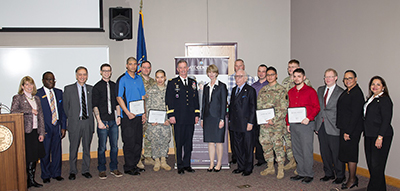
A group of 10 Fort Drum soldiers have completed a training program through SUNY Polytechnic Institute (SUNY Poly) that provided skills and connected them to New York’s advanced manufacturers.
The 56-hour, hands-on training program is a partnership between SUNY Poly, the school’s Northeast Advanced Technological Education Center (NEATEC), Jefferson Community College (JCC), Mohawk Valley Community College (MVCC), and the Fort Drum’s Soldier For Life-Transition Assistance Program.
The National Science Foundation funded the project to provide “marketable, in-demand skills” to transitioning soldiers, SUNY Poly said.
“We are proud that SUNY Poly and NEATEC, in collaboration with our educational and governmental partners, are once again supporting the attainment of technical skills that can provide a bridge for soldiers as they transition into civilian life, paving the way for job interviews and opportunities that will allow these soldiers to positively leverage their military experience and skillset to obtain important jobs that are in-demand throughout the region,” Bahgat Sammakia, interim president of SUNY Poly, said in a news release.
This is the third group of soldiers to participate in such training since NEATEC began working with the Soldier for Life-Transition Assistance Program at Fort Drum in 2015. The partnership was created to “establish a pipeline” of soldiers interested in working as technicians in advanced manufacturing.
About the training
Training is offered to soldiers scheduled to separate from service within a year, as well as some recently transitioned veterans.
While initially offering training related to radio frequency and pneumatics, the program has expanded to include advanced-manufacturing practices, pneumatics technology, and mechatronics. The topic selection and course objectives for this workshop series were based upon conversations with SUNY Poly’s industrial partners, the school said.
Current and former MVCC faculty developed and taught the curriculum. The first two trainings were offered entirely on the MVCC campus, but this most recent training was split between MVCC and JCC.
Numerous companies have participated in the program, meeting with soldiers to talk about their organizations, products, and employment opportunities, including Clinton–based Indium Corporation; Danfoss Silicon Power, a German company with a Utica facility; Plattsburgh–based Norsk Titanium; Milpitas, California–headquartered GlobalFoundries, which operates location in Albany and East Fishkill in Dutchess County; SUNY Poly’s Albany NanoTech Complex Foundry; Panasonic Eco Solutions Solar NY of Buffalo; Bartell Machinery of Rome; HMI Metal Powders-Pratt & Whitney in Clayville, south of Utica; Anaren Inc. of DeWitt; and the Watertown location of Allied Motion, which is headquartered in the Buffalo suburb of Amherst.
Student teams compete to represent Syracuse in ACC InVenture Prize competition
SYRACUSE — Student entrepreneurs at Syracuse University have applied to compete in the Atlantic Coast Conference (ACC) InVenture Prize competition. It’s a televised “Shark Tank”-style competition open to student startups at the 15 colleges and universities that are part of the ACC Academic Consortium. The InVenture Prize competition offers the only chance for ACC student
Become a Central New York Business Journal subscriber and get immediate access to all of our subscriber-only content and much more.
Click here to purchase a paywall bypass link for this article.
SYRACUSE — Student entrepreneurs at Syracuse University have applied to compete in the Atlantic Coast Conference (ACC) InVenture Prize competition.
It’s a televised “Shark Tank”-style competition open to student startups at the 15 colleges and universities that are part of the ACC Academic Consortium.
The InVenture Prize competition offers the only chance for ACC student innovators and inventors to compete in a televised pitch event in front of a live audience, Syracuse said in a news release.
The Blackstone LaunchPad at Bird Library on Feb. 16 will be hosting the campus qualifier to pick the top team to represent Syracuse University. The winning team selected by a panel of judges will receive an all-expense-paid trip to Georgia Tech in Atlanta for the finals April 5-6, and a chance to compete for $30,000 in prize funding in a broadcast scheduled for PBS.
“We have a panel of judges from every single academic discipline across the [Syracuse] campus who will … pick the top 10 teams with the most promising ideas. They’ll pitch Friday February 16 from 1 to 4 p.m. on campus and from that group, we’ll pick the winner,” says Linda Hartsock, executive director of Blackstone LaunchPad at Syracuse University. She spoke with CNYBJ on Feb. 5.
Blackstone LaunchPad is a campus-based “experiential” entrepreneurship program open to students, alumni, staff and faculty, offering coaching, ideation and venture-creation support.
It is modeled on a successful program originated at the University of Miami and further expanded by the New York City–based Blackstone Charitable Foundation. Blackstone LaunchPad is co-funded by the Blackstone Charitable Foundation and Syracuse University.
Last year, Syracuse University entrepreneur Kate Beckman, founder of Fresh U and now a graduate student in the Newhouse School, made it to the final five of the competition at Georgia Tech, which was broadcast live and streamed by PBS.
Fresh U is a national online publication geared toward college freshmen, which launched in June 2015, according to its website.
In addition to Syracuse University, the participating universities are: Boston College, Clemson, Duke, Florida State, Georgia Tech, North Carolina State, Notre Dame, Louisville, Miami, North Carolina, Pittsburgh, Virginia, Virginia Tech, and Wake Forest. It’s the same 15 schools that are in the ACC athletic conference.
Students may make appointments to meet at the Blackstone LaunchPad with experts from the U.S. Small Business Administration and New York State Small Business Development Center for technical assistance, according to the Syracuse release.
TSA PreCheck enrollment center at Syracuse airport relocates due to construction project
SYRACUSE — The TSA (Transportation Security Administration) PreCheck enrollment center at Syracuse Hancock International Airport has relocated due to the ongoing construction project at the airport. The new location is on the second level, near the security checkpoint, the airport said in a news release. The enrollment center is open Monday through Friday from 7:30
Become a Central New York Business Journal subscriber and get immediate access to all of our subscriber-only content and much more.
Click here to purchase a paywall bypass link for this article.
SYRACUSE — The TSA (Transportation Security Administration) PreCheck enrollment center at Syracuse Hancock International Airport has relocated due to the ongoing construction project at the airport.
The new location is on the second level, near the security checkpoint, the airport said in a news release. The enrollment center is open Monday through Friday from 7:30 a.m. to 4 p.m.
TSA PreCheck is a program that allows travelers to go through airport security faster by applying for the program, undergoing a background check, and paying an $85 membership fee that’s good for five years, according to the TSA.
The TSA PreCheck enrollment center is the first of several airport tenants that will be relocated due the $48.8 million construction project.
Syracuse Hancock International Airport will also move the rental-car counters and the barber shop to new locations in the terminal starting the week of Jan. 29.
Additional information regarding the renovation project is available on the airport’s website (www.flysyracuse.com).
Governor’s Budget Proposal Spends and Taxes Too Much
After spending some time poring over Gov. Andrew Cuomo’s budget proposal, it leaves me with the same sense of disappointment, as it is filled with downstate-heavy spending, costly programs, and hidden tax increases. The governor has spent his early weeks of the year setting his gaze on higher office and touting a lofty progressive agenda,
Become a Central New York Business Journal subscriber and get immediate access to all of our subscriber-only content and much more.
Click here to purchase a paywall bypass link for this article.
After spending some time poring over Gov. Andrew Cuomo’s budget proposal, it leaves me with the same sense of disappointment, as it is filled with downstate-heavy spending, costly programs, and hidden tax increases. The governor has spent his early weeks of the year setting his gaze on higher office and touting a lofty progressive agenda, which will prove to be costly for average hardworking middle-class families of our state. Worse still is that the governor has been laying down a foundation of blame directed at the federal government and localities.
I think it’s fair to say that the governor’s focus has been on the presidency for some time. He’s set his sights on 2020 and is using New York as his sandbox to “prove” to far-left progressives that he’s their guy. This year, New York is facing a possible $4 billion budget deficit. To compensate for his past and continued policies that have contributed to this emergency, the governor has peppered throughout his budget proposal revenue boosters or taxes on New York’s hardworking families. These proposals include the discontinuation of the energy service sales-tax exemption, which would cost New Yorkers $96 million in the coming fiscal year and $128 million annually in subsequent years. He places a cap on the STAR Exemption benefit growth to zero, which would cost homeowners $49 million in 2018-19.
These moves don’t make a dent in this deficit. It’s clear that reductions in spending are needed. I am frustrated by the pressure the governor forces on our local governments to “consolidate” while he has done little to alleviate the unfunded mandates that are to blame for high costs of living in New York. Further still, using his insincere version of “ethics” reform would require same-day voter registration as well as early voting, which would amount to more costly mandates on our county governments.
Our upstate local communities need investment and attention from the state. The governor’s solution to revitalizing downtowns is the continuation of his Downtown Revitalization Program which pits 10 “winning” cities against each other to divide up a $100 million pot. The governor has gamified almost every aspect of government and investment, but I have serious reservations as to whether this is the best way to lift up and support our upstate communities. He further proposes to eliminate $1.8 million worth of village-per-capita aid, which helps small villages like those found in the Mohawk Valley and North Country. Elsewhere in his budget, Cuomo proposes to cut $11.5 million in agricultural aid, which supports rural districts like the one I represent.
The governor’s proposal provides $438.1 million to Consolidated Local Street and Highway Improvement Program (CHIPs) and $39.7 million to the Marchiselli Program to repair bridges, the rates from the previous year. His budget proposal offers another $100 million from his PAVE-NY and BRIDGE-NY. This, however, is not enough to repair the overall decline in our vast local infrastructure due to lack of state investment, and it pales in comparison to the billions being spent in downstate New York like the rebuild of the formerly named Tappan Zee Bridge, which cost about $4 billion. In last year’s budget, the governor offered $546 million to work on JFK Airport roads alone, and now he plans to give a $194 million subsidy to the highly mismanaged Metropolitan Transportation Authority (MTA). Upstate New Yorkers continually have to fund billions or forgo their share in windfall settlement money to support downstate infrastructure. The governor fails to see the gross inequity in funding for our region.
Our state and budget are not items the governor should use for his political gains. His flagrant use of the budget and state policy for his own means puts upstate New Yorkers at a disadvantage. I urge him to abandon this approach and really come to the table and listen to our proposals to make this a budget that will work for middle-income families, small businesses, and the many people relying on the state to make wise decisions with the programs and services we offer.
Marc W. Butler (R,C,I, Ref–Newport) is a New York State Assemblyman for the 118th District, which encompasses parts of Oneida, Herkimer, and St. Lawrence counties, as well as all of Hamilton and Fulton counties. Contact him at butlerm@nyassembly.gov
State Considers More Business Killing Regs
Unfortunately, New York State has a habit of creating policies that punish businesses. In the past two years, business owners in New York have had to ingest several onerous mandates such as new wage orders, higher minimum wages, and a new paid family leave policy. Now the Department of Labor is considering another mandate, known
Become a Central New York Business Journal subscriber and get immediate access to all of our subscriber-only content and much more.
Click here to purchase a paywall bypass link for this article.
Unfortunately, New York State has a habit of creating policies that punish businesses. In the past two years, business owners in New York have had to ingest several onerous mandates such as new wage orders, higher minimum wages, and a new paid family leave policy.
Now the Department of Labor is considering another mandate, known as the “call-in pay” regulation that will, if adopted, place additional strain on affected businesses. In short, the “call-in pay” regulation would require employers to provide employees with a 14-day work schedule and, if there is deviation from that schedule, the employer must pay the employee “call-in pay.” The amount of “call-in pay” depends on when and how the worker’s schedule deviates. In some cases, an employer would be required to be pay an employee four hours at minimum wage.
The intention of this proposed regulation is to address challenges some workers face with erratic work schedules. Unfortunately, as is too often the case, the proposed regulation instead of taking a reasonable approach to address the issue, takes a one-size-fits-all approach and fails to balance the interest of the employee and the employer.
While this mandate will have a substantial impact on all businesses effected, its impact will be significantly negative for small businesses. While national chains and big-box stores have thousands of employees, small businesses operate with far fewer employees. An employee calling in sick for a national retail store will cause less disruption and scheduling issues than an employee calling in sick at a small business that employs less than 10 individuals. Presumably, in this type of situation, the small-business owner would either have to cover the shift himself or call in another employee to fill the shift. Under the proposed regulations, if an employee was called in to cover the shift as described above, the employer would have to pay the employee the additional call-in rate along with his regular wage. Penalizing a business for scheduling issues beyond its control is excessively punitive.
Secondly, it is unclear why the Department of Labor has settled on mandating a 14-day schedule as opposed to a shorter period. In today’s business world, circumstances can change quickly. Orders can come in, be filled and be out the door to customers in less than a day. On the other hand, customers have more options and years of loyalty to a supplier is no longer the reality. Penalizing an employer for his or her inability to predict work flow 14 days in advance illustrates that the Department of Labor does not understand how modern business works. A more balanced workable approach would be a shorter time-period.
Finally, the proposed regulations fail to provide an exemption for weather-dependent businesses. What happens if, within the 14-day scheduling period, weather plays a role in the employer’s ability to provide a service? For example, what if there is no snow for a snow-removal company to plow. Would the company still have to provide call-in pay for the employees whose work schedule was canceled? Again, the proposed regulations are divorced from how business works and at the very least, weather-dependent businesses should be exempted from the regulations.
These proposed regulations have yet to be adopted by the New York State Department of Labor. I and other legislators have written to the department expressing our concerns over the regulations. It’s my hope that the agency listens to our concerns and at the very least amends the regulations to better match the realities of today’s business. If the Department of Labor goes ahead and adopts the regulations as proposed, I would look to work with my legislative colleagues, to enact legislation that would overturn the department’s adoption of the call-in pay regulations.
William (Will) A. Barclay is the Republican representative of the 120th New York Assembly District, which encompasses most of Oswego County, including the cities of Oswego and Fulton, as well as the town of Lysander in Onondaga County and town of Ellisburg in Jefferson County. Contact him at barclaw@assembly.state.ny.us, or (315) 598-5185.
Stay up-to-date on the companies, people and issues that impact businesses in Syracuse, Central New York and beyond.