
Stay up-to-date on the companies, people and issues that impact businesses in Syracuse, Central New York and beyond.

Veterans Legal Clinic at SU College of Law receives $150K state grant
SYRACUSE, N.Y. — The Betty and Michael D. Wohl Veterans Legal Clinic (VLC) at the Syracuse University (SU) College of Law will use a $150,000 state grant to help provide services to Central New York veterans. The New York State Department of Veterans’ Services awarded the school a Justice for Heroes grant, according to a […]
Become a Central New York Business Journal subscriber and get immediate access to all of our subscriber-only content and much more.

Click here to purchase a paywall bypass link for this article.
SYRACUSE, N.Y. — The Betty and Michael D. Wohl Veterans Legal Clinic (VLC) at the Syracuse University (SU) College of Law will use a $150,000 state grant to help provide services to Central New York veterans.
The New York State Department of Veterans’ Services awarded the school a Justice for Heroes grant, according to a post on the department’s Facebook page. The SU College of Law is one of just five law schools in New York state selected for the grant funding, SU noted.
Besides the SU College of Law, Cornell Law School, Hofstra University School of Law, University at Buffalo School of Law, and Albany Law School were also awarded grants, per the Facebook post.
With this funding, Syracuse University says the VLC will expand its legal support for local veterans and launch a new initiative to serve military-connected students, faculty and staff at the University, described as a “first-of-its-kind effort in higher education” in the SU announcement.
The grant will also strengthen the College of Law’s capacity to provide legal representation in areas such as U.S. Department of Veterans Affairs (VA) health and disability benefits, while simultaneously training the next generation of veteran-focused legal advocates, SU noted.
“This grant will enable the VLC to build upon its 10-year track record of delivering exceptional level services and representation to the veteran community and their families,” Beth Kubala, executive director of the Office of Clinical Legal Education, director of the VLC, said. “This grant program demonstrates New York state’s dedication to improving the lives of veterans and their ongoing support of law school outreach programs.”
Kubala is also a teaching professor in the College of Law and a U.S. Army veteran.
The VLC represents veterans and their families in claims for VA benefits and military discharge upgrades, SU said. Student attorneys, under faculty supervision, gain hands-on experience with real clients, navigating federal agencies and honing their legal skills — all while learning the value of pro bono service and engaging directly with military culture.
“The Veterans Legal Clinic exemplifies our commitment to experiential learning, community service, and public interest law,” Terence Lau, dean of Syracuse University College of Law, said. “We are proud of the clinic’s impact and grateful to the Department of Veterans’ Services for supporting this important work.”

Barclay Damon operating in expanded NYC office inside Rockefeller Center
The New York City office of Syracuse–based law firm Barclay Damon LLP is now operating in a newly renovated, significantly expanded, and more modern space on the 23rd floor of Rockefeller Center. The firm had announced its office relocation within Rockefeller Center back on July 22. The move “effectively doubles the firm’s space and office
Become a Central New York Business Journal subscriber and get immediate access to all of our subscriber-only content and much more.
Click here to purchase a paywall bypass link for this article.
The New York City office of Syracuse–based law firm Barclay Damon LLP is now operating in a newly renovated, significantly expanded, and more modern space on the 23rd floor of Rockefeller Center.
The firm had announced its office relocation within Rockefeller Center back on July 22.
The move “effectively doubles the firm’s space and office count” in New York City as part of a continued investment in its “growing” major-market offices. Those offices include New York City; Boston; New Haven, Connecticut; and Washington D.C. It also supports its long-term strategy of attracting top legal talent and providing exceptional legal representation to clients in a geographically expanded platform, Barclay Damon contended.
The new offices in New York City cover 11,590 square feet and were designed with flexibility, functionality, and further growth in mind, the firm said. The offices accommodate Barclay Damon’s 33 New York City–based attorneys and eight professional staff, while also providing ample space for visiting attorneys and clients as well as future lateral hires.
The space includes the latest in office technology, modern design, and collaborative work areas, and offers all the amenities of the Rockefeller Center campus, including direct access to restaurants, retail, and transportation, the firm said.
“This move represents an important step forward for our firm as we continue to strengthen our position in major markets,” Connie Cahill, Barclay Damon’s managing partner, said in the announcement. “It also reflects an extraordinary level of success in finding great lawyers in New York and expanding that office over the past five years, from less than a half-dozen lawyers before COVID-19 to over 30 lawyers today.”

“Our New York City team plays a critical role in many of the firm’s core practices, from complex litigation, bankruptcy, and regulatory matters to high-stakes transactional work,” Lizz Acee, managing director of major markets, said in the firm’s announcement. “This investment allows us to better support our clients with expanded capacity, new technology, and a more welcoming, collaborative environment. It also helps us continue to attract top-tier talent who want to practice at a firm that values excellence and innovation.”
Acee oversees the more than 90 lawyers making up the firm’s major-market offices and works closely with Cahill in the “careful expansion the firm has enjoyed,” the firm said.
With about 300 attorneys, Barclay Damon describes itself as a regional law firm that operates New York offices in Albany, Buffalo, Rochester, Syracuse, and New York City, along with offices in Boston, Massachusetts; New Haven, Connecticut; Washington D.C.; and Toronto, Ontario.

Five Star Bank parent reports nearly 32 percent drop in Q2 net income
WARSAW, N.Y. — Financial Institutions, Inc. (NASDAQ: FISI), parent company of Five Star Bank, recently reported net income of more than $17.5 million in the second quarter of this year, down 31.6 percent from $25.6 million in the second quarter of 2024. After preferred dividends, Financial Institutions’ net income available to common shareholders was almost
Become a Central New York Business Journal subscriber and get immediate access to all of our subscriber-only content and much more.
Click here to purchase a paywall bypass link for this article.
WARSAW, N.Y. — Financial Institutions, Inc. (NASDAQ: FISI), parent company of Five Star Bank, recently reported net income of more than $17.5 million in the second quarter of this year, down 31.6 percent from $25.6 million in the second quarter of 2024.
After preferred dividends, Financial Institutions’ net income available to common shareholders was almost $17.2 million, or 85 cents per share, in the second quarter of 2025, down 33 percent from nearly $25.3 million, or $1.62 a share, in last year’s second quarter.
The banking company recorded a provision for credit losses of $2.6 million in the second quarter, compared to a provision of $2 million in the year-ago quarter.
Financial Institutions posted a net interest margin of 3.49 percent for second quarter of 2025, up from 2.87 percent from last year’s second quarter. Year-over-year margin expansion was driven by an increase in the average yield on investment securities, following the restructuring of the available-for-sale securities portfolio in December 2024, which supported an increase in the average yield on interest-earning assets, the banking company said.
Financial Institutions reported net interest income of $49.1 million in this year’s second quarter, up more than 19 percent, from $41.6 million in the second quarter of 2024.
Noninterest income at the company came in at $10.6 million in the second quarter of 2025, down 56 percent from
$24 million in the year-earlier quarter, when its results benefited from a $13.5 million pre-tax gain associated with the sale of the company’s insurance business, per the earnings report issued on July 24.
Income-tax expense at Financial Institutions was $4 million for this year’s second quarter, compared to $4.5 million in the second quarter of 2024. The company also recognized federal and state tax benefits related to tax-credit investments placed in service and/or amortized during both the second quarter of 2025 and last year’s second quarter, resulting in income-tax expense reductions of $1.1 million and $1.3 million, respectively.
The banking company’s effective tax rate was 18.4 percent for this year’s second quarter versus 15 percent for the second quarter of 2024. The effective tax rate fluctuates on a quarterly basis primarily due to the level of pre-tax earnings and may differ from statutory rates because of interest income from tax-exempt securities, earnings on corporate-owned life insurance (COLI), the tax impact of the COLI repositioning, and the impact of tax-credit investments, the company noted.
Financial Institutions is a financial holding company, based in Warsaw in New York’s Wyoming County, with about $6.1 billion in assets, offering banking and wealth-management products and services. Its Five Star Bank subsidiary provides consumer and commercial banking and lending services to individuals, municipalities, and businesses through banking locations spanning Western and Central New York and a commercial-loan production office serving the Mid-Atlantic region. Five Star Bank’s Central New York offices include a commercial-loan production office in Syracuse and retail branches in Auburn, Waterloo, and Geneva.

Buffalo law firm Rupp Pfalzgraf expands into Syracuse market
SYRACUSE — Buffalo–based law firm Rupp Pfalzgraf LLC has expanded into the Syracuse market with an office at the State Tower Building at 109 S. Warren St. in Syracuse. Rupp Pfalzgraf sees it as “another significant step in the firm’s continued growth across New York State,” per its July 29 announcement. The firm says the
Become a Central New York Business Journal subscriber and get immediate access to all of our subscriber-only content and much more.

Click here to purchase a paywall bypass link for this article.
SYRACUSE — Buffalo–based law firm Rupp Pfalzgraf LLC has expanded into the Syracuse market with an office at the State Tower Building at 109 S. Warren St. in Syracuse.
Rupp Pfalzgraf sees it as “another significant step in the firm’s continued growth across New York State,” per its July 29 announcement. The firm says the Syracuse office, which opened Aug. 1, follows previous expansions into Rochester, Jamestown, and the Capitol Region.
“We are incredibly excited to establish a physical presence in Syracuse. This office allows us to better serve our existing clients in Central New York and provides an opportunity to forge new partnerships within this community,” David Pfalzgraf, managing partner of Rupp Pfalzgraf LLC, said in the announcement. “We are thrilled to bring Paul Tortora, Jr. into the firm as the lead partner in Syracuse. Not only does he bring years of local experience to the firm, but he’s offering his clients something truly rare – the personalized attention of a sole practitioner with the comprehensive resources of a larger practice behind him.”
Altogether, the firm tells CNYBJ it has an employee count of 155, including 73 attorneys.
The Syracuse office is led by family law attorney Paul Tortora, Jr., who joined Rupp Pfalzgraf earlier this summer with the intention of expanding the firm’s presence in the area. As of Aug. 19, the Syracuse office has two attorneys and support staff member.
Tortora brings more than a decade of experience in divorce and family law, including high-conflict custody disputes, child-support matters, and complex matrimonial cases.
As partner, he leads the Syracuse team while also playing an active role in firm leadership and mentorship. Tortora earned both his undergraduate and law degrees from Syracuse University and is licensed to practice in New York, Virginia, Maryland, and Washington, D.C.
“Having practiced in Syracuse for the past seven years, I’ve witnessed firsthand the unique needs of this community,” Tortora said. “Joining Rupp Pfalzgraf to open this new office is an exciting opportunity to combine my local insights with the firm’s extensive resources and expertise. We are committed to providing top-tier counsel and to becoming a trusted partner for clients throughout Central New York.”
Litigation attorney Christopher McCune, who focuses on premises and products liability, personal injury and general commercial litigation, joined Tortora in mid-July, and the firm is actively seeking a commercial litigator and a corporate lawyer. Rupp Pfalzgraf expects to continue expanding the Syracuse team, the firm said.

Albany–area accounting firm set to combine with Bonadio Group
ROCHESTER — An accounting and advisory firm that operates in Watervliet, northeast of Albany, is set to combine with The Bonadio Group in early September. The deal involving DALLE Accounting and Cash Management, Inc. is expected to close on Sept. 8. That’s when all employees of the Watervliet firm will join the Bonadio Group and
Become a Central New York Business Journal subscriber and get immediate access to all of our subscriber-only content and much more.
Click here to purchase a paywall bypass link for this article.
ROCHESTER — An accounting and advisory firm that operates in Watervliet, northeast of Albany, is set to combine with The Bonadio Group in early September.
The deal involving DALLE Accounting and Cash Management, Inc. is expected to close on Sept. 8. That’s when all employees of the Watervliet firm will join the Bonadio Group and DALLE will begin to operate under the Bonadio Group name.
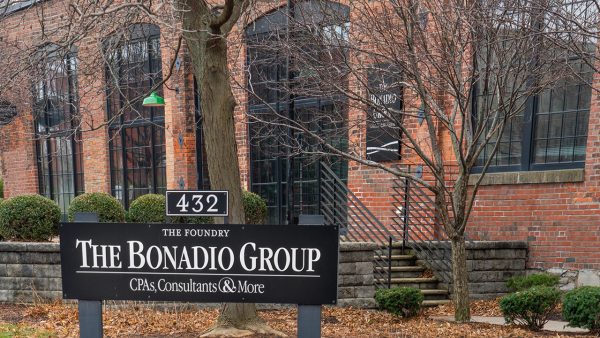
The Bonadio Group is headquartered in Rochester and operates an office in at 432 N. Franklin St. in Syracuse’s Franklin Square area. The firm also describes itself as the largest independent provider of accounting, assurance, tax, and consulting and advisory services in upstate New York.
This strategic partnership will enhance the Bonadio Group’s presence in the Capital Region, adding about 20 new employees, including one partner, and more than 500 client relationships, per the Bonadio announcement. DALLE’s clients will continue to work with the same DALLE representatives, but they’ll have access to Bonadio’s expanded service offerings, resources, and industry expertise, Bonadio said.
“This is an exciting step for our firm that enables us to offer more services to more clients in the Capital Region,” Bruce Zicari, CEO and managing partner of the Bonadio Group, said. “DALLE’s strong track record of success, specialized expertise and deep roots in the Albany market align perfectly with Bonadio’s values and commitment ‘To Be Growing.’ We’re thrilled to welcome their talented team to our firm.”
Founded in 2006 in Watervliet in Albany County, DALLE works to provide small businesses and nonprofit organizations with financial leadership. Over the past two decades, the firm has grown a client roster of more than 500, “delivering everything from day-to-day accounting support to complex financial transactions and regulatory compliance through a unique team-based model,” per the Bonadio announcement.
“Our decision to join Bonadio reflects our shared commitment to people-first values, forward-looking client service, and continuous improvement,” Dan Lortie, managing director at DALLE, said. “Together, we can offer our clients more resources and our team greater opportunities, all while preserving the personalized service that has defined our approach.”

Former Vernon Center FD treasurer pleads guilty to stealing over $300,000
VERNON CENTER— A former treasurer for the Vernon Center Fire Department has pled guilty to stealing more than $300,000 from the department. Jonnell Rose, 52, pled guilty before Judge Michael Nolan in Oneida County Court to grand larceny in the second degree and will be sentenced on Oct. 28. That’s according to an Aug. 14
Become a Central New York Business Journal subscriber and get immediate access to all of our subscriber-only content and much more.

Click here to purchase a paywall bypass link for this article.
VERNON CENTER— A former treasurer for the Vernon Center Fire Department has pled guilty to stealing more than $300,000 from the department.
Jonnell Rose, 52, pled guilty before Judge Michael Nolan in Oneida County Court to grand larceny in the second degree and will be sentenced on Oct. 28. That’s according to an Aug. 14 announcement from New York State Comptroller Thomas P. DiNapoli, Oneida County District Attorney Todd Carville, and New York State Police Superintendent Steven G. James.
A joint investigation by DiNapoli’s office and the State Police found Rose, of Vernon, stole $309,000 from the department over a six-year period from May 2018 to May 2024.
Rose wrote fire department checks to cash, which he pocketed, deposited checks written to various legitimate fire department vendors into his personal accounts, and deposited checks intended for the department into his own bank account, according to the guilty-plea announcement.
A forensic examination by DiNapoli’s office revealed that Rose made numerous personal purchases and payments, including crypto-currency transactions, credit-card payments, and cash withdrawals with the funds he stole from the department.
Rose was arrested in early February of this year.
“Jonnell Rose betrayed his community’s trust and stole over $300,000 meant to protect it,” DiNapoli said in the announcement. “I thank District Attorney Carville and the New York State Police for their partnership in holding him accountable.”
James added, “This guilty plea demonstrates the vital collaborative work of our law enforcement partners focused on the same goal; holding those who break our laws, accountable. Mr. Rose took advantage of a position he was entrusted in, and stole funds intended to support the Vernon Center Fire Department and the community it serves.”

New DEC general counsel appointed
ALBANY — Anthony Luisi has been appointed to serve as general counsel of the New York State Department of Environmental Conservation (DEC), the state’s environmental regulatory agency. His selection was one of four key appointments to leadership positions at the agency announced by DEC Commissioner Amanda Lefton on Aug. 12. Luisi rejoined DEC after serving
Become a Central New York Business Journal subscriber and get immediate access to all of our subscriber-only content and much more.
Click here to purchase a paywall bypass link for this article.
ALBANY — Anthony Luisi has been appointed to serve as general counsel of the New York State Department of Environmental Conservation (DEC), the state’s environmental regulatory agency.
His selection was one of four key appointments to leadership positions at the agency announced by DEC Commissioner Amanda Lefton on Aug. 12.
Luisi rejoined DEC after serving as regional director for DEC’s Region 4 for several years. He also previously served as regional attorney for Region 4, managing legal affairs for the nine-county Capital Region and working closely with the Office of General Counsel team.
Most recently, Luisi was senior counsel at the law firm of Harris Beach Murtha Cullina PLLC in Albany, where he led the firm’s environmental law practice group and was a member of its commercial real estate, government compliance and investigations, and business litigation practice groups. Prior to his work at DEC, Luisi was an attorney with law firms in Albany (Couch White, LLP) and White Plains (Cuddy & Feder LLP), per his LinkedIn profile. Luisi earned his law degree from the Fordham University School of Law and his bachelor’s degree from Binghamton University.
The former DEC general counsel was Thomas S. Berkman, who has moved onto a position as partner at the law firm of Hodgson Russ LLP in Albany, where he serves in its environmental & energy practices, according to that firm’s website.

VIEWPOINT: The Trump Private Equity Order: What Plan Fiduciaries Need to Know Now
On Aug. 7, 2025, President Donald Trump issued an executive order that may result in an expansion in the types of holdings common in 401(k), 403(b) and other defined-contribution plans. Generally, a plan fiduciary’s decision to offer a designated investment alternative is subject to fiduciary duties enumerated in section 404 of the Employee Retirement Income
Become a Central New York Business Journal subscriber and get immediate access to all of our subscriber-only content and much more.

Click here to purchase a paywall bypass link for this article.
On Aug. 7, 2025, President Donald Trump issued an executive order that may result in an expansion in the types of holdings common in 401(k), 403(b) and other defined-contribution plans.
Generally, a plan fiduciary’s decision to offer a designated investment alternative is subject to fiduciary duties enumerated in section 404 of the Employee Retirement Income Security Act of 1974 (ERISA). Thus, fiduciaries have duties to prudently select and monitor designated investment alternatives.
On June 3, 2020, during the first Trump administration, the U.S. Department of Labor (DOL) issued an information letter providing guidance on selecting investment alternatives featuring private-equity investments. The letter stated that a “plan fiduciary of an individual account plan may offer an asset allocation fund with a private equity component.” However, the letter also noted important fiduciary concerns, including complexity and relatively higher fees associated with private-equity investments.
The Biden administration further clouded the outlook for these types of investments by issuing a “Supplement Statement” in 2021 “to ensure that plan fiduciaries do not expose plan participants and beneficiaries to unwarranted risks.” The Supplement Statement not only reiterated concerns of the original 2020 letter, but also highlighted a U.S. Securities and Exchange Commission (SEC) “Risk Alert” addressing concerns with private-equity investments, including conflicts of interest, fees, and nonpublic information.
Simply put, the new [Trump] executive order states that American retirement savers should have access to investments in alternative assets — more on what that means later — when a plan fiduciary determines that those investments would enhance net “risk-adjusted” returns. According to the order, this policy is intended to bring 401(k) and other defined-contribution plan (e.g., 403(b)) participants to parity with participants in public plans and defined-benefit plans by expanding access to the “long-term net benefits” of alternative assets.
So, what are investments in alternative assets? The executive order provides a list, and while much coverage has focused on private equity and cryptocurrency, the order is much broader than that. The executive order also includes real estate, commodities, infrastructure financing, and pooled longevity risk sharing (which is an interesting concept with a historical legacy worthy of a discussion all its own). Regarding cryptocurrency, the order refers to holdings in actively managed investment vehicles that hold cryptocurrencies, rather than the cryptocurrencies themselves.
The executive order does not simply allow fiduciaries of defined-contribution plans to start offering investments in alternative assets. The ERISA fiduciary framework discussed above continues to apply. Instead, the order directs the DOL, in consultation with the Department of the Treasury and the SEC, to revisit earlier guidance and issue new guidance.
First and foremost, the order directs the secretary of labor to reexamine all guidance on ERISA fiduciary duties with an eye to allowing investments in asset-allocation funds that hold alternative assets. In particular, the order instructs the secretary of labor to consider whether to rescind the 2021 Supplement Statement discussed [earlier].
Second, the order instructs the secretary to clarify the “fiduciary process” used to offer asset-allocation funds that hold alternative assets. Here, the order shows some restraint by requiring the guidance to balance the likely higher cost of such investments with their possible benefits, including better returns and diversification. Further, the secretary should propose new rules or guidance on fiduciary duties owed to plan participants in deciding whether to offer asset allocation funds holding alternative assets. The order instructs the secretary of labor to prioritize actions that would reduce litigation constraining plan fiduciaries.
Finally, the order directs the SEC to consider ways to facilitate access to investments in alternative assets in 401(k) and other defined-contribution plans. Again, this is meant to be accomplished through revisions to guidance and regulations. In particular, the order calls out the rules on accredited investors and qualified purchaser status.
This executive order walks a fine line between taking actions to eventually allow 401(k) and other defined-contribution participants access to investments in alternative assets and the dual constraints of ERISA’s statutory fiduciary framework and policy concerns about exposing plan participants to undue risk. In other words, while it doesn’t open the floodgates for these types of investments, it does take substantive steps towards their availability.
Further, it will take time for the agencies to revise their guidance. The order sets a 180-day deadline, but if the DOL goes the traditional notice and comment rulemaking route, finalizing any rule will take longer than that.
Nothing in the order would require plan sponsors to offer investments in alternative assets in their defined-contribution plans. Even imagining a future where such investments in alternative assets are common in defined-contribution plans, a suit alleging underperformance for only offering traditional investments seems farfetched.
If you are a plan fiduciary considering offering investments in alternative assets, you should first monitor future agency guidance closely as the details will matter. Second, consider building relationships with advisors with the right competencies to evaluate the prudence of such investments. Different classes of alternative investments may necessitate different advisors. Finally, ensure that your decision-making process is well thought out and well documented.
Gregory M. Katz is senior counsel in the New York City office of Syracuse–based Bond, Schoeneck & King PLLC. He is an employee-benefits attorney specializing in multiemployer and defined-benefit plans. Contact him at gkatz@bsk.com. This article is drawn from Bond’s website.

OPINION: In New York, the Threat to Democracy Comes from Within
Political theatrics are common in Albany. And regrettably, blatant hypocrisy is never too far behind. New Yorkers got a healthy dose of both in early August, as Gov. Hochul claimed she is prepared to “fight for democracy” by taking the most un-democratic action imaginable. While hosting Texas Democrats who abandoned their posts to avoid participating
Become a Central New York Business Journal subscriber and get immediate access to all of our subscriber-only content and much more.
Click here to purchase a paywall bypass link for this article.
Political theatrics are common in Albany. And regrettably, blatant hypocrisy is never too far behind. New Yorkers got a healthy dose of both in early August, as Gov. Hochul claimed she is prepared to “fight for democracy” by taking the most un-democratic action imaginable.
While hosting Texas Democrats who abandoned their posts to avoid participating in a legislative session at home, the governor stated she’s ready to eliminate the voter-approved Independent Redistricting Commission (IRC), the body responsible for drawing the state’s election district lines. In effect, Gov. Hochul would rather create the state’s election maps through a single political party, rather than an independent panel. That shameful step would send a clear message to the people of New York: “Your voice doesn’t matter.”
“Redistricting” is the process by which Congressional, Senate, and Assembly district maps are redrawn every 10 years to account for population shifts within the state. For decades, the legislature controlled that process. It was a flawed system that often produced maps deeply driven by political interests. To address this, in 2014, New Yorkers went to the polls and voted overwhelmingly to change the state constitution and create the IRC, transferring map-drawing responsibilities to an independent body.
The IRC was created to ensure “the voice of the voters of New York is both reflected and protected.” At its core, the amendment championed “fair and open elections” and set a national standard for independent redistricting. So why is New York’s own governor trying to undermine that?
Beyond suggesting that the IRC be eliminated, Democrats introduced legislation to allow New York to redraw its congressional lines mid-decade if other states do the same. Essentially stating: If another state changes its maps, New York will “retaliate” by reworking its own, as if the goal is to out-gerrymander the competition to preserve Democratic power. But as Rachael Fauss, senior policy advisor for Reinvent Albany, stated, “We fundamentally don’t think that New York is going to save American democracy by gerrymandering.”
But let’s be clear, New York Democrats haven’t needed actions in other states to justify changing the rules in the middle of the game. Over the years, election laws in our state have been brazenly revised in ways to strengthen One-Party Rule. Based on Democrats’ recent statements, we may be headed down a very dangerous road — one that openly disregards the will of the people and the principles of democracy.
William (Will) A. Barclay, 56, Republican, is the New York Assembly minority leader and represents the 120th New York Assembly District, which encompasses all of Oswego County, as well as parts of Jefferson and Cayuga counties.

OPINION: Controlling federal government spending is difficult but urgent
The United States government spent nearly $7 trillion in the most recent fiscal year. No matter how you slice it, that’s a lot of money. Most of us would agree the government spends more than it needs to spend. Getting a handle on spending is no easy task, but we need to do it. Of
Become a Central New York Business Journal subscriber and get immediate access to all of our subscriber-only content and much more.
Click here to purchase a paywall bypass link for this article.
The United States government spent nearly $7 trillion in the most recent fiscal year. No matter how you slice it, that’s a lot of money. Most of us would agree the government spends more than it needs to spend. Getting a handle on spending is no easy task, but we need to do it.
Of course, spending is only part of the problem. The national debt keeps growing because our elected officials won’t levy the taxes needed to pay for what we spend. President Donald Trump’s so-called One Big Beautiful Bill Act [could] increase deficits by [an estimated] $3.4 trillion over the next 10 years, thanks largely to tax cuts.
One challenge is that America is a big, complicated country with a big, complicated government. The concept of $7 trillion is hard to grasp. The numbers are abstractions; we can’t visualize a trillion dollars. We could cut billions here and there, but the overall impact wouldn’t seem significant.
Another difficulty is that most spending serves a purpose, and much of it is necessary to keep government running effectively. We saw that recently when agencies had to call back employees who had been sent home when Elon Musk’s Department of Government Efficiency (DOGE) slashed the federal workforce. We may not like government, but we rely on much of what it does.
Finally, a great deal of federal spending is off limits for cuts, at least in the short term. Over 20 percent pays for Social Security. Another 13 percent funds Medicare, and 13 percent goes for national defense. Another major cost, Medicaid, provides health care for one in five Americans. When budget hawks target these programs, they often claim they are focused on “waste, fraud and abuse.” But watchdog groups typically fail to turn up significant fraud in government. One person’s waste is another’s lifeline.
Foreign aid is a popular place to cut, but Americans typically think we spend a lot more on aid than we do. In fact, it’s less than 1 percent of the federal budget in most years. And foreign aid isn’t just charity: It’s a key tool for achieving our foreign policy objectives. Importantly, it allows us to be a force for good, easing the effects of hunger and disease around the world.
One area of spending that we should be concerned with is interest on the national debt. For a long time, many economists downplayed its importance, but that has changed as the debt has ballooned. We now spend more on interest than on Medicare or defense.
While tax cuts have helped grow the debt, it’s also true that spending has increased markedly since 2000. The wars in Iraq and Afghanistan were a factor, and so is the aging of the large Baby Boom generation, which increased Social Security and Medicare costs. The COVID-19 pandemic produced vast emergency spending; some of it was temporary but some of it continues.
Donald Trump was right to prioritize controlling government spending, but relying on Musk and his team of outsiders and eliminating entire programs was wrong-headed and doomed to fail. Trump’s insistence on massive tax cuts showed he wasn’t serious about the debt.
Fifty years ago, William Proxmire, a senator from Wisconsin, instituted what he called the Golden Fleece Award to call out wasteful government spending. The projects he cited were often small; the first award, for example, went to an $84,000 study of why people fall in love. But the awards served a purpose. Proxmire’s knack for combining humor and outrage got a lot of media coverage, which focused attention on government spending. And public attention can make a difference.
Ultimately, it will be up to Congress to control spending. It’s the branch of government that’s closest to the people, and the Constitution gives Congress authority over taxes and spending. So all eyes are turning toward the Congress.
Lee Hamilton, 94, is a senior advisor for the Indiana University (IU) Center on Representative Government, distinguished scholar at the IU Hamilton Lugar School of Global and International Studies, and professor of practice at the IU O’Neill School of Public and Environmental Affairs. Hamilton, a Democrat, was a member of the U.S. House of Representatives for 34 years (1965-1999), representing a district in south-central Indiana.
Stay up-to-date on the companies, people and issues that impact businesses in Syracuse, Central New York and beyond.