
Stay up-to-date on the companies, people and issues that impact businesses in Syracuse, Central New York and beyond.

New Visions FCU chief HR officer wants to listen and learn
ENDWELL, N.Y. — Visions Federal Credit Union (FCU) has a new VP/chief human resources officer (CHRO), who started her new duties back in the summer. For Aoife Quinn, the priority early on has been to listen and learn. “After getting a sense of who we are, where we are, and where we want to be, […]
Become a Central New York Business Journal subscriber and get immediate access to all of our subscriber-only content and much more.

Click here to purchase a paywall bypass link for this article.
ENDWELL, N.Y. — Visions Federal Credit Union (FCU) has a new VP/chief human resources officer (CHRO), who started her new duties back in the summer.
For Aoife Quinn, the priority early on has been to listen and learn.
“After getting a sense of who we are, where we are, and where we want to be, my focus will be translating those insights into clear priorities that strengthen our culture, deepen employee engagement, and reinforce the trust our employees and members place in us,” Quinn said. “We’re building alignment and momentum for the future — ensuring that our people strategy is a lever for growth, impact, and long-term value.”
Quinn comes to Visions FCU with 30 years of experience in human resources (HR), per the Sept. 9 announcement. She also has experience in change management, workplace culture transformation, and executive leadership coaching with corporate clients, and global, multicultural SaaS (software as a service) enterprises for more than a decade.
Prior to joining Visions FCU, Quinn worked as VP/people & culture, head of global human resources at Utopus Insights, which is based in Valhalla in Westchester County. In that role, she led all HR activity for the renewable-energy analytics organization across 10 countries.
In three years, Quinn implemented HR strategies that drove engagement and recruitment, reduced turnover, and supported a positive workplace culture. During that time, she also provided her leadership in change management as Utopus Insights was acquired by and integrated into Vestas Wind Technologies, Visions FCU said.
“I’ve consistently been drawn to organizations, like Visions, that prioritize the employee experience,” Quinn said. “I’m driven by the opportunity to shape an inclusive workplace culture where everyone has a chance to thrive.”
Visions FCU’s workforce includes more than 900 full-time employees across its three-state footprint in New York, New Jersey, and Pennsylvania. In addition to providing financial services, the credit union emphasizes “people helping people” and includes service and community as two of its corporate values, the credit union noted.
Visions FCU went on to say that Quinn has already noticed how these values “resonate among the workforce.”
“I’ve already met so many individuals who are not only deeply passionate about their work but also kind, intellectually curious, and engaged in the world beyond their day-to-day roles,” she said.
Established in 1966, the nonprofit Visions Federal Credit Union serves more than 250,000 members in communities throughout New York, New Jersey, and Pennsylvania. Services include banking as well as auto, home, personal, and business loans.

CNY banking leader sees solid area business conditions, outlook
Region is buoyed by Micron project SYRACUSE, N.Y. — Even as stock markets continue to make all-time highs, there has been a lot of chatter about national economic uncertainty this year with slowing job growth and concern about the potential impact of tariffs, continued inflation, and most recently the federal-government shutdown. But current conditions and
Become a Central New York Business Journal subscriber and get immediate access to all of our subscriber-only content and much more.

Click here to purchase a paywall bypass link for this article.
SYRACUSE, N.Y. — Even as stock markets continue to make all-time highs, there has been a lot of chatter about national economic uncertainty this year with slowing job growth and concern about the potential impact of tariffs, continued inflation, and most recently the federal-government shutdown.
But current conditions and the outlook for the Central New York economy and business climate are not really showing those problems, says one local banking expert.
“I’ll be honest there hasn’t been much shift. We’re not really seeing much negativity,” says Lindsay Weichert, Community Bank, N.A.’s regional president for the Central New York market. “Margins are really holding up. Revenues and sales are holding up well, pretty much across our book of clients.”
Weichert spoke with CNYBJ on Oct. 16. In her position, she is responsible for leading Community Bank’s business development and community-engagement activities while ensuring effective communication across all bank and non-bank lines of business in the Central New York region.
Weichert says tariffs have not yet created many impacts for her bank’s clients, inflation has steadied some, and interest rates have ticked down in recent months.
“We’re still seeing kind of just the normal business cycle. It’s end of year; folks are evaluating equipment purchases. [Clients] still seem kind of unphased by the economy. So we’re not really seeing any pullbacks, anything like that,” she says.
One indicator Weichert looks at to gauge how businesses are doing, is their credit-line usage.
“You expect that if there is broad concern with the economy, they may borrow, throw some cash into an account, and sort of sit tight,” she explains. The bank is not seeing that. Credit-line usage is “totally within a normal range. It’s actually down a little bit from a couple months back,” Weichert notes.
“It’s really kind of business as usual. And I think we do have a pretty significant advantage here in Syracuse relative to some of the rest of the country with Micron,” Weichert says, referring to Micron Technology’s (NASDAQ: MU) project to build a massive semiconductor campus at the White Pines Commerce Park in the town of Clay. “That provides some pretty good certainty… it’s pretty nice to know that by the end of next year we’ll have 5,000 construction workers on site.”
Even before that, the stage is being set within the community.
“We’re really starting to build out a talent pipeline …you can see it in the higher education space between OCC, Syracuse University, CenterState CEO, all these different folks, MACNY, kind of gearing up to really focus on the apprenticeship program and build on the talent pipeline,” says Weichert. “That sort of feeds on itself and attracts more folks into our market. And then just the multiplier effect. You get 5,000 people as an influx into the community, there is no way they’re not spending a couple bucks while they’re here.”
Micron says it expects to create 9,000 jobs directly over the next 20 years or so.
“But then that multiplier effect is like 5 or 6 [times that] for all the ancillary businesses. So, all those folks are renting and purchasing homes. And going out and patronizing the restaurants, and so on and so forth,” says Weichert.
That helps provide a foundation that there is going to be a certain amount of economic growth going forward in our area and helps allay some concerns about the variability of the broader national and global economy.

Five Star Bank parent reports Q3 net income jumped 52 percent
WARSAW, N.Y. — Financial Institutions, Inc. (NASDAQ: FISI), parent company of Five Star Bank, recently reported net income of nearly $20.5 million in the third quarter of this year, up 52 percent from almost $13.5 million in the third quarter of 2024. The company, in its Oct. 23 earnings report, cited strong performance in each
Become a Central New York Business Journal subscriber and get immediate access to all of our subscriber-only content and much more.
Click here to purchase a paywall bypass link for this article.
WARSAW, N.Y. — Financial Institutions, Inc. (NASDAQ: FISI), parent company of Five Star Bank, recently reported net income of nearly $20.5 million in the third quarter of this year, up 52 percent from almost $13.5 million in the third quarter of 2024.
The company, in its Oct. 23 earnings report, cited strong performance in each of its commercial banking, consumer banking, and wealth management lines of business.
After preferred dividends, net income available to common shareholders of Financial Institutions totaled $20.1 million, or 99 cents per share, in the third quarter of 2025, compared to $13.1 million, or 84 cents, in the year-earlier earnings period.
Net interest margin expanded 76 basis points from the banking company’s year-ago quarter, to 3.65 percent this past quarter. Financial Institutions’ net interest income of $51.8 million in the third quarter was an all-time quarterly high and was up by $11.1 million, or 27 percent, from the third quarter of 2024.
Noninterest income at Financial Institutions totaled $12.1 million in the latest quarter, up $2.6 million, or almost 28 percent, from the third quarter of 2024. Higher investment advisory income and swap fees boosted results, per the earnings report.
The banking company’s total loans increased by $187.4 million, or 4.3 percent, from Sept. 30, 2024 levels, to reach $4.59 billion as of Sept. 30, 2025, driven by solid commercial-loan growth, it stated.
Financial Institutions is a financial holding company, based in Warsaw in New York’s Wyoming County, with about $6.3 billion in assets, offering banking and wealth-management products and services. Its Five Star Bank subsidiary provides consumer and commercial banking and lending services to individuals, municipalities, and businesses through banking locations spanning Western and Central New York and a commercial-loan production office serving the Mid-Atlantic region. Five Star Bank’s Central New York offices include a commercial-loan production office in Syracuse and retail branches in Auburn, Waterloo, and Geneva.

Corning Inc. donates $185K to school food centers in Chemung and Steuben Counties
CORNING, N.Y. — Corning Incorporated (NYSE: GLW) has awarded a $185,000 grant to the Food Bank of the Southern Tier to support eight school food centers in Chemung and Steuben counties. Each school will receive $22,500 to sustain school-based food pantries, with an additional $5,000 allocated for project management, Corning Inc. said in an Oct.
Become a Central New York Business Journal subscriber and get immediate access to all of our subscriber-only content and much more.

Click here to purchase a paywall bypass link for this article.
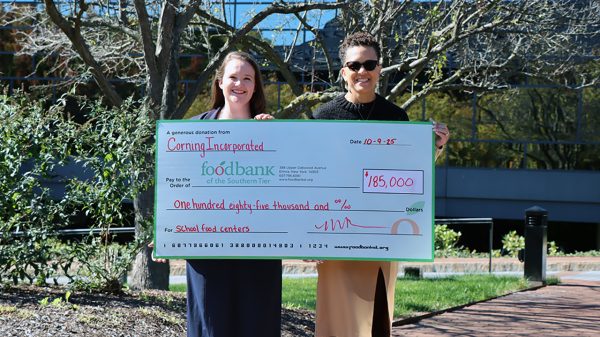
CORNING, N.Y. — Corning Incorporated (NYSE: GLW) has awarded a $185,000 grant to the Food Bank of the Southern Tier to support eight school food centers in Chemung and Steuben counties.
Each school will receive $22,500 to sustain school-based food pantries, with an additional $5,000 allocated for project management, Corning Inc. said in an Oct. 15 announcement.
Part of a Food Bank initiative, school food centers serve as spaces where food and other grocery items can be distributed at no cost within a school, providing students and their families with consistent access to nutritious meals in a supportive, inclusive environment, the organization contends.
The Corning Inc. grant will support the Food Bank’s efforts to combat food insecurity in the Southern Tier, where levels far outpace the national average. Currently, 73,070 individuals in the region — including thousands of children — are at risk of hunger annually. Chemung and Steuben counties are among the hardest-hit areas in New York state, with child food insecurity rates at 25 percent and 26.7 percent above the national average, respectively.
“Food insecurity remains a heartbreaking challenge in the Southern Tier, particularly for children,” said Millicent Ruffin, division VP at Corning Community Impact (CCI). “Tackling this issue requires decisive yet collaborative action. We’re proud to partner with the Food Bank to support its innovative School Food Centers, which ensure that families in our community have access to healthy food and essential resources.”
Established in December 2023, CCI centralizes Corning’s philanthropic contributions in the U.S. under a single organization to maximize impact in areas that align closely with its values and business objectives, the company says.
“School Food Centers are transforming how we support families,” Mark Bordeau, president and CEO of the Food Bank of the Southern Tier, said in the Corning announcement. “By embedding food assistance into schools, we meet students and families where they are — building trust and reducing stigma. Corning’s generous support will help us expand this program and ensure no child has to wonder where their next meal is coming from.”
The school food center program also offers older students the chance to develop leadership and life skills through activities ranging from inventory management and budgeting to customer service.

Tompkins Chamber names new VP who will help lead key initiatives
ITHACA, N.Y. — The Tompkins Chamber recently announced it has chosen Rob Montana to serve as its new vice president. Montana has 25 years of community-focused experience in communications, stakeholder engagement, and organizational leadership, including the last four years as communications manager for Visit Ithaca, a division of Tompkins Chamber. His ability to foster strong
Become a Central New York Business Journal subscriber and get immediate access to all of our subscriber-only content and much more.

Click here to purchase a paywall bypass link for this article.
ITHACA, N.Y. — The Tompkins Chamber recently announced it has chosen Rob Montana to serve as its new vice president.
Montana has 25 years of community-focused experience in communications, stakeholder engagement, and organizational leadership, including the last four years as communications manager for Visit Ithaca, a division of Tompkins Chamber. His ability to foster strong relationships with community and business leaders, as well as shaping and implementing strategic initiatives, will play a key role in helping lead the chamber as it supports Tompkins County’s economic and workforce development, and enhances the quality of life for the whole community, the chamber said in its Sept. 30 announcement.
The Tompkins Chamber says it selected Montana from among 100 applicants for the position.
“We were looking for the right person to elevate our work,” Tompkins Chamber President and CEO Peggy Coleman said in the announcement. “Rob’s passion for community building for the greater success of the Tompkins County business community is inspiring. I look forward to working with him in this new capacity and celebrating the positive impacts he makes.”
As VP, Montana will oversee the Tompkins County Employer Resource Network, manage the Live + Work in Ithaca initiative, as well as administer the Tompkins Chamber Foundation fiscal sponsorships of Tompkins Connect and Ithaca Pride Alliance. Additionally, he will collaborate with Coleman on long-term strategic planning and enhancing Tompkins County’s business climate.
“I am grateful for the opportunity to serve as Tompkins Chamber’s vice president and continue working with my dedicated colleagues to build upon the organization’s work in Tompkins County,” said Montana. “Building relationships with others in a way that strengthens the community is work I am excited to continue doing to keep Tompkins County a great place to live, work and visit.”
Montana has two decades of community journalism experience, including managing local newspapers The Ithaca Times and Tompkins Weekly and others in Maine, as well as working in development and communications roles for several nonprofit organizations and working as a grant writer. Additionally, Montana has served on several nonprofit boards and grant review committees and was a graduate of the Leadership Tompkins program in 2024.
With more than 700 members, the Tompkins Chamber says it is dedicated to making Tompkins County a great place to live, work, and do business by fostering sustainable economic growth.

Dominican-style fried chicken restaurant formally opens in Utica
UTICA, N.Y. — Downtown Utica has a popular new fast food, fried chicken restaurant with the formal opening of Equis Pica Pollo. The Dominican-style fried-chicken restaurant officially opened a new location at 1155 Mohawk St., Suite 10, with an Oct. 9 ribbon-cutting event held with the Greater Utica Chamber of Commerce. The restaurant opened to
Become a Central New York Business Journal subscriber and get immediate access to all of our subscriber-only content and much more.
Click here to purchase a paywall bypass link for this article.
UTICA, N.Y. — Downtown Utica has a popular new fast food, fried chicken restaurant with the formal opening of Equis Pica Pollo.
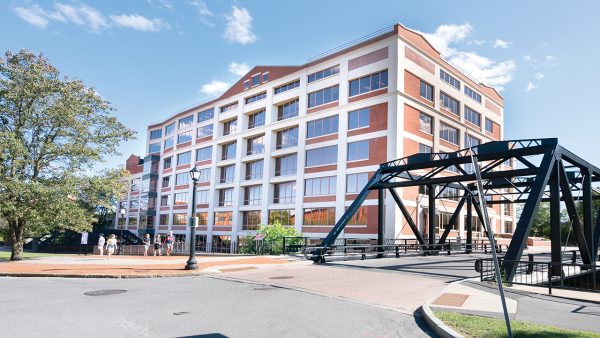
The Dominican-style fried-chicken restaurant officially opened a new location at 1155 Mohawk St., Suite 10, with an Oct. 9 ribbon-cutting event held with the Greater Utica Chamber of Commerce. The restaurant opened to customers months earlier.
Equis Pica Pollo was founded by entrepreneur Carlos Rijo with a vision to bring the authentic flavor and family-centered experience of the Dominican Republic to communities across the U.S., the Greater Utica Chamber said in an Oct. 7 email announcement.
The first location of Equis Pica Pollo opened in Brooklyn, quickly gaining local popularity for its signature pica pollo, homemade sides, and welcoming atmosphere. The restaurant has now expanded to five states with Utica being its 18th location.

Brown & Brown, Inc. (NYSE: BRO) — the Florida–based parent of Brown & Brown of New York, Inc., which has an office in Syracuse — recently announced that its board of directors has increased its regular quarterly cash dividend by 10 percent. The insurance-brokerage firm will pay a dividend of 16.5 cents per share on
Become a Central New York Business Journal subscriber and get immediate access to all of our subscriber-only content and much more.

Click here to purchase a paywall bypass link for this article.
Brown & Brown, Inc. (NYSE: BRO) — the Florida–based parent of Brown & Brown of New York, Inc., which has an office in Syracuse — recently announced that its board of directors has increased its regular quarterly cash dividend by 10 percent.
The insurance-brokerage firm will pay a dividend of 16.5 cents per share on Nov. 12, to shareholders of record on Nov. 5. The dividend is up from the 15 cents a share that Brown & Brown paid last quarter. It marks its 32nd straight annual dividend increase, according to the firm’s Oct. 22 announcement.
Brown & Brown also reported that its board has authorized the purchase of up to an additional $1.25 billion of the company’s common stock outstanding. With this authorization, Brown & Brown will now have approval to repurchase up to $1.5 billion, in the aggregate, of the company’s shares. The firm said it will buy back the stock from time to time, at the company’s discretion and subject to the availability of shares for purchase, market conditions, the trading price of the stock, and alternative uses for capital. Other factors considered include the company’s financial performance and objectives to reduce dilution from Brown & Brown’s employee equity incentive plans, decrease outstanding shares, or manage other potential factors.
Daytona Beach–headquartered Brown & Brown says it is a major insurance-brokerage firm delivering comprehensive and customized insurance products and risk-management services since 1939. It has more than 23,000 employees and over 700 offices worldwide. Brown & Brown makes frequent acquisitions of insurance agencies a major part of its growth strategy. Its stock price has declined about 12 percent year to date and fallen 15 over the last year, as of Oct. 24, according to Yahoo Finance data. But Brown & Brown’s stock is up more than 27 percent over the last two years and up 102 percent over the past five years.
Brown & Brown has an office at 500 Plum St. in Syracuse’s Franklin Square area.

Kotlikoff formally inaugurated as Cornell’s 15th president
ITHACA, N.Y.— Michael I. Kotlikoff was officially installed as Cornell University’s 15th president in a Friday, Oct. 24 ceremony in Barton Hall on the university’s campus. Kotlikoff had been appointed as Cornell president back on March 21, after having served as interim president since July 2024. The inauguration event followed a dinner for Cornell trustees,
Become a Central New York Business Journal subscriber and get immediate access to all of our subscriber-only content and much more.

Click here to purchase a paywall bypass link for this article.
ITHACA, N.Y.— Michael I. Kotlikoff was officially installed as Cornell University’s 15th president in a Friday, Oct. 24 ceremony in Barton Hall on the university’s campus.
Kotlikoff had been appointed as Cornell president back on March 21, after having served as interim president since July 2024.
The inauguration event followed a dinner for Cornell trustees, council members, and guests as part of the trustee-council annual meeting schedule, according to an Oct. 27 Cornell Chronicle article.
Anne Meinig Smalling, chair of the Cornell board of trustees, presided over the ceremony, welcoming Kotlikoff’s family members and the two former Cornell presidents in attendance — Martha E. Pollack and Jeffrey S. Lehman.
Bob Harrison, emeritus chair of the board of trustees, offered a toast, lauding Kotlikoff for his 25 years at Cornell as a professor, department chair, dean and then as the longest-serving provost in Cornell’s history (2015-24) before stepping into the role of interim president in 2024.
Provosts rarely go on to become presidents of the same university, Harrison noted, because they typically must make many unpopular administrative decisions and balance competing academic interests and priorities, according to the Cornell Chronicle.
“Remarkably, while Mike has done all of these things, every dean with whom I have spoken during his tenure has told me how fair, straightforward and decent Mike has been as their boss,” Harrison said, thanking Kotlikoff for his “truly extraordinary leadership.”
In his own remarks at the Oct. 24 event, Kotlikoff reflected on his lengthy career at Cornell and the opportunities and challenges that lie ahead.
“It’s a different thing to be inaugurated as president of the university where you’ve spent most of your career — when you’ve been asked to help shape the future of an institution that is already your home, and to which you owe a debt of gratitude impossible ever to repay,” he said. “Cornell has given me opportunities that I could not have conceived of when I started college 56 years ago — a directionless freshman on a scholarship. And I never know quite how to respond, when people say, ‘I don’t know if I should offer you congratulations on your new job, or condolences.’ ”
Kotlikoff continued, “The truth is, that I could not think of a more meaningful time to serve an institution that has given me so much. And I am endlessly grateful, both for the opportunity, and for your support.”

VIEWPOINT: Timing is Everything: Mapping Charitable-Giving Plans Under New Tax Law
It’s never been easy to navigate the ever-shifting tax rules around charitable giving, and now it’s even trickier. Major changes under the One Big Beautiful Bill Act (OBBBA), signed into law on July 4, 2025, are creating complexity, opportunity, and, for some, urgency. The OBBBA reshapes both how much you can deduct for charitable contributions
Become a Central New York Business Journal subscriber and get immediate access to all of our subscriber-only content and much more.

Click here to purchase a paywall bypass link for this article.
It’s never been easy to navigate the ever-shifting tax rules around charitable giving, and now it’s even trickier. Major changes under the One Big Beautiful Bill Act (OBBBA), signed into law on July 4, 2025, are creating complexity, opportunity, and, for some, urgency. The OBBBA reshapes both how much you can deduct for charitable contributions and who can benefit from these deductions in the first place.
Whether you are working with clients as a professional advisor, or planning your own year-end giving, these rules are worth understanding. At the Community Foundation, we often serve as a sounding board when charitable giving comes up. We have tools that can help, and if we can’t help directly, we’ll point you in the right direction.
Here are three key changes to keep in mind as 2025 winds down.
The OBBBA expands the standard deduction to $15,750 for single filers and $31,500 for married couples in 2025, with even higher levels for taxpayers aged 65 and older. This will make it harder for many households to itemize deductions. A strategy known as “bunching” charitable donations can help. For example, instead of giving $12,000 each year, a donor could contribute $36,000 (three years’ worth of gifts) to a donor-advised fund in 2025. This pushes total deductions high enough to itemize for one year, while future gifts can be distributed to charities from the fund while taking the standard deduction.
Beginning in 2026, only charitable donations exceeding 0.5 percent of adjusted gross income will be deductible. That means a couple with $225,000 in adjusted gross income (AGI) would see their deductible charitable amount reduced by $1,125 annually. In addition, the maximum tax benefit from charitable deductions for high-income taxpayers will be calculated at a 35 percent rate instead of 37 percent. For many households, 2025 will be a pivotal year to consider accelerating charitable gifts using bunching strategies to maximize current tax strategies before these tighter rules take effect.
Also starting in 2026, taxpayers who take the standard deduction will be able to claim up to $1,000 (single filers) or $2,000 (married filing jointly) in direct charitable deductions. This is good news for the roughly 100 million Americans who don’t itemize. But note the fine print: this deduction only applies to cash gifts made directly to charities — it excludes gifts of stock or contributions to donor-advised funds, which are tax-effective and convenient charitable-giving vehicles.
The bottom line is that 2025 is shaping up to be a pivotal year for charitable-giving decisions. Nonprofits across our community are in urgent need of donor support, and beyond the tax implications, philanthropy addresses critical local needs that transcend any deduction. Whether you’re advising clients or planning your own giving, now is the time to consider how to maximize both the tax benefits and the community impact of your charitable contributions.
Pragya Murphy serves as director of development & impact investing at the Central New York Community Foundation, where she leads charitable planning for individuals, families, and companies and provides outreach to the local professional advisor community and nonprofit organizations. She also supports the Community Foundation’s impact investment program and is available to nonprofits interested in learning more about or applying for impact investments.

VIEWPOINT: Strategy Without a Soul: When Marketing Leads Without Brand Strategy
You’re launching campaigns, hitting deadlines, and filling the pipeline. On paper, things look great. But something’s off. Internal-messaging debates keep resurfacing. Campaigns feel shallow and reactive instead of resonant and on-point. Ask people what the brand stands for, and you get different answers from each. These are classic signs your marketing is outpacing your brand
Become a Central New York Business Journal subscriber and get immediate access to all of our subscriber-only content and much more.
Click here to purchase a paywall bypass link for this article.
You’re launching campaigns, hitting deadlines, and filling the pipeline. On paper, things look great. But something’s off. Internal-messaging debates keep resurfacing. Campaigns feel shallow and reactive instead of resonant and on-point. Ask people what the brand stands for, and you get different answers from each.
These are classic signs your marketing is outpacing your brand strategy. The body is in motion, but the soul is missing. Without a clear brand soul, marketing actions lose direction and authenticity; without active marketing, even a strong soul never makes an impact. Brand is the why and the identity. Marketing is the how and the action. When they fall out of sync, trouble follows.
Too often, brand strategy gets mistaken for a logo, a color palette, or a mood board. In reality, it’s the organization’s inner compass (purpose, values, identity, and promise) guiding every decision over the long term.
It answers the big questions: Who are we? What do we believe in? How are we different, and why should anyone care? Brand strategy is the North Star, aligning the organization around a meaningful identity that resonates with customers, informs product decisions, and shapes culture.
Brand strategy is a long-term discipline. Strong brands reinforce the same core narrative and values over years, building equity: trust, loyalty, and a price premium. Inconsistent brands have to work harder and spend more to be heard. It’s not mere theory: studies show brands with consistent messaging earn more, seeing a 10 percent to 20 percent revenue boost compared to fragmented brands, and that brand-aligned companies are two times more profitable as inconsistent ones.
If brand is the soul, marketing is the body in motion — the campaigns, channels, and content that bring the brand to life. Marketing is how you reach people, drive action, and achieve near-term objectives.
When marketing is aligned with a strong brand foundation, it acts as a powerful amplifier, reinforcing identity and values across every channel. Without that foundation, marketing risks becoming movement without purpose. Teams chase trends, fragment messaging, and change their story to grab quick attention. Short-term wins can mask long-term erosion of trust.
A marketing plan without brand strategy is like a GPS without a destination: lots of directions, no clear end point.
Not every downturn in campaign performance or internal struggle is due to tactics or budget. Often, the root cause lies upstream in the brand clarity and cohesion. How can you tell if you have a brand-strategy problem, instead of a marketing problem? Look for these red flags:
• Inconsistent positioning and messaging. Your value proposition shifts from campaign to campaign. Different teams or partners describe the brand differently. Customers can’t tell what you stand for, and their trust erodes.
• Internal misalignment. Ask five employees to describe your brand promise. If you get more than two or three different answers, your brand isn’t clear internally. And if your own team isn’t sure how to describe your voice or promise, it’s a sign of a soul-and-action gap.
• Reactive, disconnected campaigns. Without brand guardrails, campaigns chase the moment instead of reinforcing the mission. Clever ideas might land in isolation but fail to build a coherent brand story. In higher education, for example, 61 percent of institutions report inconsistent marketing efforts leading to off-brand campaigns. The result is often competing funnels rather than one cohesive strategy.
Brand equity is the cumulative value of how people think and feel about you — trust, reputation, loyalty, and differentiation. Strong brand equity makes customers less price-sensitive, more loyal, and more open to new offerings. It reduces acquisition costs and increases lifetime value.
When brand clarity is missing, these advantages fade. Inconsistent brands have to spend about 1.75 times more on advertising to achieve the same growth as consistent ones.
Conversely, investing in brand is investing in resilience. Each aligned marketing action builds on the last, strengthening recognition and trust. Notably, an analysis by System1 of 56 brands found that those with consistent branding grew market share faster and were twice as profitable as those constantly switching their messaging. Decisions get easier because teams have a shared filter: Does this fit our brand? The result: sharper execution, faster consensus, and a more confident presence in the market.
• Patagonia has built decades of loyalty on a mission to “Build the best product, cause no unnecessary harm, and use business to inspire and implement solutions to the environmental crisis.” Every employee can articulate it. Every campaign reflects it.
• Cleveland Clinic lives its “Patients First” promise across the entire patient experience. That clarity shows up in consistent, patient-centered marketing and one of the strongest reputations in health care.
• USAA is a financial-services firm that serves military families with a brand rooted in service and loyalty. Every employee (whether in insurance, banking, or IT) is inculcated with the mission of “We know what it means to serve” and putting members first. In fact, many employees are veterans, bringing true authenticity to every interaction. Their marketing is essentially word-of-mouth from members whose experiences match the promise.
1. Revisit your brand foundation. Document your identity, purpose, positioning, values, personality, voice, and promise. Make sure it’s still true, relevant, and bold enough to matter. Socialize it internally so everyone can articulate it.
2. Audit marketing through a brand lens. Map your campaigns to brand pillars. Cut or adjust what doesn’t fit. Align media spend with your core story.
3. Make brand checkpoints routine. Bake brand reviews into campaign planning and creative briefs. Keep guidelines updated and accessible.
Your marketing team can be creative, data-driven, and fast. But without a clear, differentiated brand soul as the foundation, you’re building on sand. Brands that live their purpose consistently earn trust, loyalty, and profitability. Marketing that runs ahead of brand eventually burns out, wastes budget, and muddles identity.
Before your next campaign, ask: Do we know who we are? Does everyone here know it? Is our marketing expressing it? If the answer is no or unsure, slow down and realign. When brand and marketing move together, the inside matches the outside, and your message rings true. That’s the kind of alignment customers notice — and stick with.
JoAnne Gritter is the chief operations officer at ddm marketing + communications, a B2B digital-marketing agency for highly complex and highly regulated industries. She is responsible for overseeing and facilitating collaboration between all major functional areas at ddm, including finance, human resources, IT, operations, sales, and marketing.
Stay up-to-date on the companies, people and issues that impact businesses in Syracuse, Central New York and beyond.