Stay up-to-date on the companies, people and issues that impact businesses in Syracuse, Central New York and beyond.
Last Minute Financial Resolutions for 2018
As the new year launches, it’s time to think about how to make 2018 a financial success for you and your loved ones. Though there is little consensus about their origins, we know that Americans have been making New Year’s resolutions since at least the 1770s. Some of my last minute and realistic resolutions for […]
Become a Central New York Business Journal subscriber and get immediate access to all of our subscriber-only content and much more.
Click here to purchase a paywall bypass link for this article.
As the new year launches, it’s time to think about how to make 2018 a financial success for you and your loved ones. Though there is little consensus about their origins, we know that Americans have been making New Year’s resolutions since at least the 1770s.
Some of my last minute and realistic resolutions for 2018 are:
• Create emergency savings: Life is full of unexpected emergencies, and some extra cash can help a serious illness, home repair, or other sudden financial need from derailing your finances. Prepare for unpredictable expenses by putting aside six to eight months of expenses in an easily accessible cash-equivalent account.
• Maximize your retirement-plan contributions: Tax-managed retirement accounts are one of the most powerful ways to save for a more comfortable retirement. Make the most of them by contributing as much as you can each tax year. We usually recommend maxing out employer-sponsored plans first to take advantage of any matching contributions your employer may offer.
• Protect your credit identity: Identity theft and financial fraud are serious threats that can compromise your financial wellbeing. Protect yourself by reviewing financial statements and bills carefully for unauthorized activity.
Richard W. Paul is president of Richard W. Paul & Associates, LLC (www.rwpaul.com) and author of “The Baby Boomers’ Retirement Survival Guide: How to Navigate Through the Turbulent Times Ahead.”

Cuomo touts paid family leave, higher minimum wage
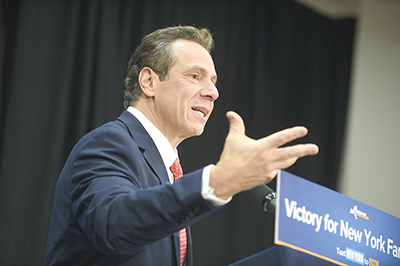
Gov. Andrew Cuomo on Dec. 31 announced the second increase toward a statewide $15 per hour minimum wage and the launch of what he says is the “nation’s strongest” paid family leave policy. “New York has made major strides in the fight for economic equality, social justice and workers’ rights and with the rollout of
Become a Central New York Business Journal subscriber and get immediate access to all of our subscriber-only content and much more.
Click here to purchase a paywall bypass link for this article.
Gov. Andrew Cuomo on Dec. 31 announced the second increase toward a statewide $15 per hour minimum wage and the launch of what he says is the “nation’s strongest” paid family leave policy.
“New York has made major strides in the fight for economic equality, social justice and workers’ rights and with the rollout of this historic minimum wage increase and the strongest paid family leave program in the country, we continue to protect the wallets of middle class New Yorkers,” Cuomo contended in a news release. “New York believes in a fair day’s pay for a fair day’s work and no family member should have to choose between caring for a loved one or losing their job … this victory will help restore fairness and equality to working families across New York.”
Paid family leave
As of Jan. 1, New Yorkers will be allowed to take job-protected paid time off to bond with a new child, care for a loved one with a serious health condition, or help relieve family pressures when a loved one is called to active military service abroad.
When fully phased in, New Yorkers will be eligible for up to 12 weeks of paid time off.
Those eligible for paid family leave include parents during the first 12 months following birth, adoption, or foster placement of a child.
They also include caretakers for a sick spouse, domestic partner, child, stepchild, parent, stepparent, parent-in-law, grandparent or grandchild.
Finally, the eligible include employees with a spouse, child, domestic partner or parent who has been notified of an order of active military service abroad.
Full-time employees with a regular schedule of 20 or more hours per week will be eligible for paid family leave after 26 consecutive weeks of employment. Part-time employees with a regular schedule of less than 20 hours per week can apply for paid family leave after working 175 days for their employer.
Minimum-wage increase
Minimum-wage increases are calculated based on where an individual works, by industry, and, in some cases, the size of the business.
As of Dec. 31, 2017, the minimum wage rate in upstate New York (not including Westchester, Suffolk, Nassau counties and New York City) rose to $10.40 an hour from $9.70 per hour. For fast-food workers outside New York City, the minimum wage rose to $11.75 an hour from $10.75.
It is estimated that more than 2.3 million workers were affected by the increase in the minimum wage statewide, Cuomo’s office said.
Middle class tax cut
Cuomo also touted a state tax cut that he says will save middle-class taxpayers a total of nearly $6.6 billion in the first four years, and annual savings are projected to reach $4.2 billion and benefit 6 million filers by 2025, Cuomo’s office said.
As the new rates phase in, they will be the state’s lowest middle-class tax rates “in more than 70 years.” Across New York, taxpayers will see an average state tax cut of $250 in 2018 and an average state tax cut of $698 in 2025 once the cut is fully phased in.
Report: P&C insurance industry generates $40B annually for state economy
DeWITT — The property and casualty (P&C) insurance industry contributes more than $40 billion annually to New York’s economy, an industry group said in a recently released report. The report by New York First, Inc. also said the industry will support more than 152,000 jobs annually, produce over $200 billion in output, and pay more than
Become a Central New York Business Journal subscriber and get immediate access to all of our subscriber-only content and much more.
Click here to purchase a paywall bypass link for this article.
DeWITT — The property and casualty (P&C) insurance industry contributes more than $40 billion annually to New York’s economy, an industry group said in a recently released report.
The report by New York First, Inc. also said the industry will support more than 152,000 jobs annually, produce over $200 billion in output, and pay more than $66 billion in wages and salaries over a five-year period between 2016 and 2020.
“The property-casualty insurance industry underpins the New York State economy,” Richard MacDonald, co-chair of New York First, said in a news release. “This report shows just how important it is to the state’s job market, tax base, and financial security.”
MacDonald also serves as board chair of DeWitt–based Big I New York, the state’s oldest insurance-producer trade association, and is VP and director of sales at Haylor, Freyer & Coon, Inc. in Salina.
Big I New York is the former Independent Insurance Agents & Brokers of New York, Inc. (IIABNY). Big I New York provided details about the report in a news release issued Dec. 4.
Formed in 2004, New York First is a coalition of insurance companies licensed to do business in New York that support the independent-agency system. Through industry research, legislative and regulatory advocacy on common issues, New York First says it “advances issues to support the independent agency system…”
Report findings
Goss & Associates and the Goss Institute for Economic Research, both headquartered in Omaha, Nebraska, prepared the report.
It estimated that the P&C industry will produce $202.9 billion for the state economy between 2016 and 2020. It will provide $66.3 billion in wages and salaries and $7.8 billion in self-employment income.
Productivity growth in New York’s insurance sector has been 2.33 times that of the insurance industry nationwide.
New York P&C firms supported wages per job of $85,270 in 2016 — about 45 percent above the state average. The industry will support an average of 152,775 jobs per year between 2017 and 2020, the report found.
Every 1,000 New York P&C jobs support 1,550 non-P&C jobs in the state.
Between 2006 and 2015, P&C companies’ purchases of New York municipal bonds reduced the bonds’ interest rates by 0.45 percent, saving state taxpayers $153.6 million annually, for a total savings of $1.5 billion, the analysis found. The P&C industry invests one-third of its fixed-income investment portfolio in state and local municipal bonds.
The industry produced $2.4 billion in state and local taxes in 2016. It will generate another $9.5 billion between 2017 and 2020. Each P&C industry job creates almost $41,000 in state and local taxes annually.
State seeks “best interest” standard for consumers in life-insurance sales
The New York State Department of Financial Services has proposed new consumer protections that would adopt a “best interest” standard for those licensed to sell life insurance and annuity products in the state. It’s a new requirement that would compel the seller to offer the product that “best reflects the customer’s interest” ahead of what
Become a Central New York Business Journal subscriber and get immediate access to all of our subscriber-only content and much more.
Click here to purchase a paywall bypass link for this article.
The New York State Department of Financial Services has proposed new consumer protections that would adopt a “best interest” standard for those licensed to sell life insurance and annuity products in the state.
It’s a new requirement that would compel the seller to offer the product that “best reflects the customer’s interest” ahead of what is “most profitable” to the seller, the office of Gov. Andrew Cuomo said in a news release issued Dec. 27.
The proposed regulation comes as the federal government has recently delayed by a year and a half implementation of similar, increased regulations on those who sell life insurance and annuities.
“As Washington continues to ignore and roll back efforts to protect Americans, New York will continue to use its role as a strong regulator of the financial services and insurance industries to fight for consumers and help ensure a level playing field,” Cuomo contended in the release.
“Given the key role insurance products play in providing financial security to middle class New Yorkers, it is essential that a provider adhere to a higher standard of care and only recommend insurance and annuity products that are in the consumer’s best interests,” Maria Vullo, New York’s financial-services superintendent, said.
Reaction to DOL delay
On Nov. 27, the U.S. Department of Labor (DOL) announced that it would delay by 18 months implementation of a fiduciary rule, adopted under the previous administration, which expands the definition of investment advice under the federal Employee Retirement Income Security Act, applies to certain annuity and life-insurance sales, and requires financial advisors to adhere to “enhanced” standards of conduct. The date of implementation has been pushed back from Jan. 1, 2018 to July 1, 2019.
During the 18-month transition period, “fiduciary advisers have an obligation to give advice that adheres to ‘impartial conduct standards.’ These fiduciary standards require advisers to adhere to a best interest standard when making investment recommendations, charge no more than reasonable compensation for their services, and refrain from making misleading statements,” the DOL said.
The proposed amendments to New York’s current suitability regulation would provide for a “best interest standard of care” for all sales of life insurance and annuity products, “beyond” the types of advice covered by the federal DOL rule. That includes retirement planning, and when recommendations are made prior to the sale of an insurance product, or after the sale — but during the servicing of the product — for the consumer.
A transaction is considered in the best interest of a consumer when it assists a consumer’s needs and objectives and is recommended to the consumer “without regard to the financial interest of the product seller,” the state says. Insurers would also be required to develop and maintain procedures to “prevent financial exploitation of consumers.”
The amendments “supplement” consumer protections already in effect in New York and that are “key elements” of the conflict of interest rule. They include setting limits on compensation and compensation transparency for the sale of a life insurance or annuity product in New York.
The proposed amendments are subject to a 60-day notice and public-comment period following the Dec. 27, 2017, publication in the New York State Register before its final issuance.
Industry reaction
In a Dec. 27 Bloomberg article, the Life Insurance Council of New York, expressed concern about New York’s proposed regulations putting the state’s life insurers at a competitive disadvantage against insurers from other states.
“We do have serious concerns about implementing any regulations that will result in an unfair playing field for New York’s life insurance companies,” the group said in an emailed statement to Bloomberg. “Any implemented regulation should be uniform across the country, so companies do not face different standards in different states.”

Arc of Seneca Cayuga receives $5,000 from Community Bank for expansion
WATERLOO — Arc of Seneca Cayuga announced it has received a $5,000 donation from Community Bank, N.A. of Waterloo. The money will be used toward the agency’s major expansion and renovation of its work facility at 1885 Danaren Drive in Waterloo, which houses the agency’s Finger Lakes Textiles (FLT) division. The Arc has now raised
Become a Central New York Business Journal subscriber and get immediate access to all of our subscriber-only content and much more.
Click here to purchase a paywall bypass link for this article.
WATERLOO — Arc of Seneca Cayuga announced it has received a $5,000 donation from Community Bank, N.A. of Waterloo. The money will be used toward the agency’s major expansion and renovation of its work facility at 1885 Danaren Drive in Waterloo, which houses the agency’s Finger Lakes Textiles (FLT) division.
The Arc has now raised $700,000 of the $915,000 cost of this project and says it is in the process of reaching out to numerous foundations, businesses, and individuals for additional financial support.
The $5,000 check presentation was made by Alexis Spina, Community Bank’s Waterloo branch manager, and Jim Vedora, a commercial banking officer in Community Bank’s Geneva office.
“We have many challenges, but the decreasing support from both state and federal governments is the biggest challenge we face. FLT is our most viable option to become financially sustainable. We’re very pleased that Community Bank, N.A. believes in our ability to do just that,” Arc Executive Director Allen Connely said in a news release.
Last year, FLT produced more than 1 million pieces of headwear, most of which fulfilled contracts with the U.S. military, the Arc said. The agency says that the surpluses generated by FLT operations are the primary reason it has been “able to stay in the black, despite major government funding cuts.” The Arc’s strategic plan aims to build on this success and greatly increase these surpluses.
“Everyone at Community Bank, N.A., is excited to be involved in this project that will increase income for Arc and preserve more than 60 jobs for people with developmental disabilities,” Spina said in the release.
Expansion plan
Step one of the Arc’s plan calls for adding 4,500 square feet to the FLT building, increasing work space by 50 percent. Step two involves using the additional space created by the expansion for a “state–of-the-art, automatic computer-driven, fabric-cutting system,” enabling the Arc to cut its own fabric and save $200,000 a year, the release stated.
Step three will move the tagging, bagging, and shipping part of the operation to Arc’s facility at 180 North St. in Auburn, preserving jobs at that site, while increasing production at the Waterloo facility. ν
HR Challenges: 2017 Year In Review
My team and I were recently reviewing all the work we handled in 2017. It’s an exercise we do annually and use it to prepare for the new year. I compared our work with a list provided by the Society of Human Resources. Wow. Prior years have been active, but 2017 takes the cake. Nearly
Become a Central New York Business Journal subscriber and get immediate access to all of our subscriber-only content and much more.
Click here to purchase a paywall bypass link for this article.
My team and I were recently reviewing all the work we handled in 2017. It’s an exercise we do annually and use it to prepare for the new year. I compared our work with a list provided by the Society of Human Resources.
Wow. Prior years have been active, but 2017 takes the cake. Nearly every month presented a change or challenge that required some type of response from the human resources (HR) side of running a business. Many changes required guidance from our labor-attorney friends. Yet to implement those changes, most solutions required the skills, knowledge, and abilities found with a team of HR experts.
Here is the list of 2017 changes that affected human resources in chronological order:
• Federal and state minimum wage and salary basis changes that caused wage compression issues
• Women’s’ march — time out of work and increased awareness of inequities at work
• Travel ban — the shock and confusion caused and the impact on international companies
• Immigration marches in support of successful immigrant businesses — more time out of work
• Hacking and cyber security issues — personal and employment data being stolen
• Natural disasters — HR’s role in helping workers and developing disaster recovery plans
• Active shooters — HR’s role addressing trauma and developing an emergency response plan
• Transgender issues and arguments surrounding the bathrooms
• The federal government targeting illegal immigrants while at the same time capping the ability to legally get a visa
• Hate groups poisoning the workplace — increase in workplace conflicts
• ACA repeal fails but then certain parts get repealed — what do you communicate?
• New tax rules on both federal and state level impacting legal and illegal payroll deductions
• Ban the box in hiring
• Pay-equity issues and interviewing compliance
• OSHA reporting changes — on, off, on again?
• Overtime rules changing — on, off on again?
• Medical marijuana and workplace issues
• aid family leave — need for automation, tracking absences, abuse, and compliance
• Labor shortages and re-educating the unemployed/underemployed
• Me-too phenomenon and the increase in sexual-harassment complaints
• Greater need for harassment training, complaint procedures, and retaliation issues
• Greater need for interview investigations
• Social-media guidelines lessened or not
• ADA rulings impacting return to work compliance
• DACA workers — possible replacements needed
• Travel bans and changes in even inter-state travel
• I-9 changes
• New visa rules when hiring foreign nationals
• Back to the future — adjusting to the new year’s minimum wage and salary basis tests
All of this would make most people’s heads spin. The need for the right HR skill, knowledge, and ability is greater than ever. For the business owner who is taking on these issues by themselves, I ask the following questions:
• Has your company effectively responded to all the changes?
• Do you know which changes apply to your company?
• Are you aware of the impact these challenges are having on your business/revenue/workers?
• What have you sacrificed to stay on top of these changes?
• What opportunities were missed to increase business or improve products and services while dealing with these changes?
• Do you think your internal staff is knowledgeable or experienced enough to handle these issues?
• Do you think it’s wise to continue to use administrative or financial staff to keep up with this stuff?
• Are you just receiving information on changes as they occur yet still lack the expertise to implement them?
In times of extreme change and stress, only the strong survive. A strong HR delivery system is more needed than ever.
In 2018, we anticipate no shortage of challenges resulting from laws and guidelines being revised, eliminated, or newly created. These are turbulent times, and everyone will need an “all hands-on deck” approach to keeping ahead of it all. And you don’t have to face these challenges alone. There are so many smart ways to approach business problems, and leveraging the use of experts is a good one.
Rose Miller, SPHR is an HR consultant and the president of Pinnacle Human Resources LLC. Contact her at rmiller@pinnaclehrllc.com or John M. Davis, business development manager, at jdavis@pinnaclehrllc.com.
Generations Bank adds Aikman to board of directors
SENECA FALLS — Generations Bank announced that Cynthia Aikman of Auburn has joined its board of directors, effective Jan. 1. Aikman currently works as a business-development specialist and serves as a mentor and coach to area managers, CEOs, and organizations, Generations said in a news release. She also serves on the board of directors for
Become a Central New York Business Journal subscriber and get immediate access to all of our subscriber-only content and much more.
Click here to purchase a paywall bypass link for this article.
SENECA FALLS — Generations Bank announced that Cynthia Aikman of Auburn has joined its board of directors, effective Jan. 1.
Aikman currently works as a business-development specialist and serves as a mentor and coach to area managers, CEOs, and organizations, Generations said in a news release. She also serves on the board of directors for the Cayuga Economic Development Agency (CEDA). In addition, Aikman is the founder and trustee of the Cayuga Women’s Business Trust Fund as well as a member of the Cayuga Community Fund Leadership Council.
“The board was unanimous in its support of Cynthia becoming a director,” Menzo Case, president and CEO of Generations Bank, said. “Her breadth of knowledge and her ability to create and foster meaningful relationships across the region is an asset. She brings a unique perspective that will benefit our organization for years to come.”
Generations Bank is headquartered in Seneca Falls and has additional branch offices in Auburn (2), Union Springs, Waterloo (2) Geneva, Phelps, and Farmington.
How Could They All Be So Wrong?
I came upon a Fortune Magazine investment guide for the upcoming year. It carried articles by and about various investment wizards. When it came to the stock market, the wizards said beware. Stocks are way too expensive, they told us. The market is likely to tank. Or make only modest gains. The headline for the
Become a Central New York Business Journal subscriber and get immediate access to all of our subscriber-only content and much more.
Click here to purchase a paywall bypass link for this article.
I came upon a Fortune Magazine investment guide for the upcoming year.
It carried articles by and about various investment wizards.
When it came to the stock market, the wizards said beware. Stocks are way too expensive, they told us. The market is likely to tank. Or make only modest gains. The headline for the main article was “Trump — Why the Market is Stacked Against Him?”
When it came to the economy, the wizards told us it would probably stink. There were too many headwinds against it.
I read their predictions carefully. After all, these are top-shelf experts. They work for major Wall Street firms. Fortune rounded them up because they are among the best in their field.
I concentrated on their reasons. This trend is weak. That trend is strong. The Fed will do this. Inflation will do that. The workforce has these problems. History tells us times will be tough. The numbers on the economy tell the story. And the story is a sad one.
Their gloom pretty much convinced me. When it comes to stocks and the economy, the year ahead looks lousy.
As I got further into the articles, a few things sounded odd. This prompted me to flip back to the cover of the magazine. Where I discovered it was a year old. Fortune published it shortly after Trump’s election. What I was reading were predictions for 2017.
Wow. These experts got everything wrong. After all, the S&P 500 soared nearly 22 percent (with dividends reinvested) in 2017, and the NASDAQ jumped almost 30 percent.
Next, I Googled predictions from experts whom Yahoo Finance hosted — back in January 2017. Sixteen of them. They predicted virtually no growth in stocks for 2017.
If they were weather forecasters, they would have sent you sailing into the teeth of the last hurricane. If they were your doctors, you would be dead — or in pain from their many surgeries on you.
So, what went on here? How could these brilliant people be so wrong about predicting what would happen to the stock market in 2017?
Several ingredients at play here. Would you like to talk with an expert on the economy? Would you like to get close to an expert on stocks? Plonk your bottom on a barstool in your nearest tavern. Over a few nights, you will get a bellyful of predictions from experts.
Their wording won’t be fancy like the wording of the experts in Fortune. But they will be as accurate as those you find in big investment magazines. As accurate as Fortune’s wizards. As accurate as others, like Bloomberg Business online. As accurate as the guys on investment shows on TV.
The reality is that those experts don’t know what they are jabbering about. Or writing about. Their predictions are worthless. Fortune prints them because it needs to stick something between the ads.
The super reality is that nobody consistently predicts what the economy will do. Or what the stock market will do. Not the wizards in Fortune. Not the top government analysts. Not the tavern experts.
It’s not that they are stupid. The problem is that there is no way to predict such things accurately. Sorry.
One of the many reasons why the Fortune wizards were wrong is that they let their emotions color their thinking. Like many of their colleagues, they don’t like Trump. Maybe it’s his ties. Or his hair. Or his nasty tweets. Or his boasting. Or his arrogance. Bottom line: They don’t like him. To many folks in the Big Apple, Trump is a slob.
Nothing wrong with that. Unless you are in the prediction business. In this instance, the wizards’ prejudice pointed their noses in the wrong direction. Up.
Even if they were not prejudiced, there is a 50 percent chance they would be wrong about the market and the economy. That is just the way things are.
The big gain in the stock market that these gurus missed is equivalent to your guide taking you to Staten Island for the St. Patrick’s Day parade — which happens to occur in Manhattan.
The gurus also missed the healthy GDP figures on the economy throughout the year.
(By the way, their tips for individual stocks did well. Their attitude was that certain stocks might weather the storm the market was likely to suffer. The storm did not come. Instead the rising tide lifted most boats — including their stock picks.)
So, how do you suppose stocks will do in 2018? What do you predict our GDP and employment figures will be? Don’t be meek. Your guess is as good as mine. As good as those of some of the top guys on Wall Street. As good as those of the Gurus Maximus of government.
You know as much as they do. Whether you occupy a barstool or an easy chair.
From Tom…as in Morgan.
Tom Morgan writes about political, financial, and other subjects from his home near Oneonta. You can write to Tom at tomasinmorgan@yahoo.com. You can read more of his writing at tomasinmorgan.com
Pathfinder Bancorp increases quarterly dividend
OSWEGO — Pathfinder Bancorp, Inc. (NASDAQ: PBHC), holding company for Pathfinder Bank, recently declared a quarterly cash dividend of 5.75 cents per share on its common stock for the fiscal quarter ending Dec. 31. That’s up from the 5.5 cents a share it paid in the previous quarter. It’s the third straight quarter in which
Become a Central New York Business Journal subscriber and get immediate access to all of our subscriber-only content and much more.
Click here to purchase a paywall bypass link for this article.
OSWEGO — Pathfinder Bancorp, Inc. (NASDAQ: PBHC), holding company for Pathfinder Bank, recently declared a quarterly cash dividend of 5.75 cents per share on its common stock for the fiscal quarter ending Dec. 31. That’s up from the 5.5 cents a share it paid in the previous quarter.
It’s the third straight quarter in which Pathfinder has boosted its dividend by a quarter of a cent.
The new, increased dividend will be payable to all Pathfinder shareholders of record on Jan. 12 and will be paid on Feb. 3, the banking company announced in a news release.
At Pathfinder’s current stock price, the dividend payment yields about 1.4 percent on an annual basis.
Pathfinder Bank is a New York state–chartered savings bank headquartered in Oswego. The bank has nine full-service branches located in its market areas of Oswego and Onondaga counties.
Pathfinder Bank ranks first in deposit market share in Oswego County with a 42 percent share of all deposits, according to the latest FDIC data from June 30, 2017. The bank also has the most branch offices in the county with seven.
Thomas W. Schneider is president and CEO of Pathfinder Bancorp.
Pinckney Hugo Group has hired ZACH ADAMS as director of brand insight, ALEX WALSH as a public relations account manager, and JANE SCHIRTZ as an assistant account manager. Adams previously worked as a senior research strategist and as a research analyst at a local research firm. He is also an adjunct professor at Syracuse University.
Become a Central New York Business Journal subscriber and get immediate access to all of our subscriber-only content and much more.
Click here to purchase a paywall bypass link for this article.
Pinckney Hugo Group has hired ZACH ADAMS as director of brand insight, ALEX WALSH as a public relations account manager, and JANE SCHIRTZ as an assistant account manager. Adams previously worked as a senior research strategist and as a research analyst at a local research firm. He is also an adjunct professor at Syracuse University. Adams has a bachelor’s degree in marketing from Le Moyne College. Walsh previously worked as a public information specialist for Onondaga County and as a legislative aide for a New York State senator. He has a bachelor’s degree from the State University of New York at Oswego. Schirtz previously served as an intern at Pinckney Hugo Group while completing her bachelor’s degree in business administration at SUNY Oswego.
Stay up-to-date on the companies, people and issues that impact businesses in Syracuse, Central New York and beyond.