Stay up-to-date on the companies, people and issues that impact businesses in Syracuse, Central New York and beyond.

KeyBank officials discuss community-benefits plan’s impact on Syracuse
SYRACUSE — Cleveland, Ohio–based KeyBank (NYSE: KEY) in early 2017 announced its five-year, national community-benefits plan that includes $16.5 billion in investments across the communities it serves. The blueprint “addresses concerns expressed by the National Community Reinvestment Coalition (NCRC) and NCRC member organizations, in light of KeyBank’s … acquisition of First Niagara,” according to a […]
Become a Central New York Business Journal subscriber and get immediate access to all of our subscriber-only content and much more.
Click here to purchase a paywall bypass link for this article.
SYRACUSE — Cleveland, Ohio–based KeyBank (NYSE: KEY) in early 2017 announced its five-year, national community-benefits plan that includes $16.5 billion in investments across the communities it serves.
The blueprint “addresses concerns expressed by the National Community Reinvestment Coalition (NCRC) and NCRC member organizations, in light of KeyBank’s … acquisition of First Niagara,” according to a description on the KeyBank website.
The Washington, D.C.–based NCRC works with “community leaders, policymakers and financial institutions to champion fairness in banking, housing and business,” according to its website.
KeyCorp, the parent company of KeyBank, acquired Buffalo–based First Niagara Financial Group in 2016, adding to its presence in Central New York and the broader upstate New York region.
Local impact
KeyBank expects to allocate up to 35 percent of the overall $16.5 billion figure in the overlapping KeyBank and First Niagara markets in upstate New York and Pennsylvania.
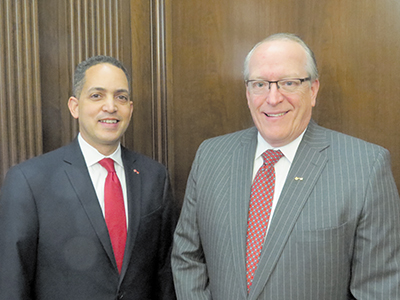
“That’s where we expect more than a third of … the $16.5 billion to go to,” says Don Graves, Jr., head of corporate responsibility at KeyBank. He spoke with CNYBJ on May 2 at the KeyBank office at 201 S. Warren St. in Syracuse.
“The $16.5 billion is focused on low and moderate-income communities in our footprint,” Graves notes.
In the program’s first year, KeyBank spent close to $30 million in 2017 in supporting affordable-housing projects in the Syracuse area with low-income tax credits and affordable-housing loans, says Stephen Fournier, market president for KeyBank in Central New York. Fournier joined Graves for the CNYBJ interview on May 2.
The projects include the Harborbrook Apartments near the Centers at St. Camillus in Geddes. The bank also made about $1.2 million in donations to nonprofit organizations, including a $200,000 donation to the Syracuse Rescue Mission last October to help cover costs in its $6.5 million renovation and expansion of the organization’s food-services center.
The KeyBank Business Boost & Build program on May 1 announced it had awarded $115,000 to CenterState CEO. The funding will help expand its UP Start Syracuse program in collaboration with the Upstate Minority Economic Alliance (UMEA). It’ll also help its support of the South Side Innovation Center (SSIC) at 2610 S. Salina St. in Syracuse and Women Igniting the Spirit of Entrepreneurship (WISE).
Types of investments
The KeyBank plan in its overall footprint includes $5 billion worth of investments in mortgage lending and $8.8 billion of investments in community-development lending.
“These are for projects that help build and sustain communities, mixed-use projects, affordable-housing developments,” says Graves.
The plan also includes $2.5 billion in small-business investments, along with $175 million that KeyBank plans for philanthropic investments across the footprint. It also includes an additional $3 million that the bank has set aside for innovation projects.
Graves joined Fournier to visit with a local advisory council for input on what local projects and issues KeyBank’s plan could benefit as the program continues. Fournier says the council includes the City of Syracuse, the Gifford Foundation of Syracuse, and Syracuse–based Home HeadQuarters Inc.
Fournier called it a “collaborative process” as KeyBank works with community stakeholders to figure out how to get people out of poverty and have a “broader impact on the community.”
It’s a group that Graves hopes will “give me a better flavor of the types of issues that folks are dealing with and everyday challenges.”
In his new role as KeyBank’s head of corporate responsibility, Graves is succeeding Bruce Murphy, who is vacating the position. Graves is working with Murphy as he transitions into the role. His office is in Cleveland, Ohio, he says.
Graves has worked for KeyBank for more than a year, originally hired as senior VP and senior director of corporate community initiatives and relations, according to his LinkedIn page.

The Agency: Consulting group to study redevelopment of former BAE site in Union
UNION — A firm based in Saratoga Springs, north of Albany, will lead a consulting group in conducting a redevelopment study on 600 Main St. in the town of Union, the former site of the defense contractor BAE Systems. The Agency selected Elan Planning Design and Landscape Architecture to lead the group, it said in
Become a Central New York Business Journal subscriber and get immediate access to all of our subscriber-only content and much more.
Click here to purchase a paywall bypass link for this article.
UNION — A firm based in Saratoga Springs, north of Albany, will lead a consulting group in conducting a redevelopment study on 600 Main St. in the town of Union, the former site of the defense contractor BAE Systems.
The Agency selected Elan Planning Design and Landscape Architecture to lead the group, it said in a May 3 news release.
The Agency is the entity that governs the Broome County Industrial Development Agency and the Broome County Local Development Corporation.
Elan has included two Binghamton–based firms — Griffiths Engineering, LLC and Woidt Engineering & Consulting, PC — in its consulting group. Both firms have “extensive” experience with post-2006 and 2011 flood-mitigation efforts, the Agency said.
Elan will also work with Venue Strategies, which has offices in New York City and Buffalo, to conduct an economic analysis of potential uses, the Agency said.
The Agency also expects to work closely with Town of Union’s economic-development and planning departments to ensure that uses identified align with the town and the county’s comprehensive plans, the organization said.
“Critical” priority
The Agency has identified the redevelopment of 600 Main St. as a “critical” economic development priority in the year ahead, the organization said.
“This property is in the center of our urban core and it’s imperative that we identify the right development opportunity,” Stacey Duncan, deputy director of community and economic development at The Agency, said in the release. “Elan has put together a great team and understands our goals for this study. We are looking forward to working with them.”
The U.S. Air Force in 2017 demolished the BAE building, which was “devastated” by flooding from Tropical Storm Lee in 2011, the Agency said.
The Agency now owns the property and will work with Elan’s team to identify site-development costs; assess flood-mitigation needs; and conduct economic analyses for potential uses. The Agency expects to issue a developer request-for-proposal later this year.
The Elan firm is “extremely excited” to help the Agency and the Town of Union work on the redevelopment of this “key” site, Lisa Nagle, principal of Elan Planning, said in the Agency’s news release.
“Repurposing previously developed sites in our urban centers is key to the long term sustainability of our upstate New York communities. Integrating recent investments such as the Binghamton University Pharmacy School, the planned nursing school, and the Johnson City Health and Cultural iDistrict present opportunities to think broadly about revitalization,” said Nagle.
Agency officials expect the consultants to complete final recommendations for the redevelopment of the property by November of this year.
The office of U.S. Senator Charles Schumer (D–N.Y.) assisted in securing grant funds from the U.S. Department of Defense’s Office of Economic Adjustment to complete the redevelopment study and create a master plan for the 27-acre site.
The federal government approved more than $200,000 for the project, according to a Jan. 10 news release posted on the Agency’s website.
“I worked hard to deliver the federal resources to resurrect the flood-damaged former BAE site, and the selection of a firm to lead a comprehensive redevelopment study is welcome news. In no time, this vacant lot will be bustling with new development and activity, making a positive contribution to Broome County’s economy.” Schumer said in the Agency’s release.
Eric Mower + Associates ad agency now simply called Mower
SYRACUSE — Eric Mower + Associates has rebranded, trimming the name down to Mower. Eric Mower, who founded the advertising agency in 1968, will continue to serve as chairman and CEO. “The agency’s name has changed but my role has not; I’ll continue to serve as the company’s chairman and chief executive officer and continue
Become a Central New York Business Journal subscriber and get immediate access to all of our subscriber-only content and much more.
Click here to purchase a paywall bypass link for this article.
SYRACUSE — Eric Mower + Associates has rebranded, trimming the name down to Mower.
Eric Mower, who founded the advertising agency in 1968, will continue to serve as chairman and CEO. “The agency’s name has changed but my role has not; I’ll continue to serve as the company’s chairman and chief executive officer and continue to delegate increasing levels of responsibility to the firm’s most seasoned, most trusted senior professionals across the organization. The goal is to assure continuity and another 50 years of success,” he tells CNYBJ in an email.
The firm has designed a new logo for the new name. Presented in uppercase letters, in a custom, sans serif typeface, “Mower” will be seen in different bright colors. The primary color will be magenta, says Stephanie Crockett, SVP and managing director of Mower’s Syracuse office, but it will also be presented in nearly neon shades of other colors as well, plus charcoal.
A company release said the new look “is a refreshed brand that reflects a sharpened strategic focus and energized commitment to creative solutions to fuel its clients’ growth.”
Crockett says the new brand is more culturally reflective, noting it includes the word “we.” As Crockett puts it, “together we’re all Mower.” Plus, she says, Eric Mower and Associates “felt a little bit like a law firm from the 1980s.”
The design was one of dozens considered by the ad agency and was worked on by people at all nine Mower offices, she says.
It is also part of the Syracuse–based firm’s 50th anniversary.
Since the 1970s, the ad agency has gone through eight logos before this latest iteration. Once known as Silverman & Mower, the company has been Eric Mower and Associates since 1980.
The largest advertising firm in Central New York, measured by local employees, according to Business Journal News Network research, Mower traces its roots back to 1968 when Eric Mower opened a four-person office in Syracuse. As the company has grown, it has always had its headquarters in Syracuse, Crockett says. It’s currently located on West Jefferson Street in Armory Square.
Today, Mower has offices in New York City, Atlanta, Boston, Charlotte, North Carolina; Cincinnati; Buffalo; Rochester; Albany, and Syracuse with 175 employees, including 75 in Syracuse, according to Crockett.
Mower generated more than $192 million in capitalized billings in 2017, the firm says.
The advertising agency has created some memorable ad campaigns and branding over the years, Crockett says, pointing to Crouse Health, which has been a client of the firm for some 30 years. Mower created the “Take me to Crouse” campaign, she says, and the hospital’s current “Carepassion” slogan.
Mower coined “CenterState CEO” when the Greater Syracuse Chamber of Commerce merged with the Metropolitan Development Agency. More recently, the firm redesigned the logo for Loretto using a custom-designed typeface, as it did on its own rebranding.
Ithaca Tompkins Regional Airport readies for renovations
ITHACA — Ithaca Tompkins Regional Airport is joining other airports in the region as it prepares to kick off a $22 million renovation. The airport, which offers direct flights to Newark Liberty International Airport, Detroit, and Philadelphia, will use a $14.2 million state grant to help pay for the work to “revitalize and expand” the facility,
Become a Central New York Business Journal subscriber and get immediate access to all of our subscriber-only content and much more.
Click here to purchase a paywall bypass link for this article.
ITHACA — Ithaca Tompkins Regional Airport is joining other airports in the region as it prepares to kick off a $22 million renovation.
The airport, which offers direct flights to Newark Liberty International Airport, Detroit, and Philadelphia, will use a $14.2 million state grant to help pay for the work to “revitalize and expand” the facility, the office of Gov. Andrew Cuomo said in a news release. The grant comes from the $200 million Upstate Airport Economic Development and Revitalization Competition.
Syracuse Hancock International Airport and Elmira Corning Regional Airport are also getting major facelifts this year utilizing state grant money
The availability of the state grants has helped drive the surge in airport work, explains Bill Hopper, aviation director at Elmira Corning Regional Airport. He notes that airports in Rochester and Plattsburgh are also using state funds for renovations.
On May 7, the state announced another round of grants for work on upstate airports. The state will make $20 million in new funding available to all public-use airports listed in the State Airport System Plan. That includes 70 general aviation airports and 18 commercial airports.
The work at Elmira Corning, scheduled to be completed this fall, includes a new baggage area, screening section, and boarding areas. Some could be in use as soon as August, says Hopper, the airport’s director of aviation.
Elmira Corning Regional Airport offers direct flights to Detroit, Newark, and seasonal destinations in Florida.
In Syracuse, Hancock International Airport has been undergoing a $48.8 million renovation, forcing the relocation of many airport tenants and the rerouting of traffic. The project, expected to be completed in the fall, seeks to “turn an archaic facility into a state-of-the-art transportation hub that meets the needs of the 21st century traveler,” according to a release from Gov. Andrew Cuomo’s office.
The work includes a redesign of the grand hall; the food, beverage and retail concessions; and the exterior façade. It will also include a new Regional Aviation History Museum; a glass pedestrian bridge; and an “eco-friendly” roof along with new flooring and furniture.
Hancock International Airport has 21 direct flights. Destinations include Boston, New York, Detroit, Minnesota, Denver, Dallas-Fort Worth, Toronto, and Las Vegas as well as five airports in Florida.
The upgrades in Ithaca will include construction of a new 5,000-square-foot federal customs facility, 1,700-square-feet of space at the main entrance and an expanded ticket counter to improve passenger circulation and provide more room for ticket lines.
The improvements will include reconfiguration of the security checkpoint and relocation of Transportation Security Administration (TSA) office space as part of a 7,500-square-foot expansion of the passenger hold room.
Plans call for the reconfiguration of airline office space and expansion of baggage screening space as part of a 2,500-square-foot addition on the east side. The upgrades will also include “major” security enhancements, including updating TSA baggage screening to be compliant with post-9/11 security requirements and adding another line for passenger security screening to “alleviate wait times,” Cuomo’s office said.
In addition, the upgrades include three new passenger boarding bridges to accommodate jet aircraft and additional service. The airport converted to all-jet service last year.
The state expects work at Ithaca Tompkins Regional Airport to be completed next year.

EZaccessMD, a mobile telehealth provider, enters CNY market
EZaccessMD, a Rochester–based company, on May 1 started providing mobile telehealth services in the Syracuse area, partnering with a DeWitt firm to offer them. EZacccessMD describes itself as a mobile telehealth provider that brings diagnostics “right to the patient.” The firm is working with DeWitt–based K&A Services, Inc., a portable X-Ray provider,” to offer its
Become a Central New York Business Journal subscriber and get immediate access to all of our subscriber-only content and much more.
Click here to purchase a paywall bypass link for this article.
EZaccessMD, a Rochester–based company, on May 1 started providing mobile telehealth services in the Syracuse area, partnering with a DeWitt firm to offer them.
EZacccessMD describes itself as a mobile telehealth provider that brings diagnostics “right to the patient.”
The firm is working with DeWitt–based K&A Services, Inc., a portable X-Ray provider,” to offer its services to area businesses and their employees.
“Our technologically advanced medical equipment and service delivery model goes far beyond traditional telehealth phone and video chat,” Lois Irwin, president of EZaccessMD, contended in a news release. “Consumers everywhere are embracing, and seeking out, services like groceries and home goods that can be delivered directly to their homes, so why not health care too? We’re offering an unparalleled level of health-care convenience that isn’t available anywhere else in the U.S., and we’re thrilled to bring it to Syracuse.”
How it works
The employer signs up with EZaccessMD for a group subscription at $15 to $18 per employee per month. The company’s employees are enrolled at no cost with no premium required. The employees can then begin using the service with physician care available “24/7/365” with no copay required.
The services include phone and video consults that can assess and diagnose, e-prescribe, order tests, and deploy the EZaccessMD mobile team.
With the mobile visits and services, providers can handle bedside exams for ear, nose, throat, and cardiac issues; basic laboratory work; electrocardiograms, or EKGs; X-rays; and ultrasounds.
The attending physician will then follow-up with a call to check on the patient’s condition.
Company expanding
EZaccessMD launched its employer model in 2016. After a “successful pilot year” with Rochester businesses in 2017, it started work to expand across New York state.
In addition to its service in the Syracuse area, EZaccessMD will also enter the Albany and Buffalo markets with partner organizations, launching this quarter. Expansion is also planned this year across the downstate area, New Jersey, and Massachusetts, according to the release.
“We are so excited to be partnering with EZaccessMD, this unique, outside the box concept is truly innovative, and breaking the mold of ‘traditional healthcare,” Emily Duckett, director of business development at K&A Services, exclaimed in the EZaccessMD release. “The cost of health care is becoming unmanageable. It is too expensive for employers to offer. It is too expensive for employees to participate. This is an amazing new way to bring basic care to all those people. It is opening so many doors, and we are thrilled for the opportunity to be involved.”
Overcoming usage barriers
Telemedicine is seen “across the globe as the future of health care,” EZaccessMD contends, “alleviating stress” on doctor’s offices and emergency rooms. However, only 5 percent of those who have telemedicine services as part of their employee health-care plans are using it.
A Feb. 7, 2018, article on the website of Telemedicine Magazine, titled “Three Reasons Telemedicine Utilization Remains So Low,” cited lack of education for end-users, emphasis on lowest upfront cost instead of best value, and unsatisfactory service as the main factors telemedicine hasn’t taken off yet.
EZaccessMD contends it “overcomes these barriers” by not only bringing free telehealth directly to the user with its mobile team but providing a cloud-based, mobile application platform that “does not require” subscriber codes or a lengthy log-in process to access services when needed.
These offerings have helped drive utilization rates of “more than 50 percent, 45 percent higher than traditional telemedicine,” the company says.

Clarkson University adds minor in health care
School cites growing student interest as a key factor behind the move POTSDAM — Clarkson University has added a minor, titled “Medicine and Healthcare.” “The medical and health-care professions are among the fastest growing in the U.S., and student interest in health-care fields is growing rapidly at Clarkson University,” Tom Langen, a professor and chair
Become a Central New York Business Journal subscriber and get immediate access to all of our subscriber-only content and much more.
Click here to purchase a paywall bypass link for this article.
School cites growing student interest as a key factor behind the move
POTSDAM — Clarkson University has added a minor, titled “Medicine and Healthcare.”
“The medical and health-care professions are among the fastest growing in the U.S., and student interest in health-care fields is growing rapidly at Clarkson University,” Tom Langen, a professor and chair of the university’s biology department, said in a news release.
The minor will require 23 credits and is open to students pursuing any major, the university said.
Topics covered in courses for the minor degree include human anatomy and physiology, medical history, medical ethics, and health psychology. The program will also include a seminar that will introduce students to working health professionals and familiarize them with health-care careers. An experiential learning component will be required as well, the school said.
The program is overseen by Clarkson’s biology department.
“This minor provides an opportunity for students in any Clarkson program to acquire the foundations for pursuing a health-care career and highlights Clarkson’s commitment to students who will be the next generation of health-care practitioners,” Langen noted.
Clarkson University, founded in 1896, is a private, national research university whose main campus is located on 640 acres in Potsdam. The university has more than 60 academic programs in engineering, business, education, science, liberal arts, and health professions. Enrollment totals 4,300 undergraduate and graduate students. Anthony G. Collins is Clarkson’s president.
Hartwick College adds hospital-suite simulation unit for nursing program
ONEONTA — Hartwick College believes a new hospital-suite simulation unit in the school’s nursing department will help it “better prepare” nursing students to enter the field. The $300,000 grant that Hartwick will use to help pay for the unit will also help it add another 10 students to the department, the college said in a
Become a Central New York Business Journal subscriber and get immediate access to all of our subscriber-only content and much more.
Click here to purchase a paywall bypass link for this article.
ONEONTA — Hartwick College believes a new hospital-suite simulation unit in the school’s nursing department will help it “better prepare” nursing students to enter the field.
The $300,000 grant that Hartwick will use to help pay for the unit will also help it add another 10 students to the department, the college said in a recent news release.
Hartwick had a total enrollment of 285 students in its Department of Nursing in the Spring 2017 semester, according to BJNN Research.
The Clark Foundation, headquartered in Cooperstown, awarded the funding, Hartwick said. The grant represents the fourth donation that the Clark Foundation has given the college since 2011.
Hartwick will put the new equipment in repurposed space in Smith Hall. It chose Smith Hall as the “ideal location” for the simulation unit because of its proximity to the school’s Johnstone Science Center and other academic areas. The size and shape of the space is also “compatible” with space needed for a simulated hospital suite.
“The new, state-of-the-art unit will allow us to provide students with innovative learning opportunities central to success, and, at the same time, support collaborative initiatives across disciplines within the college, as well as with our external clinical partners,” Patricia Grust, clinical associate professor and nursing-department chair, contended. “This new space will be an exciting addition to our program and is a vital component in the education of nurses in the current health-care environment.”
“We are delighted to be helping Hartwick College further enhance its nursing program,” Jane Forbes Clark, president of the Clark Foundation, said. “This latest funding not only helps grow the size of the program but also deepen the training the nursing students receive so they can be ready to make an immediate impact upon graduation when working at Bassett or other upstate healthcare institutions or systems.”
The Bassett Healthcare Network, which is based in Cooperstown, describes itself as an “integrated health-care system that provides care and services to people living in an eight-county region covering 5,600 square miles in upstate New York,” according to its website.
Founded in 1931, the Clark Foundation supports programs and provides grants to various charitable causes in New York City, Cooperstown, and elsewhere.
About the unit
The grant funding will help Hartwick replicate a hospital unit, the school said.
The unit will include four single-bed rooms, an eight-bed room, and a nursing station. It’ll also have technical equipment, including patient-care simulation manikins; computers; cardiac monitors; and instrumentation and supplies.
The space will allow students to learn advanced nursing and problem-solving skills, the school contends.
Students will rotate into this section from their clinical-learning environment at regional health-care facilities. Simulation learning, which is the objective of this suite, will “supplement” the hospital, rehabilitation center, psychiatric unit, and long-term care facility clinical training currently available to Hartwick nursing students, the school said.

SUNY Oswego adds all-online option for wellness-management program
OSWEGO — SUNY Oswego says it has received state approval to offer its bachelor of science program in wellness management as an online-only option beginning this fall. The university contends the option can help students “who are busy balancing work, family and school.” the option could work for students who are “eager” to reach graduate
Become a Central New York Business Journal subscriber and get immediate access to all of our subscriber-only content and much more.
Click here to purchase a paywall bypass link for this article.
OSWEGO — SUNY Oswego says it has received state approval to offer its bachelor of science program in wellness management as an online-only option beginning this fall.
The university contends the option can help students “who are busy balancing work, family and school.” the option could work for students who are “eager” to reach graduate school or the workforce ahead of the “normal” four-year timetable for an undergraduate degree.
In a news release, SUNY Oswego highlighted the example of Jamie Walzer, a senior from Rochester with a wellness-management major with a minor in biology. Walzer is pursuing graduate school for training as a physician assistant. She took the wellness management online courses already available and is “on track” to obtain her undergraduate degree in three years.
“That’s why I did a lot of the classes in my major online,” Walzer said. “I did a whole semester over last summer.”
The all-online option for wellness-management core courses and electives has “evolved over years of improvements in instructional methods and design,” Sandra Bargainnier, chair of health promotion and wellness in SUNY Oswego’s School of Education, said in the release. The knowledge and skills students are expected to take away from each course are “equivalent” to those delivered in a classroom, she contends.
“Instructors have to add value to the experience, to bring their engaged and present and creative selves to these courses,” Bargainnier said. “It takes time to do it well.”
Courses available in the wellness-management sequence include “Introduction to Health Promotion and Wellness;” “Essentials of Exercise Physiology;” “Health Promotion Program Planning;” “Nutrition Concepts;” “Evaluation and Research in Health Promotion;” and electives in psychology, management, and marketing.
Whether students opt for face-to-face, online only, or a hybrid approach, Bargainnier said SUNY Oswego’s undergraduate degree in wellness management offers a “strong foundation” for many career and advanced-degree opportunities. The areas include public health, nursing, mental-health counseling, medical school, athletic coaching, personal training, human-services programs with health components, nutrition, physical therapy, self-enrichment fields such as yoga instructors and wellness consultants, and entrepreneurship in health and wellness fields.
“What’s great about our program is the flexibility it gives you to go in a variety of directions,” said Bargainnier. ν

Upstate Medical researchers work on prototype saliva test to diagnose autism
SYRACUSE — Could a small saliva sample aid in the early diagnosis of autism? Researchers at Upstate Medical University say they believe they are getting close to making this happen. Autism is a developmental disability that affects one in 68 children, often affecting their ability to learn, communicate, and interact with others. No known cure
Become a Central New York Business Journal subscriber and get immediate access to all of our subscriber-only content and much more.
Click here to purchase a paywall bypass link for this article.
SYRACUSE — Could a small saliva sample aid in the early diagnosis of autism?
Researchers at Upstate Medical University say they believe they are getting close to making this happen.
Autism is a developmental disability that affects one in 68 children, often affecting their ability to learn, communicate, and interact with others. No known cure for autism exists.
No medical test that can diagnose autism is currently available, according to a March 30 Upstate Medical news release. Diagnosis is made after health-care professionals evaluate a child’s behavior.
The purpose of the federally funded study is to explore the possible use of saliva in helping to make this diagnosis. Researchers have already collected and analyzed saliva samples from 400 children, Upstate Medical said. The study is titled, “Validation of a Salivary miRNA Diagnostic Test for Autism Spectrum Disorder,” and is sponsored by the National Institutes of Health.
Saliva contains microRNA, which might affect how a child’s brain works. Finding microRNA particles with altered levels in children with autism may lead to an earlier diagnosis of the disorder and the delivery of “more efficient services” for these children.
“This study helps us understand what changes may be occurring in the brain of a child with autism spectrum disorder,” Frank Middleton, Ph.D., principal investigator of the study, said in the release.
The ongoing study is being conducted in collaboration with Upstate Medical University alumnus Steve Hicks, M.D., Ph.D. (now at Penn State Hershey Medical Center) and is also sponsored by Quadrant Biosciences, Inc., a Start-Up NY company based on the Upstate Medical campus.
Just over two decades ago, scientists discovered a new way that cells control the different kinds of proteins that they express. This mechanism involves the synthesis of short strands of ribonucleic acid (RNA) that were called microRNA. Humans have more than 2,000 different microRNAs. Each of these microRNAs can block the expression of dozens to hundreds of distinct proteins. The specific microRNAs that are found in a biological sample can therefore indicate what proteins are being shut off, the release stated.
“The study is very close to having a finished prototype, with a performance that rivals the widely used rapid Strep or influenza tests,” Middleton said, adding, “What it will benefit the most from at this point is additional participants to further establish the validity of the test.”
The “encouraging results” are leading researchers to expand the study with the goal of enrolling another 750 to 800 children, Upstate Medical said.
The organization said the study works like this: A clinician will ask parents some questions about how the child thinks and acts, and then watch the child perform some simple games and tasks that are routinely used to diagnose autism. Finally, to measure microRNAs, a small amount of saliva will be collected from the child’s mouth using a soft absorbent swab. The study will not have any effect on how a child behaves, Upstate Medical said.
Children who are between the ages of 18 months and 6 years and who have a diagnosis of autism-spectrum disorder or developmental delays are eligible to participate in the study.
The research group recently submitted a full-length report of its work for publication based on results from 436 children, and was expected to present findings at the Pediatric Academic Societies Meeting in Toronto, Canada, and at the International Society for Autism Research Meeting in Rotterdam, Netherlands.
Four Ways for Providers to Better Connect with Patients through email
Any health-care professional knows the importance of bedside manner. It builds a powerful relationship with your patients, instilling trust and safety in a setting where they may feel vulnerable. This relationship is key for delivering optimal care, retaining your patient base, and building your reputation. However, it can be difficult to extend that level of
Become a Central New York Business Journal subscriber and get immediate access to all of our subscriber-only content and much more.
Click here to purchase a paywall bypass link for this article.
Any health-care professional knows the importance of bedside manner. It builds a powerful relationship with your patients, instilling trust and safety in a setting where they may feel vulnerable. This relationship is key for delivering optimal care, retaining your patient base, and building your reputation.
However, it can be difficult to extend that level of care if you only interact with patients once or twice a year. One way to nurture patient relationships outside of the exam room is through email marketing.
Here are some tips to use email as a means of building stronger, long-lasting relationships with your patients.
Make it useful
While the entire purpose of email is to send and receive messages, recipients delete more than 10 percent of emails sent by businesses before even opening them. So, make sure your message includes something useful to your patients.
Share information that is both health-related and practice-related, such as news of recent office hires, promotions, or health tips. All of these reinforce the role your practice plays in patients’ wellbeing. For easy reading and predictable delivery times, consider packaging these messages into a monthly newsletter.
At a loss for news? Consider sending emails relating to national health observances, such as American Diabetes Month or National Immunization Awareness Month. These provide a great opportunity to educate your patients.
Make it personal
Do any of the marketing emails you receive address you by your first name? Adding personalization to your message can be a crucial step to making your email conversational, rather than coming off as disinterested, bland, or one-sided.
Write messages in the second person, using pronouns like “you” and “your,” which reinforce building a personal connection with patients.
To ensure your emails are even more personalized and useful to patients, you can segment emails by interests. For instance, if you know a portion of your patients are mothers, consider sending them information and articles about children or developments in pediatrics.
Something as simple as sending an email wishing each patient a happy birthday, or recognizing a patient’s anniversary with your practice associates you with goodwill. This gesture recognizes a day special to your patient and honors the personal connection that you’ve developed during appointments and treatments.
Make it easy
The last thing you want to do is waste anyone’s time. Make sure your messages are easy to understand, simple, and to the point.
Today, 54 percent of emails are opened on a mobile device, so there’s only so much room on the screen for content. Review what you write and ensure that your message is clear and explicit, getting the point across as quickly as possible.
Assuming your patients aren’t experts in the health-care field, avoid using acronyms, industry terms, or jargon.
Finally, make it easy for your patients to connect back with you. Link back to your practice’s contact information, hours, social-media platforms, website, or any additional contact information you’re willing to share.
Track, refine, and repeat
Email marketing should be an ongoing process, and tracking a few simple email metrics will help define your email success. To gain the best results you can will take some trial and error.
Fortunately, email-marketing effectiveness is fairly easy to measure. Delivery success (the number of emails that are successfully sent and were not bounced back to you because the email address is incorrect); open rates (the number of people who opened your email); unsubscribe rates (how many people opted out of receiving your emails); and click-through rates (how many times people clicked a link or image in the email) are all good metrics to determine the success of your email campaign. Evaluate what works and what doesn’t, and then adjust your approach accordingly.
Email is a communication platform that continues to grow. Take advantage of it to nurture relationships with your patients, as well as keep them informed and engaged.
Chris Panebianco is chief marketing officer at Bankers Healthcare Group, a provider of financing to health-care providers. In the past two decades, BHG has provided more than $3 billion in working capital and worked with more than 100,000 licensed health-care professionals. Contact Panebianco at chrisp@bhg-inc.com
Stay up-to-date on the companies, people and issues that impact businesses in Syracuse, Central New York and beyond.