Stay up-to-date on the companies, people and issues that impact businesses in Syracuse, Central New York and beyond.
Oneida County hotel occupancy rate rises in February
UTICA — Hotels in Oneida County were slightly fuller in February than in the year-ago month, according to a new report. The hotel occupancy rate (rooms sold as a percentage of rooms available) in the county increased 2.1 percent to 47.9 percent in February from 46.9 percent a year prior, according to STR, a Tennessee–based […]
Become a Central New York Business Journal subscriber and get immediate access to all of our subscriber-only content and much more.
Click here to purchase a paywall bypass link for this article.
UTICA — Hotels in Oneida County were slightly fuller in February than in the year-ago month, according to a new report.
The hotel occupancy rate (rooms sold as a percentage of rooms available) in the county increased 2.1 percent to 47.9 percent in February from 46.9 percent a year prior, according to STR, a Tennessee–based hotel market data and analytics company. The county’s occupancy rate has gained in 11 of the last 12 months.
Revenue per available room (RevPar), a key industry gauge that measures how much money hotels are bringing in per available room, edged up 0.9 percent to $50.38 in February from $49.91 in February 2018. Oneida County’s RevPar has also increased in 11 of the past 12 months.
Average daily rate (or ADR), which represents the average rental rate for a sold room, fell 1.1 percent to $105.25 in February from $106.45 a year ago.
Jam Fitness leases more than 2,700 square feet at Genesee Plaza
SYRACUSE — Jam Fitness of CNY has leased a 2,708-square-foot retail storefront to become the latest tenant to join the Genesee Plaza on Syracuse’s near westside, according to Cushman & Wakefield/Pyramid Brokerage Company, which helped arrange the transaction. No lease terms were disclosed. Genesee Plaza is a neighborhood shopping center located at 1001 West Genesee
Become a Central New York Business Journal subscriber and get immediate access to all of our subscriber-only content and much more.
Click here to purchase a paywall bypass link for this article.
SYRACUSE — Jam Fitness of CNY has leased a 2,708-square-foot retail storefront to become the latest tenant to join the Genesee Plaza on Syracuse’s near westside, according to Cushman & Wakefield/Pyramid Brokerage Company, which helped arrange the transaction.
No lease terms were disclosed.
Genesee Plaza is a neighborhood shopping center located at 1001 West Genesee St., with nearly 50,000 square feet of total retail space spread across a series of freestanding buildings. The plaza’s tenants include Aldi, Dollar Tree, Dunkin’ Donuts, EarQ, Jreck Subs, and United Auto Supply.
The property, located at the high-traffic corner of West Genesee Street and North Geddes Street, was the longtime home to the Sam Dell Dodge dealership, which went out of business. The property lay vacant for several years before being redeveloped into a shopping center in the last few years. Cushman & Wakefield/Pyramid Brokerage has the exclusive rights to market and lease the plaza. The real-estate firm is currently marketing a new 10,000-square-foot retail building, with a dock door built in 2018, for lease within the plaza.
Some recent tweets that came across the @cnybj Twitter feed, offering various small business, leadership, HR, career, and personal tips. SBA @SBAgovReady to expand your small business? SBA’s #export finance programs can help — http://ow.ly/wLkv30oeErY Small Business Expo @SmallBizExpoWhat James Holzhauer Is Doing on Jeopardy! Can Teach Everyone a Business Lesson http://twib.in/l/9MxXkBGazrGE NFIB @NFIBStuck on
Become a Central New York Business Journal subscriber and get immediate access to all of our subscriber-only content and much more.
Click here to purchase a paywall bypass link for this article.
Some recent tweets that came across the @cnybj Twitter feed, offering various small business, leadership, HR, career, and personal tips.
SBA @SBAgov
Ready to expand your small business? SBA’s #export finance programs can help — http://ow.ly/wLkv30oeErY
Small Business Expo @SmallBizExpo
What James Holzhauer Is Doing on Jeopardy! Can Teach Everyone a Business Lesson http://twib.in/l/9MxXkBGazrGE
NFIB @NFIB
Stuck on choosing a name for your #SmallBiz? This can help: https://www.nfib.com/content/resources/start-a-business/how-to-name-your-small-business/
Jeff Bullas @jeffbullas
7 Data-Backed Reasons Why 2019 Is The Best Year To Start Your Online Business #smallbusiness #startonlinebusiness http://bit.ly/2WQzIlu
Allen Ruddock @AllenRuddock
Find the simple formula for business success http://dld.bz/dZaCd #smallbiz #marketing
Danielle Guzman @guzmand
Emotional agility is key for leaders in the #futureofwork. Here’s how to actively invest in building it. @whirlingchief via @forbes. http://bit.ly/2IBeJjL #skills #career #leadership #HR
Mark C. Crowley @MarkCCrowley
Too many managers lack equanimity, the inclination to experience joy in the success of other people. Just as a coach would never compete with, or feel threatened by the achievements of his/her players, we need the same mindset in workplace
Atkinson HR Consulting @atkinson_hr
According to @LinkedIn, flexible working is 1 of the top 4 #HR trends that most affects organizations in 2019. Today, it’s increasingly an expectation. You may not get praise for offering flexibility, but you’ll probably stand out for not (and not in a good way).
Dave Ulrich @dave_ulrich
The community and context in which an organization operates is an additional and increasingly important external stakeholder. Leaders and #HR professionals need to be socially accountable for how their organizations respond to these challenges.
WSR Accountants @WSR_Accountants
Employers may receive no match letters from the Social Security Admin. The reason of the letter is to advise employers that corrections are needed in order for the SSA to properly post its employee’s earnings to the correct record. https://bit.ly/2MZnZh1. #SmallBiz #taxes
PwC @PwC
71% of organizations say developing coordinated tech, #workforce, location & tax strategies is important to the future of their business. Are you planning accordingly? See how you stack up: https://pwc.to/WFSD-19
Hannah Morgan @careersherpa
What To Put In Your LinkedIn Summary Section: @Careersherpa https://buff.ly/2FkOrOr
Mitch Mitchell @Mitch_M
We’re All In Control Of Our Destinies https://www.ttmitchellconsulting.com/Mitchblog/were-all-in-control-of-our-destinies/ … #leadership
William G. Pomeroy Foundation @wgpfoundation
Have you seen our #historicmarker videos produced by @WCNY? The series highlights a variety of historically significant people, places and things from across New York State. You can watch them on WCNY or check them out on our YouTube channel! https://bit.ly/2UEaPbu

New state task force to help train technicians for auto-industry jobs
A new state task force will develop programs for training auto technicians and enabling participants to directly transition into the industry. Gov. Andrew Cuomo on April 20 announced the “Excelsior Automotive Technician Task Force” at the opening of the New York International Auto Show. Cuomo directed the New York State Department of Motor Vehicles (DMV)
Become a Central New York Business Journal subscriber and get immediate access to all of our subscriber-only content and much more.
Click here to purchase a paywall bypass link for this article.
A new state task force will develop programs for training auto technicians and enabling participants to directly transition into the industry.
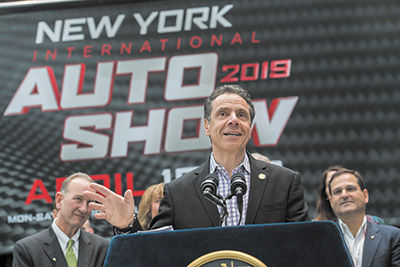
Gov. Andrew Cuomo on April 20 announced the “Excelsior Automotive Technician Task Force” at the opening of the New York International Auto Show.
Cuomo directed the New York State Department of Motor Vehicles (DMV) to take the lead in organizing the task force. The group will also “strive to create opportunities to enhance diversity within the industry,” according to a news release from the governor’s office.
“One of the things we’re going to do here in this state is change our education system, where the State University of New York [SUNY] is going to offer specialized training in tandem with the manufacturers so that you can go to school and come out as a Nissan-certified technician or a Honda-certified technician or a BMW technician,” Cuomo said. “We have over 75,000 technician jobs that are good jobs, high-paying jobs, and we want to educate New Yorkers for those jobs right here in New York. This new task force will set us on that path.”
Many current vocational programs offer a generalized technician program, but training that is more specific could better help students and companies, the state says. Typically, auto manufacturers require a “unique” training program to teach prospective technicians how to work on their vehicles. This work is currently happening at several SUNY schools where they are working with automotive companies like Subaru, Tesla, and Toyota.
“We applaud Gov. Cuomo for this innovative approach to strengthen New York’s competitive edge in training workers for the jobs of tomorrow,” Mark J.F. Schroeder acting DMV commissioner, said in the news release. “We look forward to working with all stakeholders to create a positive program that will benefit students and industry and ultimately the people who buy and drive cars.”
Areas of focus
The task force will convene stakeholders from the automotive, labor, manufacturing, and academic arenas to address several areas in the marketplace.
Those areas include improving the current automotive-technician curricula at the secondary and higher-education levels to “ensure it is keeping pace with technology.”
The group will also “identify and improve” current training models and facilities to “ensure they reflect modern workforce needs.”
Its effort will also seek to “replicate and scale” best practices and educational models to reach dealers and potential technicians in online space.
In addition, the group will also work to “develop and implement” professional-development programs for teachers and college professors to “ensure they are aligned with market needs.”
The marketplace areas also include creating new veteran and women-specific campaigns to “broaden the diversity” of the workforce, develop and invest in new re-training programs and apprenticeships to enable new and older workers to continue their careers, and explore options with prisons to create an automotive-technician reentry program, per the release.
DRI contest criteria includes downtowns where millennials want to live
If a community wants to capture a $10 million grant in the state’s regional downtown competition, it should have a downtown area where millennials want to live. That’s among the criteria for consideration in the fourth round of New York’s Downtown Revitalization Initiative (DRI). The downtown area must be “an attractive and livable community for diverse
Become a Central New York Business Journal subscriber and get immediate access to all of our subscriber-only content and much more.
Click here to purchase a paywall bypass link for this article.
If a community wants to capture a $10 million grant in the state’s regional downtown competition, it should have a downtown area where millennials want to live.
That’s among the criteria for consideration in the fourth round of New York’s Downtown Revitalization Initiative (DRI).
The downtown area must be “an attractive and livable community for diverse populations of all ages,” including existing residents, millennials, and skilled workers, the office of Gov. Andrew Cuomo said in an April 19 news release.
It’s one of several criteria that the Regional Economic Development Councils (REDC) will consider when selecting the grant recipient.
The new state budget includes $100 million for the next round of DRI awards. The effort will support 10 additional downtown neighborhoods, one in each region of the state, “boosting local economies and fostering vibrant neighborhoods that offer a higher quality of life,” Cuomo’s office contended.
The governor first presented the DRI program in his 2016 State of the State address.
As in the previous three iterations, one community in each of the 10 REDC zones will be selected by the regional council to receive a $10 million investment following an application process and evaluation of each downtown’s “potential for transformation.” Applications for the fourth round are due by 4 p.m. on May 31.
Regional winners of the $10 million in DRI grant funding through the first three rounds include Auburn, Cortland, and Oswego in Central New York; Owego, Watkins Glen, and Elmira in the Southern Tier; Amsterdam, Rome, and Oneonta in the Mohawk Valley; and Saranac Lake, Watertown, and Plattsburgh in the North Country.
Other DRI criteria
Besides the “diverse populations” living component, the REDCs will weigh several criteria to select nominees, Cuomo’s office said.
Its downtown area should be compact, with well-defined boundaries. It should also be able to “capitalize on prior or catalyze future” private and public investment in the neighborhood and its surrounding areas.
The community should have “recent or impending job growth within, or in close proximity to” its downtown that can attract workers to the downtown, support redevelopment, and make growth sustainable.
The municipality should already “embrace or have the ability to create and implement policies” that increase livability and quality of life, including the use of local land banks, modern zoning codes and parking standards, complete street plans, energy-efficient projects, green jobs, and transit-oriented development.
The community should have conducted an “open and robust community-engagement process resulting in a vision for downtown revitalization” and a preliminary list of projects and initiatives that may be included in a DRI investment plan.
The municipality must also have identified “transformative projects that will be ready for implementation with an infusion of DRI funds within the first one to two years,” Cuomo’s office said.
New York Amends Law Regarding Employee Paid Time Off to Vote
In the early morning hours of April 1, New York State passed its new yearly budget. Though the budget included several items of importance and interest, it was an under-the-radar provision revising paid voting time for employees that caught our attention. Previously, the law provided that if an employee had four consecutive hours either between
Become a Central New York Business Journal subscriber and get immediate access to all of our subscriber-only content and much more.
Click here to purchase a paywall bypass link for this article.
In the early morning hours of April 1, New York State passed its new yearly budget. Though the budget included several items of importance and interest, it was an under-the-radar provision revising paid voting time for employees that caught our attention.
Previously, the law provided that if an employee had four consecutive hours either between the opening of the polls and the start of his or her shift, or between the end of his or her shift and the closing of the polls, the employee would be deemed to have had sufficient time to vote and was not entitled to paid time off to vote. If the employee did not have this four-hour window of time, the employee was permitted to take up to two hours of paid time off to vote either at the beginning or end of his or her shift.
The new law, which is effective immediately, makes several important changes. First, the amount of paid time off that must be granted for voting leave changes from “up to two hours” to “up to three hours.” Furthermore, under the previous law, employees used to have a limited period of time between two and 10 days before the election to notify their employer of their need for paid time off to vote. The new law eliminates this outside limit of 10 days and just requires employees to request the paid time off to vote not less than two working days before the date of the election. Finally, and perhaps most significantly, the new law eliminates the presumption that an employee is not entitled to paid time off to vote if he or she has four consecutive hours outside of work time to vote.
By eliminating the four-hour consecutive window, the law virtually guarantees that all employees who request time off for voting must be granted sufficient paid time off to enable them to vote, up to a maximum of three hours. The effect that this could have on some employers, especially those who previously did not grant paid leave for elections because they could ensure that all employees had four consecutive hours off in which to vote, may be profound.
School districts may find the new law particularly problematic. Under the previous law, school-district employees, such as teachers and bus drivers, almost always had four consecutive hours off between the end of their work day and the closing of the election polls, which usually occurs at 9 p.m. This meant that these types of employees were not eligible to take paid leave to vote. These previously ineligible employees arguably must now be granted up to three hours of paid time off for voting.
Employers may still have a basis for denying paid voting leave (or granting something less than the maximum of three hours of voting leave) on the ground that the statute only allows employees to “take off so much working time as will enable him or her to vote.” However, it is not clear whether employers can ask for verification that employees actually voted and how long it took them to vote. Furthermore, the statute used to allow employees to “take off so much working time as will, when added to his voting time outside of working hours, enable him to vote.” The amendment to the law eliminated the italicized phrase, which suggests that the amount of time an employee has to vote outside of working hours can no longer be considered in determining how much paid time off an employee is entitled to take to vote.
Setting aside these unresolved questions, school districts, and similarly situated employers must now carefully consider the implications of all of their employees who are registered voters requesting up to three hours off to vote “at any election.” Exactly which elections qualify for paid leave under this law also remains an open question, but the language of the law is certainly broad enough to support an interpretation that all federal, state, or local elections would be covered. Regardless of the number or type of elections that the law extends to, affected employers must begin to plan for substantial portions of their workforce to make requests to be absent for up to three hours on election days. This will almost certainly mean increased scheduling problems. This situation becomes even more complicated when other considerations, such as employment agreements and obligations arising under collective-bargaining agreements are also factored into the analysis.
Finally, the law requires that all employers post a notice of the paid time off to vote law at least 10 working days before every election. Although this requirement has not changed in the new law, employers should be sure that their posters and voting-leave policies in their employee handbooks are updated to reflect the changes in the law.
Theresa Rusnak is a labor and employment law attorney with the Rochester office of Syracuse–based Bond Schoeneck & King PLLC. Contact her at trusnak@bsk.com. This viewpoint is drawn from the law firm’s New York Labor and Employment Law Report.
EBRI study: Confidence in retirement security rebounds
More than four in five retirees are confident in their ability to live comfortably throughout retirement, up from 75 percent last year and comparable to highs measured in 2005 and 2017. That’s according to the Employee Benefit Research Institute’s (EBRI) annual Retirement Confidence Survey (RCS) report, which was released April 23. The percentage of workers
Become a Central New York Business Journal subscriber and get immediate access to all of our subscriber-only content and much more.
Click here to purchase a paywall bypass link for this article.
More than four in five retirees are confident in their ability to live comfortably throughout retirement, up from 75 percent last year and comparable to highs measured in 2005 and 2017.
That’s according to the Employee Benefit Research Institute’s (EBRI) annual Retirement Confidence Survey (RCS) report, which was released April 23.
The percentage of workers who say they are very confident in their ability to live comfortably throughout retirement reached 23 percent. That’s up from last year’s 17 percent and “now reflecting levels measured more consistently in the late 1990s and early 2000s, prior to the financial crisis of 2008,” the EBRI) said in its report.
Now in its 29th year, the annual RCS is the longest-running survey of its kind, measuring worker and retiree confidence about retirement. EBRI and independent research firm Greenwald & Associates, both headquartered in Washington, D.C., conducted the study.
Researchers initiated the 2019 survey of 2,000 Americans online between Jan. 8 and Jan. 23. All respondents were ages 25 or older. The survey included 1,000 workers and 1,000 retirees, EBRI said.
Other findings
The survey also found that retirees this year are also much more likely than last year to be confident in their ability to afford the lifestyle that they’re accustomed to (77 percent, up from 70 percent) and having enough money to last their entire life (76 percent, up from 67 percent).
Eight in 10 retirees also indicate they are very or somewhat confident they will have enough money to take care of medical expenses, compared with 70 percent in 2018. Retirees are also less likely than last year to say their overall expenses, health-care expenses, and long-term care expenses are higher than they expected.
The RCS found that two-thirds of American workers (67 percent) feel confident in their ability to retire comfortably, with 23 percent feeling very confident. It reflects a 6 percentage point increase in the workers who feel very confident over 2018.
Though comparable to highs last seen 1997 through 2006 and in 2015 and 2016, worker confidence in 2019 still falls short of the 27 percent high measured in 2007, pre-financial crisis.
“Retirement confidence continues to be closely related to having a retirement plan,” Craig Copeland, EBRI senior research associate and co-author of the report, said in the survey report. “Workers reporting they or their spouse have money in a defined contribution plan or IRA, or have benefits in a defined-benefit plan, are nearly twice as likely to be at least somewhat confident about retirement (74 percent with a plan vs. 39 percent without a plan).”
The survey found 72 percent of workers are very or somewhat confident about being able to afford basic expenses in retirement. However, 41 percent are not confident about their ability to cover medical expenses and nearly half (48 percent) do not feel confident about having enough money for long-term care in retirement.
Workers are also more likely to cite debt as a concern compared with retirees. RCS found 61 percent of workers say debt is a problem for them, compared with 26 percent of retirees.
“Historically, the RCS has found a correlation between debt levels and retirement confidence,” said Copeland. “In 2019, 41 percent of workers with a major debt problem say that they are very or somewhat confident about having enough money to live comfortably in retirement, compared with 85 percent of workers who indicate debt is not a problem. Thirty-two percent of workers with a major debt problem are not at all confident about their prospects for a financially secure retirement, compared with 5 percent of workers without a debt problem.”
Managing finances
Asked to identify their guiding principle for managing finances in retirement — income stability versus preserving principal and wealth — a majority of both retirees (65 percent) and workers (74 percent) select “Income Stability: Ensuring a set amount of income for life.”
More than four out of five retirees and workers indicate that Social Security is or will be a source of retirement income, but differences emerge in the income sources (and the stability of those sources) that retirees report and the expectations of workers.
Eight in 10 workers (82 percent), for example, expect income from a workplace retirement-savings plan (separate from a pension plan), while just half of retirees (54 percent) report this is a source of income. Also notable, EBRI said, half of workers suggest they expect a product that guarantees income for life, such as an annuity, will be a source of retirement income for them, whereas only a third of retirees (33 percent) receive income from this type of product.
“The most pronounced gap in retiree experience and worker expectation for retirement-income sources remains working for pay in retirement,” Lisa Greenwald, executive VP of Greenwald & Associates, said in the EBRI report. “Three-quarters of workers believe work for pay will be a source of income in retirement and only a quarter of retirees actually receive income from work. It is risky for workers to assume they will be able to work into retirement when, for so many retirees, this has not been the case. I understand there’s a strong desire for income stability, but for many, continuing to receive a regular paycheck from work may not be the solution.”
Retirement age
The RCS “continues to identify a lack of alignment” between workers’ expectations about their age of retirement and prospects for working in retirement, compared with retiree experiences.
Workers continue to report an expected median retirement age of 65, while retirees report they retired at a median age of 62. The survey has consistently found that 43 percent of retirees leave the workforce earlier than planned, with 35 percent citing illness or disability as the reason and 35 percent retiring due to changes at their company.
In keeping with their income expectations, 80 percent of workers expect to work for pay in retirement, while only 28 percent of retirees report that they have actually done so.
MVP Health Care names chief medical officer
SCHENECTADY — MVP Health Care on April 29 announced the appointment of Dr. Bruce Himelstein as chief medical officer. Himelstein will lead MVP’s medical-management strategy by “implementing policies and programs to improve outcomes for MVP’s members and continue to build healthy communities,” the health insurer said in a news release. “Bruce is bringing the highest
Become a Central New York Business Journal subscriber and get immediate access to all of our subscriber-only content and much more.
Click here to purchase a paywall bypass link for this article.
SCHENECTADY — MVP Health Care on April 29 announced the appointment of Dr. Bruce Himelstein as chief medical officer.
Himelstein will lead MVP’s medical-management strategy by “implementing policies and programs to improve outcomes for MVP’s members and continue to build healthy communities,” the health insurer said in a news release.
“Bruce is bringing the highest caliber of expertise to MVP through his experience as a chief medical officer and a physician,” Denise Gonick, MVP’s CEO and director, contended. “His vision and passion to improve the lives of our members is unparalleled and we look forward to the positive impact he will have at MVP.”
Schenectady–based MVP Health Care operates Central New York regional offices at 333 W. Washington St. in Syracuse; at 3360 George F Highway in Endwell; and at 421 Broad St. in Utica, per its website.
Himelstein joins MVP Heath Care with more than 25 years of leadership in clinical medicine, education, research, and strategic program design. He most recently served as the senior executive medical director for government solutions at the Health Care Service Corporation, a privately held, nonprofit Blue Cross plan in Chicago.
He began his career as a pediatric oncologist at the Children’s Hospital of Philadelphia and after years of clinical practice and research, he made a career change to executive roles in various managed-care organizations.
Himelstein earned his doctor of medicine degree from New York University School of Medicine. He earlier received his bachelor’s degree from Harvard University and his executive MBA degree from the University of South Florida.
“Bruce is a highly accomplished, forward-thinking health care executive with a dynamic track record,” Christopher Del Vecchio, MVP’s president and COO, added in the news release. “He is an innovator who will build upon our clinical strategies and programs to cultivate positive results.”
YMCA of Greater Syracuse names Grayson VP of HR & development
SYRACUSE — The YMCA of Greater Syracuse announced that Erin Grayson recently joined the organization as VP of human resources & development. Grayson is a longtime YMCA professional in the areas of human resources, leadership development, coaching, and a wide range of program development. Grayson most recently was the leadership development and human resources director
Become a Central New York Business Journal subscriber and get immediate access to all of our subscriber-only content and much more.
Click here to purchase a paywall bypass link for this article.
SYRACUSE — The YMCA of Greater Syracuse announced that Erin Grayson recently joined the organization as VP of human resources & development.
Grayson is a longtime YMCA professional in the areas of human resources, leadership development, coaching, and a wide range of program development.
Grayson most recently was the leadership development and human resources director at the Central Connecticut Coast YMCA. While her husband Tim was pursuing his education, she spent a short period of time with the YMCA of Greater Syracuse at the East Area YMCA, working with youth and teens, according to an organization news release.
Prior to Syracuse, Grayson worked at the Silver Bay YMCA, serving in many different roles for more than a decade. She grew up in Norwich, and spent most of her time at the Norwich Family YMCA.
Grayson has a bachelor’s degree in youth development, with a minor in YMCA professional studies, and master of education degree in recreation management from Springfield College. She holds her organizational leader certification from YMCA of the USA, as well as certifications from the Center for Creative Leadership and The Bigger Game Company, per the release.
3 Ways to Reduce Employee Turnover & Produce a Better Workforce
Sometimes a good salary isn’t enough. Companies that want to attract and keep the best talent are finding that — perhaps more than ever — they need to understand just what it is that today’s employees want out of work and then find ways to provide that. While a great salary and good benefits are
Become a Central New York Business Journal subscriber and get immediate access to all of our subscriber-only content and much more.
Click here to purchase a paywall bypass link for this article.
Sometimes a good salary isn’t enough.
Companies that want to attract and keep the best talent are finding that — perhaps more than ever — they need to understand just what it is that today’s employees want out of work and then find ways to provide that.
While a great salary and good benefits are important, employees also desire such things as flexible schedules, a way to let their talents shine, and work that gives them a purpose, according to the 2018 Global Talent Trends study by Mercer.
And, with the unemployment rate so low, it’s easier for employees to find work elsewhere if they become discontented. That makes it even more important to keep them happy, since replacing employees can prove expensive.
The majority of human behavior is emotionally driven, but unfortunately a higher percentage is driven by negative emotions.
A high turnover of employees suggests a high level of stress, which indicates there are human-resources problems that need to be addressed. In some cases, an employee may just be a bad fit. But in other cases, it could be that management in some way isn’t meeting the needs of the employees.
Anytime an employee leaves, the business will need to find a replacement and then train that replacement. There is reduced productivity during that hiring and training timeframe, and there also could be morale problems if other employees have to take up the slack.
Just a few of the ways companies can give employees what they want — and benefit the business at the same time — include the following.
• Help them understand their purpose. It’s important for employees to be able to grasp the connection between their daily tasks and the goals, vision, and purpose of the company. This connection is the key to building the employees’ awareness that they are a part of something bigger than themselves, which gives them purpose. This is especially true for the millennial generation. Purpose is essential to their happiness and retention. One of the most important things to millennials in a work setting is to be able to make that connection, allowing them to adopt the company’s goals as their own.
• Empower them to grow and learn. A good manager should inspire employees to think outside the box. You want to push them outside their comfort zones so they can find better ways to achieve their goals. Employees who don’t feel they are being challenged, who aren’t growing in their abilities, are more likely to become bored and seek employment elsewhere.
• Provide coaching and mentoring. Coaching and mentoring means guiding people through failures and mistakes. This is the best way to learn and gain experience. But if you try to mentor people by telling them exactly what they need to do and making sure they do it, he says, you’re not a leader or a mentor. Instead, you are a supervisor who is ensuring that processes are being followed. There’s no creativity there. Telling people how to solve a problem limits their professional growth and prevents them from realizing their potential.
To keep employees happy and engaged, it’s important for businesses to have a clarity of purpose and an ability to communicate expectations.
Without these, employees end up not knowing what they should be doing, how they should be doing it, what goals they need to achieve, and how they fit into the organization. They become frustrated and start looking for another workplace that will give them what they need.
Alex Zlatin (www.alexzlatin.com) is CEO of Maxim Software Systems, a dental-practice-management software company, and author of the book, “Responsible Dental Ownership”
Stay up-to-date on the companies, people and issues that impact businesses in Syracuse, Central New York and beyond.