Stay up-to-date on the companies, people and issues that impact businesses in Syracuse, Central New York and beyond.

Utica to host State Summer Games for Special Olympics N.Y. the next three years
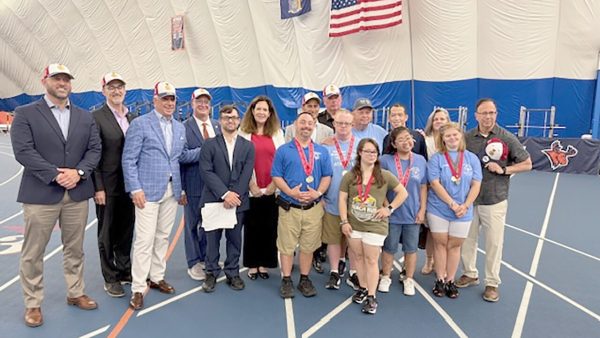
UTICA, N.Y. — Utica will host the next three annual editions of the State Summer Games for Special Olympics New York between 2026 and 2028. Utica University will serve as the hub of State Summer Games, with Opening & Closing Ceremonies and most of the sports competitions held on site. The campus will also provide […]
Become a Central New York Business Journal subscriber and get immediate access to all of our subscriber-only content and much more.
Click here to purchase a paywall bypass link for this article.
UTICA, N.Y. — Utica will host the next three annual editions of the State Summer Games for Special Olympics New York between 2026 and 2028.
Utica University will serve as the hub of State Summer Games, with Opening & Closing Ceremonies and most of the sports competitions held on site. The campus will also provide housing and meals for athletes and coaches. Additional venues scheduled to host State Summer Games events include Hamilton College (swimming), City of Utica (tennis) and Mohawk Valley Community College (volleyball).
Special Olympics New York, Utica University, and community leaders on July 28 gathered at the Utica University Hudson Sports & Recreation Center at 1600 Burrstone Road in Utica to make the announcement.
State Summer Games is the largest statewide competition for athletes with intellectual disabilities, Special Olympics New York said in its announcement. The games will be offered each June for more than 1,200 athletes and coaches from across the state to compete in six sports: basketball, powerlifting, swimming, tennis, track & field, and volleyball.
“We are thrilled to be partnering with Utica University and the surrounding communities to give our athletes a first-class State Summer Games where they will go for the gold in their favorite sports, reconnect with friends from all across New York, and meet new volunteers,” Stacey Hengsterman, president and CEO of Special Olympics New York, said in the announcement. “Making this three-year commitment to inclusion is a significant undertaking, and we are so grateful to our partners for their collaboration and support.”
In addition to the sports competitions, State Summer Games also includes a signature Special Olympics Opening Ceremony. In the ceremony, participants and the community come together to celebrate inclusion; activities for aspiring young athletes from local elementary schools; and a victory dance. In addition, it includes a Healthy Athletes event where athletes receive free health screenings in several disciplines such as vision care, dental care, hearing, podiatry, nutrition, and mental health, per the announcement.
“We’re excited to welcome more than 1,200 Special Olympics athletes and their coaches and families. With the support of the community, I know we’re going to make this a weekend to remember for everyone involved,” Utica University President Todd Pfannestiel said. “This is such a natural fit on so many levels, but in particular, the Special Olympics mission of providing opportunity aligns so closely with our own. We’re happy to have the Games back in Utica for three years and hopefully longer, and we cannot wait for next June to be here.”
“We are honored that the Special Olympics New York State Summer Games will be held in Oneida County for the next three years,” Oneida County Executive Anthony Picente, Jr., said. “This is more than a sporting event — it’s a celebration of courage, determination and inclusion. We look forward to welcoming these incredible athletes, their families and supporters and showing them the warmth, pride and spirit that define our community.”

Startup fund Upstate Biotech Ventures now has $10 million
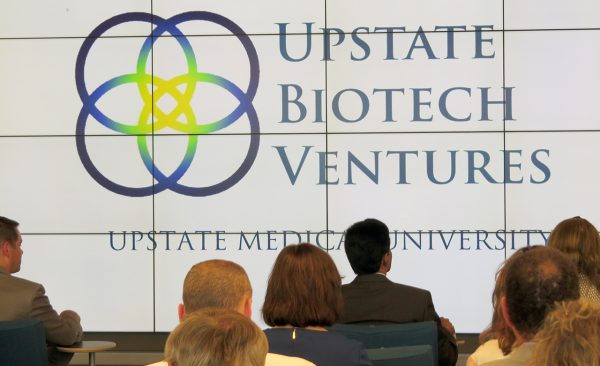
SYRACUSE, N.Y. — Upstate Biotech Ventures (UBV), Upstate Medical University’s startup biotech fund, now has significantly more funding than it did when UBV was announced in July 2024. SUNY Chancellor John King, Jr. on July 16 announced a $4 million increase in the startup biotech fund for a total $10 million investment. Empire State Development
Become a Central New York Business Journal subscriber and get immediate access to all of our subscriber-only content and much more.
Click here to purchase a paywall bypass link for this article.
SYRACUSE, N.Y. — Upstate Biotech Ventures (UBV), Upstate Medical University’s startup biotech fund, now has significantly more funding than it did when UBV was announced in July 2024.
SUNY Chancellor John King, Jr. on July 16 announced a $4 million increase in the startup biotech fund for a total
$10 million investment. Empire State Development (ESD) and Upstate Medical University provided the $4 million, SUNY said in the announcement.
The move comes about a year after the fund’s official launch in July 2024 with an initial $6 million in backing from ESD and Upstate Medical University.
Upstate Biotech Ventures (UBV) is a regional venture-capital fund supported by Upstate Medical University, Empire State Development (ESD), and SUNY, and managed by Excell Partners.
UBV was established to support and accelerate the growth of early-stage biotech, life sciences, and health-tech companies in upstate New York. The latest infusion of capital “underscores growing confidence in the region’s innovation potential and the fund’s targeted approach to advancing cutting-edge healthcare solutions,” SUNY said.
“The ongoing investment by SUNY, Empire State Development, and Upstate Medical supports transformative early-stage scientific research that will benefit New York State, our nation, and the entire global community,” King said in the announcement. “We look forward to the continued success of this fund and the research projects it serves.”
Fundraising has already begun with private investors to continue growing the fund.
Besides the additional funding, UBV also announced its first round of investments, totaling over $1.8 million across three “high-potential” startups. The investments include $1 million for DUB Therapeutics, $500,000 for MimiVax, and $350,000 for sayhii.
In keeping with the funding guidelines, all companies that receive investments are clients of the Central New York Biotechnology Accelerator (CNYBAC) at Upstate Medical University.
DUB Therapeutics, an Upstate Medical University spinout company, is developing a revolutionary self-delivering siRNA (sdRNA) therapeutic aimed at preventing inflammation and scarring in corneal injuries.
By targeting the USP10 protein, their sdRNA technology can penetrate cells without additional reagents and provide long-lasting treatment with just a single dose. The firm’s initial product — an eye drop for corneal opacification — is designed to reduce vision loss risk from infection or trauma, addressing a significant unmet need in ocular medicine.
MimiVax is advancing immunotherapy for brain cancer, with a focus on glioblastoma (GBM), one of the most lethal forms of brain tumors.
The company’s lead candidate, SurVaxM, is a peptide-based vaccine targeting survivin, a protein highly expressed in cancer cells. Currently in phase 2B clinical trials, SurVaxM has already “achieved full enrollment” and represents a “potentially” life-extending therapy for patients with GBM and other cancers, SUNY said.
The startup sayhii is described as a “transformative voice-of-the-employee platform focused on daily engagement,” per the SUNY announcement.
By delivering personalized questions each morning, sayhii captures real-time employee feedback to enhance culture, improve communication, and support leadership decision-making with actionable insights. Its mission is to make every employee’s voice heard — “driving trust, transparency, and data-informed workplace strategies.”
“Upstate Biotech Ventures exists to support companies like DUB Therapeutics, MimiVax, and sayhii, which are just three examples of the many promising high-tech companies that are innovating new technologies and addressing challenges in the healthcare industry,” Theresa Mazzullo, CEO of Excell Partners, said in the SUNY announcement. “UBV provides life science companies like sayhii, DUB Therapeutics, and MimiVax the critical capital required to launch and grow in Upstate NY.”
“Continued investment in the Upstate Medical University community and the broader Central New York region provides much needed capital to researchers and entrepreneurs who are developing life-changing medical and life sciences innovations,” Melur Ramasubramanian, SUNY executive vice chancellor for academic affairs and provost, said. “As part of a robust portfolio of innovative programs that make up SUNY’s technology-to-market strategy, Upstate Biotech Ventures plays an important part in catalyzing SUNY’s far-reaching research, innovation, and entrepreneurial capacity.”
Ramasubramanian also serves as president of the SUNY Research Foundation.
“Empire State Development is proud to support Upstate Biotech Ventures as it identifies and invests in the next generation of biotech and life sciences companies across the region,” Hope Knight, president, CEO, and commissioner of Empire State Development said in the SUNY announcement.

Students learn about sports-medicine careers at Guthrie event
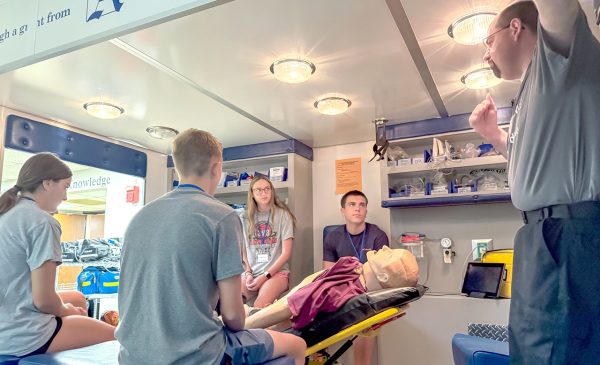
DICKINSON, N.Y. — Nearly 40 students from area high schools learned about professions in sports medicine and received hands-on experience during a July 18 event hosted by Guthrie Sports Medicine. The inaugural “Game Plan: Careers in Sports Medicine” provided instruction for 39 students in an interactive career day at SUNY Broome Community College, near Binghamton
Become a Central New York Business Journal subscriber and get immediate access to all of our subscriber-only content and much more.
Click here to purchase a paywall bypass link for this article.
DICKINSON, N.Y. — Nearly 40 students from area high schools learned about professions in sports medicine and received hands-on experience during a July 18 event hosted by Guthrie Sports Medicine.
The inaugural “Game Plan: Careers in Sports Medicine” provided instruction for 39 students in an interactive career day at SUNY Broome Community College, near Binghamton (town of Dickinson).
Zach Spencer, a certified athletic trainer with Guthrie Sports Medicine, came up with the idea for the program and organized it.
“The goal for ‘Game Plan’ was to spark interest in health care careers, especially within sports medicine, and show students the diverse paths available,” Spencer said in a Guthrie announcement. “Many schools host career day fairs where students learn about different professions, but these events rarely offer hands-on experiences of daily work activities. Our goal was to provide interactive learning opportunities that actively engage students in the healthcare field.”
Guthrie Sports Medicine specializes in care for athletes and active individuals, with services ranging from injury prevention and diagnosis to treatment and rehabilitation. The organization’s team of athletic trainers and strength coaches works with numerous high school sports programs throughout the Twin Tiers region, helping student-athletes “recover and return to peak performance,” Guthrie said.
Throughout the daylong event, students rotated among three teams, participating in hands-on sessions led by Guthrie professionals. Morning activities centered on emergency-medical services, CPR, and athletic training.
Afternoon sessions focused on orthopedics, strength and conditioning training, and physical-therapy fundamentals with Windsor Physical Therapy, Guthrie Physical Therapy, and Broome Physical Therapy Assistant Program collaborating. During lunch, a Guthrie nutritionist educated students on the topic of sports nutrition.
The event also included the American Heart Association Heart Saver course, which Guthrie described as a “key component of the program.” Students completed online coursework before the event and then received in-person certification during the July 18 program in AED (automatic external defibrillator) use, first aid, adult and infant CPR, EpiPen administration, and scene safety.
The afternoon also featured three Guthrie orthopedic physicians who demonstrated practical skills including casting, diagnostic ultrasound, and other orthopedic procedures. Nurses and athletic trainers provided additional expertise throughout the day.
“The event allowed us to share our passion and provide practical, hands-on experience that can truly shape their future decisions,” Spencer said. “We hope to offer this program again next summer and continue serving local students in the years ahead.”

SRC wins patent for adaptive digital filter for radar systems
CICERO, N.Y. — The U.S. Patent and Trademark Office has recently issued SRC, Inc. a patent for “Discrete Time Adaptive Notch Filter,” a process that allows for the selective filtering of complex signal components in radar systems. The patent develops an adaptive digital filter designed to efficiently remove specific types of unwanted interference, while minimizing
Become a Central New York Business Journal subscriber and get immediate access to all of our subscriber-only content and much more.
Click here to purchase a paywall bypass link for this article.
CICERO, N.Y. — The U.S. Patent and Trademark Office has recently issued SRC, Inc. a patent for “Discrete Time Adaptive Notch Filter,” a process that allows for the selective filtering of complex signal components in radar systems.
The patent develops an adaptive digital filter designed to efficiently remove specific types of unwanted interference, while minimizing the loss of signals useful to a radar, SRC said in a July 22 announcement. A distinctive feature is the filter’s ability to automatically track interference frequency using minimal firmware resources, enhancing efficiency, and efficacy without sacrificing performance, the company noted.
The inventors for this patent are John Dougherty, chief systems engineer, and Andrew Nadeau, staff systems engineer, both employees of SRC. Dougherty is also named on seven additional patents, the company said.
“By rethinking traditional approaches, SRC engineers continue to develop reliable, resilient solutions,” Kevin Hair, president and CEO of SRC, contended in the announcement. “This innovation underscores our commitment to redefining possible and delivering advanced technology that keeps America and its allies safe and strong.”
SRC, a nonprofit research and development company, says it combines information, science, technology, and ingenuity to solve “impossible” problems in the areas of defense, environment, and intelligence. Founded in 1957, SRC today has more than 1,400 employees, including engineers, scientists, and other professionals.

KeyCorp to pay 3rd quarter 2025 dividend in mid-September
KeyCorp (NYSE: KEY) — parent company of KeyBank, the No. 2 bank ranked by deposit market share in the 16-county Central New York region — has declared a quarterly cash dividend of 20.5 cents per share of its common stock for the third quarter of this year. The dividend is payable on Sept. 15, to
Become a Central New York Business Journal subscriber and get immediate access to all of our subscriber-only content and much more.
Click here to purchase a paywall bypass link for this article.
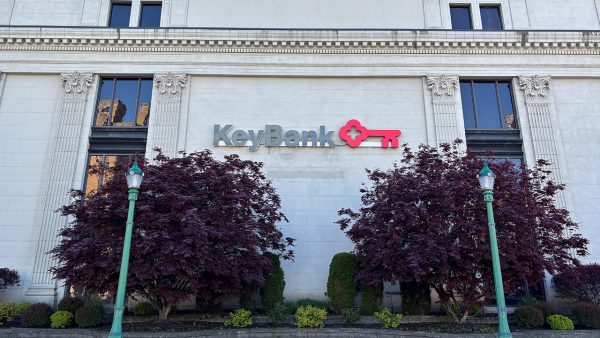
KeyCorp (NYSE: KEY) — parent company of KeyBank, the No. 2 bank ranked by deposit market share in the 16-county Central New York region — has declared a quarterly cash dividend of 20.5 cents per share of its common stock for the third quarter of this year.
The dividend is payable on Sept. 15, to holders of record as of the close of business on Sept. 2. At Key’s current stock price, the dividend yields about 4.6 percent on an annual basis.
Headquartered in Cleveland, Ohio, Key is one of the nation’s largest bank-based financial-services companies, with assets of more than $185 billion as of the end of the second quarter of 2025. Its roots trace back 200 years to Albany. KeyBank has a network of about 1,000 branches and about 1,200 ATMs in 15 states.

Syracuse Fire Department’s Engine Company 12 reopens at Station 12 after 27 years
SYRACUSE, N.Y. — After being closed since 1998, the Syracuse Fire Department’s Engine Company 12 reopened and returned to Station 12 at 400 West Genesee St. on July 2. Engine 12 will respond to calls for fires, car accidents, EMS, and other 911 emergencies across the city. The fire department said that amid record-breaking call
Become a Central New York Business Journal subscriber and get immediate access to all of our subscriber-only content and much more.
Click here to purchase a paywall bypass link for this article.
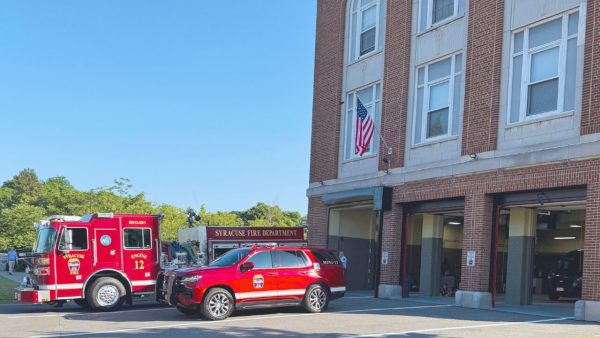
SYRACUSE, N.Y. — After being closed since 1998, the Syracuse Fire Department’s Engine Company 12 reopened and returned to Station 12 at 400 West Genesee St. on July 2.
Engine 12 will respond to calls for fires, car accidents, EMS, and other 911 emergencies across the city.
The fire department said that amid record-breaking call volume and city budget cuts, the addition of Engine 12 will help ensure city citizens “receive exceptional service and protection. The reopening will restore just a sliver of the former network of fire stations that once safeguarded the city,” the department said in a July 2 statement.
“We want to thank our elected officials and the dedicated teams within the Syracuse Fire Department, whose years of planning and preparation helped restore this vital emergency response resource,” the department added.

Community Foundation honors Human Technologies with Community Impact Award
UTICA, N.Y. — The Community Foundation of Herkimer and Oneida Counties presented its Community Impact Award to Human Technologies on June 26. The Community Impact Award celebrates, rewards, and encourages outstanding achievement in the charitable sector and is presented to a nonprofit organization serving Herkimer and/or Oneida counties that has shown outstanding service to its
Become a Central New York Business Journal subscriber and get immediate access to all of our subscriber-only content and much more.

Click here to purchase a paywall bypass link for this article.
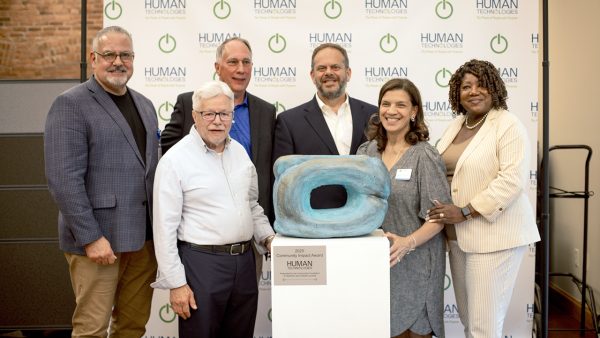
UTICA, N.Y. — The Community Foundation of Herkimer and Oneida Counties presented its Community Impact Award to Human Technologies on June 26.
The Community Impact Award celebrates, rewards, and encourages outstanding achievement in the charitable sector and is presented to a nonprofit organization serving Herkimer and/or Oneida counties that has shown outstanding service to its constituents, according to an announcement from the Community Foundation.
Human Technologies says it creates employment opportunities for people with differing abilities by developing, investing in, and growing their business lines including environmental facilities management, apparel and equipment supply chain, uniform management services, and manufacturing and packaging operations. Established in 1954 and founded with a mission to provide jobs to veterans and those with disabilities, the organization employs nearly 450 people throughout New York, Pennsylvania, Delaware, and Northern Virginia, and generates tens of millions in annual revenue.
“Human Technologies is a great example of what is possible when you think outside of the box,” Alicia Dicks, president and CEO of the Community Foundation of Herkimer and Oneida Counties, said in the announcement. “The opportunities they are creating are keeping talent in our community, attracting investment locally, and contributing to the revitalization of our region, which is something we always talk about.”
The relationship between Human Technologies (HT) and the Community Foundation dates back to 1960. Since then, the foundation has awarded more than $85,000 in grants to support HT’s mission, including funding to grow its facilities management services. Over the years, HT has developed a sustainable business model that generates multiple revenue streams while staying true to its people-centered mission.
“This award from the Community Foundation celebrates our work, and more importantly shines a spotlight on what’s possible when inclusion, purpose, and business come together,” said Carl Reistrom, president and CEO of Human Technologies. “At Human Technologies, we remain steadfast in our mission to break down barriers and create opportunities that empower people with differing abilities to thrive in work and in life. It shows that our model works — that when you lead with purpose, build with intention, and believe in people, real impact follows. We’re grateful to the Community Foundation for standing with us and sharing our vision of shifting perceptions while creating a more equitable and resilient region.”
Past recipients of the Community Impact Award, presented by the Community Foundation of Herkimer and Oneida Counties, include: Arc Herkimer, Community Transportation Services, Compassion Coalition, Hope House, Johnson Park Center, LivingADK, Sitrin Healthcare, SUNY Poly’s FIRST LEGO League, Thea Bowman House, and Young Scholars.

Unique Development lands contract for IKEA store at Destiny USA
SYRACUSE, N.Y. — Unique Development Companies, Inc. of Syracuse recently announced it has been selected by home-furnishings retailer IKEA to help build out its brand-new store at Destiny USA. The IKEA store, which will open sometime this fall, will occupy the 88,500-square-foot former At Home space at Destiny USA. It will be the Swedish retailer’s
Become a Central New York Business Journal subscriber and get immediate access to all of our subscriber-only content and much more.
Click here to purchase a paywall bypass link for this article.
SYRACUSE, N.Y. — Unique Development Companies, Inc. of Syracuse recently announced it has been selected by home-furnishings retailer IKEA to help build out its brand-new store at Destiny USA.
The IKEA store, which will open sometime this fall, will occupy the 88,500-square-foot former At Home space at Destiny USA. It will be the Swedish retailer’s first location in Central and Upstate New York, but third in New York state overall. IKEA has stores in Brooklyn and Long Island.
“We’re honored to be part of this milestone, and we’re looking forward to getting to work on what will be an exciting addition to our local landscape,” Unique (www.generalcontractorsyracuse.com) said in its announcement. “In choosing us over several larger out-of-town firms, IKEA made a bold decision to stay local. And not just local. They chose a small, family-owned construction company made up of just eight people.”
No financial terms or other details of the contract were disclosed.
The IKEA store at Destiny will feature its signature showroom, marketplace, and a Swedish food experience, according to a Destiny USA announcement. IKEA Syracuse will also include a central planning area where customers design and order home-furnishing products for spaces in the home such as kitchens, bedrooms and restrooms with support from an IKEA employee.

OPINION: More Upstate Utility Customers Paying a Steep Price for NY’s Unsustainable Energy Plan
There are lots of factors contributing to New York state’s unaffordable cost of living, and out-of-control utility costs are near the top of the list. Earlier this year, I wrote about the New York Public Service Commission’s decision to approve phased-in rate hikes for many upstate communities, a troubling development considering costs are already unsustainably
Become a Central New York Business Journal subscriber and get immediate access to all of our subscriber-only content and much more.
Click here to purchase a paywall bypass link for this article.
There are lots of factors contributing to New York state’s unaffordable cost of living, and out-of-control utility costs are near the top of the list. Earlier this year, I wrote about the New York Public Service Commission’s decision to approve phased-in rate hikes for many upstate communities, a troubling development considering costs are already unsustainably high for struggling families.
It’s no secret why we are in this precarious situation: Gov. Kathy Hochul and her legislative allies refuse to accept the impossible energy standards passed in the Climate Leadership and Community Protection Act (CLCPA). Banning natural gas and legislating the full electrification of the state are nothing short of ridiculous considering the economic realities facing everyday New Yorkers.
Now, even more families are expected to see substantial hikes as National Grid customers face increases of 27 percent for natural gas and 20 percent for electricity by the time new rates are fully implemented. [In August], the commission will be voting on the potential hike. Those new rates are expected to add $22 a month to customers initially before going up again next year and the year after that. Making matters worse, some of the revenue generated is needed simply to offset a poorly administered discount program — one that ends up helping some low-income New Yorkers by charging eligible families who haven’t signed up. Less than half of eligible New Yorkers are currently enrolled in the program.
Without state funding to support discount programs, rates for lower-income and middle-income families are going to go up in order to offset savings. And what are the savings we can expect for those who participate in the state’s newest discount program? National Grid customers making 60 percent to 80 percent of the state’s median income, once enrolled, can anticipate $6 in savings. Those making less than 60 percent of the median income, which is the lowest bracket qualifying for the state’s “energy affordability programs,” would see $13 in savings.
A hard look at these figures shows a system in which seemingly everyone loses. Low-income earners unaware and unenrolled households will be lumped into a category of ratepayers who will see enormous hikes in their utility bills to offset rising costs for others. And those savings don’t even make up the difference for the lowest-income families qualifying for a discount.
The unfortunate reality is that our energy plan is inadequate. A recent announcement that the state is considering expanding our nuclear-energy program is a good start, but much more needs to be done if we are going to meaningfully lower utility costs for customers. Most importantly, a fundamental shift in approach is needed at the state level. Strengthening our infrastructure, keeping utility costs to a minimum, and diversifying our energy portfolio through attainable, reliable generation must be our priority. Until then, ratepayers across the state will be crushed by unnecessary and unsustainable energy costs.
William (Will) A. Barclay, 56, Republican, is the New York Assembly minority leader and represents the 120th New York Assembly District, which encompasses all of Oswego County, as well as parts of Jefferson and Cayuga counties.

OPINION: It is time to replace the War Powers Act of 1973
Many Democrats and some Republicans expressed alarm [in late June of this year] when President Donald J. Trump ordered attacks on Iran’s nuclear facilities. Most Americans agree that Iran shouldn’t develop nuclear weapons, but was joining Israel in attacking Iran the best way to stop it? Would the strikes risk a wider Middle East war?
Become a Central New York Business Journal subscriber and get immediate access to all of our subscriber-only content and much more.
Click here to purchase a paywall bypass link for this article.
Many Democrats and some Republicans expressed alarm [in late June of this year] when President Donald J. Trump ordered attacks on Iran’s nuclear facilities. Most Americans agree that Iran shouldn’t develop nuclear weapons, but was joining Israel in attacking Iran the best way to stop it? Would the strikes risk a wider Middle East war? Should Congress have been involved in the decision?
The question is as old as the American republic: Who should decide whether to engage U.S. armed forces in combat? The Constitution gives Congress the power to declare war but makes the president the commander in chief of the military. It’s inevitable there will be conflicts over when Congress should get involved and when the president can act on his own to keep the country safe.
Congress tried to resolve the dilemma with the [War Powers Resolution, commonly called the War Powers Act], which we passed in 1973. Responding to expansion of the Vietnam War, the law required presidents to consult with Congress before engaging the military in battle, and it gave Congress the authority to reject the president’s actions after the fact. It passed with bipartisan support over a veto by President Richard Nixon.
But presidents from both parties have generally ignored the law, typically arguing that its limits on their powers are unconstitutional. It’s also vague and doesn’t clearly prescribe when congressional action is required. Congress has rarely forced the issue, and the courts have usually declined to get involved. We have a War Powers Act on the books, but it has no practical effect on our leaders.
As a result, America continues to fight undeclared wars and engage in military adventures that may not have the clear support of the American people. Congress hasn’t formally declared war since World War II, yet the Korean and Vietnam wars, which were never declared, together caused nearly 100,000 U.S. deaths. Since Vietnam, we’ve engaged in military action in Panama, Grenada, Bosnia, Iraq, Afghanistan, Syria, Libya, Yemen, and elsewhere. In some instances, presidents sought and received congressional authorization. In others, they did not.
Nearly 20 years ago, I was part of an effort to resolve this dilemma. Convened by the Miller Center at the University of Virginia, the bipartisan National War Powers Commission was chaired by former two former secretaries of state, Warren Christopher and James A. Baker III. The proposal that we developed and unanimously approved would have required presidents to consult with a set group of legislators from both parties before initiating military action that would last longer than a week, with limited exceptions. Congress would then have 30 days to go on record with its approval or disapproval. It would also have created a permanent joint committee of Congress to monitor war powers decisions. Legislation to enact the plan, the War Powers Consultation Act, was introduced in 2014 by Sens. John McCain, a Republican, and Tim Kaine, a Democrat, but it failed to pass.
What we proposed isn’t perfect, and it doesn’t resolve the constitutional questions about the limits of presidential and congressional power; only the courts can do that. But it would provide greater clarity about what happens when presidents order military action. It would promote much-needed consultation between the president and the Congress. Importantly, it would be unlikely to be ignored.
The recent attacks on Iran may have ended [with no American casualties and no wider regional conflict ensuing], but what Warren Christopher and James Baker wrote in 2008 remains true: “When it comes to war, Americans deserve better than a law that is ineffective and ignored.” Deciding when to send our men and women in uniform into combat is the most consequential decision that our government can make. The American people deserve to know that their views, as expressed through Congress, will be considered in such life-and-death decisions.
Lee Hamilton, 94, is a senior advisor for the Indiana University (IU) Center on Representative Government, distinguished scholar at the IU Hamilton Lugar School of Global and International Studies, and professor of practice at the IU O’Neill School of Public and Environmental Affairs. Hamilton, a Democrat, was a member of the U.S. House of Representatives for 34 years (1965-1999), representing a district in south-central Indiana.
Stay up-to-date on the companies, people and issues that impact businesses in Syracuse, Central New York and beyond.