
Get our email updates
Stay up-to-date on the companies, people and issues that impact businesses in Syracuse, Central New York and beyond.
What's New
Upcoming Events
CNYBJ Job Board
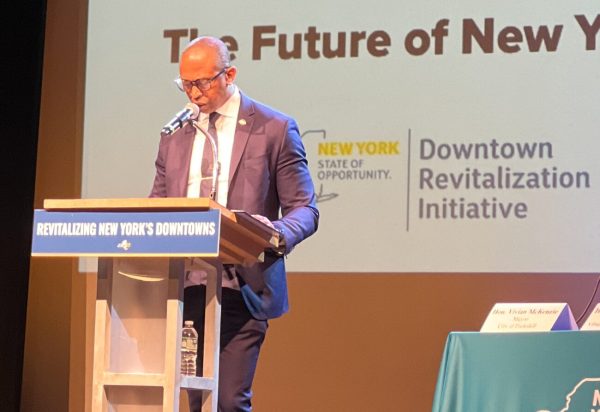
State says DRI, New York Forward programs have $200 million available for grants
ALBANY, N.Y. — New York’s signature downtown-revitalization and economic-development programs has $200 million available for the next round of funding. The state has $100 million

Economic impact of Broome County tourism tops $625 million in 2024
DICKINSON, N.Y. — The economic impact of tourism in Broome County reached $626 million between direct sales and personal income in 2024. “This enhanced economic

Syracuse police issue traffic, parking advisory for Syracuse football home opener
SYRACUSE, N.Y. — Syracuse police are advising those planning to attend Saturday’s Syracuse Orange football home opener with Connecticut to arrive early to reduce traffic

Community Foundation adopts new investment-management model
UTICA, N.Y. — The Community Foundation of Herkimer and Oneida Counties has implemented a new investment-management model, naming longtime consultant Crewcial Partners as its outsourced chief investment officer (OCIO). Based in New York City, Crewcial has worked with the Community Foundation for several decades, per a recent foundation announcement. The expanded partnership marks a new
Get Instant Access to This Article
Become a Central New York Business Journal subscriber and get immediate access to all of our subscriber-only content and much more.
- Critical Central New York business news and analysis updated daily.
- Immediate access to all subscriber-only content on our website.
- Get a year’s worth of the Print Edition of The Central New York Business Journal.
- Special Feature Publications such as the Book of Lists and Revitalize Greater Binghamton, Mohawk Valley, and Syracuse Magazines
Click here to purchase a paywall bypass link for this article.
UTICA, N.Y. — The Community Foundation of Herkimer and Oneida Counties has implemented a new investment-management model, naming longtime consultant Crewcial Partners as its outsourced chief investment officer (OCIO).
Based in New York City, Crewcial has worked with the Community Foundation for several decades, per a recent foundation announcement. The expanded partnership marks a new phase in managing and growing the Community Foundation’s charitable assets, the Utica–based nonprofit said.
This strategic move reflects the foundation’s “ongoing commitment” to long-term sustainability and sound financial stewardship of its more than $220 million investment portfolio.
For 30 years, Crewcial has worked with the Community Foundation and its investment advisory group (IAG), providing strategic investment guidance and oversight. Under the previous structure, investment decisions required approval from the Community Foundation’s board of trustees. Now, as the designated OCIO, Crewcial will take on full discretionary authority over key investment decisions — including ownership of investment-manager selection, replacement, and portfolio management.
To ensure the best fit for this expanded role, the Community Foundation conducted a request-for-proposal process and spoke with multiple investment firms, per its announcement. Following a “thorough evaluation” by the IAG and Community Foundation leadership, the board of trustees unanimously approved Crewcial as the selected partner.
“In the interest of our donors and the agencies we support, the Community Foundation conducted an exhaustive search to identify the best partner to guide us through a rapidly evolving investment landscape,” Robert Bojanek, chair of the Community Foundation’s investment advisory group, said. “We are confident that selecting Crewcial and adopting their OCIO model will strengthen our ability to generate the returns needed to sustain and grow our impact. The OCIO approach provides us with the ability to respond quickly to market changes, helping to safeguard and grow the resources entrusted to us. We look forward to continuing our long-standing partnership with Crewcial in this next chapter.”
“We’re honored to continue our decades-long partnership with the Community Foundation in our new capacity as OCIO,” Mike Miller, chief investment officer of Crewcial Partners, said in the Community Foundation announcement. “Our deep familiarity with their mission, values, and long-term goals allows us to act with both speed and conviction in navigating today’s ever-evolving investment landscape to help ensure they can sustain their impact, grow with intention, and operate effectively for generations to come.”
The transition to an OCIO model will allow Community Foundation staff and the IAG to “concentrate more fully” on strategic priorities, core operations, and philanthropic growth, the foundation contends.
However, the advantages of this partnership extend beyond just internal capacity, the Community Foundation notes.
The Community Foundation’s Nonprofit Agency Funds provide local charitable organizations with investment and gift-administration services. Through this new OCIO partnership, organizations that establish an Agency Fund will also benefit from the same investment expertise and oversight.
“It is our responsibility to steward our community’s assets both now and for years to come,” Erika Eastman, chief financial officer of the Community Foundation, said. “This new model supports our mission and future, and we feel confident that with Crewcial’s deep knowledge of our organization and proven expertise that we are set up for great success.”

WCNY training program uses $490K from CNY Community Foundation program
SYRACUSE, N.Y. — The Central New York Community Foundation announced that it has a local impact-investing program that has closed on a $490,000 deal for WCNY’s Entertainment Academy until funding from a state-grant contract is fulfilled. This project is receiving funding from a certificate of deposit (CD) that the Community Foundation has established in partnership
Get Instant Access to This Article
Become a Central New York Business Journal subscriber and get immediate access to all of our subscriber-only content and much more.
- Critical Central New York business news and analysis updated daily.
- Immediate access to all subscriber-only content on our website.
- Get a year’s worth of the Print Edition of The Central New York Business Journal.
- Special Feature Publications such as the Book of Lists and Revitalize Greater Binghamton, Mohawk Valley, and Syracuse Magazines
Click here to purchase a paywall bypass link for this article.
SYRACUSE, N.Y. — The Central New York Community Foundation announced that it has a local impact-investing program that has closed on a $490,000 deal for WCNY’s Entertainment Academy until funding from a state-grant contract is fulfilled.
This project is receiving funding from a certificate of deposit (CD) that the Community Foundation has established in partnership with Pathfinder Bank.
WCNY — Central New York’s public-communications organization — is located at 415 W. Fayette St. in Syracuse.
WCNY’s Entertainment Academy is a 28-week, workforce-development training program. This new agreement will allow WCNY to host the training program while awaiting reimbursement from Empire State Development. The course teaches 25-to-39-year-olds from underserved neighborhoods the skills needed to work in the television and film trades.
The program is comprised of 14-week sessions, during which up to 40 students learn skills in shopcraft, gaffer, and grip work as well as the operation of aerial lifts. Those involved can apply those skills to higher paying film production and warehouse jobs. WCNY says most of the previous participants who started the training while on public assistance have since been able to reduce or fully eliminate their assistance within a month of completing the program.
“We are grateful for the partnership with the Central New York Community Foundation, Pathfinder Bank and the New York State Economic Development Corporation,” Carol Opee-Stelios, VP of human resources and workforce development at WCNY, said in the Community Foundation announcement. “This type of community coalition is instrumental in allowing WCNY to train talented and committed people for jobs in our region’s growing television and film production industry.”
Through its impact-investing program, the Community Foundation forms similar agreements for the benefit of nonprofit organizations and unincorporated organizations working with a 501(c)(3) fiscal sponsor that seek larger amounts of support than its nonprofit bridge-loan program can provide. The Community Foundation is responsible for intake and preliminary due-diligence review. Applications that meet the Community Foundation’s internal standards could be eligible to receive a lower interest rate from a local bank over the duration of a CD term, the Community Foundation said.
The bridge loan and CD line of credit programs are designed to help nonprofit organizations continue essential community services while awaiting the receipt of approved grant funding. It is common for government agencies and other funders to require awardees to draw down funds on a reimbursement basis, often taking several months to process reimbursements.
“It is not uncommon for Central New York nonprofits to wait several months to receive grant payments, forcing them to alter services or find other stop-gap measures,” Frank Ridzi, VP of community investment at the Community Foundation, said. “The vital work of local community organizations is our top priority, so by providing flexible support through this loan fund, we hope to help ensure their services continue.”
This investment marks a total of more than $6.5 million now advancing housing, business development, and lending through the Community Foundation’s local impact-investing program. Impact investing allows the organization to use its financial resources to make investments that generate both financial returns and positive social outcomes. In 2023, the foundation’s board of directors approved a policy that allows the use of up to 5 percent of its main investment pool for the purpose of impact investment.

Syracuse University chancellor to depart next June
SYRACUSE, N.Y. — The current academic year at Syracuse University will be the last for Chancellor Kent Syverud. He plans to step down as chancellor and president in June 2026, after more than 12 years in the job. Saying the decision comes “after much reflection,” Syverud, who turns age 69 in October, announced his decision
Get Instant Access to This Article
Become a Central New York Business Journal subscriber and get immediate access to all of our subscriber-only content and much more.
- Critical Central New York business news and analysis updated daily.
- Immediate access to all subscriber-only content on our website.
- Get a year’s worth of the Print Edition of The Central New York Business Journal.
- Special Feature Publications such as the Book of Lists and Revitalize Greater Binghamton, Mohawk Valley, and Syracuse Magazines
Click here to purchase a paywall bypass link for this article.
SYRACUSE, N.Y. — The current academic year at Syracuse University will be the last for Chancellor Kent Syverud.
He plans to step down as chancellor and president in June 2026, after more than 12 years in the job.
Saying the decision comes “after much reflection,” Syverud, who turns age 69 in October, announced his decision to students, faculty, staff, alumni, families, and friends in a letter posted Tuesday, Aug. 26, on the school’s news website.
The Syracuse University board of trustees in December 2022 had announced it had extended the Syverud’s contract to 2026. His departure coincides with the expiration of that contract.
Syverud, who grew up in Irondequoit, wrote, “Serving this University has been the greatest privilege of my career.” He has been Syracuse chancellor since January 2014, when he formally took office, succeeding Nancy Cantor.
In the letter, he noted the project work on the Syracuse campus during his time as chancellor. That included the National Veterans Resource Center, the Barnes Center at The Arch, along with the renovated JMA Wireless Dome and renovated Schine Student Center. “You have transformed our campus into a more dynamic and vibrant living and learning environment,” he said to the university community.
As the letter continued, Syverud said, “Applications and enrollment have reached record levels. And together, we have confronted one of the most disruptive decades in the history of higher education, including navigating a once-in-a-century global pandemic that required more of our people than ever before. I marvel at the extraordinary talent of our Orange community. And you’ve done all this while putting the University in strong financial shape, with truly balanced budgets and record fundraising.”
He also thanked the Syracuse University board of trustees for the faith it placed in him in selecting Syverud as the school’s 12th chancellor and president in September 2013.
Syverud ended the letter, saying, “Although our time in leadership will end next June, [my wife] Ruth [Chen] and I will always be part of this extraordinary Orange community. We will remain Forever Orange.”

Binghamton University’s new president to start in November
VESTAL, N.Y. — Binghamton University has its next president following an Aug. 19 vote by the SUNY board of trustees. The system selected Anne D’Alleva as Binghamton’s eighth president. D’Alleva, currently the provost and executive VP for academic affairs at the University of Connecticut (UConn), is scheduled to begin her duties in Vestal on Nov.
Get Instant Access to This Article
Become a Central New York Business Journal subscriber and get immediate access to all of our subscriber-only content and much more.
- Critical Central New York business news and analysis updated daily.
- Immediate access to all subscriber-only content on our website.
- Get a year’s worth of the Print Edition of The Central New York Business Journal.
- Special Feature Publications such as the Book of Lists and Revitalize Greater Binghamton, Mohawk Valley, and Syracuse Magazines
Click here to purchase a paywall bypass link for this article.
VESTAL, N.Y. — Binghamton University has its next president following an Aug. 19 vote by the SUNY board of trustees.
The system selected Anne D’Alleva as Binghamton’s eighth president. D’Alleva, currently the provost and executive VP for academic affairs at the University of Connecticut (UConn), is scheduled to begin her duties in Vestal on Nov. 1, Binghamton University said in its announcement.
She will succeed Harvey Stenger in the president’s role.
`”I am deeply honored to accept the position of president of Binghamton University and to join the distinguished SUNY system,” D’Alleva said in the announcement. “Binghamton has a remarkable tradition of academic excellence, research innovation and community engagement, and I am inspired by the dedication of its faculty, staff and students. I look forward to working collaboratively with campus and community partners to build research strength, expand opportunities for students, enhance alumni involvement and advance the University’s impact in New York, the nation and the world.”
D’Alleva is described as an accomplished academic leader who has focused on advancing student success. She has also been involved in multidisciplinary and collaborative efforts to expand UConn’s work in AI (artificial intelligence) and quantum technologies, partner with the state’s tribal nations, and expand academic offerings at the university’s four regional campuses.
D’Alleva has led UConn’s academic enterprise, including strategic planning, budgetary management, faculty development, and curriculum innovation across the university’s 14 schools and colleges. She also leads initiatives that support student success, faculty excellence, and institutional impact, per the Binghamton announcement.
“I want to offer my heartiest congratulations to Anne D’Alleva on being selected as Binghamton University’s next president,” Binghamton University President Harvey Stenger said. “She brings with her a reputation as a multidisciplinary collaborator in research and scholarship, a leader in expanding and enhancing Connecticut’s facilities, and an administrator who has developed innovative solutions to support student success. I wish Anne the best in her time as Binghamton president, and I look forward to many future successes for the University, its people and the local community.”
The first woman to serve as provost in UConn’s history, D’Alleva had previously served as dean of the School of Fine Arts since 2015 and first joined the UConn faculty as a joint appointment to art history and women’s, gender and sexuality studies in 1999. She received her bachelor’s degree in art history from Harvard University and her master’s and doctorate degrees in art history from Columbia University with a graduate certificate in feminist theory.

The NYS Association of Family and Consumer Science Educators is proud to announce that Mary M. Gohl-Thompson, CEO of the Home Builders & Remodelers of
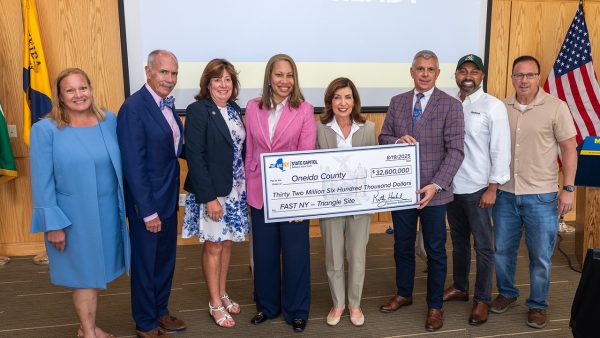
Oneida, Oswego, Broome counties to use FAST NY grant funding to improve sites
ROME, N.Y. — Oneida, Oswego, and Broome counties will use state funding to improve sites under the Focused Attraction of Shovel-Ready Tracts New York (FAST

VIEWPOINT: All the Stars We Cannot See
I would like to] discuss a favorite topic of mine — and one that economists have obsessed over for longer than a century. Of course, I am talking about r-star, the natural rate of interest. What’s fascinating about variables like r-star is that while they are unobservable, they go to the heart of monetary theory
Get Instant Access to This Article
Become a Central New York Business Journal subscriber and get immediate access to all of our subscriber-only content and much more.
- Critical Central New York business news and analysis updated daily.
- Immediate access to all subscriber-only content on our website.
- Get a year’s worth of the Print Edition of The Central New York Business Journal.
- Special Feature Publications such as the Book of Lists and Revitalize Greater Binghamton, Mohawk Valley, and Syracuse Magazines
Click here to purchase a paywall bypass link for this article.
I would like to] discuss a favorite topic of mine — and one that economists have obsessed over for longer than a century. Of course, I am talking about r-star, the natural rate of interest.
What’s fascinating about variables like r-star is that while they are unobservable, they go to the heart of monetary theory and practice. Just as the septillion stars we cannot see are vital to the existence of the universe, the constellation of economic stars is critical to our understanding of the economic universe we inhabit.
I will address three questions pertaining to the importance, measurement, and use of time-varying unobservable variables at central banks. While I will focus primarily on r-star, I should emphasize from the start that most of what I’ll talk about is applicable to a range of variables — including the closely related u-star and y-star.
My remarks will center around the stars from a “longer-run” perspective — that is, the “normal” values expected to prevail after cyclical fluctuations have fully played out and the economy is expanding at its trend rate in the absence of upward or downward pressures on inflation.
Before I go further, I’ll provide the standard Fed disclaimer that the views I express are mine alone and do not necessarily reflect those of the Federal Open Market Committee (FOMC) or any others in the Federal Reserve System.
Why Central Banks Care
I’ll start with the first question: If r-star, u-star, and y-star cannot be observed or directly measured, why do central banks care so much about them? Are they too abstract and elusive to be of practical value?
The short answer is that they play a central role in macroeconomic theory and have important implications for the conduct of monetary policy. R-star is the real short-term interest rate that is expected to prevail when the economy is at full strength and inflation is stable. Y-star is potential GDP. And u-star is the level of unemployment when an economy is at its potential. When the stars perfectly align, it means the economy has reached an equilibrium where its resources are fully utilized.
Therefore, the star variables provide key benchmarks for the economy and, in the case of r-star, the stance of monetary policy. This role of the stars is nicely illustrated by the Taylor rule, which stipulates that the interest rate should depend on the inflation rate, the deviation of output from y-star, and r-star. In addition, r-star has another important implication for monetary policy: A low r-star implies the economy can encounter more frequent and longer periods when monetary policy is constrained by the effective lower bound on nominal interest rates, potentially impeding the achievement of a central bank’s inflation goals and other macroeconomic objectives.
Uncertainty Clouds the Sky
The central role of the natural rate of interest has long been recognized by leading monetary theorists ever since the Swedish economist Knut Wicksell wrote about it in 1898. And in the 1960s, the concepts of y-star and u-star gained attention in the context of macroeconomic stabilization policy.
Through the decades, economists routinely stressed that natural rates are neither fixed in time nor easy to discern. Regarding r-star, the economist John H. Williams said in 1931 that “the natural rate is an abstraction; like faith, it is seen by its works.” Milton Friedman noted in 1968 that economists had yet to devise a method to accurately estimate both the natural rate of interest and unemployment, observing that “the ‘natural’ rate will itself change from time to time.” And in our paper on estimating r-star and y-star, Thomas Laubach and I concluded with: “Estimates of a time-varying natural rate of interest, like those of the natural rates of unemployment and output, are very imprecise and are subject to considerable real-time mismeasurement.” The uncertainty surrounding the stars is not a failure of theory or data. Rather, it is inherent to the problem of estimating a time-varying, potentially nonstationary, unobserved variable in a dynamic and constantly changing global economy.
This uncertainty complicates policymaking in practice. Gaps between real-time and ex-post estimates of u-star have been sizable and highly persistent. And this comparison likely understates the problem for policymakers because even with hindsight, we lack 20/20 vision of the stars.
The challenges in measuring natural rates can have profound policy and economic consequences. Indeed, monetary policymakers’ overreliance on what turned out to be mistaken views of natural rates contributed to poor macroeconomic performance and unmooring of inflation expectations in the U.S. during the late 1960s and 1970s.
Measuring the Stars
So, given the uncertainty around the stars, how do central banks measure them?
This issue gained in importance in the 1990s when people started using versions of the Taylor rule for monetary-policy analysis. The original Taylor rule assumed r-star was 2 percent, which prompted a number of natural questions from policymakers: Is 2 percent the right number? Does it change over time? And how would we know? These questions also led to a surge of research on these topics, including my own.
To infer r-star from data, three approaches have emerged: 1) using a statistical method to extract a longer-run trend, 2) basing it on financial market or survey data, and 3) looking at r-star’s effects on economic data. Each potentially provides useful information, but each also poses significant challenges.
As shown in one of my papers with Thomas Laubach, univariate statistical methods such as the HP filter generally do not provide reliable measures of r-star. In particular, these estimates can be overly influenced by large macroeconomic disturbances, such as the inflation of the 1970s or the COVID-19 pandemic.
Financial market and survey data are more promising sources of information in that they can tell us what people think about r-star. That said, market participants face the same challenges in measuring the stars that economists do, and therefore they do not really serve as truly independent sources of information on r-star. This is what I have referred to as a “hall of mirrors.” Indeed, market-based and survey-based measures can give a false sense of precision since the reported values do not convey the uncertainty underlying them.
In addition, financial-market measures of r-star are contaminated by liquidity and risk premiums, making a direct read of “what the markets think” elusive. Various term-structure models have been developed that aim to provide a better measure of r-star, but these estimates can vary widely. In any case, recent research suggests that market-based measures have not been better predictors of future interest rates than model estimates, and as such are not particularly useful independent guides to r-star.
That leaves us with model-based estimates of r-star that, in the spirit of the quote from John H. Williams, aim to infer r-star by its “works” — that is, from its effects on the economy. A variety of such models have been developed over the past quarter-century. Although they differ in details, the core assumption is that aggregate demand depends in part on the difference between the real interest rate and r-star. Thus, by observing the movements of demand, real interest rates, and other relevant macroeconomic variables, one can infer the likely value of r-star.
With open capital markets, r-star is inherently a global phenomenon affected by global movements in supply and demand for savings. For that reason, I will focus on global trends affecting r-star rather than on differences across countries.
Model-based estimates of r-star in many countries exhibited a sizable downtrend over the quarter-century leading up to the pandemic. A variety of factors contributed to this decline in r-star, including fundamental shifts in demographics and productivity growth.
Two powerful demographic trends have affected r-star: People are generally living longer, and birth rates are declining. Overall life expectancy in member countries of the Organization for Economic Co-operation and Development (OECD) has increased dramatically over the past several decades and is expected to grow further. At the same time, falling birth rates have led to stalling population growth. For example, among OECD economies, population growth averaged about 1 percent during the 1970s and 1980s, but it is now averaging about one-quarter of a percent per year. And this figure is expected to turn negative in about 15 years.
Amid these demographic shifts, the growth in global labor productivity — the amount produced per worker hour — has slowed. For example, productivity growth for [the United States, Canada, Euro Area, and United Kingdom] decreased from about 2 percent over the 1996 to 2005 period to about 1 percent over the 2006 to 2023 period.
The combination of slowdowns in population and productivity growth implies a slower rate of trend GDP growth and therefore less demand for investment to support a growing economy than before. In addition, greater longevity boosts the supply of savings as households build larger nest eggs for their longer period of retirement.
The big question today is whether the era of low r-star will endure. The global demographic and productivity growth trends that pushed r-star down have not reversed. Estimates of trend growth for four economies remain relatively low, similar to the levels that prevailed directly before the onset of the pandemic.
Of critical importance, the GDP-weighted estimates of r-star for these four economies — Canada, the Euro Area, the United Kingdom, and the United States — are around half of a percent, similar to the comparable real-time estimates from the period prior to the onset of the pandemic. This finding that r-star has not meaningfully rebounded is in line with evidence from a variety of models of r-star in the U.S., which show a relatively modest increase of one-quarter to one-half of a percentage point in real-time estimates of r-star between the third quarter of 2018 and the first quarter of 2025. Based on this evidence, the era of low r-star appears far from over.
Putting the Stars to Work
Now I will address the third and final question: How are star variables used by central banks?
Despite the uncertainty around these time-varying unobservable variables, model-based estimates of r-star, u-star, and y-star provide valuable information on how the economy and interest rates will likely evolve over the medium term. Estimates of r-star are foundational to considering the potential effects of the effective lower bound and strategies to mitigate its effects.
In addition to their role in internal analysis, the stars have increasingly become an aspect of central-bank transparency and communication. Transparency — including the clear communication of a central bank’s strategy and reasoning behind policy decisions — is a key principle in conducting monetary policy. As Alan Taylor recently noted, “there is value for central banks in communicating policymakers’ beliefs about the neutral interest rate whether it be some collective view or that of any individual member.”
Many central banks now regularly communicate their analyses of star variables, including r-star, u-star, and y-star. Although these estimates are useful for analysis and transparency, policymakers are well advised to avoid placing too great confidence in precise estimates of the stars in making real-world assessments and decisions. Given the wide range of uncertainties, acting as if one knows the star variables when making policy can lead to persistent deviations of inflation from the target that risk unmooring inflation expectations.
Fortunately, research has shown that approaches that don’t rely as much on estimates of starred variables and instead “follow the data” perform well when uncertainty is high. One such approach is “difference rules,” where the short-term nominal interest rate is raised or lowered in response to inflation and changes in economic activity. Hybrid approaches that combine some aspects of the response of Taylor-type rules and difference rules have been shown to perform well in models in the presence of a wide range of uncertainties. In the end, policy decisions must be based on the totality of information and assessments, including those related to risks.
Don’t Give Up
I’ll end my remarks where I started. For more than 125 years, economists have grappled with a dilemma: How can a concept at the heart of monetary theory be so vexing to quantify? The star variables are either explicitly or implicitly at the core of any macroeconomic model or framework one can imagine. Wishing away the economic stars does not change that.
In that context, it is important that we do our best to understand the factors that influence the stars and the uncertainties related to them. In this way we can attain the best understanding of the forces affecting the evolution of the economy and monetary policy as we carry out our mandates.
These issues have been challenging central bankers [for a long time]. For the past quarter century, central banks have been at the forefront of this research, and I very much hope that will continue.
John C. Williams is president and CEO of the Federal Reserve Bank of New York. This article is drawn (and edited for space) from a speech, as prepared for delivery, that he gave on Aug. 25 at the Banco de México Centennial Conference, in Mexico City, Mexico. The full, unedited text is available at: https://www.newyorkfed.org/newsevents/speeches/2025/wil250825
Get our email updates
Stay up-to-date on the companies, people and issues that impact businesses in Syracuse, Central New York and beyond.