Stay up-to-date on the companies, people and issues that impact businesses in Syracuse, Central New York and beyond.

NY SBDC honors Watertown oral surgeon with Veteran Entrepreneur of the Year Award
WATERTOWN, N.Y. — Logan Curtis was playing football at age 15 when he broke his jaw and lost seven teeth. The injury led to his first experience with an oral surgeon and ultimately his career inspiration. Dr. Logan Curtis, a U.S. Army and Fort Drum veteran, is the Veteran Entrepreneur of the Year Award. Curtis […]
Become a Central New York Business Journal subscriber and get immediate access to all of our subscriber-only content and much more.

Click here to purchase a paywall bypass link for this article.
WATERTOWN, N.Y. — Logan Curtis was playing football at age 15 when he broke his jaw and lost seven teeth.
The injury led to his first experience with an oral surgeon and ultimately his career inspiration.
Dr. Logan Curtis, a U.S. Army and Fort Drum veteran, is the Veteran Entrepreneur of the Year Award. Curtis operates Upstate Oral Surgery and Dental Implants at 22755 Summit Drive in Watertown.
The recognition was among three awards that the New York State Small Business Development Center (NY SBDC) presented on Aug. 22. Small businesses in Camillus and Oswego were also honored.
That same day, Curtis cut the ribbon on the new location for his practice, per the NY SBDC announcement.
After serving 20 years in the U.S. Army, including his final four years at Fort Drum, he started his practice with guidance from the North Central SBDC office at Jefferson Community College. What began as a solo venture evolved into a team of multiple surgeons and 15 employees.
Sonya Smith, state director of the New York SBDC, presented the awards. All three businesses are clients of the North Central SBDC, which is headquartered at Onondaga Community College (OCC). Bob Griffin, regional director of the North Central SBDC, also participated in the presentations.
Oswego, Camillus honorees

In addition, NY SBDC recognized Bill Greene, Sr. of the Oswego Sub Shop with the Family-Owned Business of the Year Award. A family-owned business for 55 years and counting, the Oswego Sub Shop has been a “cornerstone” of the Oswego community, employing more than 40 people. The Oswego Sub Shop operates at 106 West Bridge St. in Oswego.
Oswego Sub Shop’s lengthy menu includes a sub named in honor of well-known NBC weather forecaster and SUNY Oswego alumnus Al Roker.
The NY SBDC presented the Community Impact Business of the Year Award to Karyn Dieffenderfer and Rosemary Morgese of Birch Tree Montessori at 6429 Newport Road in Camillus. Dieffenderfer and Morgese, who are both retired teachers with more than 30 years of experience, own and operate the business.
The North Central SBDC assisted them with finding a location, formation of an LLC, construction of a business plan, and a list of business partners who provided clients accounting, insurance, and legal guidance for their businesses.
About North Central SBDC
The North Central SBDC, located at OCC, serves an 8-county region including Cayuga, Cortland, Jefferson, Lewis, Madison, Onondaga, Oswego, and Seneca counties. It offers no-cost, confidential advisement services tailored to every stage of the business process — from pre-venture planning to succession strategies.
Over the years, the North Central SBDC has supported more than 58,000 individuals, helped launch over 4,400 businesses, and contributed to more than $700 million in small-business investment.

Syracuse workshops to help SDVOBs, MWBEs in minority contracting
SYRACUSE, N.Y. — Service-disabled veteran-owned businesses (SDVOBs) may be interested in a new workshop series focused on expanding access to City of Syracuse contracting opportunities for minority and women-owned business enterprises (MWBEs) and SDVOBs. Syracuse Mayor Ben Walsh says the city’s division of equity compliance and social impact is hosting the workshop series called, “Let’s
Become a Central New York Business Journal subscriber and get immediate access to all of our subscriber-only content and much more.
Click here to purchase a paywall bypass link for this article.
SYRACUSE, N.Y. — Service-disabled veteran-owned businesses (SDVOBs) may be interested in a new workshop series focused on expanding access to City of Syracuse contracting opportunities for minority and women-owned business enterprises (MWBEs) and SDVOBs.
Syracuse Mayor Ben Walsh says the city’s division of equity compliance and social impact is hosting the workshop series called, “Let’s Do Business.” The first installment was held back on Sept. 4.
“The Let’s Do Business series is an opportunity for local business owners and entrepreneurs to connect with City staff and a talented pool of professionals committed to inclusive economic development,” Walsh said in the Aug. 20 announcement. “This series is part of the City’s ongoing efforts to promote diversity, fairness, and opportunity in public procurement, and highlights our commitment to ensuring doing business with the city is more accessible.”
The series includes hands-on sessions designed to help historically marginalized businesses grow and succeed. Participants will receive support with MWBE and SDVOB certification, learn how to leverage their certification in city contracting, gain practical guidance on doing business with the City of Syracuse, and exchange best practices with other vendors.
Each session will include vendor networking to help build professional connections and explore new partnerships, the city said.
Remaining schedule
The remaining Let’s Do Business MWBE / SDVOB Support Series schedule includes the Holiday Vendor Huddle and 2026 Kickoff on Nov. 6. And then, after the holiday season, the Contracting & Coffee Small Vendor Roundtable is set for Jan. 8, 2026.
All workshops in this series will be held in the Garden Level Conference Room at One Park Place, 300 South State St. in Syracuse from 5:00-6:30 p.m. For more information and event details, visit syr.gov/lets-do-business.
State survey seeks input from women veterans
ALBANY, N.Y. — The New York State Department of Veterans’ Services (DVS), in partnership with the New York State Women Veterans Advisory Committee, is seeking input through a statewide survey to gather feedback from women veterans about the services and support they need most. The short, confidential survey is available at https://forms.office.com/g/firLyyAz09, takes less than
Become a Central New York Business Journal subscriber and get immediate access to all of our subscriber-only content and much more.
Click here to purchase a paywall bypass link for this article.
ALBANY, N.Y. — The New York State Department of Veterans’ Services (DVS), in partnership with the New York State Women Veterans Advisory Committee, is seeking input through a statewide survey to gather feedback from women veterans about the services and support they need most.
The short, confidential survey is available at https://forms.office.com/g/firLyyAz09, takes less than two minutes to complete, and addresses key areas including health care, mental health, childcare, employment, and education.
Responses will directly inform future policy decisions and program development across New York state. The survey is also accessible by scanning the QR code on the embedded graphic.
The survey will be available through the remainder of 2025.
“We are committed to listening to women who served — and ensuring their voices lead the way,” Viviana DeCohen, commissioner of the New York State Department of Veterans’ Services, said in the announcement. “Their experiences matter and this survey will help us better align our services with their important needs.”
The New York State Women Veterans Advisory Committee says it advocates for the needs of women veterans statewide and provides guidance to DVS in developing and enacting policies and programs to best serve the Empire State’s women veterans.
“Women Veterans have unique stories, strengths, and struggles that too often go unheard,” Nneka Bell, chairwoman of the New York State Women Veterans Advisory Committee, said. “This survey is not just a chance to be counted — it’s a chance to be understood. The insights we gain will drive real, responsive change across New York State, ensuring that every Woman Veteran receives the care, recognition, and respect she deserves.”
About the department
The New York State Department of Veterans’ Services works to serve New York’s veterans, service members, and military families, connecting them with benefits, services, and support.
All who served should contact the department at (888) 838-7697 or via its website (veterans.ny.gov) to meet in-person or virtually with an accredited veterans-benefits advisor to receive the benefits they have earned, the department said.

Two Central New York firms certified as SDVOBs
Several more businesses in Upstate also certified ALBANY— New York State Office of General Services (OGS) Commissioner Jeanette Moy recently announced that 26 businesses across the state were certified as service-disabled veteran-owned businesses (SDVOB), including two small firms in Central New York. The New York OGS Division of Service-Disabled Veterans’ Business Development (DSDVBD) issued the certification
Become a Central New York Business Journal subscriber and get immediate access to all of our subscriber-only content and much more.
Click here to purchase a paywall bypass link for this article.
ALBANY— New York State Office of General Services (OGS) Commissioner Jeanette Moy recently announced that 26 businesses across the state were certified as service-disabled veteran-owned businesses (SDVOB), including two small firms in Central New York.
The New York OGS Division of Service-Disabled Veterans’ Business Development (DSDVBD) issued the certification to Y.D.E. Properties and Property Management, which is located in Memphis (town of Van Buren in Onondaga County) and buys, sells, and manages real estate property. The other local firm obtaining certification was CNY Trimlight, an Oneonta–based (Otsego County) electrical and other wiring installation contractor, the OGS announced on Aug. 26.
Other businesses receiving SDVOB certification in upstate New York were the following:
• A Aye Aye, located in Tonawanda (Erie County), provides professional software solutions, specializing in AI governance, compliance automation, and risk-management framework to support federal, defense, and enterprise clients,
• Burke Electric, headquartered in Menands (Albany County), is a commercial electrical contractor.
• Haselton Lumber Products, based in Wilmington (Essex County in the Adirondacks), specializes in custom architectural woodwork and millwork manufacturing.
• Upstate Edge, located in Albany, is a cannabis dispensary.
• Grobiotics, based in Saranac Lake (Essex County in the Adirondacks), is a cannabis micro dispensary.
The DSDVBD was created by the New York State government in May 2014 through passage of the Service-Disabled Veteran-Owned Business Act. The state currently has 1,382 certified businesses.
For a business to receive certification, one or more service-disabled veterans — with a service-connected disability rating of 10 percent or more from the U.S. Department of Veterans Affairs (or from the New York State Division of Veterans’ Affairs for National Guard veterans) — must own at least 51 percent of the company. Other criteria include: the business has to be independently owned and operated and have a significant business presence in New York, it must have conducted business for at least one year prior to the application date, and it must qualify as a small business under the New York State program. Several more requirements also need to be met.

Oswego Health announces addition to Center for Wound Healing & Hyperbaric Medicine
OSWEGO, N.Y. — Oswego Health announced it has added Cheryl Youker as the newest family nurse practitioner at the Center for Wound Healing & Hyperbaric Medicine. Youker, who is also an advanced certified hospice and palliative nurse, brings more than 20 years of diverse nursing experience to her new role, including clinical work in critical
Become a Central New York Business Journal subscriber and get immediate access to all of our subscriber-only content and much more.
Click here to purchase a paywall bypass link for this article.
OSWEGO, N.Y. — Oswego Health announced it has added Cheryl Youker as the newest family nurse practitioner at the Center for Wound Healing & Hyperbaric Medicine.
Youker, who is also an advanced certified hospice and palliative nurse, brings more than 20 years of diverse nursing experience to her new role, including clinical work in critical care, pain management, palliative care, home-based primary care, and outpatient services.
Throughout her career, Youker has provided care in multiple settings, including pain management, home-based primary care for veterans, school-based clinics, outpatient family practice, and high-acuity hospital environments. She is known for her dedication to compassionate, evidence-based care, and her commitment to lifelong learning, Oswego Health stated.
Youker earned both her bachelor’s degree in nursing (2013) and master’s degree in nursing (2015) from SUNY Upstate Medical University in Syracuse, where she specialized in family nurse practitioner studies.
A member of the Healogics network — the nation’s largest provider of advanced wound care — Oswego Health’s Center for Wound Healing & Hyperbaric Medicine says it offers leading-edge treatments and evidence-based protocols that help improve healing and enhance patient outcomes.

UTICA, N.Y. — Abraham House — a nonprofit organization providing compassionate, end-of-life care at no cost to individuals with terminal illnesses — announced on Sept. 3 the creation of a donor-advised fund through the Community Foundation of Herkimer and Oneida Counties and the receipt of an anonymous $1 million donation. Abraham House says it will
Become a Central New York Business Journal subscriber and get immediate access to all of our subscriber-only content and much more.
Click here to purchase a paywall bypass link for this article.
UTICA, N.Y. — Abraham House — a nonprofit organization providing compassionate, end-of-life care at no cost to individuals with terminal illnesses — announced on Sept. 3 the creation of a donor-advised fund through the Community Foundation of Herkimer and Oneida Counties and the receipt of an anonymous $1 million donation.
Abraham House says it will be eligible to receive interest disbursements from this fund for years to come, helping support the organization’s goal to own and operate 10 homes by 2035, as it seeks to address the growing need for accessible end-of-life care services.
Currently operating two homes in Utica and Rome, Abraham House serves an average of 145 guests and families annually. The nonprofit’s expansion plan aims to boost that number to 725 guests and families each year within the next decade.
“We are incredibly excited about this new chapter in our organization’s history,” Abraham House CEO Gina Ciaccia said in the announcement. “This generous donation and the establishment of our donor-advised fund will be instrumental in helping us reach our growth goals and ensure we can continue providing our services to the community for years to come.”
Abraham House says it currently serves only 39 percent of its annual referrals, “highlighting the pressing need for additional facilities.” The organization contends it offers 24-hour care, comfort, and dignity to terminally ill individuals while eliminating financial burdens for their families.
Since its founding in 1998, Abraham House has relied completely on community donations to fulfill its mission. The new donor-advised fund through the Community Foundation provides “a structured approach to long-term sustainability and growth, ensuring the organization can continue expanding its reach to serve more families in need,” Abraham House said.

LORRAINE, N.Y. — A recent local-government audit of the Town of Lorraine, in Jefferson County, by the Office of New York State Comptroller Thomas P. DiNapoli found that the town supervisor did not maintain complete, accurate, and up-to-date accounting records and reports. As a result, the town board lacked reliable information necessary to manage the
Become a Central New York Business Journal subscriber and get immediate access to all of our subscriber-only content and much more.
Click here to purchase a paywall bypass link for this article.
LORRAINE, N.Y. — A recent local-government audit of the Town of Lorraine, in Jefferson County, by the Office of New York State Comptroller Thomas P. DiNapoli found that the town supervisor did not maintain complete, accurate, and up-to-date accounting records and reports.
As a result, the town board lacked reliable information necessary to manage the town’s financial operations, the comptroller’s office stated.
The supervisor did not identify and resolve discrepancies between recorded cash balances and adjusted bank balances, in part, because she did not perform bank reconciliations in an accurate manner, per the audit report. As of Dec. 31, 2023, three bank account cash balances totaling $105,091 were not included in the accounting records and the remaining three bank accounts’ adjusted bank balances exceeded the recorded cash balances by $513,735. State auditors identified about $440,000 in recordkeeping errors that contributed to this difference between the cash in the bank and the records.
The audit report included 10 recommendations that, if implemented, will improve the supervisor’s records and reports and the board’s oversight of financial operations, per the comptroller’s office. The recommendations included having the town supervisor attend municipal accounting training available through OSC, maintain complete and accurate financial records that properly account for all financial activity, and ensure the financial records are closed out at the end of each fiscal year. The report also recommended that the town board ensure bank reconciliations are prepared each month and independently reviewed, along with bank statements and canceled check images.
“Town officials agreed with our recommendations,” the audit report said. A response letter signed by Sandra L. Clark, supervisor of the Town of Lorraine, stated in part, “we do not contest the findings.”
The town of Lorraine is located in southern Jefferson County, bordering Oswego County, and has a population of about 1,000.

Syracuse man sentenced for stealing nearly $22K in pension checks sent to deceased mother
SYRACUSE, N.Y. — A Syracuse man who stole almost $22,000 in pension payments sent to his deceased mother was recently sentenced to serve five years’ probation and ordered to pay full restitution. That’s according to a Sept. 3 announcement by New York State Comptroller Thomas P. DiNapoli, Onondaga County District Attorney William J. Fitzpatrick, and
Become a Central New York Business Journal subscriber and get immediate access to all of our subscriber-only content and much more.
Click here to purchase a paywall bypass link for this article.
SYRACUSE, N.Y. — A Syracuse man who stole almost $22,000 in pension payments sent to his deceased mother was recently sentenced to serve five years’ probation and ordered to pay full restitution.
That’s according to a Sept. 3 announcement by New York State Comptroller Thomas P. DiNapoli, Onondaga County District Attorney William J. Fitzpatrick, and New York State Police Superintendent Steven G. James.
The defendant, Michael Glinski, 45, was arrested this past January, following an investigation by DiNapoli’s office. Glinski pled guilty to grand larceny in the third degree in May. His Sept. 3 sentencing was in Onondaga County Court before Judge Mary Anne Doherty.
“Michael Glinski concealed his mother’s death to defraud our pension system. We will continue our work to track down and bring to justice those who try to defraud the pension system which our retired public employees and their beneficiaries rely upon,” DiNapoli said in the announcement. “My thanks to DA Fitzpatrick and Superintendent James for their partnership in holding the defendant accountable.”
Glinski’s mother received a monthly pension check after retiring from her job as a clerk with the Village of Solvay Police Department in August 2014. She had also received her deceased husband’s pension payment as a beneficiary since 2019. When she died in October 2021, both payments should have stopped, but Glinski hid her death from the New York State and Local Retirement System, which discovered that she was deceased in July 2022. Her payments then stopped, and an investigation was launched, according to the comptroller’s office.
DiNapoli’s investigation determined that Glinski had deposited 17 pension checks written to his mother, totaling $21,946.36, into his personal bank account by endorsing the checks using a power of attorney, which he knew had expired by law at the time of his mother’s death.

Lockheed Martin Owego awarded more than $56M contract for B-2 equipment
OWEGO, N.Y. — Lockheed Martin Rotary and Mission Systems in Owego recently won a maximum $56.4 million firm-fixed-price, fixed-quantity contract from the Defense Logistics Agency for B-2 countermeasure receivers. The military service that will use this equipment is the U.S. Air Force, according to a Sept. 2 contract announcement from the U.S. Department of Defense.
Become a Central New York Business Journal subscriber and get immediate access to all of our subscriber-only content and much more.
Click here to purchase a paywall bypass link for this article.
OWEGO, N.Y. — Lockheed Martin Rotary and Mission Systems in Owego recently won a maximum $56.4 million firm-fixed-price, fixed-quantity contract from the Defense Logistics Agency for B-2 countermeasure receivers.
The military service that will use this equipment is the U.S. Air Force, according to a Sept. 2 contract announcement from the U.S. Department of Defense. B-2 countermeasure receivers comprise the B-2 Spirit stealth bomber’s defensive system. They detect and identify electronic threats to provide the aircraft’s crew with real-time situational awareness.
This contract award was a sole-source acquisition. It is a six-year contract with no option periods, per the announcement. The contract performance completion date is Aug. 31, 2031.
The type of appropriation involves fiscal 2025 defense working-capital funds. The contracting authority is the Defense Logistics Agency Aviation in Oklahoma City, Oklahoma.

VIEWPOINT: Hat Tip to the Economic Data
There is a lot to say about where the economy stands against the backdrop of the Federal Reserve’s dual-mandate goals. I’ll start with what we’ve learned from the data in recent months and how it relates to maximum employment and price stability. The GDP data oscillated quite a bit in the first half of this
Become a Central New York Business Journal subscriber and get immediate access to all of our subscriber-only content and much more.
Click here to purchase a paywall bypass link for this article.
There is a lot to say about where the economy stands against the backdrop of the Federal Reserve’s dual-mandate goals. I’ll start with what we’ve learned from the data in recent months and how it relates to maximum employment and price stability.
The GDP data oscillated quite a bit in the first half of this year, largely reflecting the effects from the front-running of tariff increases. Looking through the downs and ups in the data, growth in the first half of the year was about 1.5 percent, well below last year’s 2.5 percent pace.
This slowdown in growth reflects a variety of factors influencing the supply and demand sides of our economy. Much lower immigration and the sizable increase in tariffs reduce both the productive capacity of the economy and demand. In addition, the changing landscape around trade policy has increased economic uncertainty among households and businesses, weighing on demand. We have seen this in the surveys and outreach that are conducted within the Fed’s Second District and across the country. While the extent of tariff increases is becoming clearer, there is still substantial uncertainty surrounding the path of trade policy and its effects on the economy.
Seeing the Whole Picture
GDP and related measures are an important part of the overall picture. But my view is informed by a wide variety of other economic indicators as well. And those are consistent with a picture of an economy that is growing, albeit more slowly than last year.
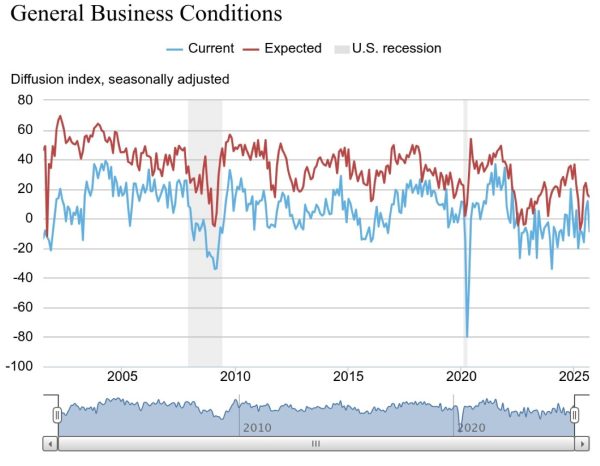
Looking at the totality of the data over the past year, there has been a gradual cooling in labor-market conditions to levels similar to those that prevailed in the years prior to the COVID-19 pandemic. You can see this pattern in the data on hiring and quits rates, vacancies, and survey measures of jobs’ and workers’ availability. And this cooling is consistent with the gradual slowing of wage growth that we have seen.
In addition, there has been a notable slowdown in payroll-employment growth in recent months, but this is likely the result of lower growth in both demand and supply, reflecting in large part the effects of reduced immigration on the labor force.
I draw three conclusions from the labor-market indicators. First, the labor market is currently in balance and not adding to inflationary pressures. Second, the gradual cooling in the labor market is consistent with the slowing in overall economic growth and my assessment of monetary policy being modestly restrictive. Third, as we are seeing today, when there are sharp changes in labor supply, it can be challenging to assess the rate of job growth consistent with that of labor supply. I therefore put greater weight on other indicators of the level of labor-market conditions in assessing the strength of the labor market.
The Tariff-Inflation Relationship
Now I will pivot to price stability. Over the past year, the core-services components of inflation have evolved broadly in line with gradual progress toward our longer-run 2 percent goal. Based on the 12-month percent change in the personal consumption expenditures (PCE) price index, headline inflation was 2.6 percent in July, and core inflation was 2.9 percent. These figures are modestly higher than comparable numbers from a year ago.
The big story here, of course, is tariffs. There are clear signs that tariff increases are affecting consumer prices and that trade diversion is taking place. One area where we can clearly see the initial effects of tariff increases is in core goods prices. Price increases for items that are exposed to higher tariffs have been well above what one would expect based on past trends and in the absence of tariffs.
The realized aggregate effects of tariffs so far have not been as large as expected earlier in the year, but it’s still early days, and it will take time for them to come to be fully realized. Combining enacted and announced tariffs, estimates of the average effective tariff rate range between 15 and 20 percent. By comparison, net tariff receipts as a share of imports rose from about 2.25 percent in the first three months of the year to around 10 percent in July. This is a sizable increase for sure, but well short of the increase implied by a straight read of the announced tariffs.
Fortunately, I am not seeing signs of amplification or second-round effects of tariffs on broader inflation trends. In particular, recent readings of the New York Fed’s Global Supply Chain Pressure Index are near historical averages. And longer-run inflation expectations have remained stable, while short-term and medium-term inflation expectations, after increasing modestly earlier in the year, have returned to their pre-pandemic ranges. This is critically important, because well-anchored inflation expectations are essential for sustained price stability.
All in all, I expect tariffs will boost overall prices by a total of between 1 percent and 1.5 percent, with these effects continuing through the first half of next year. That’s my current estimate, but there is a great deal of uncertainty about these effects. As we collect more data, we will get a better understanding of the magnitude and timing of tariffs’ effects. I’ll continue to monitor prices and broad movements in inflation over time to assess evolving conditions.
Monetary Policy
The Federal Reserve’s monetary policy stance has been modestly restrictive, as seen through the slowing of inflation and wage growth and the gradual cooling of the labor market. This policy stance is appropriate given that inflation has remained above our 2 percent target while the labor market has been generally consistent with maximum employment. With that backdrop, the Federal Open Market Committee (FOMC) decided to leave the target range for the federal funds rate unchanged at 4.25-4.5 percent at its meeting in late July.4
Looking ahead, if progress on our dual-mandate goals continues as in my baseline forecast, I anticipate it will become appropriate to move interest rates toward a more neutral stance over time. This expectation reflects a delicate balancing of risks to our mandate goals. On the one hand, we need to keep the labor market in balance to ensure that the effects of tariffs do not spill over into a longer-lasting broad increase in inflation. On the other hand, maintaining a stance of “too restrictive policy for too long” could increase risks to our maximum employment mandate.
My approach to these assessments is, as always, entirely focused on the totality of the data and what it tells us about the relative risks to achieving our maximum employment and price-stability goals.
Let me briefly comment on the Fed’s balance sheet. The FOMC continues to reduce its holdings of Treasury securities and agency debt and agency mortgage-backed securities, and that process is going smoothly. With take-up at the overnight reverse-repo facility now quite low, the level of reserves has already started to decline and is expected to decline more meaningfully going forward as our asset holdings continue to shrink and other liabilities rise. We continue to closely monitor a range of indicators related to the ampleness of reserves.
Economic Outlook
I will conclude with my economic outlook. Let me say at the outset that a number of outcomes are possible given all the uncertainty. But based on what the data tell us today, I expect the combined effects of trade and immigration policies and associated uncertainty to continue to weigh on growth. As a result, I expect GDP growth this year to be between 1.25 percent and 1.5 percent.
With this slowdown in growth, I expect the unemployment rate to gradually rise to about 4.5 percent next year. And I expect Personal Consumption Expenditures (PCE) inflation to come in between 3 percent and 3.25 percent this year, before declining to around 2.5 percent next year, and reaching 2 percent in 2027.
Conclusion
My penchant for “data dependency” has not altered. The outlook remains uncertain, and the data can shift in unexpected ways. In navigating these uncertain waters, I remain laser focused on supporting maximum employment and returning inflation to our 2 percent longer-run goal on a sustained basis.
John C. Williams is president and CEO of the Federal Reserve Bank of New York. This article is drawn (and edited for space) from a speech, as prepared for delivery, that he gave on Sept. 4 at the Economic Club of New York in New York City. In his speech, Williams gave the standard Fed disclaimer that the views he expressed were his alone and do not necessarily reflect those of the FOMC or others in the Federal Reserve System. The full, unedited text of the speech is available at: https://www.newyorkfed.org/newsevents/speeches/2025/wil250904
Stay up-to-date on the companies, people and issues that impact businesses in Syracuse, Central New York and beyond.