
Get our email updates
Stay up-to-date on the companies, people and issues that impact businesses in Syracuse, Central New York and beyond.
What's New
Upcoming Events
CNYBJ Job Board

Saab acquires firm to speed up its development of AI/ML
It’s an acquisition that Saab sees as “accelerating” the development and implementation of artificial intelligence (AI) / machine learning (ML) capabilities into the company’s portfolio. Saab on Sept. 7 announced that it has completed its acquisition of CrowdAI, which is based in San Francisco, California. The acquisition is part of Saab’s “technology leadership in this […]
Get Instant Access to This Article
Become a Central New York Business Journal subscriber and get immediate access to all of our subscriber-only content and much more.
- Critical Central New York business news and analysis updated daily.
- Immediate access to all subscriber-only content on our website.
- Get a year’s worth of the Print Edition of The Central New York Business Journal.
- Special Feature Publications such as the Book of Lists and Revitalize Greater Binghamton, Mohawk Valley, and Syracuse Magazines
Click here to purchase a paywall bypass link for this article.
It’s an acquisition that Saab sees as “accelerating” the development and implementation of artificial intelligence (AI) / machine learning (ML) capabilities into the company’s portfolio.
Saab on Sept. 7 announced that it has completed its acquisition of CrowdAI, which is based in San Francisco, California.
The acquisition is part of Saab’s “technology leadership in this new era for the defense industry,” the firm said in its announcement.
Sweden–based Saab is a defense and security company that designs, manufactures, and maintains advanced systems in aeronautics, weapons, command and control, sensors and underwater systems.
Saab acquired DeWitt–based Sensis Corp. in 2011 and split the corporation into two units — Saab Defense and Security on Enterprise Parkway and the Saab Sensis air-traffic management unit at 85 Collamer Crossing Pkwy.
Saab’s capabilities are “enhanced through proactive” acquisitions and strategic partnerships in “emerging and disruptive” technologies such as AI / ML, the company said.
The acquisition of CrowdAI — based in San Francisco, California — illustrates that “adaptive and forward-thinking approach, seamlessly integrating” AI / ML technologies within Saab’s portfolio.
Future operations will be carried out primarily in San Diego, California, Saab noted.
“CrowdAI has been a pioneer in computer vision applications to support [U.S. Department of Defense] and commercial customers,” Erik Smith, president and CEO of Saab in the U.S., said in a news release “This acquisition brings a new capability as well as deeply rooted relationships with new customers to Saab, underscoring our commitment to innovation and growth in the United States. Their talented workforce will help Saab enhance our existing portfolio with AI / ML capabilities to meet the emerging needs of our customers.”
About CrowdAI
CrowdAI says it is known for its “practical, user-friendly” no-code platform for mission-specific AI and its work leveraging dual-use computer vision for military applications. The company’s work with Fortune 500 corporations, the U.S. military, and the intelligence community has “pushed the boundaries” of AI-derived computer vision models “tailored to the unique needs” of customers, it contends.
“Joining Saab is a momentous step for us,” Devaki Raj, CEO and co-founder of CrowdAI, said in the release. “As part of Saab, the team we’ve built will open new doors for dual-use technological advancement that aligns with the DoD’s priorities. I’m eager to contribute to Saab’s important work across industries and markets.”
Devaki will join Saab, Inc.’s newly established strategy office, based in San Diego, as the chief digital and AI officer, Saab said.

Muñoz is Syracuse’s infrastructure public information officer
SYRACUSE — Sol Muñoz is the new infrastructure public information officer in the City of Syracuse Communications Office. In this role, she is responsible for a wide range of public information and communication activities supporting the Syracuse Departments of Public Works, Engineering, Water, and Cityline — the city’s online, social media and telephone constituent service
Get Instant Access to This Article
Become a Central New York Business Journal subscriber and get immediate access to all of our subscriber-only content and much more.
- Critical Central New York business news and analysis updated daily.
- Immediate access to all subscriber-only content on our website.
- Get a year’s worth of the Print Edition of The Central New York Business Journal.
- Special Feature Publications such as the Book of Lists and Revitalize Greater Binghamton, Mohawk Valley, and Syracuse Magazines
Click here to purchase a paywall bypass link for this article.
SYRACUSE — Sol Muñoz is the new infrastructure public information officer in the City of Syracuse Communications Office.
In this role, she is responsible for a wide range of public information and communication activities supporting the Syracuse Departments of Public Works, Engineering, Water, and Cityline — the city’s online, social media and telephone constituent service system, according to a Sept. 1 news release from Syracuse Mayor Ben Walsh’s office.
Muñoz will produce communications and content for web, print, and social media, relating to activities and public projects affecting roads, sewers, pedestrian traffic, and public spaces. She will develop and distribute public information to inform and engage constituents, media, and stakeholders in ongoing and upcoming infrastructure projects and initiatives, such as road reconstruction, the new trash and recycling carts rollout, sidewalk repairs, snow removal and safety, and Interstate 81 construction.
Muñoz most recently worked as a community and content manager for Soul Excellence Publishing. In that position, she worked on building and managing online websites, events, marketing platforms, and community outreach. She also previously worked as a marketing intern for the WISE Women’s Business Center, supporting events and programming while creating content and graphics for social media and collateral materials. In both positions, Muñoz provided operational support to organizational projects and client-outreach initiatives.
Muñoz is currently studying to finish her master’s degree in entrepreneurship and emerging enterprises at the Syracuse University Whitman School of Management. She received a bachelor’s degree in music, in combination with an outside field in business management and a minor in Latin American studies, from the Whalen School of Music at Ithaca College. She also received an international baccalaureate bilingual diploma in English and Spanish from Washington International School in Washington D.C.

HISTORY FROM OHA: The history of the Powelson Institute/ Bryant & Stratton in Syracuse
That statement appeared in large, bold letters at the top of page 7 in the Syracuse Herald newspaper on May 20, 1923. The brash and daring proposal intended to entice adults to enroll in the Syracuse Extension Institute of Accountancy, Inc., a classroom and correspondence school that would teach men and women the principles of
Get Instant Access to This Article
Become a Central New York Business Journal subscriber and get immediate access to all of our subscriber-only content and much more.
- Critical Central New York business news and analysis updated daily.
- Immediate access to all subscriber-only content on our website.
- Get a year’s worth of the Print Edition of The Central New York Business Journal.
- Special Feature Publications such as the Book of Lists and Revitalize Greater Binghamton, Mohawk Valley, and Syracuse Magazines
Click here to purchase a paywall bypass link for this article.
That statement appeared in large, bold letters at the top of page 7 in the Syracuse Herald newspaper on May 20, 1923. The brash and daring proposal intended to entice adults to enroll in the Syracuse Extension Institute of Accountancy, Inc., a classroom and correspondence school that would teach men and women the principles of accounting all across the U.S. Syracuse Extension Institute of Accountancy, Inc., the brainchild of John Abram Powelson in 1919, would become the Powelson Institute of Accountancy, and the Powelson Business Institute, before being sold to Bryant & Stratton College in 1976.
John A. Powelson, opened the Syracuse Extension Institute of Accountancy, Inc. at 134 West Onondaga St. in Syracuse. Prior to opening the accounting institute, Powelson, a CPA, worked for six years at the Syracuse accounting firm, Haskins and Sells.
By 1923, the Syracuse Extension Institute of Accountancy had hired George Stafford as its president, with John Powelson becoming the institute’s secretary and educational director. Stafford had been associated with the Alexander Hamilton Institute in New York City and the LaSalle Extension University in Chicago. Administrators took advantage of the latest improvements in communication services such as radio and motion pictures, as well as the postal service, to promote the institute’s concept of remote adult learning. “Interesting, compact, simplified, and thorough business education is our object,” Stafford asserted.
By 1924, more than 4,500 students across the U.S. were enrolled in the correspondence school. The institute had offices in major cities from coast to coast — Boston, New York, Washington, D.C., Baltimore, Philadelphia, Atlanta, Chicago, and San Francisco — with plans to open additional offices in the near future. In 1925, the school was educating a long-distance student in Buenos Aires, Argentina. Each student used accounting principles textbooks written by John Powelson that were endorsed by the American Society of Certified Public Accountants. Powelson received many favorable comments on his textbooks, but even more gratifying to Powelson were the testimonials of his former students who expressed their sincere appreciation of Powelson as an instructor and for his assistance with securing accounting positions for his former students.
John A. Powelson left the Syracuse Extension Institute of Accountancy to form his own accounting school, the Powelson Institute of Accountancy, at 333 S. Warren St. in Syracuse, in August 1926, while still operating his own accounting firm. Powelson’s wife, Mary, became the institute’s secretary and treasurer.
On Nov. 5, 1929, Arthur V. Cooper, the principal of the Powelson Institute of Accountancy, received a patent for an educational apparatus that was adapted to a typewriter. Cooper’s device helped typing students learn to become touch typists via a mnemonic method. Cooper’s gadget created “better typists in a quicker way” and led to the Powelson Institute to establish a secretarial department with Cooper teaching typing and shorthand.
With the addition of new subjects, the school then opened new quarters at 604 S. Salina St. in Syracuse in early 1933. By this time, the Powelson Institute also had established men’s and women’s basketball teams that played area high schools in the Onondaga County Basketball League. Through the years, the Powelson Panthers men’s team played local high school and college freshman teams at Eastwood High School and the Onondaga County War Memorial until at least the early 1960s. Powelson played against the Technical College at Alfred in January 1963.
As the Powelson Institute’s star was rising, the Syracuse Extension Institute of Accountancy’s star was dimming. By 1932, this institute was closed and no longer listed in the Syracuse City Directory. A notice in the classified section of the Syracuse Herald newspaper on Oct. 6, 1933 revealed that the school had a judgment of foreclosure with the Albany Savings Bank as the plaintiff. The property was to be sold on Oct. 17, 1933.
That was also a difficult year for the Powelson Institute with John Powelson’s death on Aug. 8, 1933 from pneumonia at age 49. His brief obituary in the Syracuse Herald stated that the Powelson Institute of Accountancy, Inc. under his supervision had quickly advanced to a high position in the business world within the seven years since it had opened. The obituary also declared, “By those who knew him, Mr. Powelson will be remembered for his courtesy, integrity and sincerity, and his devotion to the interests of those who retained his services.” The success of the institute since his death proved to be his memorial.
In 1934, school administrators dealt with employment issues created by the Great Depression. When considering the dearth of jobs during that period, and the need to educate more well-rounded students, they decided to make secretarial training obligatory for both men and women. The decision paid off in subsequent years as companies requested the more versatile Powleson Institute graduates.
During World War II, local men and women graduating from the Powelson Institute obtained jobs at area businesses that produced war products, including Carrier Corporation, Crane Company, Crouse-Hinds, Prosperity Laundry Company, Smith-Corona Typewriter Company, and General Electric. Others worked for the military as civilian employees or joined the military to fight the Axis Powers. Elizabeth J. Stephens, of Cortland, a graduate of the Powelson Institute, joined the Women’s Army Corps in April 1944. She received her basic training at Fort Ogelthorpe in Georgia and attended technical school to become a business machine operator. During the war, Miss Stephens attained the rank of technician fourth grade (T/4) and served at General Douglas MacArthur’s headquarters in Tokyo, Japan in 1946.
By the 1950s, the Powelson Institute was registered with the New York State Department of Education and was training veterans under the G.I. Bill of Rights. It expanded its curriculum to include medical, executive, and collegiate secretarial courses, as well as general business and business-administration courses. Co-educational students could take both day and night classes.
Three Syracuse businessmen, Robert Dermody, John Burke, and Daniel Brown, of the certified public accounting firm Dermody, Burke, & Brown, purchased the Powelson Institute from Clement LeLash of New York City, in May 1958. The school was located on the second floor of the Loew Building at 108 W. Jefferson St. in Syracuse (AKA Loew’s State Theater Building). Brown was elected president and director of the Powelson Institute, while Dermody became VP, and Burke also was named VP, as well as treasurer.
The 1960s was a consequential decade for the Powelson Institute. It moved from the Loew Building to 400 Montgomery St. in downtown Syracuse. This building was originally built by Dr. Ely Van de Warker as an apartment complex known as The Ely; the building’s last use was as the Syracuse University Law College. The three Powelson administrators completely renovated the five-story, brick building to create a more accommodating business school.
The Powelson Institute razed its building at 400 Montgomery St. in 1967 and built a new $1.5 million six-story, all-electric edifice on the same site, known as the Powelson Building. During demolition and new building construction, Powelson Institute students attended classes on the mezzanine at Hotel Onondaga. During Thanksgiving break in November 1968, Powelson students moved chairs into their new school. The first classes were held in the new Powelson Building after Thanksgiving in 1968.
In 1976, Bryant & Stratton College purchased Powelson Business Institute, establishing its presence in Syracuse as Bryant & Stratton Business Institute. William H. Prentice, Bryant & Stratton’s chairman, said the college planned to expand Powelson’s curriculum, and further said at the time that the merger, “means a broader range of educational opportunities will now be open to Powelson students.” Byrant & Stratton kept the name of Powelson Business Institute and kept the faculty intact.
Almost a year later, Powelson appointed Mary Ellen Avery as its first woman director. Avery had been the dean of Powelson’s Secretarial Services Department for seven years, and had been an instructor since 1963. Along with her professional duties at the Powelson Institute, Avery was an active member of the Metropolitan Business and Professional Women of Syracuse.
Powelson Institute occupied a newly renovated first floor of the Powelson Building in 1978 that was previously occupied by another tenant. The new facility on the first floor included a shorthand laboratory and a fashion-merchandise studio. Using a four-quarter schedule, students could then graduate earlier and receive associate degrees in accounting, secretarial science, business administration, retail management, computer programming, or fashion merchandising.
The New York State Board of Regents authorized the Powelson Institute to offer programs to train students for legal secretarial assistant and administrative systems secretarial positions in 1980. Later that year, local high-school teachers were invited to participate in business workshops that presented the latest in post-secondary business education. Along with the workshops, Powelson Institute fashion merchandising students offered a fashion show during lunch to showcase the latest fashions of 1980.
Powelson Institute physically expanded again in 1981 when the institute purchased the Powelson Building from Dermody, Burke, & Brown. The business school added 4,000 square feet of classroom and administration space on the building’s fourth floor. The additional space occupied by the school expanded its footprint to five of the building’s six floors. The remodeling featured a renovated student lounge, improvements to the student resource center, additional administrative offices, a word-processing instruction center, and a medical laboratory for Powelson’s new medical assistant secretarial program. The expansion was necessary to provide for an increasing student enrollment that doubled between 1976 and 1981 and increased by 20 percent in 1980, alone. In 1985, Powelson’s graduating class numbered 450 students.
Between 1989 and 1990, Bryant & Stratton Business Institute completely absorbed Powelson Business Institute and no longer used the Powelson name.
Bryant & Stratton Business Institute moved into a newly renovated building at 953 James St. in Syracuse in September 1993. The $1.6 million renovation included redesigning the interior, adding housing suites for 160 students, and installing new equipment. Bryant & Stratton then vacated the Powelson Building at 400 Montgomery St. in downtown Syracuse. The Powelson Building remained vacant for many years until the City of Syracuse razed it in May 2004.
After having a second location at the Penn-Can Mall in Cicero since 1982, Bryant & Stratton Business Institute decided to close that campus in 1996 due to the mall’s dwindling popularity. Only two tenants — Bryant & Stratton Business Institute and Albany Savings Bank — remained in September 1996. At the same time, Byrant & Stratton began to prepare another site in Liverpool for a new location. School officials chose the site because of its close proximity to area stores and businesses where students could get practical experience while taking classes. The new campus would focus on providing courses in paralegal studies and electronic technology. The James Street campus would specialize in allied-health programs.
The following year, Bryant & Stratton launched an athletic program that would include men’s and women’s soccer teams. Two years later, the Bryant & Stratton Bobcats boasted a men’s team’s record of 13-2 and a women’s team’s record of 12-1-1. Today, along with the soccer teams, Bryant & Stratton offers students an opportunity to play basketball and compete in track & field events.
Bryant & Stratton Business Institute received accreditation from the Middle States Association of Colleges and Schools in 2002 for the quality and integrity of its diverse business and professional programs. At the time, Bryant & Stratton offered its programs to local students, along with remote learning on fourteen campuses in four states. “The Middle States Commission’s accreditation places Bryant & Stratton among an outstanding group of colleges and universities,” said John J. Staschak, Bryant & Stratton’s president and CEO. “The commission’s accreditation makes a clear statement to students, the educational community, the business community and other employers that Bryant & Stratton is accomplishing its mission to provide high-quality educational programs,” continued Staschak in October 2002.
In 2003, Bryant & Stratton Business Institute celebrated its 10th anniversary at its James Street campus. The school had assisted with revitalizing an economically faltering area with its success. In 2003, Bryant & Stratton had 500 students and offered eight degree programs.
That same year, Bryant & Stratton Business Institute decided to change its local name back to Bryant & Stratton College, its original name when established in 1854. The name change came after the school was accredited by the Middle States Association of Colleges and Schools. In 2004, Bryant & Stratton College celebrated its 150th anniversary.
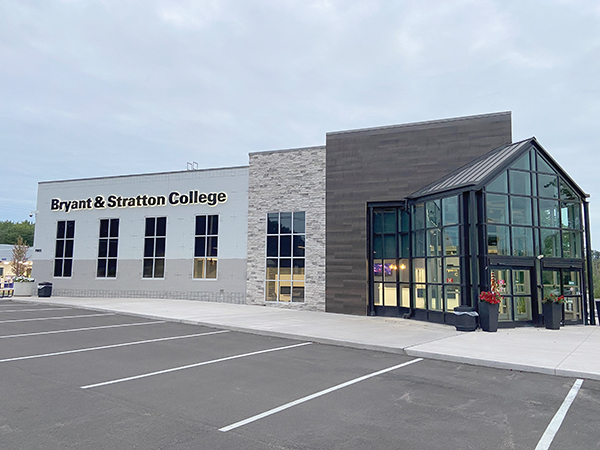
Bryant & Stratton College expanded again in 2007 by enlarging its Liverpool campus. The $1.9 million expansion allowed for a gradual student population growth for at least the next five years. The project comprised remodeling and adding 9,500 square feet to the already 28,000-square-foot building. The expanded space established eight new classrooms, two computer labs, a student lounge, and a library.
As the 21st century entered its second decade, Bryant & Stratton College offered a wider range of degrees for its students: criminal justice, graphic design, human resources specialist, medical administrative assistant, networking technology, restaurant and hotel management, travel and tourism management, and security technology. By the spring semester in 2012, Bryant & Stratton was offering a new bachelor of science degree in health services administration.
In 2023, Bryant & Stratton College still maintains two Onondaga County campuses in Syracuse and Liverpool (Route 57 in the town of Clay) and offers two-year and four-year degrees in a variety of business, health care, human, legal, and technology programs. Along with the two Onondaga County campuses, Bryant & Stratton College offers degree programs in Buffalo, Rochester, and Albany, New York, as well as in Ohio, Virginia, and Wisconsin. The college also provides career services and continuing education.
From the humble beginnings of the Syracuse Extension Institute of Accountancy in 1919, to the expanded Powelson Business Institute, and then the Bryant & Stratton Business Institute in the late 20th century, and now a varied curriculum at an accredited college, the history of Powelson Institute and Bryant & Stratton College remains intertwined. And yet, the college looks forward to providing a diverse student body with a quality education and career preparation well into the future.
Thomas Hunter is curator of collections at the Onondaga Historical Association (OHA) (www.cnyhistory.org), located at 321 Montgomery St. in Syracuse.

MVCC starts microcredential program for direct-support professionals
UTICA, N.Y. — Mohawk Valley Community College (MVCC) has launched a new direct support microcredential program, developed in partnership with SUNY and the New York State Office for People with Developmental Disabilities (OPWDD), to provide training that leads to national certification in the field of developmental disabilities. The program recognizes the skills and competencies required
Get Instant Access to This Article
Become a Central New York Business Journal subscriber and get immediate access to all of our subscriber-only content and much more.
- Critical Central New York business news and analysis updated daily.
- Immediate access to all subscriber-only content on our website.
- Get a year’s worth of the Print Edition of The Central New York Business Journal.
- Special Feature Publications such as the Book of Lists and Revitalize Greater Binghamton, Mohawk Valley, and Syracuse Magazines
Click here to purchase a paywall bypass link for this article.
UTICA, N.Y. — Mohawk Valley Community College (MVCC) has launched a new direct support microcredential program, developed in partnership with SUNY and the New York State Office for People with Developmental Disabilities (OPWDD), to provide training that leads to national certification in the field of developmental disabilities.
The program recognizes the skills and competencies required of direct-support professionals. Similar classes are offered at participating SUNY colleges throughout the state.
“There is a great need for direct-support professionals and education is a powerful tool to help people succeed in joining this honorable profession to care for New York’s families,” SUNY Chancellor John B. King, Jr. said in a news release.
Supported through $5 million in federal American Rescue Plan Act funding, the program aims to assist existing and new direct-support staff in earning college credits that meet requirements for certification from the National Alliance for Direct Support Professionals. Students will be able to secure certification and college credit toward a certificate, associate degree, or bachelor’s degree. The grant program covers tuition, certification, fees, books, and student support. Students can earn a one-time $750 stipend.
“Direct support professionals (DSPs) deserve the esteem that goes hand-in-hand with earning college certifications and credits as well as the sense of empowerment that comes from learning new skills to apply on the job,” OPWDD Commissioner Kerri Neifeld said. “OPWDD is excited for this partnership with SUNY and the National Alliance for Direct Support Professionals to encourage more people to join us in this rewarding field of supporting people with developmental disabilities to live the lives of their choosing.”
Each participating SUNY campus works with an OPWDD-operated or affiliated provider partner to help upskill incumbent workers or provide internships for those new to the field. Enrolled students not yet working in the developmental-disabilities field will be offered work-based learning opportunities with OPWDD or certified service providers. The Regional Centers for Workforce Transformation will also offer training, coaching, and mentoring supports to providers participating in the program.
“In the face of a growing workforce crisis impacting the field of direct-support professionals, this partnership marks a significant stride forward,” MVCC President Randall VanWagoner said. “We are proud to join forces with Upstate Caring Partners, SUNY, and OPWDD to create an innovative microcredential program.”
This fall, SUNY will offer nearly 600 microcredentials at 51 of its 64 campuses. Microcredentials are smaller academic- and skill-focused credentials that can be completed in months instead of years. They provide learners with immediate workforce-ready skills, knowledge, and experience along with a pathway to additional credentials, certificates, or degrees.
“Education leads to opportunities for advancement in this field and is essential to attracting and retaining staff who are committed to the complex and compassionate work that DSPs perform each and every day,” Upstate Caring Partners Executive Director Geno DeCondo said. “We are grateful to be a part of this important collaboration.”
MVCC, with campuses in Utica and Rome, offers 90 degree and certificate options to 6,000 full-time and part-time students. It also serves an additional 6,000 people through its corporate and community-education programs.
Upstate Caring Partners provides special-education, residential, and community programs and services.
Whitman School launches new local-leadership initiative
SYRACUSE — A new local-leadership initiative that Syracuse University’s Martin J. Whitman School of Management announced back in June is now underway. The school held a formal launch event Sept. 8, the Whitman School tells CNYBJ in an email. The program accepted 10 students after more than 100 applied, Whitman notes. The program seeks to
Get Instant Access to This Article
Become a Central New York Business Journal subscriber and get immediate access to all of our subscriber-only content and much more.
- Critical Central New York business news and analysis updated daily.
- Immediate access to all subscriber-only content on our website.
- Get a year’s worth of the Print Edition of The Central New York Business Journal.
- Special Feature Publications such as the Book of Lists and Revitalize Greater Binghamton, Mohawk Valley, and Syracuse Magazines
Click here to purchase a paywall bypass link for this article.
SYRACUSE — A new local-leadership initiative that Syracuse University’s Martin J. Whitman School of Management announced back in June is now underway.
The school held a formal launch event Sept. 8, the Whitman School tells CNYBJ in an email. The program accepted 10 students after more than 100 applied, Whitman notes.
The program seeks to “support professional connections and career building” for students to remain in Central New York beyond graduation, Syracuse University said in a news release.
This new initiative is made possible by David Panasci, a 1980 graduate of Syracuse University who the school describes as a “Whitman supporter.” Panasci spoke at the launch event, the Whitman School says.
“Syracuse has a rich history of business innovation and success. The emergence of new opportunities locally, such as the arrival of Micron [Technology, Inc.], increasingly makes Syracuse an outstanding place to live and work,” Alexander McKelvie, interim dean of Whitman School, said in the release. “Our hope is that this program will inform students about what they can accomplish here after graduation, inspire students about a thriving life here in this community and connect them to local opportunities so that they can hit the ground running once they graduate. As Whitman prepares students to be more engaged citizens, being able to cultivate and connect our local talent in Central New York is something we value highly. We are very grateful to David Panasci for helping the Whitman School make this possible.”
Students will follow a program offered in collaboration with Leadership Greater Syracuse, an organization that has a mission to “inspire current and future leaders to make a difference” in the Syracuse community, Syracuse University said.
The program will include topics related to regional leadership; economic development; discovering and impacting local businesses; how to lead and serve; and envisioning the future of Syracuse. The program will also pair students with local business leaders who will act as personal mentors, and the students will complete a community project.
“In recent years, I have met a number of very impressive students via the annual business plan competition at the Whitman School. The level of determination, entrepreneurial spirit and brainpower that I have witnessed has been nothing short of inspirational. We have been fortunate to have a number of these individuals launch their careers here in the Syracuse area,” Panasci said in the school’s June 21 announcement. “It is my expectation that this initiative will not only give participants the chance to learn about leadership and the local community but will also help them recognize that Central New York can provide solid career opportunities along with an exceptional quality of life. I believe those who do stay and take leadership roles will have a profound impact on the future of the region.”

New LGS executive director starts in her position
DeWITT — The new executive director of Leadership Greater Syracuse (LGS) has begun leading the organization. LGS, a nonprofit annually offering a yearlong civic-leadership training program, announced that Michele Diecuch of Syracuse has started work in the leadership role. She replaces Pam Brunet, who announced her resignation as executive director in June, following 11 years
Get Instant Access to This Article
Become a Central New York Business Journal subscriber and get immediate access to all of our subscriber-only content and much more.
- Critical Central New York business news and analysis updated daily.
- Immediate access to all subscriber-only content on our website.
- Get a year’s worth of the Print Edition of The Central New York Business Journal.
- Special Feature Publications such as the Book of Lists and Revitalize Greater Binghamton, Mohawk Valley, and Syracuse Magazines
Click here to purchase a paywall bypass link for this article.
DeWITT — The new executive director of Leadership Greater Syracuse (LGS) has begun leading the organization.
LGS, a nonprofit annually offering a yearlong civic-leadership training program, announced that Michele Diecuch of Syracuse has started work in the leadership role.
She replaces Pam Brunet, who announced her resignation as executive director in June, following 11 years in the position, LGS said in its announcement.
Diecuch (pronounced Dee-chick) previously worked as the senior director of programs at ProLiteracy Worldwide, where she spent 25 years serving in a series of progressively higher leadership roles. She had oversight of membership programs, fundraising, marketing and promotions, community outreach, and people-management functions, LGS said.
“Michele has deep experience in, and passion for, the nonprofit sector, with a strong knowledge of the sector’s needs, challenges, and opportunities; and is a respected national thought leader. Further, she exemplifies LGS’s values,” Amy Lawler, president of the LGS board of directors, said in the announcement.
Diecuch has a “proven ability to build strong relationships” with peers, donors and government leaders. In her time with ProLiteracy, she directed U.S. domestic and international program operations which supported 1,100 adult-literacy programs across the U.S. and 21 partners across 35 developing countries.
She also played an integral role in establishing the organization’s strategic direction and administered budgets totaling $2 million.
Diecuch has worked directly with grantors and corporate funders and has experience executing events and programs. She also serves as a current board member of LiteracyCNY, a long-standing nonprofit, adult-literacy organization in Syracuse.
She has also served as the VP of National Coalition for Literacy, the leading adult education advocacy organization in the U.S.
“As a lifelong and deep-rooted Syracusan, I am looking forward to this new opportunity to focus my efforts in my hometown” Diecuch said. “LGS is an amazing organization that does life-changing work. I feel honored to be able to impact folks in the community by building on the strong foundation and mission of LGS.”
About LGS
LGS says its mission is to “inspire current and future leaders to make a difference in the community where we live and work.”
In its 33 years, more than 1,400 citizens have participated in the flagship program where 85 percent remain living and giving back in Central New York. LGS also offers the CNY Political Leadership Institute, a nonpartisan political campaign training program. Additionally, LGS works in partnership with the Gifford Foundation and the CNY Community Foundation to offer Nourishing Tomorrow’s Leaders, a program aimed to increase the inclusivity on boards in CNY.
Leadership Greater Syracuse was founded by CenterState CEO, Onondaga County, the City of Syracuse, and Onondaga Community College.

Syracuse ARPA funding recipients announced
SYRACUSE — Projects including Moyer Carriage Lofts, redevelopment of a building now known as City Center, and the Gustav Stickley House are among those awarded City of Syracuse ARPA funding. Syracuse Mayor Ben Walsh on Sept. 8 announced the recipients of grants from the American Rescue Plan Act (ARPA) Distressed Property Fund. It’s a program
Get Instant Access to This Article
Become a Central New York Business Journal subscriber and get immediate access to all of our subscriber-only content and much more.
- Critical Central New York business news and analysis updated daily.
- Immediate access to all subscriber-only content on our website.
- Get a year’s worth of the Print Edition of The Central New York Business Journal.
- Special Feature Publications such as the Book of Lists and Revitalize Greater Binghamton, Mohawk Valley, and Syracuse Magazines
Click here to purchase a paywall bypass link for this article.
SYRACUSE — Projects including Moyer Carriage Lofts, redevelopment of a building now known as City Center, and the Gustav Stickley House are among those awarded City of Syracuse ARPA funding.
Syracuse Mayor Ben Walsh on Sept. 8 announced the recipients of grants from the American Rescue Plan Act (ARPA) Distressed Property Fund.
It’s a program created by the city’s department of neighborhood and business development (NBD) and authorized by the Syracuse Common Council.
The application-based grant program is designed to spur redevelopment and improvement of vacant, distressed commercial, mixed-use, and historic properties in the City of Syracuse, Walsh’s office said.
The city allocated a total of $1 million in ARPA funding to eight different properties and structures that are vacant and in need of rehabilitation.
“The recipients of the program represent projects across the city that have faced challenges since the beginning of COVID-19,” the Syracuse mayor said. “Now that the funds are allocated, we are one step closer to returning these properties to productive use and generating new investment within Syracuse neighborhoods.”
Projects awarded funding
The projects awarded funding from the Distressed Property Fund include:
• Hip Hop Center for Youth Entrepreneurship at 215 Tully St. was awarded a grant of $250,000. The center is being developed by the Good Life Foundation and will serve as a space that inspires the city’s youth through food, art and music.
• The recipients also include the Gustav Stickley House at 438 Columbus Ave., which was also awarded $250,000. The historic museum and former home of Gustav Stickley, known as the ‘father of the American arts & crafts movement’ is in its second phase of restoration, and will include spaces for educational programming, exhibits, events and rooms for overnight guests.
• In addition, the Moyer Carriage Lofts project at 1714 North Salina St. and 201 Wolf St. will use grant funding of $125,000. The former Moyer Carriage and Car Factory is being redeveloped into an integrated mixed-use building with quality affordable housing and ground floor commercial space.
• The city also awarded the City Center project at 400 South Salina St. funding in the amount of $125,000. Currently under renovation, the former Sibley’s department store now houses the Redhouse Arts Center and features spacious offices and ground level retail spaces with an attached parking garage.
• The development effort at Ra-Menes Food and Gas at 900 South Ave. will use a $100,000 grant. It includes the remediation and complete renovation of a vacant former service station to support a new full-service fuel station on the South Avenue business corridor.
• The Castle project at 2110 South Salina St. will use $50,000 for the renovation and restoration of the former South Presbyterian Church. It will become a multi-use facility that will host a variety of community centered activities around professional development, awareness building and social engagement to help rejuvenate the Southside neighborhood.
• The city also awarded $50,000 to the Syracuse Bread Factory at 200 Maple St., which is one of only four Ward Wellington designed commercial buildings still in existence. The project is a complete remediation, redevelopment and activation of a historically significant building on Syracuse’s Near Eastside.
• The recipients also included the property at 757 West Onondaga St. The $50,000 grant will renovate the building into a mixed-use property with apartments and commercial retail uses on the ground floor.

VETCON 2023 conference set for late November in Albany
ALBANY, N.Y. — The annual conference dedicated to the education and professional growth of veteran business owners and entrepreneurs is set for late November in the state capital. VETCON 2023 is scheduled for Nov. 28-29 at the Crowne Plaza Desmond Hotel in Albany, according to an Aug. 4 announcement from Tully Rinckey PLLC, Tully Rinckey
Get Instant Access to This Article
Become a Central New York Business Journal subscriber and get immediate access to all of our subscriber-only content and much more.
- Critical Central New York business news and analysis updated daily.
- Immediate access to all subscriber-only content on our website.
- Get a year’s worth of the Print Edition of The Central New York Business Journal.
- Special Feature Publications such as the Book of Lists and Revitalize Greater Binghamton, Mohawk Valley, and Syracuse Magazines
Click here to purchase a paywall bypass link for this article.
ALBANY, N.Y. — The annual conference dedicated to the education and professional growth of veteran business owners and entrepreneurs is set for late November in the state capital.
VETCON 2023 is scheduled for Nov. 28-29 at the Crowne Plaza Desmond Hotel in Albany, according to an Aug. 4 announcement from Tully Rinckey PLLC, Tully Rinckey Kuhn PLLC, and the Tully Rinckey Foundation.
Launched in 2016, VETCON provides seminars, workshops, and networking opportunities. The activities include a forum for New York State service-disabled veteran-owned businesses (SDVOBs) to connect with state agencies and authorities and develop business opportunities through state contracts.
Since 2016, hundreds of SDVOBs have attended VETCON, per the announcement. Among them is Clay–based Industry Standard USA, founded by Chris Dambach, a U.S. Marine Corps combat veteran who served in Iraq.
“I can vouch for the knowledge and opportunities that come from attending VETCON,” said Dambach, who is also a VETCON Alliance board member. “Veterans and business owners learn so much in the VETCON educational sessions, and the structure of the conference allows me to ask questions to like-minded individuals. One year, I had an employee issue that I wasn’t sure how to address. I ended up speaking to another veteran business owner over lunch, and he explained how he dealt with the same issue. I ended up using the knowledge he passed along, and it worked out very well.”
This year will be Dambach’s fifth VETCON conference. His company is a certified SDVOB & DBE (disadvantaged business enterprise) that focuses on general construction and excavation services.
“I went into VETCON for education. Little did I know, I’d be walking away with so much more,” Dambach said. “After chatting with some teams at VETCON regarding the New York State Thruway projects, we ended up winning three of the rest stop projects, which ended up being a multimillion-dollar contract.”
Dambach said he’s had “so much success” from VETCON that he feels it’s his time to give back. He said the next step could be to become a sponsor of future conferences.
 “The brave men and women who have served this country deserve to be acknowledged,” Anthony Kuhn, chairman of the VETCON Alliance and founding partner of SDVOB Tully Rinckey Kuhn PLLC, said. “VETCON helps veterans strengthen the ways they utilize the skills gained through military experience to help them grow professionally. It’s always incredible to hear success stories, like those from Chris at Industry Standard. Along with our partners at New York State OGS, we will continue to do what we can to provide these valuable resources for our veteran business owner community.”
This year’s conference will again include two awards programs. The Veterans in Business Awards highlight multiple veteran-owned businesses that have exhibited exemplary achievements in areas of patriotism, leadership, community service, and business activity.
The VETCON Business Plan Competition offers aspiring or recently formed veteran businesses a chance to pitch their business plans to a panel of judge and compete for cash prizes.
For tickets and additional information about attending or sponsoring VETCON 2023, the Business Plan Competition, or the Veterans in Business Awards, visit www.vetconny.com.

ANCA annual meeting focused on building belonging
LOWVILLE — The Adirondack North Country Association (ANCA) on Sept. 8 held its 2023 annual meeting, titled “Building Belonging in the New Economy.” The afternoon event focused on “belonging, what it is, what it looks and feels like, and how creating welcoming spaces directly benefits businesses, communities and the people they serve.” ANCA had invited
Get Instant Access to This Article
Become a Central New York Business Journal subscriber and get immediate access to all of our subscriber-only content and much more.
- Critical Central New York business news and analysis updated daily.
- Immediate access to all subscriber-only content on our website.
- Get a year’s worth of the Print Edition of The Central New York Business Journal.
- Special Feature Publications such as the Book of Lists and Revitalize Greater Binghamton, Mohawk Valley, and Syracuse Magazines
Click here to purchase a paywall bypass link for this article.
LOWVILLE — The Adirondack North Country Association (ANCA) on Sept. 8 held its 2023 annual meeting, titled “Building Belonging in the New Economy.”
The afternoon event focused on “belonging, what it is, what it looks and feels like, and how creating welcoming spaces directly benefits businesses, communities and the people they serve.”
ANCA had invited community members; small-business owners and employees; nonprofit professionals; and others interested in “building welcoming and belonging” in New York’s North Country to attend.
ANCA held the meeting and reception at the Tug Hill Estate in Lowville in Lewis County.
ANCA describes itself as an independent, nonprofit corporation with a “transformational approach to building prosperity” across northern New York. Using “innovative strategies” for food systems, clean energy, small businesses, and equity and inclusion, ANCA says it “delivers targeted interventions that create and sustain wealth and value” in local communities.
About the gathering
The meeting sought to build on the economic-development organization’s vision — “a New Economy that Works for All” — and recent collaborative efforts to increase awareness and skills related to diversity, equity, inclusion, and belonging (DEIB) in North Country businesses and communities.
“Over the last several years, our board and staff have been mindful and intentional about centering diversity, equity, inclusion and belonging in our work,” Elizabeth Cooper, ANCA executive director, said. “Building belonging is integral to ANCA’s New Economy approach which focuses on growing an economy that provides equitable access and opportunity for people of diverse backgrounds and experiences.”
Tiffany Rea-Fisher, director of ANCA’s Adirondack Diversity Initiative, facilitated a community conversation that included a lineup of speakers with different perspectives on belonging.
Speakers shared personal and professional stories before taking questions from audience members and opening a discussion about what belonging means to them.
The speakers included Scott Gilbert, owner of Tug Hill Artisan Roasters; Tamara Jolly, a BIPOC (Black, Indigenous, People of Color) educator who attended SUNY ESF’s Ranger School; and Emily Russell of North Country Public Radio, ANCA told CNYBJ in a Sept. 11 email.
ANCA wanted all attendees to leave with “actionable ideas to incorporate principles of belonging” in their businesses, organizations and communities.
“Belonging goes hand in hand with safety, and exploring the multitude of ways that people can feel unsafe in our communities is a worthwhile venture,” Rea-Fisher said in a release. “We who call this region home have so much to offer, and it is important that we are generous with those assets and not work from a place of scarcity or fear.”
ANCA leadership, including directors of the organization’s small business, food systems, clean energy, and Adirondack Diversity Initiative programs, provided updates for meeting attendees.
The annual meeting’s focus on belonging follows a series of programs delivered to small businesses, organizations, and individuals on workplace communication and DEIB practices. Through virtual and in-person events, ANCA says it aims to demonstrate how “welcoming and belonging can help businesses retain existing and gain new clientele, improve their bottom line and build resilience for the future.”
The annual meeting location, Tug Hill Estate, is a business, farm winery, distillery and event venue that transitioned to new owners Jonathan and Taren Beller in 2021. It happened with support from ANCA’s Center for Businesses in Transition (CBIT) and local assistance from CBIT partner Naturally Lewis, ANCA noted.

Clarkson joins cooperative to research electric, connected and autonomous vehicles
POTSDAM — Clarkson University announced it is part of a new nationwide collaboration focused on developing new sustainable vehicle technologies. The collaboration is part of the Center for Electric, Connected and Autonomous Technologies for Mobility (eCAT), Clarkson said in a Sept. 5 news release. The eCAT Center is an industry-university cooperative research center (IUCRC) sponsored
Get Instant Access to This Article
Become a Central New York Business Journal subscriber and get immediate access to all of our subscriber-only content and much more.
- Critical Central New York business news and analysis updated daily.
- Immediate access to all subscriber-only content on our website.
- Get a year’s worth of the Print Edition of The Central New York Business Journal.
- Special Feature Publications such as the Book of Lists and Revitalize Greater Binghamton, Mohawk Valley, and Syracuse Magazines
Click here to purchase a paywall bypass link for this article.
POTSDAM — Clarkson University announced it is part of a new nationwide collaboration focused on developing new sustainable vehicle technologies.
The collaboration is part of the Center for Electric, Connected and Autonomous Technologies for Mobility (eCAT), Clarkson said in a Sept. 5 news release.
The eCAT Center is an industry-university cooperative research center (IUCRC) sponsored by the National Science Foundation (NSF). It is tasked with developing sustainable mobility technologies such as electrification, smart infrastructure, and resilient computing systems, Clarkson said.
It is one of three universities participating in the collaboration, along with the University of North Texas in Denton, Texas and Wayne State University in Detroit, Michigan.
Chen Liu, associate professor of electrical and computer engineering, will serve as the site director of eCAT center at Clarkson University. Liu has expertise in perception and mapping for autonomous systems, hardware design and heterogeneous computing, and cybersecurity, the school said.
“The Clarkson faculty has collective strength across disciplines in sensing/perception, computing, electrification, green energy, and vehicle grid integration,” Liu said in the release. “We are looking forward to this opportunity to collaborate with industry partners and government agencies to work on these exciting areas of emerging technologies.”
The Clarkson University eCAT site will focus on hardware support and computing backbone, especially employing edge computing, edge server, cloud computing in a holistic and integrated fashion to address the computing need for connected and autonomous driving workloads.
The NSF has awarded Clarkson $600,000 over five years to conduct its research, the school added.
Get our email updates
Stay up-to-date on the companies, people and issues that impact businesses in Syracuse, Central New York and beyond.