Stay up-to-date on the companies, people and issues that impact businesses in Syracuse, Central New York and beyond.

Finger Lakes Land Trust acquires land in Spafford
SPAFFORD — The Finger Lakes Land Trust (FLLT) earlier this year acquired 850 feet of shoreline and 15 forested acres along the eastern shore of Skaneateles Lake in the town of Spafford in southern Onondaga County. The property includes 1,120 feet of streambank on Barber Gulf and a portion of the Staghorn Cliffs, the site […]
Become a Central New York Business Journal subscriber and get immediate access to all of our subscriber-only content and much more.
Click here to purchase a paywall bypass link for this article.
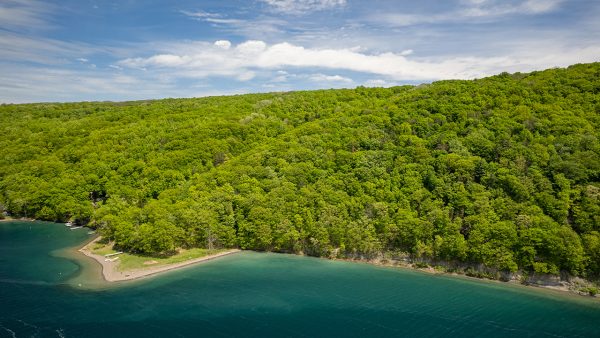
SPAFFORD — The Finger Lakes Land Trust (FLLT) earlier this year acquired 850 feet of shoreline and 15 forested acres along the eastern shore of Skaneateles Lake in the town of Spafford in southern Onondaga County.
The property includes 1,120 feet of streambank on Barber Gulf and a portion of the Staghorn Cliffs, the site of an ancient, fossilized coral reef, the FLLT said.
Located near the south end of Skaneateles Lake, this acquisition will extend the FLLT’s protected shoreline to 3,000 feet in this area, preserving the staghorn coral fossils as well as habitat for bald eagles and other wildlife.
The property is adjacent to the organization’s 90-acre Staghorn Cliffs Preserve and 21-acre Cora Kampfe Dickinson Conservation Area, which together “encompass some of the most pristine shoreline remaining in the Finger Lakes region,” FLLT contends.
Due to the hazardous nature of the steep hillsides above the cliffs, FLLT will own and manage the property as a nature preserve accessible by canoe or kayak. Protection of this property will “safeguard” wildlife habitat and the water quality of Skaneateles Lake by preventing development on its forested hillsides, the Ithaca–based organization noted.
The acquisition was made possible by an internal loan from the FLLT’s Opportunity Fund. The land trust is now launching a fundraising campaign to raise $1.1 million to cover the cost of the purchase as well as the long-term management of the site.
The property was identified as a priority for protection as part of the FLLT’s effort to create a greenbelt around the south end of Skaneateles Lake. Other nearby conservation lands include the High Vista and Hinchcliff Family preserves. The greenbelt is recognized as a priority project within New York State’s Open Space Plan and, because of its value for migratory birds, it is also recognized by National Audubon as one of the state’s Important Bird Areas, FLLT said.
Completion of this acquisition will also help ensure water quality within Skaneateles Lake, which is the unfiltered drinking-water supply for 220,000 area residents, including people living in the city of Syracuse.
“The quality of our lakes depends on the condition of the landscapes that surround them,” Andrew Zepp, president of FLLT, said in the announcement. “This acquisition will secure steep slopes and sensitive shoreline areas that would lead to increased erosion and runoff if they were developed.”
The FLLT says it focuses on protecting critical habitat for fish and wildlife, conserving lands that are important for water quality, connecting existing conservation lands, and keeping prime farmland in agriculture. The organization also provides programs to educate local governments, landowners, and residents about conservation and the region’s unique natural resources.
By working cooperatively with landowners and local communities, the Finger Lakes Land Trust says it has protected more than 34,000 acres of the region’s undeveloped lakeshore, rugged gorges, rolling forest, and scenic farmland. The FLLT owns and manages a network of more than 45 nature preserves that are open to the public and holds perpetual conservation easements on 200 properties that remain in private ownership.

Hancock Estabrook, LLP announced that Ashley D. Hayes has rejoined the firm’s Litigation, Labor & Employment and Intellectual Property departments. She rejoins the firm after

CBRE Upstate has welcomed Eddie Kirshner to its team. He brings experience in investment sales, leasing, underwriting, and financial analysis across the Binghamton and upstate

CBRE Upstate has welcomed Amie Culver to its team. She brings strong experience in commercial acquisitions, dispositions, market analysis, and client relationship management. Culver has
With Micron in mind, Le Moyne to offer new physics major in 2026
SYRACUSE — Micron Technology, Inc. (NASDAQ: MU) has plans to build a massive semiconductor-manufacturing campus in the town of Clay, and Le Moyne College wants to help prepare future students to secure a job with the Boise, Idaho–based company. The school is set to offer a bachelor’s degree in applied physics “as the region prepares
Become a Central New York Business Journal subscriber and get immediate access to all of our subscriber-only content and much more.

Click here to purchase a paywall bypass link for this article.
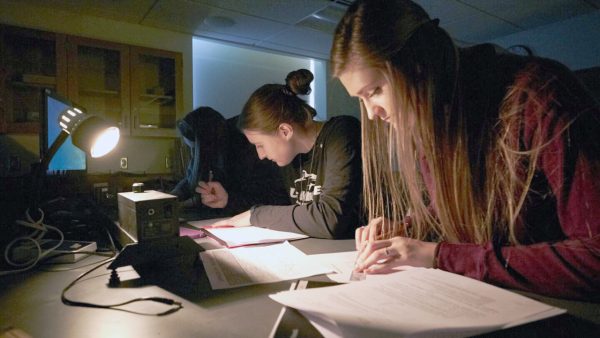
SYRACUSE — Micron Technology, Inc. (NASDAQ: MU) has plans to build a massive semiconductor-manufacturing campus in the town of Clay, and Le Moyne College wants to help prepare future students to secure a job with the Boise, Idaho–based company.
The school is set to offer a bachelor’s degree in applied physics “as the region prepares for the arrival of Micron Technology within the next several years.”
The New York State Department of Education approved Le Moyne’s request to offer the degree program, the school said in a Nov. 21 announcement. It’ll be available for new and current students starting with the 2026 fall semester.
The new major “unlocks the physical principles behind modern breakthroughs” such as semiconductors, sensors, renewable-energy systems, and other technological advances, preparing students to work in fields that are expected to “grow significantly” over the next 10 years.
“Le Moyne is excited to offer the new applied physics major, which will strengthen Le Moyne’s position as a key player in emerging careers in engineering, as well as specific fields such as semiconductors and material sciences,” Le Moyne College President Linda LeMura said in the school’s announcement. “Building from a foundation in liberal arts and sciences provided by our core curriculum, the program was created to meet the anticipated employment growth and a strong student interest within the region and across the state.”
These careers could include positions at the Micron facilities that will be built in the town of Clay. With an investment of up to $100 billion over the next 20 years, the firm estimates the fabrication (fab) plants could eventually result in 9,000 jobs at Micron and 9,500 jobs in businesses that supply Micron.
Le Moyne cites both state and federal labor statistics as indicating job growth in areas such as electrical engineering and materials science are anticipated to grow between 6 percent and 7 percent through 2034, higher than the average for all occupations.
The industries that will be hiring individuals with applied physics degrees include semiconductor and microelectronics (e.g., chip manufacturers, fabs); advanced manufacturing and materials; aerospace and defense; medical imaging and diagnostic sonographers; energy and renewable technology; software developer (instrumentation, embedded systems); government and national labs; and analytics and quantitative finance, per the Le Moyne announcement.
“Applied physics has been described as where scientific curiosity meets hands-on innovation,” Christopher Bass, chair of Le Moyne’s physics department, said. “Applied physics fully embraces Le Moyne’s educational mission by incorporating ethical scientific conduct and inquiry into the curriculum. The program will offer personalized mentoring, advanced labs and research opportunities where students will gain the knowledge and experience that will allow them to step confidently into high-demand careers.”
SUNY Sustainability Fellows include area professors
ALBANY — Three Central New York college professors and one from the Southern Tier are among 11 of SUNY’s inaugural Sustainability Faculty Fellows. They include Jean Yang, assistant professor of landscape architecture at the SUNY College of Environmental Science and Forestry in Syracuse; Augusta Williams, assistant professor of public health at Upstate Medical University in
Become a Central New York Business Journal subscriber and get immediate access to all of our subscriber-only content and much more.
Click here to purchase a paywall bypass link for this article.
ALBANY — Three Central New York college professors and one from the Southern Tier are among 11 of SUNY’s inaugural Sustainability Faculty Fellows.
They include Jean Yang, assistant professor of landscape architecture at the SUNY College of Environmental Science and Forestry in Syracuse; Augusta Williams, assistant professor of public health at Upstate Medical University in Syracuse; Jeremy Jiménez, associate professor of foundations and social advocacy at SUNY Cortland; and Neyda Gilman, associate librarian / assistant head of sustainability and STEM (science, technology, engineering, mathematics) engagement at Binghamton University.
The 11 fellows, representing 11 SUNY campuses, will assist other faculty in incorporating climate and sustainability topics into existing courses and develop new applied-learning opportunities.
SUNY Chancellor John King, Jr. on Sept. 23 announced SUNY’s inaugural Sustainability Faculty Fellows as part of New York Climate Week.
“SUNY is proud to be a key partner in Governor Kathy Hochul’s plan to build a resilient and sustainable New York,” King contended in the SUNY announcement. “With climate change affecting all elements of our society, from extreme weather emergencies to the emerging clean energy field, our students will need to be knowledgeable about sustainability to thrive as citizens and in their careers. Today’s students are eager to participate in climate action, and SUNY is taking steps so that New Yorkers are prepared.”
The Sustainability Faculty Fellows will advance climate literacy and knowledge of sustainability topics throughout the SUNY system. They’ll develop pedagogical resources and provide support for faculty as they develop and teach courses across a broad spectrum of disciplines and levels of study from microcredentials through doctoral programs, SUNY said.
SUNY selected the group following an open call for nominations.

Yang is a landscape designer, urban planner, and educator with a focus on design-driven, equity-focused, and benefits-based landscapes.
“Congratulations to Jean Yang’s for her selection as a SUNY Sustainability Faculty Fellow. Professor Yang’s research reflects the critical role ESF plays in shaping a resilient and equitable future through design and environmental leadership,” ESF President Joanie Mahoney said in a Sept. 24 ESF announcement. “We are proud to have Professor Yang represent ESF at the table ensuring that sustainability education is rooted in both innovation and impact.”

Williams has a research interest in climate change, environmental health, and health benefits of sustainability and climate solutions. Williams, who joined Upstate in 2022, also serves as the assistant director of the Upstate Public Health Program and the assistant director of the Central NY Children’s Environmental Health Center.
“Climate change has been deemed over the last decade by multiple international bodies to be the greatest public health threat of this century,” Williams said in a Nov. 17 Upstate Medical announcement. “No matter what area of public health you work in climate change will impact it in some way and it really has the potential to exacerbate existing health disparities. It’s so wide-reaching that we need many different professions, many different perspectives at the table to be ready to respond to this.”

For Gilman, the fellowship is an extension of the work she does to advance the mission of the University Libraries. Through her involvement with the Sustainability Hub located in the Science Library, Gilman recognizes the importance of environmental literacy and the impact having these skills integrated with the curriculum.
“At its core, this fellowship is a way to further integrate sustainability and climate information into courses across SUNY,” Gilman, librarian for sustainability, STEM engagement, and health sciences, said in an Oct. 7 Binghamton University announcement. “This program combines three things I find to be central to my identity and work: sustainability, education and community. Participating in this fellowship will allow me to use my skills and knowledge as a librarian to find, evaluate and share information that will be useful for faculty to integrate into their courses and beneficial to the students in those courses.”

Jiménez, a faculty member in the Foundations and Social Advocacy Department in SUNY Cortland’s School of Education, earned his doctorate in international and comparative education from Stanford University in 2017. He previously taught high school social studies for more than a decade across the world, including Norway, Venezuela, and the U.S., per a Sept. 9 announcement on the SUNY Cortland website.
Jiménez’s course topics explore race, class, gender and international issues in education and how they intersect with environmental justice. His current research focuses on how to prepare educators and schools for the transition toward life after fossil fuels, with special reverence for Indigenous conceptions of land stewardship.

Sustainable Office Solutions prepares to close its doors
DeWITT — Sustainable Office Solutions, LLC — a 16-year-old small business that sells and rents out new and pre-owned office furniture — is getting ready

Cornell plants ash trees it hopes are resistant to borer insects
ITHACA — Newly planted ash saplings on Cornell University property are potentially resistant to destructive emerald ash borer insects, making the university the first propagation center in New York state. The planting is part of The Nature Conservancy’s Trees in Peril project, seeking to restore disappearing ash trees across the United States, according to a
Become a Central New York Business Journal subscriber and get immediate access to all of our subscriber-only content and much more.

Click here to purchase a paywall bypass link for this article.
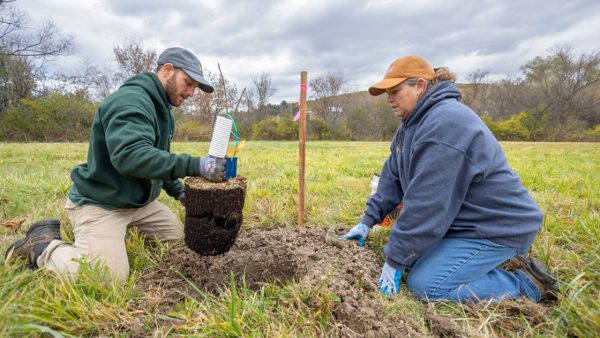
ITHACA — Newly planted ash saplings on Cornell University property are potentially resistant to destructive emerald ash borer insects, making the university the first propagation center in New York state.
The planting is part of The Nature Conservancy’s Trees in Peril project, seeking to restore disappearing ash trees across the United States, according to a Nov. 20 article on the Cornell Chronicle media relations website. The Nature Conservancy is a global environmental nonprofit founded in 1951 in the U.S.
Emerald ash borers usually kill all the trees in a stand, but studies by the USDA Forest Service have found that sometimes a few healthy trees — called lingering ash — remain, suggesting they have some natural resistance, according to the article.
After finding several resistant trees in its natural areas, Cornell Botanic Gardens is working with other conservation partners to propagate more-resistant trees. If successful, these trees and their progeny could be used to reforest decimated woodlands in New York state and elsewhere.
“Our goal is to propagate and conserve trees from 50 to 60 unique parents of green, white and black ash species, and we are thrilled that our first cohort of lingering ash have been planted out in their conservation banks,” Todd Bittner, director of natural areas for the Cornell Botanic Gardens, said in the article.
Emerald ash borer larvae have devastated black, white, and green ash trees by burrowing and eating the living tissue under the bark, which kills the trees. The insects have wiped out ash trees in 37 states, costing billions of dollars for tree removal, treatment, and replacement.
When emerald ash borer populations are at lower levels, natural resistance will likely protect trees, but when populations and pest pressures are high, the trees will likely need additional protections, or otherwise would still get destroyed the borer, Bittner noted.
The Trees in Peril program includes The Nature Conservancy, the USDA Forest Service, experts from academia, research organizations, and other partners — all of whom are collaborating to monitor, research and breed pest-resistant American beech, Eastern hemlock, and black, white, and green ash.
For more information on this project, check out the Cornell Chronicle article at: https://news.cornell.edu/stories/2025/11/cornell-ash-trees-aim-beat-back-borer-insects

OPINION: New York State’s Raise the Age Isn’t Working; Reform is a Must
The abject failure of New York’s criminal-justice reform has been evident for years. For example, “Raise the Age,” which calls for many cases involving 16-year-old and 17-year-old adolescent offenders (AOs) to be heard in family court rather than criminal court, has done nothing to make New Yorkers safer. That is much like other failed “progressive”
Become a Central New York Business Journal subscriber and get immediate access to all of our subscriber-only content and much more.

Click here to purchase a paywall bypass link for this article.
The abject failure of New York’s criminal-justice reform has been evident for years. For example, “Raise the Age,” which calls for many cases involving 16-year-old and 17-year-old adolescent offenders (AOs) to be heard in family court rather than criminal court, has done nothing to make New Yorkers safer. That is much like other failed “progressive” policies such as the near elimination of bail and solitary confinement in state prisons.
One look at New York City clearly demonstrates how dangerous and ineffective this policy is. NYPD Commissioner Jessica Tisch said the number of young shooters has nearly doubled since the law was changed and the number of children victimized by shootings is up 83 percent. However, this problem is far from a downstate-specific issue. In Albany, one incident involved 10 young people being shot, one fatally, and buildings were set on fire on the Fourth of July. Statistics indicate an overall increase in violent crime committed by 16-year-old and 17-year-old offenders across the state, while convictions plummeted.
Prior to Raise the Age, in 2017, nearly 60 percent of AOs, or 4,000, charged with serious crimes were convicted in adult criminal court, and more than 1,000 received a prison or jail sentence. In 2024, however, fewer than 10 percent of AOs, or 418, charged with a felony received a felony conviction. And less than 5 percent were placed in an Office of Children and Family Services facility for more than a year.
“The data is telling us, over the past five years, a very clear, stark story. We need to listen to that data,” said Tisch. The Assembly Minority Conference has been listening. We have been tracking this data for years, and we have continued to call for criminal accountability, fair and appropriate judicial discretion, and meaningful reforms to criminal-justice legislation that respects the rights of all New Yorkers, especially the victims of violent crime.
As such, it’s no surprise that district attorneys, law-enforcement agents, victims’ advocates, and lawmakers from every corner of New York have been persistent in their calls for change. With major changes coming in 2026 — New York City’s socialist experiment will undoubtedly create new challenges for residents and state lawmakers — it’s critical we continue to push this fight forward.
I have introduced legislation (A.4705) to prevent 16-year-old and 17-year-old adolescent offenders who commit serious felonies from escaping criminal liability by being shielded by family court, where records are sealed. The reason for this legislation is simple: These young men and women know what they are doing is wrong. The gang leaders who recruit them to do their bidding while shielded by this law know what they are doing is wrong. We must hold them accountable.
The Assembly Minority Conference will always advocate for the victims of crime. I look forward to working with my partners and colleagues in the Assembly and Senate in the upcoming session to hold perpetrators accountable and restore common sense to our criminal-justice system. Raise the Age simply did not work, and it’s long past time to move on from this failed policy.
William (Will) A. Barclay, 56, Republican, is the New York Assembly minority leader and represents the 120th New York Assembly District, which encompasses all of Oswego County, as well as parts of Jefferson and Cayuga counties.

OPINION: Congress Needs to Rebuild its Political Muscles
Watching the media’s reaction recently to the recent 427-1 vote in the U.S. House and the Senate’s unanimous consent for releasing the Epstein files, I was struck by two things. First, that even though the votes went against President Trump’s vehement opposition (until a few days before), they were hardly profiles in courage. As House
Become a Central New York Business Journal subscriber and get immediate access to all of our subscriber-only content and much more.
Click here to purchase a paywall bypass link for this article.
Watching the media’s reaction recently to the recent 427-1 vote in the U.S. House and the Senate’s unanimous consent for releasing the Epstein files, I was struck by two things.
First, that even though the votes went against President Trump’s vehement opposition (until a few days before), they were hardly profiles in courage. As House Speaker Mike Johnson put it afterward, “None of us want to go on record and in any way be accused of not being for maximum transparency,” a recognition that GOP members were under great public pressure to override the president’s original wishes.
And second, as the insider publication The Hill wrote afterward, no one should take that vote as an indication that the president’s hold on his own party has been broken. “To the contrary, he still exerts a vise-like grip on Republicans on Capitol Hill on the vast majority of issues,” they argued. To be sure, others argue differently, and you can certainly find exceptions, like the Senate’s votes in October against the administration’s tariff regime and its willingness to rebuff the president when he sought to eliminate the filibuster. Still, it’s fair to say that on most issues, President Trump still gets what he wants from the Republican-led Congress.
I wish it were otherwise. That’s because I believe Congress has grown listless in the face of presidential authority — and not just when it comes to President Trump. When I first went to the House in the mid-1960s, it was still in a decades-long period of vigorous legislating, muscular oversight of the executive branch, and even — at least in the Watergate hearings — a fierce determination to hold a president to account. The decades since have seen congressional authority erode drastically.
There’s a thread that ties together this journey from handing the president War Powers and budget-making responsibility — explicitly given to Congress by the Constitution — to what we have today: a majority party that mostly refuses to challenge the president, members who prefer to duck town halls rather than face their constituents, and committee chairs who shy away from calling agency and department heads named by a president of their own party to account. That thread, I’d argue, is pain avoidance. Over the decades, many members of Congress have lost their appetite for engaging with people who don’t agree with them and for standing up for what they believe despite presidential pressure.
True, these were both easier to do in the past, when Congressional leaders like Sam Rayburn, Mike Mansfield, and Howard Baker saw protecting Congressional prerogative as worth spending political capital on — they made it clear that they would endure pain on behalf of the institution of Congress, and that they expected their members to do so, too. These days, many members see Congress not as an institution to defend but as a platform for individual brand-building. In this world, taking political risks doesn’t hold much appeal.
Yet, if Congress is to reassert itself as a responsible branch of government, it will need both a leadership and a majority of members who embrace and understand that political give and take, and persuading people who are skeptical of their arguments, are crucial skills to develop in a representative democracy — especially when dealing with one another on Capitol Hill.
In other words, they need to rebuild a sort of muscle memory for persuasion, negotiation, principled disagreement, and compromise.
This is impossible if they opt repeatedly to take the easy route of letting others make tough decisions. Instead, people who serve in or run for Congress need to learn how to persuade and work with members who don’t agree with them — and to stiffen their spines when a president tries to browbeat them into relinquishing congressional authority. To do this, I believe, they need to build their abilities by running in competitive Congressional districts, holding regular town halls, holding floor debates that make more room for amendments, serving on committees that are empowered to make difficult decisions, and reasserting Congressional authority over tough issues like taxes and spending. In other words, they need to rebuild the skill sets that once served members of Congress — and the American people — so well.
Lee Hamilton, 94, is a senior advisor for the Indiana University (IU) Center on Representative Government, distinguished scholar at the IU Hamilton Lugar School of Global and International Studies, and professor of practice at the IU O’Neill School of Public and Environmental Affairs. Hamilton, a Democrat, was a member of the U.S. House of Representatives for 34 years (1965-1999), representing a district in south-central Indiana.
Stay up-to-date on the companies, people and issues that impact businesses in Syracuse, Central New York and beyond.