
Get our email updates
Stay up-to-date on the companies, people and issues that impact businesses in Syracuse, Central New York and beyond.
What's New
Upcoming Events
CNYBJ Job Board
Grant Thornton offers 10 year-end tax-planning tips in an uncertain tax environment
As 2017 nears its end, an uncertain tax and legislative environment means that year-end tax planning could be more important than usual. The possibility of major tax reform getting passed in Congress “opens up powerful planning opportunities” for tax savings if completed before year-end, according to Grant Thornton LLP. The firm is the U.S. unit […]
Get Instant Access to This Article
Become a Central New York Business Journal subscriber and get immediate access to all of our subscriber-only content and much more.
- Critical Central New York business news and analysis updated daily.
- Immediate access to all subscriber-only content on our website.
- Get a year’s worth of the Print Edition of The Central New York Business Journal.
- Special Feature Publications such as the Book of Lists and Revitalize Greater Binghamton, Mohawk Valley, and Syracuse Magazines
Click here to purchase a paywall bypass link for this article.
As 2017 nears its end, an uncertain tax and legislative environment means that year-end tax planning could be more important than usual. The possibility of major tax reform getting passed in Congress “opens up powerful planning opportunities” for tax savings if completed before year-end, according to Grant Thornton LLP.
The firm is the U.S. unit of Grant Thornton International Ltd, a global independent audit, tax, and advisory firm with revenue of more than $1.7 billion and 60 offices. It has an upstate New York office in Albany.
“The potential for tax reform makes year-end tax planning more important than ever for individuals and public and private companies,” Dustin Stamper, director in Grant Thornton’s Washington, D.C. national tax office, said in an Oct. 31 news release. “Tax filers should look for ways to accelerate deductions into 2017 while rates are high, and defer income into future years when rates might be lower.”
Stamper noted that the potential to lose deductions or tax incentives as part of tax reform should also factor into year-end planning. “It’s important to remember that good tax planning goes beyond what has happened. You also have to account for what may happen in the months to come,” he said.
Grant Thornton offered the following 10 key 2017 tax-planning tips for individuals:
1. Accelerate deductions and defer income. Deferring tax is usually a good strategy because of the time value of money. This year, it’s even more important, Grant Thornton says. “You want to use deductions now while rates are higher and defer income into future years when rates might be lower.” The firm recommends considering deferring bonuses, consulting income, or self-employment income. On the deduction side, accelerating state and local income taxes, interest payments, and real-estate taxes are possible moves to consider.
2. Use itemized deductions before they’re gone. Tax reform threatens many itemized deductions, including the deductions for state and local taxes and medical expenses, the firm said. If possible, individuals should consider paying expenses now while they can still use the deduction. “You can often prepay 2017 state taxes even if they aren’t due until next year.” Taxpayers can also often control the timing of expensive non-urgent medical procedures. However, some expenses cannot be deducted unless they exceed a certain percentage of one’s adjusted gross income (AGI). Medical expenses generally can’t be deducted unless they exceed 10 percent of AGI (7.5 percent for taxpayers age 65 and older), according to Grant Thornton.
3. Leverage the state and local sales-tax deduction. Individuals deducting state and local taxes can elect to deduct state and local sales taxes instead of state income taxes. This is “valuable” for people in a state without an income tax, but can also provide a larger deduction in other states if individuals made big purchases subject to sales tax (such as a car, boat, or home). The IRS has a table allowing people to claim a standard sales tax deduction so they don’t have to save all their receipts during the year. This table is based on one’s income, family size, and the local sales tax rate, and the individual can add the tax from large purchases on top of the standard amount. “If you already know you will make this election for 2017, consider making any planned large purchases before the end of the year in case the election is unavailable or doesn’t make sense next year,” Grant Thornton said.
4. Consider charitable deductions now. The charitable deduction deserves “special consideration because you have complete control over its timing.” Lawmakers have promised to keep it as part of tax reform, but they could still apply limits. Even if it is left untouched, it might not be valuable in 2018 for many taxpayers. Lawmakers are proposing to double the standard deduction, meaning fewer taxpayers will itemize deductions in the future. People who don’t itemize deductions cannot deduct charitable gifts. Individuals should consider moving gifts up into this year, because the deduction may be more valuable against today’s higher tax rates. However, AGI limits apply to deductions.
5. Get your charitable house in order. Those who do plan on giving to charity before the end of the year should remember that a cash contribution must be documented to be deductible. Those claiming a charitable deduction of more than $500 in donated property must attach Form 8283. “If you are claiming a deduction of $250 or more for a car donation, you will need a contemporaneous written acknowledgement from the charity that includes a description of the car. Remember, you cannot deduct donations to individuals, social clubs, political groups or foreign organizations,” according to Grant Thornton.
6. Make up a tax shortfall with increased withholding. Taxes are due throughout the year. People should check their withholding and estimated tax payments now while they have time to fix a problem. Those in danger of an underpayment penalty can try to make up the shortfall by increasing withholding on their salary or bonuses. “A bigger estimated tax payment can leave you exposed to penalties for previous quarters, while withholding is considered to have been paid ratably throughout the year,” the firm said.
7. Leverage retirement account tax savings. It’s not too late to boost contributions to a retirement account. Traditional retirement accounts such as a 401(k) or individual retirement account (IRA) still offer “some of the best tax savings.” “Contributions reduce taxable income at the time that you make them, and you don’t pay taxes until you take the money out at retirement.” The 2017 contribution limits are $18,000 for a 401(k) and $5,500 for an IRA (not including catch-up contributions for those age 50 and older).
8. Document your business activities. People may not need to pay a 3.8 percent Medicare tax on their business income if they participate enough in their business so that they are not considered a “passive investor.” Participation is defined as any work performed in a business as an owner, manager, or employee as long as it is not an investor activity. Still, they must document their activities, and the IRS will not let people make ballpark estimates after the fact. “Make sure you document the hours you’re spending with calendar and appointment books, emails and narrative summaries,” Grant Thornton said.
9. Take a closer look at your state residency status. For individuals who split their time in two different states throughout the year, “now is an excellent time to consider where you may be taxed as a resident for 2017.” To make it more likely that the high-tax jurisdiction will acknowledge the move and not continue to tax you as a resident, you should track the number of days you are spending in each jurisdiction. Generally, if an individual resides in a state for 183 days or more, that state will assert residency and the ability to tax all of the person’s income. “Furthermore, if you move to a new state but you maintain significant contacts with the old state (including driver’s license, residences, bank accounts, and the like), you could run the risk of being taxed as a resident in the old state,” the firm noted.
10. Tread carefully with estate planning. Normally, individuals want to make sure they don’t waste their annual $14,000 gift exclusion. This involves making gifts to heirs before the year ends. The possibility of estate tax repeal makes planning a little more “complicated” this year, Grant Thornton says. “It still makes sense to use your exclusion amounts because the estate tax may not be repealed after all and there is no tax cost to using the exclusion even if it is. But you may want to avoid using giving strategies that actually involve paying gift tax until after the legislative outlook is resolved.”

Syracuse airport offers holiday travel tips
SYRACUSE — People flying from Syracuse Hancock International Airport during the busy holiday season should prepare for “increased” passenger volume, newly implemented Transportation Security Administration (TSA) screening procedures at the checkpoint, and ongoing airport construction. Airport officials are advising passengers to arrive at least 2 hours before their flight’s scheduled departure time to “ensure they
Get Instant Access to This Article
Become a Central New York Business Journal subscriber and get immediate access to all of our subscriber-only content and much more.
- Critical Central New York business news and analysis updated daily.
- Immediate access to all subscriber-only content on our website.
- Get a year’s worth of the Print Edition of The Central New York Business Journal.
- Special Feature Publications such as the Book of Lists and Revitalize Greater Binghamton, Mohawk Valley, and Syracuse Magazines
Click here to purchase a paywall bypass link for this article.
SYRACUSE — People flying from Syracuse Hancock International Airport during the busy holiday season should prepare for “increased” passenger volume, newly implemented Transportation Security Administration (TSA) screening procedures at the checkpoint, and ongoing airport construction.
Airport officials are advising passengers to arrive at least 2 hours before their flight’s scheduled departure time to “ensure they are at their gate in time for boarding,” the Syracuse Regional Airport Authority said in a news release. That’s up from the 90-minute guideline the authority offered for last year’s holiday season.
The TSA has recently announced the implementation of new, “stronger” screening procedures for carry-on items. The new procedures require travelers to place all personal electronic devices larger than a cell phone in bins for X-ray screening and are designed to address the current terror threat by raising the baseline of aviation security, the agency says.
Examples of personal electronic items that should be removed from carry-on bags include laptops, tablets, e-readers, and cameras. The new security measures “do not apply” to passengers enrolled in TSA Pre-check who are using TSA Pre-check lanes.
Airport officials also reminded passengers that Hancock is currently undergoing a major construction project that has affected the traffic pattern and entry points to the terminal. The airport’s website — www.flysyracuse.com — has additional information and a map outlining the changes, the authority said.
14 Tips for Successful Holiday Job Searching & Networking
Your head tells you, “No one is hiring.” I am here to tell you that it is not true. This is the time we get to have fun with this process. The holidays present many leads to pursue and an abundance of opportunities to expand your network. Whether you are an introvert or an extrovert,
Get Instant Access to This Article
Become a Central New York Business Journal subscriber and get immediate access to all of our subscriber-only content and much more.
- Critical Central New York business news and analysis updated daily.
- Immediate access to all subscriber-only content on our website.
- Get a year’s worth of the Print Edition of The Central New York Business Journal.
- Special Feature Publications such as the Book of Lists and Revitalize Greater Binghamton, Mohawk Valley, and Syracuse Magazines
Click here to purchase a paywall bypass link for this article.
Your head tells you, “No one is hiring.” I am here to tell you that it is not true. This is the time we get to have fun with this process. The holidays present many leads to pursue and an abundance of opportunities to expand your network. Whether you are an introvert or an extrovert, here are practices you can implement to make job searching and holiday networking easier for you during this season:
(1) Networking is not only about attending events — also use the phone. Each day, call one friend and one former co-worker to whom you have not spoken in a while and see how they are doing. Then let the conversation gravitate to what you are up to — naturally.
(2) Gravitate toward the positive people. Stay clear of the ‘bah-humbug’ crowd. It’s imperative to stay positive during the holidays. I’m all for helping people with a pick-me-up. But if you feel someone is just a Debbie Downer who is going to bring you down with her, then find someone else to chat with, learn about, and help. This is networking, not therapy. Help someone who wants your help.
(3) When attending events, enter the event thinking, “Who can I help?” versus having the “Ugh, I don’t know anyone.” or “What are they going to think of me?” mindset. You will appear more genuine and less stressed if you want to offer assistance than if you are feeling you have to fit in with the crowd.
(4) Do your homework before choosing to attend events. If two events present themselves, pick one and do it well. Don’t spread yourself too thin. Research who will be attending to evaluate how it can fulfill your personal or professional goals. Make sure attending serves a purpose for you — even if it is just to have fun.
(5) Not sure what to say or ask? Read “The Fine Art of Small Talk” by Debra Fine. Choose 4-5 questions out of this book to help you get a conversation started. Or use it to create some of your own standbys. This will help reduce the awkward silences that can arise. Some of my favorites that get things rolling include: How are you connected to this group? What brings you to the event? What kind of day did you have today? What do you enjoy most about what you do? What do you find most challenging?
(6) Find a buddy to attend the event with you. But do not spend the event chatting with each other. You can do that anytime. Plan to facilitate introductions for each other as you meet people throughout the event.
(7) Get there early whenever possible — it’s easier to start conversations with the early crowd. It can be a challenge to enter conversations already started if you are late.
(8) Have an eloquent, concise way to describe where you are in life and what you are looking to do in the next phase of your career. Be prepared to explain that you are looking for a new position and the kind of job you seek, when it is appropriate to share.
(9) Be curious. Ask questions and learn about problems/opportunities within your contact’s industry to make mental notes of items to research and explore after the event. This could lead to your next job.
(10) Don’t ask about job openings at their company. Instead, ask questions to gain information about the person you are talking to and learn about their company, interests, and passions.
(11) Networking events are about the people — not the food. Do not spend time with the canapés, no matter how fabulous they may be. You are there to expand your network and increase your opportunities — focus on people.
(12) Give 100 percent of your attention to the person to whom you are speaking — don’t let your eyes wander. People can sense if you are looking for someone more interesting to talk to — so even if that is happening to you, you must be polite to your immediate audience. Excuse yourself gracefully, if need be. Always treat everyone with respect and attention.
(13) Follow up after the event. If you enjoyed meeting someone, email him saying so. Call the person asking to meet for coffee over the next few weeks. This is how relationships start.
(14) Do not stress yourself out — Keep your purpose for these events in perspective. You are there to meet people and make connections. You will not find a job at the event, so relax. You would not ask someone to marry you on the first date, nor would you want to be asked. Well, networking opportunities are not even the first date. So, set realistic, attainable goals in performing networking activities and you will feel less pressure throughout the season.
These tips should help make this holiday season the one that brings you the job you are seeking. Have fun. Do it right. And above all else, present the best you so potential employers can see exactly why you are perfect for them.
 Lisa Rangel is managing director of Chameleon Resumes (www.chameleonresumes.com), an author, a professional speaker, and a graduate of Cornell University. She has also been the expert moderator for LinkedIn’s Premium Career Group since 2012.
Florida Residency: It Doesn’t Have to Change New York State Charitable Giving
It’s that time of year where Central New York snowbirds are either making travel plans to flee the Empire State or have already departed. While weather is certainly one reason to fly off to Florida, many snowbirds are heading south for another reason — to establish or maintain their non-New York residency for tax purposes.
Get Instant Access to This Article
Become a Central New York Business Journal subscriber and get immediate access to all of our subscriber-only content and much more.
- Critical Central New York business news and analysis updated daily.
- Immediate access to all subscriber-only content on our website.
- Get a year’s worth of the Print Edition of The Central New York Business Journal.
- Special Feature Publications such as the Book of Lists and Revitalize Greater Binghamton, Mohawk Valley, and Syracuse Magazines
Click here to purchase a paywall bypass link for this article.
It’s that time of year where Central New York snowbirds are either making travel plans to flee the Empire State or have already departed. While weather is certainly one reason to fly off to Florida, many snowbirds are heading south for another reason — to establish or maintain their non-New York residency for tax purposes. Recent changes in the law have reduced the impact of the New York estate tax, but this state’s high income-tax rates remain a strong motivator to establish residency outside New York.
New York taxes its residents on income from all sources. On the other hand, nonresidents are only subject to tax on income derived from New York sources. Therefore, an individual who can establish legal residency outside the Empire State will eliminate or at least minimize his/her exposure to New York tax.
People have a common misconception that charitable giving also needs to be adjusted during this process. Thomas Griffith, director of gift planning at the Central New York Community Foundation, reports that he often sees donors who change their tax domicile to Florida mistakenly thinking they need to cease their gifts to charities here in Central New York to avoid New York taxation. Let’s look at this more closely.
Section 605(b) of the New York Tax Law determines a taxpayer’s residency status. The initial question is whether the taxpayer is “domiciled” in New York. Although in everyday conversation “residence” and “domicile” are used interchangeably, here they have different meanings. “Domicile” is the place that individuals intend to make their permanent home — the place to which they return after absence. And though people may have several residences, they may only have one “domicile.”
These are the five primary factors to determine domicile under New York Law: the pattern of use of the New York residence; the taxpayer’s New York business ties; where the taxpayer spends his/her time; the physical location of items “near and dear”; and the location of family. Even if a taxpayer is not considered “domiciled” in New York, the snowbird may still be taxed as a New Yorker if he/she spends more than half the year (or 183 days) in New York, and maintains a New York year-round residence.
To help snowbird clients navigate these complex rules, advisors have developed widely used checklists of “do’s and don’ts.” Often included in such lists is the recommendation that clients sever all ties with local charities. In response, clients have shifted their charitable support out of state, ceasing donations to organizations they and their families have supported for decades, and perhaps generations.
This is not the intent of New York law. In fact, advisors and clients will be reassured to know the New York Tax Law and published tax-audit guidelines specifically state that where a taxpayer volunteers and to what charity a taxpayer donates are not relevant in determining the taxpayer’s domicile. The New York Legislature amended Section 605 of the Tax Law in 1994 to clarify that charitable support and volunteer work “shall not be used in any manner to determine where an individual is domiciled.”
Professional advisors should revisit and revise their guidance to reflect this information. Surely, clients will welcome this news — one less item on the snowbird checklist and, more meaningfully, a green light to continue supporting the charities they have supported their entire lives.
For more information on this topic and ways you or your clients can support Central New York, I encourage you to connect with the Community Foundation. Its staff will work with you to identify the clients that could benefit, discern their intentions, and create a plan that maximizes the advantage of their estate and financial plans. Contact Tom Griffith at tgriffith@cnycf.org or (315) 422-9538 for assistance.
 Marion Hancock Fish is a partner at the Syracuse–based law firm Hancock Estabrook, LLP, and is a former board chair of the Community Foundation. She focuses her law practice on estate planning, transfer-of-wealth tax issues, family-business planning and succession, charitable giving, not-for-profit law, elder law, and special needs administration.

Tin Woodman’s Flask opens in Chittenango
CHITTENANGO — The Oneida Nation announced it has formally opened Tin Woodman’s Flask, a new 17,000-square-foot wine and spirits store in Chittenango. Tin Woodman’s Flask is one of the largest liquor stores in upstate New York, featuring more than 100,000 bottles of wine and spirits, the Oneida Nation contended in a news release. “We are
Get Instant Access to This Article
Become a Central New York Business Journal subscriber and get immediate access to all of our subscriber-only content and much more.
- Critical Central New York business news and analysis updated daily.
- Immediate access to all subscriber-only content on our website.
- Get a year’s worth of the Print Edition of The Central New York Business Journal.
- Special Feature Publications such as the Book of Lists and Revitalize Greater Binghamton, Mohawk Valley, and Syracuse Magazines
Click here to purchase a paywall bypass link for this article.
CHITTENANGO — The Oneida Nation announced it has formally opened Tin Woodman’s Flask, a new 17,000-square-foot wine and spirits store in Chittenango.
Tin Woodman’s Flask is one of the largest liquor stores in upstate New York, featuring more than 100,000 bottles of wine and spirits, the Oneida Nation contended in a news release.
“We are excited to be announcing another grand opening and celebrating yet another step in the economic growth of our region,” said Oneida Nation Representative and Nation Enterprises CEO Ray Halbritter. “We are confident that Tin Woodman’s Flask will be a welcomed addition to our region and we are very proud to further our investment in Chittenango with the opening of this store.”
The new store is located in the Emerald City Plaza (formerly Chittenango Plaza), between Top’s and Yellow Brick Road Casino, which the Nation built and operates.
Tin Woodman’s Flask created 20 new permanent jobs for Central New York residents, including several managerial positions such as general manager and assistant general manager, the release stated. Full- and part-time positions are still available.
The store’s construction also created “numerous” local trade jobs by working with regional vendors, the Nation said.
The new store will offer a “custom order service,” allowing consumers to order any wine or spirit that may not be featured in the store, plus a 5 percent discount. It will also feature interactive kiosks offering information about types and brands of wines and offer recommendations based on shoppers’ personal preferences.
Tin Woodman’s Flask will be open Monday through Thursday from 9 a.m. to 9 p.m., Friday and Saturday from 9 a.m. to 10 p.m., and Sundays from noon to 6 p.m. The store will host tasting events every Friday and Saturday in December.
New York egg production falls slightly in October
New York farms produced 140.7 million eggs in October, down 0.2 percent from 141 million eggs in the year-ago period, the USDA recently reported. The total number of layers in the Empire State decreased by 2.2 percent in October to 5.36 million from 5.48 million a year prior. New York egg production per 100 layers
Get Instant Access to This Article
Become a Central New York Business Journal subscriber and get immediate access to all of our subscriber-only content and much more.
- Critical Central New York business news and analysis updated daily.
- Immediate access to all subscriber-only content on our website.
- Get a year’s worth of the Print Edition of The Central New York Business Journal.
- Special Feature Publications such as the Book of Lists and Revitalize Greater Binghamton, Mohawk Valley, and Syracuse Magazines
Click here to purchase a paywall bypass link for this article.
New York farms produced 140.7 million eggs in October, down 0.2 percent from 141 million eggs in the year-ago period, the USDA recently reported.
The total number of layers in the Empire State decreased by 2.2 percent in October to 5.36 million from 5.48 million a year prior.
New York egg production per 100 layers totaled 2,623 eggs in October, up 2 percent from 2,572 eggs in October 2016.
In neighboring Pennsylvania, egg production increased more than 1 percent to 701 million eggs in October, from 692 million eggs a year earlier, the USDA reported.
Nationally, U.S. farms produced more than 8.8 billion eggs in October, down 0.2 percent from a year prior, the USDA reported.

CCBLaw, Wood & Smith to combine in merger of health-care focused firms
SYRACUSE — The Syracuse–based law firms Cohen Compagni Beckman Appler & Knoll, PLLC (CCBLaw) and Wood & Smith P.C., which both focus on health-care law, will become one on Jan. 1. The discussions that led to the eventual combination happened “casually” for a few years, according to Michael Compagni, an attorney and partner with CCBLaw.
Get Instant Access to This Article
Become a Central New York Business Journal subscriber and get immediate access to all of our subscriber-only content and much more.
- Critical Central New York business news and analysis updated daily.
- Immediate access to all subscriber-only content on our website.
- Get a year’s worth of the Print Edition of The Central New York Business Journal.
- Special Feature Publications such as the Book of Lists and Revitalize Greater Binghamton, Mohawk Valley, and Syracuse Magazines
Click here to purchase a paywall bypass link for this article.
SYRACUSE — The Syracuse–based law firms Cohen Compagni Beckman Appler & Knoll, PLLC (CCBLaw) and Wood & Smith P.C., which both focus on health-care law, will become one on Jan. 1.

The discussions that led to the eventual combination happened “casually” for a few years, according to Michael Compagni, an attorney and partner with CCBLaw.
“We come across them often. We know each other,” he says. The discussions on a merger accelerated this past summer, with both firms believing “the timing is right.” Compagni spoke with CNYBJ on Nov. 27.
The new combined firm will use the Cohen Compagni Beckman Appler & Knoll, PLLC (CCBLaw) name.
Attorneys Bruce Wood and Bruce Smith will join the firm as partners and will conduct their legal work in the CCBLaw office at 507 Plum St., according to Compagni.
Wood & Smith currently operates an office in One Lincoln Center at 110 W. Fayette St. in Syracuse, according to its website.
CCBLaw currently has 11 attorneys, eight of whom are partners in the firm, according to its website. The firm also has seven support-staff members for a total employee count of 18, according to Anastasia Semel, an attorney with CCBLaw.
The Wood & Smith firm has one support staff member in addition to its two attorneys for whom the law firm is named. Wood and Smith formed their firm in 1998.
When the merger takes effect, CCBLaw’s employee count will increase to 21 employees, with the addition of those three employees.
About the law firms
Both firms have physician-centered practices, providing business, transactional, and regulatory counsel to physician groups, provider networks, ambulatory surgery centers, health-care joint ventures, and ancillary service providers.
The combination of the two law firms will add depth to what they offer clients, Compagni says.
“Although [Wood & Smith] focus on health law, they also do a lot of business and real estate [client work] and we do that [as well], primarily as support for our health-law clients, but that will again provide more depth for both sides,” he explains.
The merger will also “further strengthen” CCBLaw’s existing business, finance, and commercial real-estate practices, he adds.
The firms’ integration will provide Wood & Smith’s clients with access to CCBLaw’s existing areas of practice in commercial litigation, labor and employment, ERISA, employee benefits, and professional license defense. ERISA is short for the Employee Retirement Income Security Act of 1974.
The integration will “further CCBLaw’s goal of continuing to be a preeminent boutique health law firm in New York State,” the firm contended in its news release announcing the merger.
Lessons from the Financial Crisis
As we mark the 10th anniversary of the onset of the financial crisis, I would like to focus on some of the lessons we should draw from that harrowing experience, and the implications of those lessons for regulatory policy going forward. (As always, what I have to say reflects my own views and opinions and not
Get Instant Access to This Article
Become a Central New York Business Journal subscriber and get immediate access to all of our subscriber-only content and much more.
- Critical Central New York business news and analysis updated daily.
- Immediate access to all subscriber-only content on our website.
- Get a year’s worth of the Print Edition of The Central New York Business Journal.
- Special Feature Publications such as the Book of Lists and Revitalize Greater Binghamton, Mohawk Valley, and Syracuse Magazines
Click here to purchase a paywall bypass link for this article.
As we mark the 10th anniversary of the onset of the financial crisis, I would like to focus on some of the lessons we should draw from that harrowing experience, and the implications of those lessons for regulatory policy going forward. (As always, what I have to say reflects my own views and opinions and not necessarily those of the Federal Open Market Committee or the Federal Reserve System.)
The first lesson is that financial crises can have grave consequences — for the economy and the nation — that can linger for many years. The toll from the financial crisis was severe, with 9 million jobs lost and 8 million housing foreclosures amid the deepest economic downturn since the Great Depression. Moreover, the road back has been long and slow. Despite economic policies oriented toward supporting recovery, it has taken eight years to push the unemployment rate down to a level consistent with the Federal Reserve’s employment objective. Other residual impacts include the large size of the Federal Reserve’s balance sheet; significantly higher public debt; and substantial damage to public trust in the nation’s government and financial institutions.
The second lesson follows from the first. We need to ensure that we have a resilient financial system. To that end, we must ensure that the safeguards put in place in response to the crisis are fully appreciated and respected. But, it also means that we need to finish the job — for example, by building out a fully workable regime for resolving a complex, global firm if one were to become insolvent. We need to ensure that our financial system can continue to provide critical services not just during good times, but also during periods of stress.
These objectives are particularly relevant today, when reopening the Dodd-Frank Act and modifying our regulatory framework are under consideration. While it is appropriate to evaluate adjustments that might improve our regulatory regime, it is critical that we do not forget the hard-learned lessons of the crisis and — in the haste to reverse course — undermine the robustness and resiliency of the financial system.
The U.S. housing market boom and bust
At the heart of the crisis was the U.S. housing boom and bust. Between 1997 and 2006, U.S. home prices nearly doubled in real terms on a national basis. Then, when the boom turned to bust, real home prices reversed course, declining by about 40 percent on a national basis, with larger price declines in several states, according to the CoreLogic home price index. The magnitude of the national price declines was unprecedented during the postwar period.
The evolution of the financial crisis illustrates many key issues, including the potential hazards of financial innovation, the procyclicality of the financial system, and the importance of confidence in sustaining effective financial intermediation.
The housing boom and bust underscores several important lessons. First, the financial sector is not only a very complex system, but also one that can be inherently unstable — subject to excess, then sharp reversal. This is especially the case when an important innovation occurs, and market participants don’t fully appreciate the powerful feedback loops that first sustain a boom and then contribute to a bust when the process runs in reverse. This means that we as regulators must continually evaluate the financial system and monitor the landscape for new developments and innovations that, if taken too far, could lead to excess and put the system at risk.
Second, when there are potential excesses that could threaten financial stability, we should look to temper them. For example, in the run-up to the financial crisis, macroprudential tools — such as requiring larger down payments or more closely evaluating the incomes of borrowers — could have been implemented to limit the demand for housing. If such an approach were successful, home prices would not have risen so dramatically, and the subsequent bust would have been less severe. Another approach would have required financial intermediaries to build stronger capital and liquidity buffers as protection against a housing bust and an economic downturn.
Third, we need to carefully monitor the incentives that govern the behavior of borrowers, savers, and financial intermediaries.
Culmination of the crisis
The bust exposed many structural flaws in the financial system that exacerbated its instability. Without being exhaustive, these included the instability of the tri-party repo system, which supported the nation’s short-term funding markets; the risks of runs in the money market mutual fund industry; and the risk of contagion caused by the huge volume of outstanding bilateral (non-centrally cleared) over-the-counter (OTC) derivative obligations between the major financial intermediaries.
The near-collapse of the U.S. financial system underscores three critical lessons.
First, financial institutions must be robust to stress. In particular, they need to have enough capital to be considered solvent even after sustaining significant losses, so that they can maintain the market access needed to recapitalize. They also need sufficient liquidity buffers so that they can respond to shocks without having to sell illiquid assets.
Second, when we identify potential sources of instability that could amplify shocks, we need to make structural changes to the financial system to reduce or eliminate them. For example, the financial crisis made it clear that changes were needed in how tri-party repo transactions were unwound each day, net asset values were calculated for prime money market mutual funds, and OTC derivative obligations were cleared, settled, and risk-managed.
Third, there should be a viable and predictable resolution regime. We need to be able to resolve a large, systemically important bank or securities firm in a way that limits contagion and stress on the rest of the financial system, while at the same time protecting the taxpayer against loss.
Considerable progress
So, where are we relative to what is needed? As I see it, there has been considerable progress. The nation’s largest banks are much safer because of substantially higher capital and liquidity requirements, as well as robust stress tests. This enhanced resiliency has been achieved without a significant negative impact on the broad availability of credit — recognizing that it is now more difficult for households with low credit scores to obtain a mortgage. Most importantly, improving the capacity of such firms to continue to lend during times of stress should make the overall economy more stable.
We have also made significant progress in addressing many of the structural weaknesses uncovered by the financial crisis. Money market reform has made the prime money market mutual fund industry smaller and safer. We have also reduced the amount of risk in the system by requiring that most standardized OTC derivatives be cleared through central counterparties, where multilateral netting occurs.
More work is still needed
Yet, we should not be complacent, as there are important areas where our work is not complete. Relative to other countries, the United States has limited ability to implement effective macroprudential tools. That is because oversight is shared by several different entities, and the power to implement macroprudential tools is constrained. Another challenge is the diverse structure of the U.S. financial system, in which non-banks and capital markets play a substantial role in credit intermediation. Although the Financial Stability Oversight Council (FSOC) could conceivably play a greater role here, whether it will be able to do so effectively remains uncertain.
Another issue that needs attention is the ability to resolve large, complex financial firms that operate on a global basis. The framework of requiring such firms to hold a large buffer of debt that could be converted into equity at the time of non-viability is an important step forward. But, the task of operationalizing this on a global basis in a way that is fully credible to these firms’ customers and counterparties has not been completed. Achieving clarity about the roles and responsibilities of home and host country authorities is still a work in progress.
Where the pendulum may have swung too far
At the same time, there are some areas where the pendulum may have swung too far, where the costs of regulation — including compliance costs and the potential impact on the provision of services — are likely to exceed the benefits. In this vein, I favor regulatory relief for smaller banking organizations. First, such firms individually are not systemically important, and therefore do not pose a significant risk to the viability of the U.S. financial system. Second, the regulatory burdens on smaller firms can be heavy because they don’t have the scale over which compliance and other regulatory costs can be spread. Regulatory requirements should be appropriately calibrated to avoid inadvertently creating a competitive advantage for larger financial firms.
I also think that the Volcker rule could be modified so that its implementation would be less burdensome. As I see it, regulators could review the criteria for permissible market-making. Trading activity should be viewed as market-making when it is customer-facing and inventories are not excessively large or stale. Market-making serves an important function, and it is important that trading desks can intervene and buy during flash crashes or sell during flash surges. Permitting this could provide greater liquidity and stability to financial markets. I would also exempt smaller banking institutions from the Volcker rule since they rarely, if ever, engage in proprietary trading.
Do no harm
Many speculate that Congress will make changes to the Dodd-Frank Act. If the scope is confined mainly to small bank relief and adjusting how the Volcker rule is applied, I have no objection. But, because the Dodd-Frank Act addresses many of the key lessons of the crisis, I think it appropriate that changes be made carefully — with a paring knife, rather than with a meat cleaver. Here, I would underscore the importance of preserving higher capital and liquidity requirements for systemically important banks; Title VII, which mandates the central clearing of standardized OTC derivatives; and Title VIII, which gives the Federal Reserve an oversight role for financial market utilities that are systemically important, and which helps promote more uniform risk management standards.
In conclusion, as we reflect on potential changes to the U.S. regulatory regime, we should not lose sight of the horrific damage caused by the financial crisis, including the worst recession of our lifetimes and millions of people losing their jobs and homes. We had a woefully inadequate regulatory regime in place, and while it is much better now, there is still work to do. We should finish the job as quickly as possible, and we should do no harm as we adjust our regulatory regime to make it more efficient.
 William C. Dudley is president and CEO of the Federal Reserve Bank of New York. This viewpoint article is drawn and edited from his remarks, as presented for delivery, at a Nov. 6 speech at The Economic Club of New York in New York City.
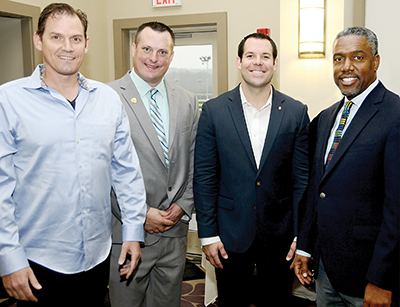
Rome Memorial’s SBHU conference in Vernon draws 200 health-care professionals
VERNON — More than 200 health-care professionals from around the region gathered at the Vernon Downs Casino Hotel Conference Center in Vernon for a day-long conference entitled, “Think Like an Olympian.” The event, hosted by the Senior Behavioral Health Unit (SBHU) of Rome Memorial Hospital, featured a number of speakers providing practical information on overcoming
Get Instant Access to This Article
Become a Central New York Business Journal subscriber and get immediate access to all of our subscriber-only content and much more.
- Critical Central New York business news and analysis updated daily.
- Immediate access to all subscriber-only content on our website.
- Get a year’s worth of the Print Edition of The Central New York Business Journal.
- Special Feature Publications such as the Book of Lists and Revitalize Greater Binghamton, Mohawk Valley, and Syracuse Magazines
Click here to purchase a paywall bypass link for this article.
VERNON — More than 200 health-care professionals from around the region gathered at the Vernon Downs Casino Hotel Conference Center in Vernon for a day-long conference entitled, “Think Like an Olympian.”
The event, hosted by the Senior Behavioral Health Unit (SBHU) of Rome Memorial Hospital, featured a number of speakers providing practical information on overcoming adversity, the value of perseverance, as well as the effects of bi-polar disorder and the newest methods of diagnosing and distinguishing mental illness.
According to event coordinator Greg Jones, admissions and marketing coordinator of the SBHU, the conference provided valuable information to caregivers who work with the mental health and aging population. “This year’s event offered a variety of information to participants on both the clinical side of caregiving as well as the importance of moving forward through difficult circumstances,” he said in a news release.
The conference’s keynote speaker, Johnny Quinn, a current U.S. Olympian in the sport of bobsled and a former NFL player, delivered a “thought-provoking,” motivational speech with a specific focus on health care and mental health.
“Johnny did a great job of sharing the knowledge he has gained from the trials and tribulations of being a former NFL player and encouraged attendees to break through barriers and use them as opportunities for professional and personal growth,” Jones said. “His unique story was both inspirational and focused on the value of perseverance.”
Jones added that the participants ranged from hospital and nursing home workers, nurses, physicians, and psychiatrists, to members of the community, “all of whom learned a great deal about the challenges associated with caring for the elderly, the mentally ill and healthcare in general today.”
Other speakers included Gabriel DiCristofaro on “Overcoming Mental Health Adversity” and Marcellus Cephas, M.D., MBA, medical director of the SBHU on “New Methods of Diagnosing and Distinguishing Mental Illness.”
Located on the hospital’s second floor, the 12-bed Senior Behavioral Health Unit is a New York State Office of Mental Health certified inpatient psychiatric unit provides health care for adults age 55 and older who have depression, anxiety, and other mental-health related issues. Treatment includes prescribed medications, psychotherapy, and other activities to help the older adults “regain their wellbeing.”
The New York State (NYS) Office of General Services commissioner recently announced that Stratus Consulting Group Inc., a Fayetteville–based consulting business focusing on professional staffing, was recently certified as a service-disabled veteran-owned business (SDVOB). The certification was granted by the Office of General Services’ (OGS) Division of Service-Disabled Veterans’ Business Development (DSDVBD). Stratus Consulting Group
Get Instant Access to This Article
Become a Central New York Business Journal subscriber and get immediate access to all of our subscriber-only content and much more.
- Critical Central New York business news and analysis updated daily.
- Immediate access to all subscriber-only content on our website.
- Get a year’s worth of the Print Edition of The Central New York Business Journal.
- Special Feature Publications such as the Book of Lists and Revitalize Greater Binghamton, Mohawk Valley, and Syracuse Magazines
Click here to purchase a paywall bypass link for this article.
 The New York State (NYS) Office of General Services commissioner recently announced that Stratus Consulting Group Inc., a Fayetteville–based consulting business focusing on professional staffing, was recently certified as a service-disabled veteran-owned business (SDVOB).
The certification was granted by the Office of General Services’ (OGS) Division of Service-Disabled Veterans’ Business Development (DSDVBD).
Stratus Consulting Group is led by Tim Coleman, president and CEO. He is a former U.S. Marine Corps infantry officer that served in the First Marine Division, with deployments to Central America, Southwest Asia, and Southeast Asia, according to the Stratus website. He worked for 13 years in the commercial sector as a plant manager, general manager, and a multi-location director both in the U.S. and Canada.
Stratus was one of six businesses that OGS announced had recently obtained the SDVOB certification. The other upstate New York business gaining the designation was Spa City Brew Bus LLC, a provider of charter and tour services that is based in Ballston Spa in Saratoga County,
The other four certified businesses are located downstate — one in the Hudson Valley, one in New York City, and two on Long Island.
The DSDVBD was created by Gov. Andrew Cuomo in May 2014 with enactment of the Service-Disabled Veteran-Owned Business Act. The law promotes and encourages participation of SDVOBs in NYS public procurements of public works, commodities, services, and technology to foster and advance economic development in the state, according to the OGS. As of Nov. 21, 400 businesses have been certified as SDVOBs in New York.
More information on the program and the certification process is available at http://ogs.ny.gov/Core/SDVOBA.asp.
Get our email updates
Stay up-to-date on the companies, people and issues that impact businesses in Syracuse, Central New York and beyond.