New York farms produced 140.7 million eggs in October, down 0.2 percent from 141 million eggs in the year-ago period, the USDA recently reported. The total number of layers in the Empire State decreased by 2.2 percent in October to 5.36 million from 5.48 million a year prior. New York egg production per 100 layers […]
New York farms produced 140.7 million eggs in October, down 0.2 percent from 141 million eggs in the year-ago period, the USDA recently reported.
The total number of layers in the Empire State decreased by 2.2 percent in October to 5.36 million from 5.48 million a year prior.
New York egg production per 100 layers totaled 2,623 eggs in October, up 2 percent from 2,572 eggs in October 2016.
In neighboring Pennsylvania, egg production increased more than 1 percent to 701 million eggs in October, from 692 million eggs a year earlier, the USDA reported.
Nationally, U.S. farms produced more than 8.8 billion eggs in October, down 0.2 percent from a year prior, the USDA reported.
SYRACUSE — The Syracuse–based law firms Cohen Compagni Beckman Appler & Knoll, PLLC (CCBLaw) and Wood & Smith P.C., which both focus on health-care law, will become one on Jan. 1. The discussions that led to the eventual combination happened “casually” for a few years, according to Michael Compagni, an attorney and partner with CCBLaw.
SYRACUSE — The Syracuse–based law firms Cohen Compagni Beckman Appler & Knoll, PLLC (CCBLaw) and Wood & Smith P.C., which both focus on health-care law, will become one on Jan. 1.
The discussions that led to the eventual combination happened “casually” for a few years, according to Michael Compagni, an attorney and partner with CCBLaw.
“We come across them often. We know each other,” he says. The discussions on a merger accelerated this past summer, with both firms believing “the timing is right.” Compagni spoke with CNYBJ on Nov. 27.
The new combined firm will use the Cohen Compagni Beckman Appler & Knoll, PLLC (CCBLaw) name.
Attorneys Bruce Wood and Bruce Smith will join the firm as partners and will conduct their legal work in the CCBLaw office at 507 Plum St., according to Compagni.
Wood & Smith currently operates an office in One Lincoln Center at 110 W. Fayette St. in Syracuse, according to its website.
CCBLaw currently has 11 attorneys, eight of whom are partners in the firm, according to its website. The firm also has seven support-staff members for a total employee count of 18, according to Anastasia Semel, an attorney with CCBLaw.
The Wood & Smith firm has one support staff member in addition to its two attorneys for whom the law firm is named. Wood and Smith formed their firm in 1998.
When the merger takes effect, CCBLaw’s employee count will increase to 21 employees, with the addition of those three employees.
About the law firms
Both firms have physician-centered practices, providing business, transactional, and regulatory counsel to physician groups, provider networks, ambulatory surgery centers, health-care joint ventures, and ancillary service providers.
The combination of the two law firms will add depth to what they offer clients, Compagni says.
“Although [Wood & Smith] focus on health law, they also do a lot of business and real estate [client work] and we do that [as well], primarily as support for our health-law clients, but that will again provide more depth for both sides,” he explains.
The merger will also “further strengthen” CCBLaw’s existing business, finance, and commercial real-estate practices, he adds.
The firms’ integration will provide Wood & Smith’s clients with access to CCBLaw’s existing areas of practice in commercial litigation, labor and employment, ERISA, employee benefits, and professional license defense. ERISA is short for the Employee Retirement Income Security Act of 1974.
The integration will “further CCBLaw’s goal of continuing to be a preeminent boutique health law firm in New York State,” the firm contended in its news release announcing the merger.
As we mark the 10th anniversary of the onset of the financial crisis, I would like to focus on some of the lessons we should draw from that harrowing experience, and the implications of those lessons for regulatory policy going forward. (As always, what I have to say reflects my own views and opinions and not
As we mark the 10th anniversary of the onset of the financial crisis, I would like to focus on some of the lessons we should draw from that harrowing experience, and the implications of those lessons for regulatory policy going forward. (As always, what I have to say reflects my own views and opinions and not necessarily those of the Federal Open Market Committee or the Federal Reserve System.)
The first lesson is that financial crises can have grave consequences — for the economy and the nation — that can linger for many years. The toll from the financial crisis was severe, with 9 million jobs lost and 8 million housing foreclosures amid the deepest economic downturn since the Great Depression. Moreover, the road back has been long and slow. Despite economic policies oriented toward supporting recovery, it has taken eight years to push the unemployment rate down to a level consistent with the Federal Reserve’s employment objective. Other residual impacts include the large size of the Federal Reserve’s balance sheet; significantly higher public debt; and substantial damage to public trust in the nation’s government and financial institutions.
The second lesson follows from the first. We need to ensure that we have a resilient financial system. To that end, we must ensure that the safeguards put in place in response to the crisis are fully appreciated and respected. But, it also means that we need to finish the job — for example, by building out a fully workable regime for resolving a complex, global firm if one were to become insolvent. We need to ensure that our financial system can continue to provide critical services not just during good times, but also during periods of stress.
These objectives are particularly relevant today, when reopening the Dodd-Frank Act and modifying our regulatory framework are under consideration. While it is appropriate to evaluate adjustments that might improve our regulatory regime, it is critical that we do not forget the hard-learned lessons of the crisis and — in the haste to reverse course — undermine the robustness and resiliency of the financial system.
The U.S. housing market boom and bust
At the heart of the crisis was the U.S. housing boom and bust. Between 1997 and 2006, U.S. home prices nearly doubled in real terms on a national basis. Then, when the boom turned to bust, real home prices reversed course, declining by about 40 percent on a national basis, with larger price declines in several states, according to the CoreLogic home price index. The magnitude of the national price declines was unprecedented during the postwar period.
The evolution of the financial crisis illustrates many key issues, including the potential hazards of financial innovation, the procyclicality of the financial system, and the importance of confidence in sustaining effective financial intermediation.
The housing boom and bust underscores several important lessons. First, the financial sector is not only a very complex system, but also one that can be inherently unstable — subject to excess, then sharp reversal. This is especially the case when an important innovation occurs, and market participants don’t fully appreciate the powerful feedback loops that first sustain a boom and then contribute to a bust when the process runs in reverse. This means that we as regulators must continually evaluate the financial system and monitor the landscape for new developments and innovations that, if taken too far, could lead to excess and put the system at risk.
Second, when there are potential excesses that could threaten financial stability, we should look to temper them. For example, in the run-up to the financial crisis, macroprudential tools — such as requiring larger down payments or more closely evaluating the incomes of borrowers — could have been implemented to limit the demand for housing. If such an approach were successful, home prices would not have risen so dramatically, and the subsequent bust would have been less severe. Another approach would have required financial intermediaries to build stronger capital and liquidity buffers as protection against a housing bust and an economic downturn.
Third, we need to carefully monitor the incentives that govern the behavior of borrowers, savers, and financial intermediaries.
Culmination of the crisis
The bust exposed many structural flaws in the financial system that exacerbated its instability. Without being exhaustive, these included the instability of the tri-party repo system, which supported the nation’s short-term funding markets; the risks of runs in the money market mutual fund industry; and the risk of contagion caused by the huge volume of outstanding bilateral (non-centrally cleared) over-the-counter (OTC) derivative obligations between the major financial intermediaries.
The near-collapse of the U.S. financial system underscores three critical lessons.
First, financial institutions must be robust to stress. In particular, they need to have enough capital to be considered solvent even after sustaining significant losses, so that they can maintain the market access needed to recapitalize. They also need sufficient liquidity buffers so that they can respond to shocks without having to sell illiquid assets.
Second, when we identify potential sources of instability that could amplify shocks, we need to make structural changes to the financial system to reduce or eliminate them. For example, the financial crisis made it clear that changes were needed in how tri-party repo transactions were unwound each day, net asset values were calculated for prime money market mutual funds, and OTC derivative obligations were cleared, settled, and risk-managed.
Third, there should be a viable and predictable resolution regime. We need to be able to resolve a large, systemically important bank or securities firm in a way that limits contagion and stress on the rest of the financial system, while at the same time protecting the taxpayer against loss.
Considerable progress
So, where are we relative to what is needed? As I see it, there has been considerable progress. The nation’s largest banks are much safer because of substantially higher capital and liquidity requirements, as well as robust stress tests. This enhanced resiliency has been achieved without a significant negative impact on the broad availability of credit — recognizing that it is now more difficult for households with low credit scores to obtain a mortgage. Most importantly, improving the capacity of such firms to continue to lend during times of stress should make the overall economy more stable.
We have also made significant progress in addressing many of the structural weaknesses uncovered by the financial crisis. Money market reform has made the prime money market mutual fund industry smaller and safer. We have also reduced the amount of risk in the system by requiring that most standardized OTC derivatives be cleared through central counterparties, where multilateral netting occurs.
More work is still needed
Yet, we should not be complacent, as there are important areas where our work is not complete. Relative to other countries, the United States has limited ability to implement effective macroprudential tools. That is because oversight is shared by several different entities, and the power to implement macroprudential tools is constrained. Another challenge is the diverse structure of the U.S. financial system, in which non-banks and capital markets play a substantial role in credit intermediation. Although the Financial Stability Oversight Council (FSOC) could conceivably play a greater role here, whether it will be able to do so effectively remains uncertain.
Another issue that needs attention is the ability to resolve large, complex financial firms that operate on a global basis. The framework of requiring such firms to hold a large buffer of debt that could be converted into equity at the time of non-viability is an important step forward. But, the task of operationalizing this on a global basis in a way that is fully credible to these firms’ customers and counterparties has not been completed. Achieving clarity about the roles and responsibilities of home and host country authorities is still a work in progress.
Where the pendulum may have swung too far
At the same time, there are some areas where the pendulum may have swung too far, where the costs of regulation — including compliance costs and the potential impact on the provision of services — are likely to exceed the benefits. In this vein, I favor regulatory relief for smaller banking organizations. First, such firms individually are not systemically important, and therefore do not pose a significant risk to the viability of the U.S. financial system. Second, the regulatory burdens on smaller firms can be heavy because they don’t have the scale over which compliance and other regulatory costs can be spread. Regulatory requirements should be appropriately calibrated to avoid inadvertently creating a competitive advantage for larger financial firms.
I also think that the Volcker rule could be modified so that its implementation would be less burdensome. As I see it, regulators could review the criteria for permissible market-making. Trading activity should be viewed as market-making when it is customer-facing and inventories are not excessively large or stale. Market-making serves an important function, and it is important that trading desks can intervene and buy during flash crashes or sell during flash surges. Permitting this could provide greater liquidity and stability to financial markets. I would also exempt smaller banking institutions from the Volcker rule since they rarely, if ever, engage in proprietary trading.
Do no harm
Many speculate that Congress will make changes to the Dodd-Frank Act. If the scope is confined mainly to small bank relief and adjusting how the Volcker rule is applied, I have no objection. But, because the Dodd-Frank Act addresses many of the key lessons of the crisis, I think it appropriate that changes be made carefully — with a paring knife, rather than with a meat cleaver. Here, I would underscore the importance of preserving higher capital and liquidity requirements for systemically important banks; Title VII, which mandates the central clearing of standardized OTC derivatives; and Title VIII, which gives the Federal Reserve an oversight role for financial market utilities that are systemically important, and which helps promote more uniform risk management standards.
In conclusion, as we reflect on potential changes to the U.S. regulatory regime, we should not lose sight of the horrific damage caused by the financial crisis, including the worst recession of our lifetimes and millions of people losing their jobs and homes. We had a woefully inadequate regulatory regime in place, and while it is much better now, there is still work to do. We should finish the job as quickly as possible, and we should do no harm as we adjust our regulatory regime to make it more efficient.
William C. Dudley is president and CEO of the Federal Reserve Bank of New York. This viewpoint article is drawn and edited from his remarks, as presented for delivery, at a Nov. 6 speech at The Economic Club of New York in New York City.
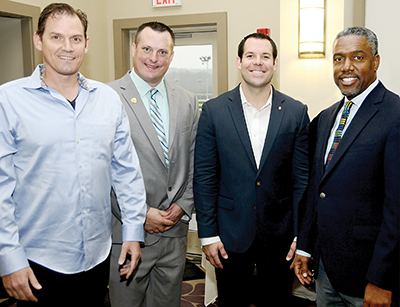
VERNON — More than 200 health-care professionals from around the region gathered at the Vernon Downs Casino Hotel Conference Center in Vernon for a day-long conference entitled, “Think Like an Olympian.” The event, hosted by the Senior Behavioral Health Unit (SBHU) of Rome Memorial Hospital, featured a number of speakers providing practical information on overcoming
VERNON — More than 200 health-care professionals from around the region gathered at the Vernon Downs Casino Hotel Conference Center in Vernon for a day-long conference entitled, “Think Like an Olympian.”
The event, hosted by the Senior Behavioral Health Unit (SBHU) of Rome Memorial Hospital, featured a number of speakers providing practical information on overcoming adversity, the value of perseverance, as well as the effects of bi-polar disorder and the newest methods of diagnosing and distinguishing mental illness.
According to event coordinator Greg Jones, admissions and marketing coordinator of the SBHU, the conference provided valuable information to caregivers who work with the mental health and aging population. “This year’s event offered a variety of information to participants on both the clinical side of caregiving as well as the importance of moving forward through difficult circumstances,” he said in a news release.
The conference’s keynote speaker, Johnny Quinn, a current U.S. Olympian in the sport of bobsled and a former NFL player, delivered a “thought-provoking,” motivational speech with a specific focus on health care and mental health.
“Johnny did a great job of sharing the knowledge he has gained from the trials and tribulations of being a former NFL player and encouraged attendees to break through barriers and use them as opportunities for professional and personal growth,” Jones said. “His unique story was both inspirational and focused on the value of perseverance.”
Jones added that the participants ranged from hospital and nursing home workers, nurses, physicians, and psychiatrists, to members of the community, “all of whom learned a great deal about the challenges associated with caring for the elderly, the mentally ill and healthcare in general today.”
Other speakers included Gabriel DiCristofaro on “Overcoming Mental Health Adversity” and Marcellus Cephas, M.D., MBA, medical director of the SBHU on “New Methods of Diagnosing and Distinguishing Mental Illness.”
Located on the hospital’s second floor, the 12-bed Senior Behavioral Health Unit is a New York State Office of Mental Health certified inpatient psychiatric unit provides health care for adults age 55 and older who have depression, anxiety, and other mental-health related issues. Treatment includes prescribed medications, psychotherapy, and other activities to help the older adults “regain their wellbeing.”
The New York State (NYS) Office of General Services commissioner recently announced that Stratus Consulting Group Inc., a Fayetteville–based consulting business focusing on professional staffing, was recently certified as a service-disabled veteran-owned business (SDVOB). The certification was granted by the Office of General Services’ (OGS) Division of Service-Disabled Veterans’ Business Development (DSDVBD). Stratus Consulting Group
The New York State (NYS) Office of General Services commissioner recently announced that Stratus Consulting Group Inc., a Fayetteville–based consulting business focusing on professional staffing, was recently certified as a service-disabled veteran-owned business (SDVOB).
The certification was granted by the Office of General Services’ (OGS) Division of Service-Disabled Veterans’ Business Development (DSDVBD).
Stratus Consulting Group is led by Tim Coleman, president and CEO. He is a former U.S. Marine Corps infantry officer that served in the First Marine Division, with deployments to Central America, Southwest Asia, and Southeast Asia, according to the Stratus website. He worked for 13 years in the commercial sector as a plant manager, general manager, and a multi-location director both in the U.S. and Canada.
Stratus was one of six businesses that OGS announced had recently obtained the SDVOB certification. The other upstate New York business gaining the designation was Spa City Brew Bus LLC, a provider of charter and tour services that is based in Ballston Spa in Saratoga County,
The other four certified businesses are located downstate — one in the Hudson Valley, one in New York City, and two on Long Island.
The DSDVBD was created by Gov. Andrew Cuomo in May 2014 with enactment of the Service-Disabled Veteran-Owned Business Act. The law promotes and encourages participation of SDVOBs in NYS public procurements of public works, commodities, services, and technology to foster and advance economic development in the state, according to the OGS. As of Nov. 21, 400 businesses have been certified as SDVOBs in New York.
More information on the program and the certification process is available at http://ogs.ny.gov/Core/SDVOBA.asp.
One of the quirks of life in Washington, D.C., is that pretty much the only people who don’t refer to lobbyists by that name are, well, lobbyists. They’re “policy advisors,” “strategic counsel,” or “public relations advisors,” or lawyers, or even just “consultants.” Whatever they’re called, though, they play a huge role in making policy. For
One of the quirks of life in Washington, D.C., is that pretty much the only people who don’t refer to lobbyists by that name are, well, lobbyists. They’re “policy advisors,” “strategic counsel,” or “public relations advisors,” or lawyers, or even just “consultants.” Whatever they’re called, though, they play a huge role in making policy.
For the most part, they are able, well-informed, and skillful at what they do. Their aim is to develop a cordial relationship with policymakers — whether elected to Congress or serving in some federal agency — so that they can advance their points of view. And policymakers rely on them: for information, for research and writing, for persuasive arguments, and, of course, for political support.
Though there are members of the influence industry who aren’t especially well-heeled, there are plenty who are. As a whole, they spend a lot of money: $3.15 billion in 2016, according to the Center on Responsive Politics, which tracks lobbying and lobbyists.
Some industries — among them pharmaceuticals, communications, insurance, and oil and gas — employ hundreds of people whose sole mission is to influence federal policymaking. They write checks to politicians for speeches, dole out campaign contributions, pay for travel. They work hard to get their favored politicians elected and to rally their members at important moments. They are extremely sophisticated in the use of media, including social media. They pursue public education campaigns, grassroots organizing, and other means of getting members of the public to back them.
There is a reason for all of this: the stakes are high. When I was in Congress, I used to wonder why I’d see CEOs walking around Capitol Hill or stopping by my office for a visit. These are important men and women who have major responsibilities that have nothing to do with politicians, and yet there they are. Why? Because, if they can get a few words added to or eliminated from regulations or legislation, their companies can benefit by millions and sometimes billions of dollars. It’s that simple.
And it’s why, no matter how much politicians like to talk about “draining the swamp,” they never do. The swamp keeps growing because what’s at stake for the influence industry and the interests that fund it does too.
I should say that I’ve known a lot of lobbyists over the years, and respected them as hard-working, well-informed participants in the process. I’ve been helped by many of them, and misled by only a few. But I worry about the growth of the lobbying industry and its outsized weight compared to that of ordinary Americans. As the impact of well-resourced interests grows, I think the voice of ordinary citizens has been diminished. The voter may have a vote every few years, and that should not be discounted, but it cannot possibly match the effect of people who are there day in and day out, wielding the resources many of them can bring to bear.
So, what do we do about this? I do not think it’s enough to say, as some politicians do, that in the scheme of things there are so many countervailing voices that they cancel each other out. That’s simplistic.
Part of the answer lies with robust disclosure and transparency laws and enforcement. But just as important, I believe that Congress ought to increase its capacity to do its own research, analysis, oversight, and fact-finding. It has some capabilities in this regard, through the Congressional Research Service, the Congressional Budget Office, and the Government Accountability Office. But as the Brookings Institution pointed out earlier this year, those three agencies, through budget cuts, lost 45 percent of their combined staffs over the last 40 years, even as members’ workloads grew. Lacking the independently provided information they need to make informed decisions, Brookings noted, “Congress members will fall back on documents provided by interest groups and lobbying efforts.”
The problem is, members of Congress don’t seem especially concerned about the outsized role that the influence that the lobbying industry plays in their deliberations. They also don’t seem especially interested in building their own independent capacity to analyze issues and legislation. But if you care about representative democracy, you ought to be.
Lee Hamilton is a senior advisor for the Indiana University (IU) Center on Representative Government, distinguished scholar at the IU School of Global and International Studies, and professor of practice at the IU School of Public and Environmental Affairs. Hamilton, a Democrat, was a member of the U.S. House of Representatives for 34 years, representing a district in south central Indiana.
Fust Charles Chambers LLP has hired the following people as associates. ARIANA ANOCETO has joined as a tax associate. She received her bachelor’s degree in accounting, with a concentration in information systems, and MBA from Le Moyne College. Anoceto is currently working to complete the examination requirements to earn her CPA license. LUKE ASTON joins
Fust Charles Chambers LLP has hired the following people as associates. ARIANA ANOCETO has joined as a tax associate. She received her bachelor’s degree in accounting, with a concentration in information systems, and MBA from Le Moyne College. Anoceto is currently working to complete the examination requirements to earn her CPA license. LUKE ASTON joins the firm as an audit associate. He received his bachelor’s degree and MBA in accounting from SUNY Oswego. Aston has passed all four parts of the CPA exam and is currently gaining relevant experience to meet license requirements. MIKE DOWNS has come aboard as an audit associate. He received his bachelor’s degree in accounting from SUNY Geneseo and his MBA in public accounting from SUNY Oswego. Downs is currently working to complete the examination requirements to earn his CPA license. BRYAN KIMBALL has been hired as an audit associate. He received his bachelor’s degree in accounting from SUNY Oswego. Kimbell is working to complete the examination requirements to earn his CPA license. AMANDA LATTIMORE has joined the firm as an audit associate. She received her bachelor’s degree and MBA in accounting from SUNY Oswego. Lattimore is working to complete the examination requirements to earn her CPA license. KATIE REGIN has been hired as an audit associate. She received her bachelor’s degree and MBA in accounting from SUNY Oswego. Regin is working to complete the examination requirements to earn her CPA license. KRISTI TARR has come aboard as a special project analyst after holding several financial accounting and analyst positions with both local and national organizations. She received her bachelor’s degree in business administration with accounting specialty from Saint Leo University in Tampa, Florida.
Chianis + Anderson Architects announced that RENEE DEPRATO recently joined the firm as business development coordinator. She has more than 15 years of experience in communications and marketing. DePrato received her bachelor’s degree in health and human services from the University at Buffalo.
Chianis + Anderson Architects announced that RENEE DEPRATO recently joined the firm as business development coordinator. She has more than 15 years of experience in communications and marketing. DePrato received her bachelor’s degree in health and human services from the University at Buffalo.
The Hayner Hoyt Corporation has hired recent SUNY College of Environmental Science and Forestry graduate AARON DEVEREAUX as a project engineer. With a degree in construction management, he is a certified associate constructor and previously worked as an assistant project manager at G.M. Crisalli & Associates, where he gained experience in commercial construction project management
The Hayner Hoyt Corporation has hired recent SUNY College of Environmental Science and Forestry graduate AARON DEVEREAUX as a project engineer. With a degree in construction management, he is a certified associate constructor and previously worked as an assistant project manager at G.M. Crisalli & Associates, where he gained experience in commercial construction project management and estimating. CONOR UTTER has joined Hayner Hoyt as a project engineer. Also a recent SUNY ESF graduate, he graduated with a degree in sustainable construction management engineering. He previously worked as a construction laborer in Ithaca and has carpentry experience. Another recent SUNY ESF grad, ZACH BATES, has joined Hayner Hoyt as a project engineer. Graduating with a degree in construction management, he has prior experience with construction project oversight, precast concrete work, and residential repairs and additions.
Barton & Loguidice (B&L) announced that DONALD R. GENTILCORE, JR. has joined the firm’s Solid Waste Group as a senior project manager in its Syracuse office. He received his bachelor’s degree in environmental management from Rochester Institute of Technology. Gentilcore has more than 20 years of experience in management, operations, development, construction, and permitting in
Barton & Loguidice (B&L) announced that DONALD R. GENTILCORE, JR. has joined the firm’s Solid Waste Group as a senior project manager in its Syracuse office. He received his bachelor’s degree in environmental management from Rochester Institute of Technology. Gentilcore has more than 20 years of experience in management, operations, development, construction, and permitting in the solid waste industry. In his previous position as a chief operating officer, he developed solid waste projects in various markets. Gentilcore has also served as an area manager for Progressive Waste Solutions and also previously served as district manager for the Seneca Meadows Landfill, which was recognized with multiple awards during his tenure. He has managed complex projects across multiple solid-waste disciplines and is a registered New York State Department of Environmental Conservation Class A/B operator of underground storage tanks.
Get our email updates
Stay up-to-date on the companies, people and issues that impact businesses in Syracuse, Central New York and beyond.