Stay up-to-date on the companies, people and issues that impact businesses in Syracuse, Central New York and beyond.

One of SU’s “single largest gifts” to help fund National Veterans Resource Center
SYRACUSE — Syracuse University (SU) describes it as “one of the single largest gifts” in its history, one that will benefit an upcoming addition to its campus. SU on Feb. 5 announced a $20 million donation from life trustee Daniel D’Aniello and his wife, Gayle, for the upcoming National Veterans Resource Center (NVRC). The donation […]
Become a Central New York Business Journal subscriber and get immediate access to all of our subscriber-only content and much more.
Click here to purchase a paywall bypass link for this article.
SYRACUSE — Syracuse University (SU) describes it as “one of the single largest gifts” in its history, one that will benefit an upcoming addition to its campus.
SU on Feb. 5 announced a $20 million donation from life trustee Daniel D’Aniello and his wife, Gayle, for the upcoming National Veterans Resource Center (NVRC).
The donation will help pay for the construction of the NVRC. The $62.5 million, 115,000-square-foot facility will open in the spring of 2020.
D’Aniello graduated from Syracuse University in 1968 and is a veteran of the U.S. Navy, SU said in a news release.
Once built, the NVRC will house the school’s Institute for Veterans and Military Families (IVMF). The IVMF is an academic institute focused on the concerns of the nation’s more than 20 million veterans and their families as well as other veteran-focused educational, vocational and community-engagement programs, according to SU.
D’Aniello also serves as co-chair of the IVMF advisory board, the school said.
Syracuse University Chancellor Kent Syverud describes the D’Aniello family’s donation as “profoundly transformative” and one that will allow Syracuse University to “fulfill its promise of being the best place for veterans.”
New York City–based SHoP Architects is designing the NVRC. SU in November chose Rochester–based LeChase Construction Services, LLC to lead construction-management efforts on the project.
About D’Aniello
Daniel D’Aniello is co-founder and chairman emeritus of the Carlyle Group (NASDAQ: CG), a Washington, D.C.–based investment firm.
He also served as a supply officer in the U.S. Navy from 1968 to 1971. He went on to earn a graduate degree at the Harvard Business School, where he was a Teagle Foundation Fellow.
D’Aniello in 2016 was awarded the U.S. Navy Memorial Foundation’s Lone Sailor Award for drawing upon his sea-service experience to achieve success in his personal and professional life while exemplifying the core values of honor, courage and commitment, per the release.
Since its founding in 2011, more than 90,000 transitioning service members, veterans and military family members have participated in IVMF programs. The IVMF has pledged to place 30,000 veterans, transitioning service members and military spouses into desirable jobs by 2022 through its veterans’ career-transition program called “onward to opportunity.”
“The work being done at Syracuse, specifically at the IVMF, is simply unrivaled,” D’Aniello said. “The fact is that unlike any other university, Syracuse understands and appreciates the significant contributions by and the great role veterans and military families play in our society. This new center will allow Syracuse University to help our nation not only respond to but anticipate the unique needs of this population by helping veterans more seamlessly transition to civilian life. To say this center is a game changer in the ongoing efforts to better the post-service lives of our veterans and their families is an understatement.”

Centolella Green Law merges with Virginia–based law firm
DeWITT — DeWitt–based law firm Centolella Green Law, P.C. has combined with a law firm based in the Richmond, Virginia area that focuses on health-care law. The firm’s merger with Glen Allen, Virginia–based Hancock, Daniel & Johnson, P.C. became effective Feb. 1, says Jason Centolella, a partner in and president of Centolella Green Law. The
Become a Central New York Business Journal subscriber and get immediate access to all of our subscriber-only content and much more.
Click here to purchase a paywall bypass link for this article.
DeWITT — DeWitt–based law firm Centolella Green Law, P.C. has combined with a law firm based in the Richmond, Virginia area that focuses on health-care law.
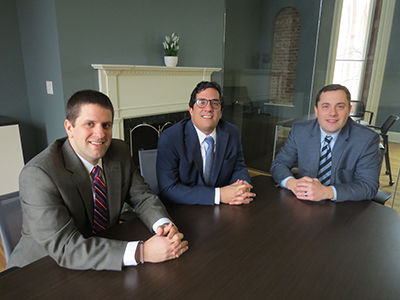
The firm’s merger with Glen Allen, Virginia–based Hancock, Daniel & Johnson, P.C. became effective Feb. 1, says Jason Centolella, a partner in and president of Centolella Green Law.
The Virginia law firm markets itself as Hancock Daniel.
The local firm focuses on legal matters pertaining to health care, business, and taxes, says Centolella, who spoke with BJNN on Jan. 31 at its office at the Hamilton White House at 307 S. Townsend St. in Syracuse.
Following the merger, the former Centolella Green firm is maintaining both its Syracuse office and its main office at 6832 E. Genesee St. in DeWitt.
The firm is seeing “a lot of changes” in the health-care sector, says Centolella.
“The clients are getting bigger. The systems are getting larger. We felt that it would be the best way to serve our client by having a deeper bench,” he added. “In the health-care space, there’s no other or maybe only a handful of law firms that have as deep of a health-care bench as Hancock Daniel.”
With the merger, the local firm will no longer use the name Centolella Green Law, according to Centolella.
The local firm has four partners. Centolella and Dr. G. Randall Green are joining Hancock Daniel as directors, while Sam Burgess and Eric Bronstad will join the firm as associates.
Centolella says he was not allowed to discuss the financial terms or other transaction details of the deal.
On its own, Centolella Green had four attorneys and three support employees. With the combination, Hancock Daniel’s employee count increases to 127, including a total of 64 attorneys.
“Jason and his team have developed a very sophisticated health-law practice, which is not easy to do … and it’s a geographic region that’s interesting to us,” says Page Gravely, managing partner at Hancock Daniel. Gravely spoke with BJNN by phone during the interview at the Hamilton White House.
Centolella became familiar with Hancock Daniel while working with attorney James Daniel on legal matters pertaining to an accountable-care organization in 2012. Daniel is a senior partner and founder of the Hancock Daniel firm. The accountable-care organization is located in upstate New York, but Centolella declined to identify a specific location.
They stayed in contact, would share best practices, and their business relationship turned into a friendship. Over time, they started seeing “a lot of synergies” between their firms.
“One day, we were both in Washington, D.C., we raised the issue and it progressed from there,” says Centolella.
Daniel and Centolella had been considering the merger since October 2016. They finalized the deal last fall, according to Centolella.
“Sometimes my voice isn’t heard.” I have often heard this complaint from leaders at all levels — individual contributors, middle managers, and senior level executives. It’s a critical issue. When people don’t feel heard, they often believe they’re not being fully utilized for all they have to offer — and often, they’re not. They have something
Become a Central New York Business Journal subscriber and get immediate access to all of our subscriber-only content and much more.
Click here to purchase a paywall bypass link for this article.
“Sometimes my voice isn’t heard.” I have often heard this complaint from leaders at all levels — individual contributors, middle managers, and senior level executives. It’s a critical issue. When people don’t feel heard, they often believe they’re not being fully utilized for all they have to offer — and often, they’re not. They have something to give, perhaps in the form of an idea, and the team is missing out on it.
When people aren’t heard, it’s not only a problem for the person experiencing this, but also for the organization as a whole. The consequences tend to snowball. If people don’t feel heard, they may not be completely committing to organizational decisions. The company is therefore missing out on that commitment, and also then losing the opportunity to tap into all the people resources available to them. And, since speaking up is part of how one develops leadership presence and influence, not being heard causes people to feel disrespected and to lose confidence. This loss of confidence causes them to hesitate to try things outside their comfort zone, which is precisely how organizations nurture and grow their leaders. So, both growth and leadership suffer.
For the “unheard” individual, consider two questions:
Question 1 — Are you not being heard because you aren’t speaking up — due to either lack of confidence, lack of opportunity to connect with the right people, or because you are surrounded by a bunch of extraverts who just won’t shut up (or all of the above)?
Question 2 — Are you not being heard because what you’re saying doesn’t seem to be received, considered, or recognized?
Let’s tackle each scenario.
Lack of confidence
Next question: why? Why do you lack confidence? Reassess your qualifications, experience, and education. If you’ve got what it takes, say it. But perhaps to build up your confidence, you might need more practice. So, get more practice. Find opportunities to practice speaking up in low-risk situations. Practice sharing your ideas and opinions — especially if they differ — in an environment that feels somewhat easy. Then work your way up. If you truly believe in what you have to say, then say it. Don’t let the inner critic inside your head get the best of you. The more you speak up, the easier it will get.
Lack of opportunity
If you feel like you don’t have the opportunity to be heard by the right people, work on building rapport with those right people. Building relationships is part of one’s professional development. It’s how things get done. And if you want to be more influential, rapport is the first place to start. Connect with that someone in the lunch line or at the coffee machine, get on a committee that you know that someone is also on, or join that individual’s golf league. Find something you have in common with that person that will allow you to get to know him/her better. Think genuine bonding and rapport.
Surrounded by extraverts
Get used to it, my friend. The world is full of them. Here’s the funny thing: they’re wondering why you’re so quiet and why you won’t speak up more often. Start saying things like, “Hey, I’d like to jump in here.” Or “I’ve got something I’d like to share.” Whatever it takes to get their attention, say it. And if that doesn’t work, you can try, “Who wants a cookie?” It works with my puppy every time.
Message not received
This is where you need some feedback from others you trust. Could it be that the problem is with how you’re saying it (tone, pace, volume, message clarity)? Recruit some trusted colleagues to provide feedback on your interactions with others. Are you rambling when delivering a thought — saying too much to the point where the crux of your message is diluted? Thinking out loud isn’t the most effective way to deliver an important idea. Save that for brainstorming sessions. Make sure your message is clear and succinct, especially when it’s a higher priority idea or request.
Are you not saying enough? Sharing an idea is not enough. Sharing your idea and explaining why it’s important is critical. Don’t skip the part about how your idea will impact the bottom line, performance, employee engagement, or client relationships. Also, play around with prefacing your ideas with “From my experience…,” “Here’s what I’ve seen…,” “What my work has taught me is…” That will get listeners’ attention every time. If you’re thinking that what you have to say won’t make a difference, recognize this thought for what it is: an assumption. Don’t do it. Your idea just might spark yet a different thought that could be even more amazing than the first. Just put it out there. Some ideas are great, some good, some not so good. That’s what makes great ideas great.
Lastly, if someone else is controlling the conversation in such a way that it appears they are attempting to convince you to their point of view, hear them out. Then say, “that’s one approach. Would you be willing to consider another?”
One definition of leadership is “to influence an outcome.” If you are taking your leadership seriously, you must find the right way, the best way, to make your voice heard. Take some time to consider how you can best do so. Recognize that we may have to come at things multiple times, utilizing different approaches. Keep going. You will make a difference, and both you and the organization will benefit.
Keep speaking, so you can keep leading.
Cindy Masingill is a partner with Emergent, a leadership training and professional coaching company based in Baldwinsville, offering services and programs to improve the performance of individuals, teams, and organizations. Contact her at Cindy@GetEmergent.com

NexGen Power Systems receives $3 million in tax incentives from OCIDA
SYRACUSE — The $90 million building New York State built for California light-bulb maker Soraa, only to have the company pull out, moved a step closer to usefulness Feb. 6. The Onondaga County Industrial Development Agency (OCIDA) approved a 15-year, $3.1 million payment in lieu of taxes (PILOT) agreement with a different California firm to
Become a Central New York Business Journal subscriber and get immediate access to all of our subscriber-only content and much more.
Click here to purchase a paywall bypass link for this article.
SYRACUSE — The $90 million building New York State built for California light-bulb maker Soraa, only to have the company pull out, moved a step closer to usefulness Feb. 6.
The Onondaga County Industrial Development Agency (OCIDA) approved a 15-year, $3.1 million payment in lieu of taxes (PILOT) agreement with a different California firm to take over the empty space in DeWitt.
Following a brief phone discussion with Dinesh Ramanathan, president and CEO of NexGen Power Systems, the OCIDA board approved the PILOT for his company. But the vote didn’t come until after a discussion of what measures were in place to ensure the project went through.
Responding to questions from OCIDA board member Kevin Ryan, Ramanathan said there was wording in the agreement requiring the company to reach certain job-creation numbers. “There are clawbacks and other terms that essentially make sure what happened with Soraa doesn’t happen with us,” Ramanathan told the board. A clawback is the recovery of money already disbursed.
“We have clawbacks on everything,” OCIDA Executive Director Julie Cerio added.
The space NexGen is looking to occupy is an 82,000-square-foot building at 50 Collamer Crossing Parkway in DeWitt originally built, with state taxpayer money, to host Soraa, a maker of LED lighting. That company eventually walked away from the project.
In its application, NexGen said the high-tech company expects to create 290 jobs in the next seven years. The application said those jobs will pay annual salaries between $51,000 for fabrication technicians and $155,000 for those working in research and development.
OCIDA also approved a sales-tax exemption on materials the firm buys to improve the facility, saving NexGen up to $40,000.
NexGen holds multiple patents and creates gallium-nitride semiconductor devices. The company says its products allow for the building of smaller and more efficient power converters. Such converters are part of most electronics, creating a market NexGen said tops $3 billion and is expected to grow larger than $9 billion.
During the phone call, Ramanathan said Empire State Development had approved a $15 million grant for NexGen’s project.
Lockheed Martin to pay first quarter dividend on March 23
The Lockheed Martin Corporation (NYSE: LMT) board of directors has authorized a first quarter 2018 dividend of $2.00 per share. The dividend is payable on March 23, to holders of record as of the close of business on March 1. It’s the same amount that Lockheed paid for its fourth-quarter dividend, when it raised the
Become a Central New York Business Journal subscriber and get immediate access to all of our subscriber-only content and much more.
Click here to purchase a paywall bypass link for this article.
The Lockheed Martin Corporation (NYSE: LMT) board of directors has authorized a first quarter 2018 dividend of $2.00 per share.
The dividend is payable on March 23, to holders of record as of the close of business on March 1.
It’s the same amount that Lockheed paid for its fourth-quarter dividend, when it raised the payment from the $1.82 paid in the third quarter.
Headquartered in Bethesda, Maryland, Lockheed Martin is a global security and aerospace company that employs about 97,000 people worldwide. Locally, Lockheed Martin currently employs about 1,600 people at its Salina plant and about 2,500 at its Owego facility.
Businesses need to use their CRM systems for marketing as well
When people think of a customer relationship management (CRM) tool, they think “sales.” If that’s the case, then you’re doing it wrong. Yes, this is a technology system where sales managers can manage and analyze all customer/prospect data — a repository for all the information that their sales team needs to be successful and a
Become a Central New York Business Journal subscriber and get immediate access to all of our subscriber-only content and much more.
Click here to purchase a paywall bypass link for this article.
When people think of a customer relationship management (CRM) tool, they think “sales.” If that’s the case, then you’re doing it wrong.
Yes, this is a technology system where sales managers can manage and analyze all customer/prospect data — a repository for all the information that their sales team needs to be successful and a place where they can see what their salespeople are doing.
But, most companies don’t use their CRM to its full capability and that’s where they’re missing the boat. I’m talking about the companies that aren’t using CRM in their marketing departments as well.
Is yours one of them? This is understandable as, even at the sales level, there is often a lack of resources to really dig deep into the software or people to babysit all sales reps and ensure they are inputting the right information into the right places. One of the biggest problems facing organizations is the alignment of their sales and marketing teams. The sales team is doing one thing while the marketing team is doing another. While this is an age-old problem in business, there are many things today that can help put these both on the same track.
Your CRM system is one of those things. It probably has the ability to keep track of your marketing efforts and even house the documents within the system to allow for easy access to a marketer’s dream of messaging consistency.
Let’s talk about marketing and sales alignment and how it can help drive sales — which, let’s be honest, is why we are all in business, after all.
While we shouldn’t ignore our traditional marketing strategies, it’s important to make sure we try some newer ones as well. Content marketing through blogs, webinars, and white papers will influence the conversations and thought processes potential buyers have at the start of the buying cycle. You want to be seen as an authority.
Your CRM system can help organize and manage information so your sales team knows what prospects are seeing and engaging with. It becomes an assistant to the sale. It’s no longer the sole responsibility of sales reps to generate leads. It should be a joint venture between marketing and sales. The digital world has allowed marketers to become lead generators. Marketers have the power to influence early dialogue, sometimes even before prospects know they need to buy.
Having a comprehensive and properly used CRM will allow a real-time glance of the effectiveness of all marketing initiatives and how they travel through the sales funnel, allowing better decisions to be made within the sales and marketing departments.
If your sales director and marketing director are not meeting and working together regularly, this is a problem. In today’s world, these two people need to ride in tandem to hit your sales goals. If you outsource your marketing to an advertising agency and it has not asked the sales director to be in the strategy and measurement meetings, find another agency. Lastly, if you don’t have a CRM, get one and use it for marketing.
Jenn Cline is chief operating officer at ABC Creative Group and owner of Nordique Consulting Group, a sales and marketing consulting firm. Contact her at jenn@abcideabased.com
New York milk production dips more than 2 percent in December
New York dairy farms produced 1.22 billion pounds of milk in December, down 2.2 percent from the year-ago period, the USDA’s National Agricultural Statistics Service (NASS) recently reported. Milk production per cow in the state averaged 1,950 pounds in December, down 3 percent from 2,010 pounds a year prior. The number of milk cows on
Become a Central New York Business Journal subscriber and get immediate access to all of our subscriber-only content and much more.
Click here to purchase a paywall bypass link for this article.
New York dairy farms produced 1.22 billion pounds of milk in December, down 2.2 percent from the year-ago period, the USDA’s National Agricultural Statistics Service (NASS) recently reported.
Milk production per cow in the state averaged 1,950 pounds in December, down 3 percent from 2,010 pounds a year prior.
The number of milk cows on farms in New York state totaled 625,000 head in December, up 0.8 percent from 620,000 head in December 2016, NASS reported.
The average milk price received by New York dairy farmers in November was $18.30 per hundredweight, up 10 cents from October and 50 cents higher than in November 2016.
In neighboring Pennsylvania, dairy farms produced 916 million pounds of milk in December, up 0.5 percent from a year earlier. The average milk price received by Pennsylvania farmers in November was $18.70 per hundredweight, up 10 cents from October, and $1 higher than in November 2016.

Area colleges host game makers for global event
SYRACUSE — Jan. 26-27 wasn’t a typical weekend for thousands of college students, including more than two dozen in Central New York, as they gathered to take part in a planet-straddling game-creating event. Global Game Jam, organized by a group of the same name, took place at 803 spots around the world, attracting 42,800 participants
Become a Central New York Business Journal subscriber and get immediate access to all of our subscriber-only content and much more.
Click here to purchase a paywall bypass link for this article.
SYRACUSE — Jan. 26-27 wasn’t a typical weekend for thousands of college students, including more than two dozen in Central New York, as they gathered to take part in a planet-straddling game-creating event.
Global Game Jam, organized by a group of the same name, took place at 803 spots around the world, attracting 42,800 participants in 108 countries. Combined, participants created 8,597 games.
On Jan. 26, as 5 p.m. struck in each time zone, participants learned what the theme was for this year’s event. Then they chose teams from among themselves and set to work creating games — video games, card games, or even board games.
They had 48 hours, until 5 p.m. Sunday, to complete their work and share it with the world on Global Game Jam’s website (globalgamejam.org).
Syracuse event
By Saturday evening, midway through the event, teams at Syracuse University were deep into their work. Haley Knapp, a senior studying music, history, and culture at Syracuse’s College of Arts and Sciences, was putting together the soundtrack to play with the game her team was creating.
To match the Global Game Jam theme, “transmission,” the team was creating a game called “Mursil,” an Arabic word meaning “transmitter.”
Junior Anjelica Escalante, who is majoring in English and textual studies at the College of Arts and Sciences, was creating the story script, including dialogue for the characters. Mursil was to be a “choose-your-adventure” game where players can decide what to do next and each choice would bring a different result.
“Middle Eastern steam punk visual” is how Knapp described the look of the game, with cartoon-style characters in the foreground and sepia-toned backgrounds.” The soundtrack she was working on was “Pan-Asian fusion” with music and instruments from the region.
The idea of the game is to take steps to fix a transmitter in time for a festival, lest the ruler get angry with your family.
The task of making the game work on a computer fell to Alexander Jansing, a graduate student at SUNY Polytechnic Institute who works as a senior consultant for Booz Allen Hamilton in Rome. He was focused on writing in open-source software called Ren’Py and had a clear goal. “My thing is I just want to get a game finished. One of the most important parts of this is getting it finished,” he says.
At 28, he’s seven years older than his teammates. That’s not unusual, area Game Jam organizers say. The event attracts plenty of students but also adults who are just interested in games. Like Jansing, Knapp, and Escalante, many don’t even know each other before the event begins, but they team up shortly after the start.
In this case, Jansing showed up about three hours into the Game Jam. “Alex saved the day,” Knapp says, noting that neither she nor Escalante are coders.
“For people who don’t know each other, we work together pretty well,” says Escalante.
Knapp, Escalante, and Jansing successfully completed their game. It was named “Most Immersive” of the nine games completed at the university’s event, says John Sanders, one of the campus organizers.
Sanders is a fan of games. (Sid Meier’s “Civilization” is a favorite, he says.) A Ph.D. student in English, with a concentration in film, screen and game studies, he spent Global Game Jam moving from area to area at the university library watching over game developers, offering tips, and ordering pizza.
Morrisville event
The ability to collaborate with others is something employers value, Morrisville State College President David Rogers says in a phone interview. His school has hosted Global Game Jam for the past nine years, in part to encourage students to develop those skills.
“They are not just people who know how to code or build things or grow things,” he says of Morrisville students. They are able to be creative and work with others creatively.
The college has more than a dozen student-run enterprises on campus, Rogers says. Products include ice cream and flowers, and services include car repair. Morrisville also has semester-long internships where students spend a portion of their senior year in the working world.
Compared to the work involved in creating and maintaining those programs, deciding to support Game Jam was laughably easy, Rogers says. “I said, ‘are you kidding me?’” he recalled when Morrisville Professor Richard Marcoux first floated the idea.
“Anytime our faculty can find a way for our students to learn skills employees are looking for, we will,” he says. “It instills confidence in them,” he adds. And “working in teams is what employers are looking for.”
This year Marcoux reports that the Morrisville event drew 15 participants. They broke into teams and created four games.
“It’s not a competition,” Marcoux says, explaining that the concept of Global Game Jam has always been to give people interested in game making a chance to get together and create. The Morrisville event has drawn students over the years as well as Morrisville alumni and people who live in the area.
It’s even drawn people from other colleges, Marcoux says. He says visitors from Syracuse University and Ithaca College came several years back, saw what was going on, and decided to host their own events.
Marcoux, who fondly recalls buying a few cases of caffeinated soda for the first Global Game Jam at Morrisville, is already planning for next year. For the 10th anniversary he and Rogers are planning to invite back all past participants.
Rogers, who was the dean of Morrisville’s school of business when he first approved having the event there, says the college is now considering the possibility of creating a game-design major. It may be an option or minor first. It’s a long process to develop and get approval for such a move, he says.
But Rogers is obviously impressed by what game makers offer. Students who combine creativity and the ability to work in teams aren’t common, he says. “But they show up in droves for Game Jam.”

Utica College’s new accelerated program seeks to stem looming teacher shortage
UTICA — In five years, a third of the state’s 270,000 teachers will be eligible to retire, according to the New York State Teachers Retirement System (NYTRS). Already, more than 50,000 active teachers are older than 55, NYTRS statistics show. At the same time, the supply of new teachers in New York state is declining,
Become a Central New York Business Journal subscriber and get immediate access to all of our subscriber-only content and much more.
Click here to purchase a paywall bypass link for this article.
UTICA — In five years, a third of the state’s 270,000 teachers will be eligible to retire, according to the New York State Teachers Retirement System (NYTRS).
Already, more than 50,000 active teachers are older than 55, NYTRS statistics show.
At the same time, the supply of new teachers in New York state is declining, according to a fact sheet from the New York State United Teachers.
“Since 2009-10, enrollment in teacher education programs in New York has decreased by roughly 49 percent — from more than 79,000 students to about 40,000 students in 2014-15,” NYSUT reports. “Anecdotally, teacher education programs report those numbers have declined further in the last two years,” it added.
Of those students who do graduate with teaching degrees in New York, an estimated 10 percent leave the state to work elsewhere, NYSUT said in a May 2017 news release it labeled, “Severe teacher shortage looms for New York State.”
To help alleviate that shortage, Utica College is re-introducing an accelerated program designed to get aspiring teachers in front of classrooms.
The initiative targets individuals holding bachelor’s degrees in courses of study that are in high demand. Students who complete a summer course of study and pass required exams will earn a New York State Transitional B Certificate, the college says.
That certificate will allow them to secure a full-time teaching job by this fall, according to the college. After that, the new teachers will have as long as five years to complete the remaining work for a master’s degree in education.
Transitional B teacher certificates are offered by 17 institutions around the state. Utica College says its program is the only one in Central New York. However, some institutions, such as SUNY Empire State College, offer much of the program through online classes with some in-person requirements.
“This program is ideal for people who are already in careers but want to make the switch to teaching,” says John Rowe, executive director of graduate admissions at Utica College. “It prepares teachers faster and gets them in classrooms where they’re needed most.”
The college says 30 school districts in Upstate New York have said they are interested in teachers with specific areas of certification. The districts are in Oneida, Herkimer, and Madison counties. In addition, Rowe says the college is working with the Syracuse City School District to prepare its teaching assistants and substitute teachers for certification through the program.
A survey the school sent out last year found area school districts anticipating a need to hire teachers. Now, Rowe says, the districts expect to hire dozens of new teachers in the next few years.
“They see it coming,” he says, explaining that the program ran for several years in the early 2000s, but was shelved when the recession dropped demand for new teachers.
The program at Utica College can accommodate 20 to 25 students, Rowe estimates. Those students will need to show they had a 3.0 or better GPA for their undergraduate degree. The program is targeting those with degrees in in-need areas — English, French, social studies, Spanish, biology, chemistry, earth science, physics, mathematics, and technology.
The admission process will include an application and an interview with a committee including college faculty in the education department and local school superintendents, Rowe says.
“This will be a highly competitive process,” he adds, noting that more than 100 individuals have already inquired about applying. He suggests that those interested in applying first email him (jrowe@utica.edu) their college transcripts — to make sure they meet the basic qualifications.
The summer program will start in May and run through August with participants taking nine graduate credits worth of study on Monday and Wednesday evenings. They will also need to take a state test to become teachers.
The entire master’s program will cost about $33,000, including roughly $7,200 for the portion of the program that will take place this summer, Rowe says. He adds that students may qualify for unsubsidized loans.
Applications for the program are due by Feb. 28.
Those who are successful in the summer program will still need to complete their master’s degree to go from Transitional B to full teacher certification.
Rowe adds that those who don’t qualify for the program at this time can take evening courses at the school that could get them qualified when the program is offered again.
“We anticipate running this once a year for a few years,” Rowe says, as long as school districts still have a need for new teachers.

Utica College to add on-campus housing for 144 students
UTICA — With undergraduate enrollment up more than 20 percent, Utica College is planning to build new housing on campus for 144 students. More than 100 Utica College students currently stay at the nearby Ramada, says Jeffery Gates, the school’s senior VP for student life and enrollment management. The new housing will allow those students
Become a Central New York Business Journal subscriber and get immediate access to all of our subscriber-only content and much more.
Click here to purchase a paywall bypass link for this article.
UTICA — With undergraduate enrollment up more than 20 percent, Utica College is planning to build new housing on campus for 144 students.
More than 100 Utica College students currently stay at the nearby Ramada, says Jeffery Gates, the school’s senior VP for student life and enrollment management. The new housing will allow those students to live on campus and accommodate some growth beyond, he says.
The housing will consist of three three-story buildings holding four-bedroom apartments, each designed to hold four students. They will be built by the school’s tennis courts, near Nye Ave.
To blend with the nearby neighborhood, the housing will not be traditional brick, Gates says. Instead it will be built clapboard-sided with conventional roofs. There will not be access to Nye Ave. from the dorms, he adds. “We want to be good neighbors.”
The project is expected to cost between $13 million and $14 million, Gates says, and will be funded by a public-private partnership including BBL, the college, and the Utica Municipal Housing Authority.
“The students want to be on campus,” Gates says. He adds that beyond those currently lodged at the Ramada, other students live elsewhere off campus.
Utica College has seen enrollment rise — from 2,064 in 2014 to 2,521 last fall — since it “reset” its tuition rate below $20,000 starting in the fall of 2016. In addition, Gates says, “the college offers 16 of the 20 majors that students and their families are searching for today.”
Work is expected to begin late this spring and finish in time for students to move in for the fall 2019 semester.
Stay up-to-date on the companies, people and issues that impact businesses in Syracuse, Central New York and beyond.