
Stay up-to-date on the companies, people and issues that impact businesses in Syracuse, Central New York and beyond.

KeyCorp’s chief HR officer, Buffie, to retire this year; Fishel named as replacement
Key has named Brian Fishel to take over the role of chief human resources officer. Buffie and Fishel will work together over the next several months to “ensure a smooth transition,” according to news release the banking company issued. Buffie has served as KeyCorp’s chief human resources officer since joining the company in 2013. “Craig […]
Become a Central New York Business Journal subscriber and get immediate access to all of our subscriber-only content and much more.

Click here to purchase a paywall bypass link for this article.
Key has named Brian Fishel to take over the role of chief human resources officer. Buffie and Fishel will work together over the next several months to “ensure a smooth transition,” according to news release the banking company issued.

Buffie has served as KeyCorp’s chief human resources officer since joining the company in 2013. “Craig has been instrumental in our company’s growth over the last five years, transforming our leadership and talent development capabilities and guiding significant improvements to the employee experience at Key,” Beth Mooney, KeyCorp chairman and CEO, said in the release. “Craig also served in an integral role during our integration of First Niagara in 2016, co-leading the Transition Leadership Team.”
Fishel has served as KeyCorp’s chief talent officer since joining the banking company in 2013. Fishel will report to Mooney and become a member of Key’s executive leadership team.
Cleveland, Ohio–based KeyCorp’s roots trace back 190 years to Albany, New York. Its KeyBank unit today ranks second in deposit market share in the 16-county Central New York area.
Premier Aviation shutdown to cost 127 jobs
ROME — The shutdown of Premier Aviation Overhaul Center in Rome will cost 127 workers their jobs. In a legally required Worker Adjustment and Retraining Notification, Quebec–based Premier said 127 workers would be laid off Aug. 22. In letters to employees and officials, Premier said the shutdown was due to “the fact of a sustained
Become a Central New York Business Journal subscriber and get immediate access to all of our subscriber-only content and much more.
Click here to purchase a paywall bypass link for this article.
ROME — The shutdown of Premier Aviation Overhaul Center in Rome will cost 127 workers their jobs.
In a legally required Worker Adjustment and Retraining Notification, Quebec–based Premier said 127 workers would be laid off Aug. 22.
In letters to employees and officials, Premier said the shutdown was due to “the fact of a sustained lower revenue stream that cannot sustain the contractual obligations of the leased property and the utility costs at the business premises, and the continued failing health of the CEO.”
The letter continued: “We have attempted for an extended period of time to negotiate a reduction in rent and utility costs, but were unable to obtain necessary relief.”
The building is leased from 394 HRC, a wholly owned subsidiary of Mohawk Valley EDGE, the area’s economic-development agency.
In an email to CNYBJ, EDGE President Steven J. DiMeo said the lease for Premier has been modified multiple times. “394 HRC was accepting less rent than what is currently required under the last lease modification that was approved less than two years ago,” he wrote.
“The decision to discontinue operations was primarily due to the fact that the owner has sold his other operations and his customer base is down to one customer and it is no longer feasible for him to attempt to maintain this operation. In addition, he is getting up in years and has health concerns, which also factored into his decision not to continue the business,” DiMeo said.
In an official statement issued shortly after Premier notified officials of the layoffs, EDGE said it was disappointed with Premier Aviation’s decision to close its Rome maintenance facility. “We have worked with Premier over the past seven years in its Rome operation. We will work with them on the transition and will coordinate with Oneida County and our workforce development partners on assistance to the employees impacted by this announcement and will work with Oneida County and Griffiss International Airport officials on the marketing of the hangar complex for aviation and UAS/UAV related opportunities.”
Oneida County Executive Anthony Picente said it was “disheartening” to hear Premier was closing and workers would be losing jobs. “Oneida County will do anything it can to help assist with this situation.”
Premier has facilities at Griffiss Business and Technology Park in Rome as well as in Canada.
The Rome facility has nearly 380,000 square feet of space in hangars and other buildings, plus a 50,000-square-foot paint hangar, according to Premier’s website.
Letters to employees notifying them they would be losing their jobs did not mention the opportunity to work elsewhere for Premier. However, the letters mention that “employees may possibly receive offers of employment with competitors. We will provide you with further information as it becomes available.”
Premier purchased the assets of Empire Aero Center in 2013, taking over space that company had occupied. Founded in 2002, Premier’s business is providing aircraft maintenance services including inspections, maintenance, modifications, and refinishing.
Premier has been a major employer of graduates from Mohawk Valley Community College’s Airframe and Powerplant Technology program. Program director Walter Constantini told CNYBJ earlier this year that some 60 percent of graduates of the MVCC program go to work for Premier.
Constantini also said that employment prospects were strong in the field, as industry growth and retirements among current workers are expected to create more than 100,000 openings in aircraft maintenance and overhauling in the next two decades in the United States and some 700,000 openings globally.

Minority awards’ audience urged to take on challenge
SYRACUSE — Syracuse has had three major economic expansions, Vaughn Irons told more than 300 people gathered May 24 in the grand ballroom of the Marriott Syracuse Downtown for the inaugural Community Engagement Awards, held by the Upstate Minority Economic Alliance. The first two expansions — the prosperity brought on by the Erie Canal and
Become a Central New York Business Journal subscriber and get immediate access to all of our subscriber-only content and much more.
Click here to purchase a paywall bypass link for this article.
SYRACUSE — Syracuse has had three major economic expansions, Vaughn Irons told more than 300 people gathered May 24 in the grand ballroom of the Marriott Syracuse Downtown for the inaugural Community Engagement Awards, held by the Upstate Minority Economic Alliance.
The first two expansions — the prosperity brought on by the Erie Canal and the salt industry and the industrial boom of the early 20th century — saw full participation by the minority community, he said. But, he noted, the current expansion, built on education and medicine, “has not helped the minority community in the way the previous two did.”
Irons was the keynote speaker for the awards program. A Syracuse native who graduated from Corcoran High School and Syracuse University, he worked for a dozen years at Freddie Mac, the government-supported mortgage backer, rising to national director of housing and community investment. He is now CEO of APD Solutions, an economic-development firm currently involved in building a $200 million sports and entertainment complex in a 98 percent minority neighborhood outside Atlanta.
Recalling his youth in Syracuse’s Brighton neighborhood, Irons said, “We knew where everybody’s parents worked.” Now, “jobs have moved to someplace else.”
Irons told the audience that only 10.5 percent of the jobs in the city of Syracuse are held by African Americans, even though about 30 percent of Syracuse residents are African American.
He noted that 110 years ago, Syracuse was home to more than 500 factories making more than 300 distinct products. “We were awesome,” he said.
Irons showed a photo of a gingerbread-style home on the Southside from that time. “We made that,” he said. He showed a more recent photo of the home, ravaged by the years. “We made that too,” he said solemnly.
He urged listeners to get involved and make things better in his hometown. Irons recalled the words of his grandfather, a road-builder who moved to Syracuse from South Carolina. “My grandfather told me, sometimes the system does let you down, but sometimes you are part of the system because you are not part of the solution.”
Irons shared statistics for his old neighborhood, showing it was 76.3 percent African American, 18.3 percent Jamaican, and that 30.2 percent of residents don’t own a car.
That final fact meant jobs outside the city are hard to reach for many Brighton residents but he added that six of the largest 20 employers in the city are in areas adjacent to the Southside.
He said the Southside needs investment because investment is like air and “the Southside has simply been suffocating for the last 30 years.”
His call to “roll up our sleeves” to take on the challenge was greeted by a standing ovation.
Irons’ keynote followed the presentation of the Community Engagement Awards, held by the Upstate Minority Economic Alliance. Awards were given in several categories.
• David Nutting, of VIP Structures, was named executive of the year.
• Tajuana (Tae) Cerutti, of Onondaga Community College, was named procurement professional of the year.
• Pathfinder Bank won community partner of the year.
• Deborah Little, of Lil More Stix, was named innovator of the year.
• Home HeadQuarters was the community organization of the year.
• Price Rite Supermarket was selected as community development project of the year.
• Onondaga County took home the prize for municipal procurement of the year.
• Dreissig Apparel Inc. was named MWBE business of the year.
• Onondaga County Executive Joanie Mahoney received the Legacy Award.
In accepting her award, Mahoney discussed her administration’s efforts to reduce barriers for minorities, including doing away with rules that once required those seeking county jobs to have their applications signed by county legislators.
Unemployment rates in the Syracuse, Utica–Rome, Ithaca, and Binghamton regions increased in April relative to the year-earlier period. The jobless rate in the Elmira area had a slight decline, while in the Watertown–Fort Drum region it remained unchanged compared to April 2017. The figures are part of the latest New York State Department of Labor
Become a Central New York Business Journal subscriber and get immediate access to all of our subscriber-only content and much more.
Click here to purchase a paywall bypass link for this article.
Unemployment rates in the Syracuse, Utica–Rome, Ithaca, and Binghamton regions increased in April relative to the year-earlier period.
The jobless rate in the Elmira area had a slight decline, while in the Watertown–Fort Drum region it remained unchanged compared to April 2017.
The figures are part of the latest New York State Department of Labor data released May 22.
CNY unemployment rates
The jobless rate in the Syracuse area rose to 4.9 percent in April from 4.8 percent a year prior, while the Utica–Rome region’s rate increased to 5.3 percent in April from 5.0 percent in the year-earlier period.
In the Ithaca area, the unemployment rate inched up to 3.9 percent in April from 3.8 percent in the same month in 2017, while the Binghamton region’s rate edged up to 5.4 percent from 5.3 percent a year before, according to figures from the state Labor Department.
The jobless rate in the Elmira region was 5.3 percent in April, down from 5.4 percent in the year-earlier period. Meanwhile, the unemployment rate in the Watertown–Fort Drum area was unchanged at 6.6 percent.
The local unemployment data isn’t seasonally adjusted, meaning the figures don’t reflect seasonal influences such as holiday hires. The unemployment rates are calculated following procedures prescribed by the U.S. Bureau of Labor Statistics, the state Labor Department said.
CNY job gaines/losses
The Syracuse, Watertown–Fort Drum, and Ithaca regions all gained jobs between April 2017 and this past April. Meanwhile, the Utica–Rome, Binghamton, and Elmira regions lost positions in the same period.
That’s according to the latest monthly employment report that the New York State Department of Labor issued May 17.
The Syracuse region gained 3,000 jobs in the past year, a 0.9 percent increase; the Watertown–Fort Drum area picked up 100 jobs in the past 12 months, a rise of 0.2 percent; and the Ithaca region gained 1,700 positions in the between April 2017 and this past April, an increase of 2.6 percent.
The Utica–Rome metro area lost 1,900 jobs in the past year, a decrease of 1.5 percent; the Binghamton region lost 1,000 positions, a decline of 1 percent; and the Elmira area shed 400 jobs in the past 12 months, a decrease of 1.1 percent.
Three Ways New College Grads & Employers Can Achieve the Right Fit
As college seniors wrap up their academic careers, they’re looking forward to finally entering the workforce with those hard-earned degrees in hand. But for many of them, the first weeks and months at a new job could prove stressful and at times frustrating as they struggle to fit into their new company’s culture. It’s exciting
Become a Central New York Business Journal subscriber and get immediate access to all of our subscriber-only content and much more.
Click here to purchase a paywall bypass link for this article.
As college seniors wrap up their academic careers, they’re looking forward to finally entering the workforce with those hard-earned degrees in hand.
But for many of them, the first weeks and months at a new job could prove stressful and at times frustrating as they struggle to fit into their new company’s culture.
It’s exciting to be fresh out of college and launching the career you dreamed about for four years. Unfortunately, class work, internships, and work studies may not have completely prepared these students for the pressures and expectations of full-time employment. If they fail to adapt to the company culture, the graduates could end up with low morale and in turn, disappoint the employer, who was so excited about the new hire.
Luckily, both the employee and employer can take steps to improve the odds that this first job out of college is a shining success. Those steps include the following.
• Make sure this is the right fit
The path to a smooth transition for an employee fresh out of college begins with the hiring process. Both the employer and the prospective employee need to feel that this will be a good fit. Otherwise, one or both parties may soon experience regret. Taking the time to find the exact match is well worth the time and energy. If you have any doubt, the answer is no.
• Understand the importance of benefits
A new college graduate might be tempted to grab the first opportunity and not pay much attention to the benefits the company offers. But to avoid a form of new-employee buyer’s remorse, they need to determine what benefits they consider a must and what’s not a priority for them. At the same time, a business can more successfully attract and keep the best people by offering a generous benefits package. Beyond retirement benefits, health benefits, and paid time-off, other benefits could include educational opportunities and rewards programs.
• Put a priority on wellness
It’s important that employees know that their company not only cares about their work, but also cares about their health and happiness. Meanwhile, those young employees accustomed to all-night parties and Ramen-noodle diets need to understand that maintaining good mental and physical health translates into a more satisfying life at work. If they take care of themselves — getting proper sleep, eating right, participating in hobbies that make them happy — they will perform better. Employers can do their part by promoting wellness, perhaps by offering nutritional snacks instead of donuts during meetings, and encouraging exercise.
The great thing from an employer’s standpoint is that these steps will not only help with any recent college students, but also with all employees no matter their experience.
Kerry Alison Wekelo (www.kerryalison.com) is managing director of human resources and operations at Actualize Consulting. She is author of “Culture Infusion: 9 Principles to Create and Maintain a Thriving Organizational Culture.” Wekelo is also a yoga teacher, life coach, author of children’s books, and founder of Zendoway, a company that encourages holistic wellness.

EPA awards Clarkson University $75K grant for food-waste project
POTSDAM — The U.S. Environmental Protection Agency (EPA) has awarded Clarkson University a $75,000 grant to develop a “more efficient” ammonia removal and recovery process for food-waste digesters. The effort seeks to reduce the volume of food waste sent to solid-waste landfills, “simultaneously addressing the objectives of improving air quality and revitalizing land,” the EPA
Become a Central New York Business Journal subscriber and get immediate access to all of our subscriber-only content and much more.
Click here to purchase a paywall bypass link for this article.
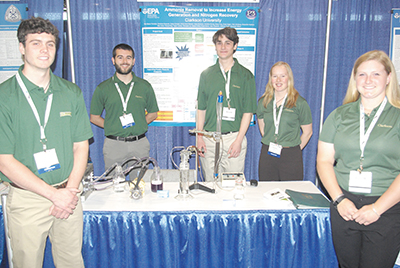
POTSDAM — The U.S. Environmental Protection Agency (EPA) has awarded Clarkson University a $75,000 grant to develop a “more efficient” ammonia removal and recovery process for food-waste digesters.
The effort seeks to reduce the volume of food waste sent to solid-waste landfills, “simultaneously addressing the objectives of improving air quality and revitalizing land,” the EPA said in a May 25 news release.
The EPA refers to the $75,000 in funding as a “people, prosperity, and the planet (P3)” grant.
“These P3 students are tackling some of our most pressing and complex environmental issues,” Pete Lopez, EPA regional administrator, said in the release. “The innovative research funded today will help us better protect human health and the environment.”
“We are excited for … Clarkson’s P3 student team [which is] developing innovative food-waste solutions to address our most pressing environmental, health and energy questions while educating our future engineers and scientists,” Gina Lee-Glauser, VP for research and scholarship at Clarkson University, said in the EPA release. “Environmental projects like this one give our students the chance to solve real-world, open-ended problems with creativity and risk-taking to obtain solutions that are practical and sustainable.”
“These students are applying what they have learned in the classroom to create innovative solutions to environmental challenges,” EPA Administrator Scott Pruitt added. “These awards support the next generation of scientists and engineers in their commitment to environmental protection, while helping states, tribes, and local communities find solutions to their environmental issues.”
Nationally, EPA awarded more than $557,000 in funding for eight student teams through the P3 grants program during its second phase. These teams, made up of college students from across the country, are developing sustainable technologies to solve current environmental and public health challenges.
Besides Clarkson, the EPA awarded funding to student teams at Montclair State University in New Jersey; Kennesaw State University in Georgia; the University of Cincinnati in Ohio; the Texas Woman’s University; California State University, Chico; Butte College in California; and the University of California, Riverside.
Background
The P3 program is a two-phase, research-grants program that challenges students to research, develop, and design innovative projects addressing environmental and public health problems.
Phase I serves as a “proof of concept,” where teams are awarded a $15,000 grant to develop their idea and showcase their research in the spring at EPA’s National Sustainable Design Expo.
These teams are then eligible to compete for a Phase II grant of up to $75,000 to implement their design in a real-world setting.
Maguire buys Lowery Bros. Chrysler Jeep, plans move
Will transform Hiawatha Blvd. facility into LEED-certified green building SYRACUSE — Lowery Bros. Chrysler Jeep, on Syracuse’s automobile row, has a new owner and will be moving in a couple of years. Maguire Family of Dealerships has purchased the Lowery Bros. dealership, the company recently announced. Lowery Bros. will now “focus its auto retail and
Become a Central New York Business Journal subscriber and get immediate access to all of our subscriber-only content and much more.
Click here to purchase a paywall bypass link for this article.
Will transform Hiawatha Blvd. facility into LEED-certified green building
SYRACUSE — Lowery Bros. Chrysler Jeep, on Syracuse’s automobile row, has a new owner and will be moving in a couple of years.
Maguire Family of Dealerships has purchased the Lowery Bros. dealership, the company recently announced.
Lowery Bros. will now “focus its auto retail and service operations on its nearby Infiniti brand location,” it said in a news release.
Maguire Dealerships began operating the Chrysler Jeep dealership June 1, at first at its current spot at 647 West Genesee St. However, the dealership has begun efforts to convert its current Dodge Ram dealership at 959 Hiawatha Boulevard to house the Chrysler Jeep business. Maguire has some extensive green goals for that property.
“Plans are already underway to completely transform that facility into a LEED-certified green building with solar panels, high density plantings, rain-water harvesting, solar electric vehicle charging, and more. The project — due for completion in late 2020 — is to be expanded by an additional 10,000 square feet to accommodate the addition of the Chrysler and Jeep brands, putting all four FCA (Fiat Chrysler Automobiles) brands under one roof in a first-of-its-kind CNY facility,” the release said.
The purchase of Lowery Bros. Chrysler Jeep includes the dealership, but not the building, according to Maguire Family of Dealerships President Philip Maguire.
“The Lowery family will continue to own the building,” he adds.
Maguire Family of Dealerships includes 19 franchises in 11 locations, with dealerships in Ithaca, Watkins Glen, Trumansburg, and Syracuse. In Syracuse, Maguire owns a Nissan dealership at 716 West Genesee St. that it plans to move into a new facility next to its Dodge Ram dealership.
The company is noted for its “up-front lowest price” pricing and three-day money-back guarantee.
New York milk production dips more than 2 percent in April
New York dairy farms produced nearly 1.24 billion pounds of milk in April, down 2.4 percent from 1.27 billion pounds in the year-ago period, the USDA’s National Agricultural Statistics Service (NASS) recently reported. Production per cow in the Empire State averaged 1,980 pounds in April, down almost 3 percent from 2,035 pounds a year prior.
Become a Central New York Business Journal subscriber and get immediate access to all of our subscriber-only content and much more.
Click here to purchase a paywall bypass link for this article.
New York dairy farms produced nearly 1.24 billion pounds of milk in April, down 2.4 percent from 1.27 billion pounds in the year-ago period, the USDA’s National Agricultural Statistics Service (NASS) recently reported.
Production per cow in the Empire State averaged 1,980 pounds in April, down almost 3 percent from 2,035 pounds a year prior.
The number of milk cows on farms in New York state totaled 625,000 head in April, up 2,000 head from April 2017, NASS reported.
The average milk price received by New York dairy farmers in March was $15.80 per hundredweight, up 20 cents from February, but down $2.80 from March 2017.
In neighboring Pennsylvania, dairy farms produced 932 million pounds of milk in April, down 1.7 percent from a year earlier.
Bergmann principal discusses energy audits in NYSERDA’s commercial-tenant program
SYRACUSE — The New York State Energy Research and Development Authority (NYSERDA) is offering a commercial-tenant program, involving energy audits to help “tenants enhance the comfort, efficiency, and productivity of their office spaces.” Bergmann, a Rochester–based architecture, engineering, and planning firm with an office in Syracuse, says it is working with NYSERDA on the effort,
Become a Central New York Business Journal subscriber and get immediate access to all of our subscriber-only content and much more.
Click here to purchase a paywall bypass link for this article.
SYRACUSE — The New York State Energy Research and Development Authority (NYSERDA) is offering a commercial-tenant program, involving energy audits to help “tenants enhance the comfort, efficiency, and productivity of their office spaces.”
Bergmann, a Rochester–based architecture, engineering, and planning firm with an office in Syracuse, says it is working with NYSERDA on the effort, the firm said in a May 7 news release.
The energy-audit program has two tracks, or options, says Charles Bertuch, principal at Bergmann, who spoke with CNYBJ on May 25.
In the first track, participants receive a free, basic energy analysis, which could then lead to the high-performance track. Under that option, auditors will provide participants with a “more comprehensive” energy and financial assessment, which could result in changes to the worksite.
The program’s benefits include “more comfortable and healthier spaces, greater productivity, and a safer environment,” Bergmann contends.
The program is open to all commercial-office tenants and property owners in New York “at any stage of leasing,” per NYSERDA.
Commercial offices, including banks, are eligible for the audits. Retail spaces are not eligible, according to Bertuch.
The program “encourages collaboration” between tenants, property owners, and consultants to “optimize the energy performance” of commercial office spaces throughout the state.
Tenants, or their building’s owner, must also pay the system-benefits charge on their electric bill, NYSERDA added.
Bertuch says he’s not sure if Bergmann is the only consultant in Central New York providing the program’s audits, “but we are not the only ones eligible to do it.”
Bergmann has performed energy-conservation work for clients in the Syracuse area, but not under the commercial-tenant program as of May 25, he adds.
How it works
Under the program’s basic option, the participant doesn’t pay for the audit. The client would “receive up to 100 percent of the cost of an energy analysis, up to $5,000,” according to the NYSERDA website.
Bergmann would conduct the assessment and write a report for the client. The firm would then bill NYSERDA for the cost of the service, Bertuch says.
“Our contract, under the first option … is completely with NYSERDA,” he notes.
Under the high-performance audit, Bergmann would work under two contracts, including one contract with the client and a second contract with NYSERDA.
In explaining the high-performance option, Bertuch provided an example involving the consultant helping a building manager develop construction guidelines for tenants in its building. The guidelines would outline requirements for energy-conservation practices, such as light levels, type of lighting, and the control systems to use. “That’s an example of a high-performance track project,” he says.
With the dual contract, every time Bergmann works on it, half the time gets charged to the client, half the time gets charged to NYSERDA, according to Bertuch.
After the payment, the client can pursue a reimbursement if the company can demonstrate that it took action based on the audit, such as providing a new tenant the guidelines for a build-out project.
“Once they show NYSERDA they’ve done that, NYSERDA will reimburse them the money that they paid us,” says Bertuch.
SUNY Poly professor awarded $320K NSF grant for materials research
Research could lead to longer-lasting, clean-energy systems SUNY Polytechnic Institute (SUNY Poly) announced that Dr. Kathleen Dunn, associate head and associate professor of the college’s Nanoscience Constellation, has been selected to receive $320,000 in federal funding from the National Science Foundation (NSF). Dunn’s work will focus on exactly why adding certain metals to copper at
Become a Central New York Business Journal subscriber and get immediate access to all of our subscriber-only content and much more.
Click here to purchase a paywall bypass link for this article.
Research could lead to longer-lasting, clean-energy systems
SUNY Polytechnic Institute (SUNY Poly) announced that Dr. Kathleen Dunn, associate head and associate professor of the college’s Nanoscience Constellation, has been selected to receive $320,000 in federal funding from the National Science Foundation (NSF).
Dunn’s work will focus on exactly why adding certain metals to copper at the atomic level, such as tin or cobalt, changes copper’s characteristics, like its ability to conduct electricity, for example, according to a SUNY Poly news release. The money is from the NSF’s Metals and Metallic Nanostructure program under the Division of Materials Research.
By utilizing a suite of SUNY Poly’s “next-generation” electron microscopy and spectroscopy tools, Dunn and a team of researchers, including SUNY Poly students, seek to use the foundational knowledge they gain to design better alloys. These can potentially lead to more cost-effective, less wasteful additive manufacturing and “more robust” clean-energy system components, the release stated.
The NSF funding will support research that leverages “advanced SUNY Poly tools,” including its electron energy-loss spectroscopy (EELS) capabilities. This is made possible by the FEI Titan3 Scanning Transmission Electron Microscope, which provides the chance to “interrogate individual atoms and the ways in which electrons are shared between them,” SUNY Poly said.
Dunn and her team will be able to correlate changes in the electron band structure with the observed behavior and characteristics of the alloys at the macroscopic level to fine-tune its properties for specific applications. This could lead to a more targeted additive manufacturing process with decreased material waste and is also applicable to materials used in fuel cells and battery electrodes, the college explained.
The research project, called “2D Grain Boundary Phases: Establishing an Electronic Basis for Engineering Superior Copper Alloy Behavior,” builds upon “years of innovation-centered materials research” by Dunn with industry partners, including the Semiconductor Research Corporation, IBM via a faculty award, and Atotech USA.
Stay up-to-date on the companies, people and issues that impact businesses in Syracuse, Central New York and beyond.