Stay up-to-date on the companies, people and issues that impact businesses in Syracuse, Central New York and beyond.

People news: Adirondack North Country Association adds Smoke as board member
SARANAC LAKE, N.Y. — The Adirondack North Country Association (ANCA) has announced the recent addition of Edward Smoke of Akwesasne to its board of directors.
Senators announce more than $47K in federal funding for Whitesboro Fire Department
WHITESBORO — U.S. Senate Minority Leader Charles E. Schumer and U.S. Sen. Kirsten Gillibrand, both Democrats from New York, recently announced $47,620 in federal funding for the Whitesboro Fire Department in Oneida County. The money was allocated through the Department of Homeland Security’s Assistance to Firefighters Grant (AFG) Program and will be used to replace
Become a Central New York Business Journal subscriber and get immediate access to all of our subscriber-only content and much more.
Click here to purchase a paywall bypass link for this article.
WHITESBORO — U.S. Senate Minority Leader Charles E. Schumer and U.S. Sen. Kirsten Gillibrand, both Democrats from New York, recently announced $47,620 in federal funding for the Whitesboro Fire Department in Oneida County.
The money was allocated through the Department of Homeland Security’s Assistance to Firefighters Grant (AFG) Program and will be used to replace a diesel exhaust system, which will help remove harmful chemicals and particles from the department’s fire truck engines to ensure clean air in the station, the senators said in a release.
“The fire department is excited to be able to secure the grant to install the diesel exhaust system. This project will considerably reduce carbon monoxide exposure which will ultimately keep our firefighters safer,” Whitesboro Fire Chief Peter Sobel said in the release.
Five Star Bank parent hires Benjamin as chief human resources executive
WARSAW, N.Y. — Financial Institutions, Inc. (NASDAQ: FISI), parent company of Five Star Bank, recently announced it has appointed Valerie C. Benjamin as its chief human resources executive. Benjamin is an experienced human-resources leader, most recently serving as associate dean and chief human resources officer (CHRO) at Cornell University’s School of Labor and Industrial Relations,
Become a Central New York Business Journal subscriber and get immediate access to all of our subscriber-only content and much more.
Click here to purchase a paywall bypass link for this article.
WARSAW, N.Y. — Financial Institutions, Inc. (NASDAQ: FISI), parent company of Five Star Bank, recently announced it has appointed Valerie C. Benjamin as its chief human resources executive.
Benjamin is an experienced human-resources leader, most recently serving as associate dean and chief human resources officer (CHRO) at Cornell University’s School of Labor and Industrial Relations, according to a Financial Institutions news release. She previously was CHRO at EarthLink, an IT services company.
At Financial Institutions, Benjamin succeeds Paula D. Dolan, former director of human resources and enterprise planning at the banking company. Dolan stepped down from her role as HR director in July, but to help with the transition she will continue to serve as human resources project manager through her retirement on Dec. 31, according to the release.
Benjamin’s career also includes 11 years as a global human capital consultant at Accenture, a worldwide management consulting and professional services firm. Benjamin earned a master’s degree in organizational psychology from Columbia University and a bachelor’s degree in labor relations from Cornell.
Financial Institutions, Inc. — headquartered in the town of Warsaw in Wyoming County — provides financial services through its subsidiaries Five Star Bank; Scott Danahy Naylon, LLC; Courier Capital, LLC; and HNP Capital, LLC. It employs about 700 people total.
Five Star Bank has more than 50 offices throughout Western and Central New York. Its Central New York branches include offices in Auburn, Geneva (2), Seneca Falls, Ovid, Elmira (2), and Horseheads.
Schumer announces $700K in federal funding for business complex at Watertown International Airport
HOUNSFIELD — U.S. Senate Minority Leader Charles E. Schumer recently announced $700,000 in federal funding for the Jefferson County Industrial Development Agency (JCIDA) and the Town of Hounsfield. The money was allocated through the U.S. Economic Development Administration (EDA) and will be used to construct public infrastructure to attract businesses to a new 100-acre business complex
Become a Central New York Business Journal subscriber and get immediate access to all of our subscriber-only content and much more.
Click here to purchase a paywall bypass link for this article.
HOUNSFIELD — U.S. Senate Minority Leader Charles E. Schumer recently announced $700,000 in federal funding for the Jefferson County Industrial Development Agency (JCIDA) and the Town of Hounsfield. The money was allocated through the U.S. Economic Development Administration (EDA) and will be used to construct public infrastructure to attract businesses to a new 100-acre business complex at Watertown International Airport.
The EDA funding seeks to help JCIDA and the Town of Hounsfield to install water, sewer, stormwater management, and fiber-optic cable necessary for business development at the complex. Schumer said in a release that he has “long advocated for this vital funding for Jefferson County,” and in March 2017, sent a letter to the U.S. Commerce in support of JCIDA’s application.
“This is great news for Jefferson County. This federal investment in the exciting, new Business Complex at Watertown International will help Jefferson County attract good-paying jobs by creating shovel-ready sites needed to push the region’s economy into the future,” Schumer contended in the release.
David J. Zembiec, deputy CEO of Jefferson County Economic Development, said the federal money will help the county provide “shovel-ready site options that the county needs in order to compete for new business development in today’s global economy.” He said the location of the business complex adjacent to Watertown International Airport and near Interstate 81 and the Canadian border make it “a logistically attractive location.”
The EDA provided this grant through its Local Technical Assistance Program, which “assists eligible recipients in developing economic-development plans and studies designed to build capacity and guide the economic prosperity and resiliency of an area or region,” the release stated.
SBA seeks nominations for 2019 National Small Business Week
SYRACUSE — The Syracuse district office of the U.S. Small Business Administration is now accepting nominations for the agency’s 2019 National Small Business Week Awards, including the annual Small Business Person of the Year. The local office will take in nominations for small businesses located in upstate New York counties that include Albany, Broome, Cayuga,
Become a Central New York Business Journal subscriber and get immediate access to all of our subscriber-only content and much more.
Click here to purchase a paywall bypass link for this article.
SYRACUSE — The Syracuse district office of the U.S. Small Business Administration is now accepting nominations for the agency’s 2019 National Small Business Week Awards, including the annual Small Business Person of the Year.
The local office will take in nominations for small businesses located in upstate New York counties that include Albany, Broome, Cayuga, Chemung, Chenango, Clinton, Columbia, Cortland, Delaware, Essex, Franklin, Fulton, Greene, Hamilton, Herkimer, Jefferson, Lewis, Madison, Montgomery, Oneida, Onondaga, Oswego, Otsego, Rensselaer, Saratoga, Schenectady, Schoharie, Schuyler, St. Lawrence, Steuben, Tioga, Tompkins, Warren, and Washington.
In addition to the national-award categories, the SBA Syracuse district office also invites nominations for the SBA Young Entrepreneur of the Year Award, which will be presented at the district level. The individual must serve as a majority owner and operate or maintain principal responsibility for operating a small business. The business owner must have been under the age of 30 as of June 1, 2018.
Complete details on eligibility and criteria are available at https://www.sba.gov/content/sba-invites-nominations-2019-national-small-business-week.
For all award categories, please contact Rachael Stanton at rachael.stanton@sba.gov or (315) 471-9393 ext. 244. Nominations should be mailed to the SBA Syracuse district office at 224 Harrison St., Suite 506, Syracuse, NY 13202 by Jan. 9, 2019.
The SBA will recognize winners in an awards ceremony during National Small Business Week, which is scheduled for May 5-11, 2019.
Since 1963, National Small Business Week has recognized the “outstanding achievements of America’s small businesses for their contributions to their local communities, and to our nation’s economy,” the SBA says.
“This is a great opportunity to recognize those small businesses that have contributed significantly to their local communities, developed creative products or made advances with innovative technologies,” SBA Administrator Linda McMahon said in a news release. “A National Small Business Week award is one of the nation’s highest honors for small business achievement. I encourage you to visit our dedicated website www.sba.gov/nsbw to download forms, criteria and guidelines for submitting a nomination. I look forward to your nomination and wish you the best of luck.” n
NFIB names Syracuse alumna as assistant director for N.Y.
The NFIB, a national small-business association, on Aug. 28 named Syracuse University graduate Ashley Ranslow the assistant state director for New York state. NFIB says it advocates on behalf of more than 10,000 small businesses in New York and represents 325,000 members nationwide. The organization describes Ranslow as a “business-advocacy veteran” in Albany, having served the
Become a Central New York Business Journal subscriber and get immediate access to all of our subscriber-only content and much more.
Click here to purchase a paywall bypass link for this article.
The NFIB, a national small-business association, on Aug. 28 named Syracuse University graduate Ashley Ranslow the assistant state director for New York state.
NFIB says it advocates on behalf of more than 10,000 small businesses in New York and represents 325,000 members nationwide.
The organization describes Ranslow as a “business-advocacy veteran” in Albany, having served the past four years as manager of government affairs for the Northeast Retail Lumber Association (NRLA). Her duties involved advancing the interests of the lumber industry and NRLA’s members in Albany and Washington, D.C.
“Ashley brings years of business advocacy and association management experience to NFIB and possesses a keen understanding of the unique challenges and opportunities small business owners are facing across New York State,” Greg Biryla, NFIB’s state director in New York, said in a news release. “Ashley’s skill set and passion for NFIB’s mission are the perfect fit for our organization and its members.”
Ranslow’s experience at NRLA has allowed her to establish “vital” relationships with employer-advocacy partners across New York and within the New York State Legislature.
Her previous experience also includes time with J Strategies, an Albany–based firm that focuses on communications, government affairs, and alliance development, according to its website.
“I am very excited to be part of the NFIB team and work with Greg Biryla. For the last five years, I had the privilege of representing independent businesses in the lumber and building materials industry across the Northeast,” Ranslow said. “From my experience, I understand the challenges New York’s small businesses face on a daily basis and look forward to continuing to advocate for the independent businesses that drive and grow our economy and support our communities. I am thrilled for the opportunities and challenges ahead and am ready to represent NFIB members as we advance the small-business legislative agenda in Albany.”
A native of New Hampshire, Ranslow currently lives in Niskayuna in Schenectady County with her husband, Ted.
Ranslow, who graduated from Syracuse University in 2010, serves as president of the university’s Albany alumni club and is active with the Empire State Society of Association Executives. n

Brockett Creative Group expands, moves back to original home in Clinton
CLINTON — Brockett Creative Group — a Mohawk Valley advertising, marketing, and internet strategy firm — says it has moved back to where the business first got its start in Clinton. Matthew Brockett started Brockett Creative Group in 2002 and one of his first offices was located behind the Clinton Cleaners. As the business grew,
Become a Central New York Business Journal subscriber and get immediate access to all of our subscriber-only content and much more.
Click here to purchase a paywall bypass link for this article.
CLINTON — Brockett Creative Group — a Mohawk Valley advertising, marketing, and internet strategy firm — says it has moved back to where the business first got its start in Clinton.
Matthew Brockett started Brockett Creative Group in 2002 and one of his first offices was located behind the Clinton Cleaners. As the business grew, it moved to New Hartford where it developed into a full-service marketing company, offering web design, marketing and public-relations services, branding, video-production services, creative/graphic-design services, and more.
In the last year, Brockett Creative Group has expanded from nine employees to 11, so it needed more space, according to Catrina M. Dibble, the firm’s director of marketing.
Brockett Creative Group, which is celebrating its 16th anniversary, found that additional room at the site of the former Clinton Cleaners at 43 College St. in Clinton, where it is leasing 1,800 square feet of space. The company’s prior location at 4299 Middle Settlement Road in New Hartford was about 1,100 square feet, according to Dibble.
“The new location is more accommodating for clients, has a fresh feel, lends itself to a more ‘creative’ environment, and is a larger space,” she tells CNYBJ

Owego deciding how to spend its $10 million DRI award
OWEGO — The Village of Owego in Tioga County is working to figure out how to spend its $10 million award in the third round of the state’s Downtown Revitalization Initiative (DRI). Owego will use the $10 million in state funding and investments to “revitalize its downtown neighborhoods and generate new opportunities for long-term growth,”
Become a Central New York Business Journal subscriber and get immediate access to all of our subscriber-only content and much more.
Click here to purchase a paywall bypass link for this article.
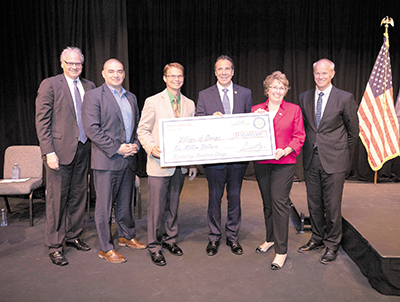
OWEGO — The Village of Owego in Tioga County is working to figure out how to spend its $10 million award in the third round of the state’s Downtown Revitalization Initiative (DRI).
Owego will use the $10 million in state funding and investments to “revitalize its downtown neighborhoods and generate new opportunities for long-term growth,” the office of Gov. Andrew Cuomo said in an Aug. 23 news release.
Owego now joins Elmira and Watkins Glen as DRI award winners in the Southern Tier region.
The Southern Tier regional economic-development council chose Owego as part of a “competitive review” process, Cuomo’s office said.
The village will leverage DRI funding to “build” upon recent public and private investment in downtown buildings and infrastructure, “growing employment opportunities and a strong tourist economy.”
The DRI effort will “boost the local economy by attracting new and strengthening existing business and skilled labor, enhancing cultural and recreational amenities, and addressing the demand for affordable and resilient housing for residents of all ages and income levels,” Cuomo’s office said.
The DRI is a component of Southern Tier Soaring, the region’s economic-development blueprint. As in the first two rounds of the DRI, one downtown in each of the state’s 10 regional economic-development areas is selected as a $10 million winner, Cuomo’s office said.
The next step
Owego will soon begin the process of developing a “strategic-investment plan to revitalize” its downtown with up to $300,000 in planning funds from the
$10 million DRI grant. A local planning committee that’ll include municipal representatives, community leaders, and other stakeholders will lead the effort, supported by a team of private-sector experts and state planners.
The plan for downtown Owego will examine local assets and opportunities and identify economic development, transportation, housing, and community projects that “align with the community’s vision for downtown revitalization and that are poised for implementation,” the release explained.
The downtown Owego plan will outline the spending of DRI grant funds on “revitalization” projects that will “advance the community’s vision” for its downtown and that can “leverage and expand” upon the state’s $10 million award. Owego’s plan for the DRI’s third round will be complete in 2019, according to Cuomo’s office. n
Commonsense Chairs: A Brief History of Mottville’s F. A. Sinclair Chair Factory
This factory, like so many others in the area, was built on the banks of the Skaneateles Creek, utilizing the readily available water power to run its machinery. Francis Sinclair was born in 1824 in Central New York. He honed his chair-making skills at an early age working at The Community Chair Works in Skaneateles
Become a Central New York Business Journal subscriber and get immediate access to all of our subscriber-only content and much more.
Click here to purchase a paywall bypass link for this article.
This factory, like so many others in the area, was built on the banks of the Skaneateles Creek, utilizing the readily available water power to run its machinery.
Francis Sinclair was born in 1824 in Central New York. He honed his chair-making skills at an early age working at The Community Chair Works in Skaneateles Falls (“The Community” was a communal sect similar to the Oneida Community). He opened his first shop in 1859. When the Civil War broke out, however, Sinclair sold all his tools and leased his factory. It is said that upon hearing about Fort Sumter, he climbed off the factory roof he was repairing, rode to Auburn, and enrolled immediately in the 138th Infantry. He returned to Mottville three years later after suffering a leg wound and opened the Union Chair Works Co. His featured chairs were the Union Chair, the General Grant Chair, and the Mayflower Chair.
Sinclair designed his Mottville Chair (originally nicknamed the Commonsense Chair), based on many previous chair-making traditions. His design combined that of the splint-bottomed chairs of the 17th century, with the shape of the Windsor furniture from the 18th century, and finally the simplicity of the 19th century Shaker style. These practical and affordable chairs were noted for their durability, lightness, and spare elegance and quickly became fixtures in homes, offices, classrooms, hotel lobbies, and porches across the country and beyond.
The name of the company went through several iterations, but it generally always carried Sinclair’s name. In 1866, Sinclair partnered with Joseph Hubbard and built a three-story stone building near his earlier works to manufacture other articles of furniture along with his original line of chairs. Within 10 years he decided that he would revert back to manufacturing chairs only. He continued with chair manufacturing until 1901.
Early chairs were heavier with broader, more elaborate turnings. They featured ash splints for the seats and backs. By the 1880s, Sinclair began using cane for the seats as later chairs were simpler, thus caning was more appropriate. The uprights and front stretchers had incised bands painted black or filled with a tar-like black material. The frames utilized local hardwoods, principally maple, oak, hickory, and white elm. This wood was thoroughly seasoned as opposed to kiln-dried, which destroys the life and the strength of the timber. Each slat and round was driven in as tight as possible and then glued with 1X glue and finished with varnish. The seats were double caned and spliced with Sinclair’s specially designed tie.
Selected, more expensive pieces, were painted red using a shade of English vermillion mixed with boiled linseed and finally coated twice with a heavy-duty varnish guaranteed not to chip or fade. Some chairs were stained mahogany and also warranted not to fade. Four finishes in all were available — a natural finish on maple, an antique oak finish and as noted above the mahogany and English Vermillion/linseed oil finishes. Spindle turnings ranged from simple to more ornate, depending on the finish used. Mushroom-shaped “hat rounds” were always placed on the uprights of chairs manufactured for dining and church use. These chairs also had a third stretcher for reinforcement purposes since they were intended for public use and exposed to greater wear and tear. The more expensive versions had fancier turnings and black stripes present on the uprights. Many variations of Sinclair’s original Commonsense Chair were designed and constructed including furniture such as sewing chairs, double rockers, billiard chairs, student chairs with a tablet arm, church chairs, settees, armchairs, and even small tables. Due to some counterfeit products produced by other companies, a Sinclair chair was always marked by the stamp “F.A. Sinclair/ Mottville, NY.” This stamp, in two straight lines, distinguished it from counterfeit models. His boldest competitor happened to also be located in Mottville and went under the name of Mottville Chair Works. Their products closely resembled the chairs produced by Sinclair’s original Union Chair Works Co., although the Mottville Chair Works chairs were slightly different in height and seat size and in the arrangement of the burnt rings and beveling below the top knobs on the back posts. Sinclair oversaw and took part in every aspect of his manufacturing process. In 1869, this unfortunately resulted in the loss of all the fingers on his left hand to a buzz saw.
F.A. Sinclair printed numerous catalogues to advertise its products. It also benefited from the many flattering testimonials given by individuals — famous and not so famous —throughout the country. Sinclair Company chairs were widely distributed and retail outlets existed in six major American cities. There was also great international demand for the chairs. Adirondack Great Camps and popular Adirondack resorts ordered the rockers in particular for use in their living spaces and on their porches. A special type of lounge chair was designed for convalescent use, possibly with TB patients in mind, which could be adjusted to seven positions. This was called the Adirondack Adjustable Recliner. Early in his career, Sinclair offered a dozen of his chairs for a mere $30 wholesale (Note: Today, one chair in top condition can sell for as much as $100.) Besides the use of catalogues, Sinclair erected a tent annually at the New York State Fair. He exhibited several examples of his products and regularly had lines of Fair visitors waiting to test his most comfortable rocking chairs. Due to the continuing demand for his chairs, Sinclair expanded upon his original factory building numerous times.
In 1901, Sinclair sold his ownership of the company to John Allen. Mr. Allen continued the business alongside his son, Albert, as the Sinclair Allen Chair Works. He purchased the nearby competitor, Mottville Chair Works Co., and merged the two businesses under the name Mottville Chair Works. The business continued until the death of Albert in 1943. (Mr. Sinclair had died in 1918.) The building went through several hands but managed to be kept in fairly good condition. Today’s owners, the Carberry and Engle families, have lovingly restored the building and now run it as a wedding and event venue (the owners went so far as to track down and purchase 200 original Mottville chairs for use in the venue). Obviously, Commonsense Chairs designed and built by Francis A. Sinclair have long outlived him, continuing to be enjoyed by collectors worldwide today.
Karen Y. Cooney is support services administrator at OHA in Syracuse.
Oneida County hotel occupancy rate rises nearly 5 percent in July
Hotels in Oneida County were fuller in July compared to a year earlier, according to a recent report. The hotel occupancy rate (rooms sold as a percentage of rooms available) in the county rose 4.6 percent to 71.6 percent in July from 68.5 percent in the year-ago month, according to STR, a Tennessee–based hotel market
Become a Central New York Business Journal subscriber and get immediate access to all of our subscriber-only content and much more.
Click here to purchase a paywall bypass link for this article.
Hotels in Oneida County were fuller in July compared to a year earlier, according to a recent report.
The hotel occupancy rate (rooms sold as a percentage of rooms available) in the county rose 4.6 percent to 71.6 percent in July from 68.5 percent in the year-ago month, according to STR, a Tennessee–based hotel market data and analytics company. It’s the fifth consecutive monthly rise in Oneida County’s occupancy rate following a streak of 11 straight monthly declines. Year to date through July, the occupancy rate was up 4.2 percent to 55 percent.
Revenue per available room (RevPar), a key industry gauge that measures how much money hotels are bringing in per available room, edged up 1.4 percent to $94.25 this July from $92.92 in July 2017. This also was the fifth straight monthly rise in RevPar. Year to date through the first seven months of 2018, RevPar was up 3.8 percent to $61.75.
Average daily rate (or ADR), which represents the average rental rate for a sold room, dipped 3 percent to $131.60 in July, compared to $135.71 a year earlier. Year to date, ADR was off 0.4 percent to $112.22.
Stay up-to-date on the companies, people and issues that impact businesses in Syracuse, Central New York and beyond.