
Get our email updates
Stay up-to-date on the companies, people and issues that impact businesses in Syracuse, Central New York and beyond.
What's New
Upcoming Events
CNYBJ Job Board

Five Star Bank implements executive leadership changes, including several promotions
WARSAW, N.Y. — Five Star Bank, a unit of Financial Institutions, Inc. (NASDAQ: FISI), recently announced a reorganization in its executive leadership team, which it says will “more effectively meet the needs of customers across all segments of its business in support of the bank’s continued growth.” Five Star Bank named William L. Kreienberg chief […]
Get Instant Access to This Article
Become a Central New York Business Journal subscriber and get immediate access to all of our subscriber-only content and much more.
- Critical Central New York business news and analysis updated daily.
- Immediate access to all subscriber-only content on our website.
- Get a year’s worth of the Print Edition of The Central New York Business Journal.
- Special Feature Publications such as the Book of Lists and Revitalize Greater Binghamton, Mohawk Valley, and Syracuse Magazines
Click here to purchase a paywall bypass link for this article.
WARSAW, N.Y. — Five Star Bank, a unit of Financial Institutions, Inc. (NASDAQ: FISI), recently announced a reorganization in its executive leadership team, which it says will “more effectively meet the needs of customers across all segments of its business in support of the bank’s continued growth.”
Five Star Bank named William L. Kreienberg chief banking and revenue officer, a new role combining all revenue and relationship-building businesses for banking, insurance, and wealth management. He will be responsible for the bank’s retail-branch network and commercial and consumer-lending teams, as well as its insurance and wealth-management affiliates, according to a Five Star Bank news release. Kreienberg will also continue to serve as the bank’s general counsel. He previously was chief corporate development executive.
The bank appointed Joseph L. Dugan “chief customer experience and go to market officer,” a new position consolidating leadership of marketing, technology, product, and customer experience, the release stated. He will provide leadership and advocacy across the organization for “innovative technology solutions” for both employees and customers. Dugan previously was Five Star’s retail growth and profitability executive.
Sean M. Willett was named chief administrative officer. In this job, he will lead audit, compliance, operations, risk, and strategy. Willett previously was the bank’s chief risk officer.
The reorganization also included the promotions of employees in several departments, which Five Star Bank said were part of its focus on the “development of future talent and increased diversity in leadership positions.” The bank promoted Bethany Bowers to chief compliance officer, Amy Barone to director of operations, Diane Camelio to director of retail relationships, Staci Casseri to director of customer experience, Randy Phillips to chief risk officer, and Cory Popen to enterprise data manager.
“Change and evolution are constant and necessary to excel and fulfill our commitment to our customers, our shareholders, our associates and the communities we serve. We have many talented individuals within Five Star, and giving them the chance to assume new or enhanced roles is critical for our success and an opportunity for them to continue their personal development,” Martin K. Birmingham, Five Star Bank president and CEO, contended. “We believe that these leadership changes and the related reorganization will facilitate continued execution of our long-term strategic plan.”
Five Star Bank, based in Warsaw in Wyoming County, has more than 50 branches throughout Western and Central New York. Its CNY branches include offices in Auburn, Geneva (2), Seneca Falls, Elmira (2), and Horseheads.
Crack the Prospect Code to Win More Sales
Why do so many meetings with prospects fizzle out and go nowhere? Is it just the way it is, so we should just accept it? Or, is it possible that our “this is what went wrong” explanations are merely excuses for failing to turn prospects into customers? As sure as Friday is pizza night, salespeople
Get Instant Access to This Article
Become a Central New York Business Journal subscriber and get immediate access to all of our subscriber-only content and much more.
- Critical Central New York business news and analysis updated daily.
- Immediate access to all subscriber-only content on our website.
- Get a year’s worth of the Print Edition of The Central New York Business Journal.
- Special Feature Publications such as the Book of Lists and Revitalize Greater Binghamton, Mohawk Valley, and Syracuse Magazines
Click here to purchase a paywall bypass link for this article.
Why do so many meetings with prospects fizzle out and go nowhere? Is it just the way it is, so we should just accept it? Or, is it possible that our “this is what went wrong” explanations are merely excuses for failing to turn prospects into customers?
As sure as Friday is pizza night, salespeople are drawn to prospects like kids to puddles of water. No argument. But what about the other way around? How much thought do salespeople give as to whether or not prospects are drawn to them? Is it possible that the drive to make the sale blinds them to the possibility that prospects may reject them?
The key to getting prospects to buy what you’re selling starts with getting them to buy you. It requires cracking the prospect code and below is how to go about it.
Abandon the urge to impress
Sure, you want prospects to like you, but efforts to impress them can make the wrong impression. It sends the message you are overly impressed with yourself. In other words, you come across as being less interested in understanding their situation and more interested in selling yourself.
All this happens when salespeople use confusing terminology, dominate the conversation, speak too fast, and make prospects feel inadequate. It’s the perfect prescription for rejection.
Set the stage for success
Productive sales calls don’t just happen. They are carefully choregraphed to give the salesperson an edge in getting the order. The first step is disarming the customer, neutralizing a prospect’s natural reaction to become defensive, to clam-up, or even to get away.
The task is to figure out and focus on what customers want, what they are looking for, and what satisfies them. Why is this important? They are trying to decide if the salesperson cares or just wants to make a sale.
Issue a challenge
It may sound odd or strange, but this is what it takes for prospects to clarify their thinking and commitment to making a prudent purchasing decision — and avoid experiencing buyer’s regret.
It’s time to ask what some may consider a risky question. “Are you sure this is what you want to do?” is a necessary question, one that helps prospects clarify their thinking. If the answer is “no” or “I’m not sure,” then it’s time to stop and probe until the concerns and doubts are explored and resolved to the prospects’ satisfaction. This is how trust develops and what it means to be a sales consultant.
Stay with them
No one wants to feel ignored, abandoned, or rejected. Yet, this happens when a salesperson makes an “exit” after deciding prospects aren’t going to buy. When this occurs, prospects react negatively and get even by badmouthing the salesperson and the company.
Even so, it’s easy to avoid. Let them know you appreciate the opportunity to help them, but you also recognize it doesn’t always work out. Do it correctly and there’s a good chance that should they leave they will be back or refer others.
Second guess yourself
It’s tough to recover when you’re put on the defensive while making a sales presentation. Even if you’re fast on your feet, it’s difficult to think clearly, let alone to organize an effective response.
The way to avoid getting caught with the unexpected is to second guess yourself. Lay out possible objections and anticipate possible responses and disagreements that could undermine your proposal. Show their deficiencies and why your position is the best solution.
Focus on why, not what
Salespeople like to talk about what customers get when making a purchase — long lasting, the latest, solid, fashionable, popular, convenient, and so on. But that’s changing. Today, it’s the why that motivates customers.
Here’s are examples of how to make why work for you:
• A solar energy company says its installations do more than lower energy costs. They help reduce the carbon footprint.
• A janitorial services company builds its case for clean facilities: reduces lost time due to illness, increases employee satisfaction, and helps improve productivity.
• British engineer James Dyson, who invented the Dual Cyclone bagless vacuum cleaner, sells a cordless version. In a TV ad, Dyson explains why: “It’s right to do something better.”
Ask the right questions
Salespeople don’t set out to alienate prospects. Yet, it’s easy to “trip” during the “sales dance.” To avoid making a misstep that can turn prospects off, it helps to have them talk about what customer satisfaction means to them and what they expect from a salesperson. Besides providing helpful information, it lets prospects know you want them to become satisfied customers.
It can also help to ask what’s bothersome about salespeople. Urge them to be candid. The more a salesperson knows, the better.
Don’t leave feedback to chance
“We need your feedback” or the various versions of these overworked words are tacked on countless marketing messages. Some call it the electronic “complaint box.” But feedback is too valuable to be left to chance.
Nothing is more important than making sure you and your prospects are on the same page, and that there’s no misunderstanding. This is why it’s helpful to think of presentations as an opportunity to ask prospects, “Is something not clear? Am I missing something that’s important to you?”
Rise to the occasion
It’s inevitable to get bored with what we do every day, including those who say they love their work. Even salespeople, who take pride in being “always up” get bored. But that’s the challenge. The test is our ability to push aside the “dark stuff” and meet the expectations of others.
If there is one quality prospects (and customers) look for in a salesperson, it’s vigor —an alive feeling. It’s catching and it moves prospects to action. It should be as much a part of a successful sales presentation as the words said.
What it takes to turn more prospects into customers is cracking the prospect code. Get them to buy you before trying to get them to buy what you’re selling.
John Graham of GrahamComm is a marketing and sales strategy consultant and business writer. He is the creator of “Magnet Marketing,” and publishes a monthly eBulletin, “No Nonsense Marketing & Sales Ideas.” Contact him at jgraham@grahamcomm.com or visit johnrgraham.com

NEXT 2018 conference spotlighted tech innovations
SALINA — Cornell University professor Rob Shepherd says energy efficiency is a “critical goal” for improvement in robotics. “One of the ways we’re going about that is to increase the sensor density, or the ability for a robot to feel, so we can change what it’s doing for the most energy-efficient approach to its task,”
Get Instant Access to This Article
Become a Central New York Business Journal subscriber and get immediate access to all of our subscriber-only content and much more.
- Critical Central New York business news and analysis updated daily.
- Immediate access to all subscriber-only content on our website.
- Get a year’s worth of the Print Edition of The Central New York Business Journal.
- Special Feature Publications such as the Book of Lists and Revitalize Greater Binghamton, Mohawk Valley, and Syracuse Magazines
Click here to purchase a paywall bypass link for this article.
SALINA — Cornell University professor Rob Shepherd says energy efficiency is a “critical goal” for improvement in robotics.
“One of the ways we’re going about that is to increase the sensor density, or the ability for a robot to feel, so we can change what it’s doing for the most energy-efficient approach to its task,” says Shepherd, associate professor in mechanical engineering at Cornell.
When asked to define robotics, Shepherd replied that one of the definitions of robots is that they are “machines that can adapt to their environment and basically seem like animals.”
He also noted that manufacturers use robots to improve efficiencies and “throughput to produce more goods.”
Shepherd was the morning keynote speaker at NEXT 2018 held Nov. 15 at the Holiday Inn Syracuse–Liverpool in the town of Salina.
Shepherd spoke on the topic in a presentation, titled, “The human touch: How bio-inspired design and advance fabrication are revolutionizing robotics.”
When asked afterward what he hopes attendees would remember from his presentation, Shepherd said one of the messages from his remarks is that hardware is not done.
“There’s a great way to improve robots and hardware design and part of that involves 3-D printing and another part involves new types of sensors and new types of actuators,” he added.
More about NEXT
Organizers of NEXT 2018 describe it as “the event for technology, manufacturing & biotech … where fast-track companies meet and learn from world-class business leaders and industry experts.”
The event, in its fifth year, also included “interactive” workshops on topics that included law and commercialization, manufacturing excellence, and biotech innovation.
Chris Kelly, a former Facebook executive and current angel investor, delivered the conference’s luncheon keynote address. He spoke on the topic “The Future of Technology, Cybersecurity, Innovation, and our Digital World.”
Following both keynote presentations, attendees participated in breakout sessions that included topics such as “Innovation and Intellectual Property – Decision Points for Startups,” and “Key Legal Issues for Technology Companies: Startup and Finance.” The mid-afternoon group of breakout sessions focused on “Supporting the Changing Workplace,” “Finding the Funds: New Venture Assistance for Innovation and Capitalization,” and “UAS/Drone Industry Update.”
NEXT 2018 sponsors included Central New York Biotech Accelerator; CASE (Center for Advanced Systems and Engineering) at Syracuse University; NYS Science + Technology Law Center at the Syracuse University College of Law; TDO (Train Develop Optimize); and Empire State Development’s Division of Science, Technology & Innovation (NYSTAR).
EPA awards funding to CNY small businesses for tech development
The U.S. Environmental Protection Agency (EPA) recently announced $1.7 million in funding to 16 small businesses across the country to develop new technologies that it says protect the environment while growing the economy. The two winners in New York state include DMax Plasma LLC of Potsdam (St. Lawrence County), which will receive $98,991 to develop
Get Instant Access to This Article
Become a Central New York Business Journal subscriber and get immediate access to all of our subscriber-only content and much more.
- Critical Central New York business news and analysis updated daily.
- Immediate access to all subscriber-only content on our website.
- Get a year’s worth of the Print Edition of The Central New York Business Journal.
- Special Feature Publications such as the Book of Lists and Revitalize Greater Binghamton, Mohawk Valley, and Syracuse Magazines
Click here to purchase a paywall bypass link for this article.
 The U.S. Environmental Protection Agency (EPA) recently announced $1.7 million in funding to 16 small businesses across the country to develop new technologies that it says protect the environment while growing the economy.
The two winners in New York state include DMax Plasma LLC of Potsdam (St. Lawrence County), which will receive $98,991 to develop a competitive remediation technology to chemically reduce Per- and Polyfluoroalkyl Substances (PFAS) in contaminated water quickly. The other New York winner is Vergason Technology, Inc. of Van Etten (Chemung County), which will get $99,441 to create a green process for manufacturing plastic chrome.
“EPA is providing small businesses with financial support to develop innovative technologies that will address urgent environmental and public health needs across the nation,” EPA Acting Administrator Andrew Wheeler said in a news release. “This year, we are encouraging the development of a variety of new technologies, including innovations to help address PFAS and improve water quality nationwide.”
The announced contracts are funded through EPA’s Small Business Innovation Research (SBIR) program, which encourages the development and commercialization of “novel technologies that support EPA’s mission to protect human health and the environment.” The small businesses getting funded are working on a range of topics including water quality, air quality, land revitalization, homeland security, manufacturing, and construction materials.
EPA is awarding 17 Phase I contracts to 16 small businesses for up to $100,000 for six months. Phase I recipients are eligible to apply for a phase II contract, which will help commercialize the technology that was conceptualized in phase I. A phase II contract can fund these companies with up to $300,000 to develop their environmental technology for the marketplace, the EPA said.
More detailed information about these SBIR contracts is available at: https://cfpub.epa.gov/ncer_abstracts/index.cfm/fuseaction/recipients.display/rfa_id/644/records_per_page/ALL
Lockheed Martin launches $30M STEM scholarship program
Lockheed Martin Corp. (NYSE: LMT) on Nov. 15 launched a $30 million STEM (science, technology, engineering and math) scholarship program for high school and college-undergraduate students planning to pursue a major in engineering and computer science. Bethesda, Maryland–based Lockheed Martin is a defense contractor with plants in Salina and in Owego. Beginning in 2019, the Lockheed
Get Instant Access to This Article
Become a Central New York Business Journal subscriber and get immediate access to all of our subscriber-only content and much more.
- Critical Central New York business news and analysis updated daily.
- Immediate access to all subscriber-only content on our website.
- Get a year’s worth of the Print Edition of The Central New York Business Journal.
- Special Feature Publications such as the Book of Lists and Revitalize Greater Binghamton, Mohawk Valley, and Syracuse Magazines
Click here to purchase a paywall bypass link for this article.
 Lockheed Martin Corp. (NYSE: LMT) on Nov. 15 launched a $30 million STEM (science, technology, engineering and math) scholarship program for high school and college-undergraduate students planning to pursue a major in engineering and computer science.
Bethesda, Maryland–based Lockheed Martin is a defense contractor with plants in Salina and in Owego.
Beginning in 2019, the Lockheed Martin STEM Scholarship program will award a $10,000 annual scholarship to 200 recipients who “demonstrate financial need and come from underrepresented or underserved communities,” according to a company news release.
Recipients may renew the scholarship up to three times for a total potential value of $40,000 per student.
When asked what role the Salina and Owego plants would play in the scholarship program, company spokesperson Maureen Schumann said in an email reply that the “program is open to U.S. citizens attending U.S. colleges and universities so we encourage widest dissemination.”
“We are looking for students who are creative and innovative skills that are necessary for success in today’s high-tech economy,” Patricia Lewis, senior VP of human resources at Lockheed Martin, said in the release. “As a global leader in innovation, Lockheed Martin is focused on growing and inspiring the next generation of STEM talent that will help our customers tackle the world’s toughest challenges and shape the future.”
The STEM Scholarship program will continue to add up to 200 new recipients each year for a minimum total investment of $30 million over five years. The program is part of a series of investments Lockheed Martin said it is making in education and innovation “as a direct result” of the Tax Cuts and Jobs Act, which cut the corporate tax rate this year.
Mentoring opportunities will be a “key component” of the program, and recipients will also be eligible for Lockheed Martin internship opportunities following their freshman year in college.
The application period opens on Jan. 15, 2019 and will be administered by Scholarship America, an organization with more than 60 years of experience designing and managing scholarship programs, Lockheed Martin said.
Those interested can visit the STEM Scholarship page at lockheedmartin.com/scholarship to learn more about eligibility requirements and to be notified when the scholarship application opens.
Four Tactics to Help Attract and Retain Manufacturing Talent
Attracting and retaining top talent for the manufacturing industry is more challenging than ever. Employment is up, the U.S. unemployment rate is near historic lows, and Baby Boomers are reaching retirement age and exiting the workforce. The global supply of high-skill workers is not keeping up with demand, and, according to the McKinsey Global Institute,
Get Instant Access to This Article
Become a Central New York Business Journal subscriber and get immediate access to all of our subscriber-only content and much more.
- Critical Central New York business news and analysis updated daily.
- Immediate access to all subscriber-only content on our website.
- Get a year’s worth of the Print Edition of The Central New York Business Journal.
- Special Feature Publications such as the Book of Lists and Revitalize Greater Binghamton, Mohawk Valley, and Syracuse Magazines
Click here to purchase a paywall bypass link for this article.
Attracting and retaining top talent for the manufacturing industry is more challenging than ever. Employment is up, the U.S. unemployment rate is near historic lows, and Baby Boomers are reaching retirement age and exiting the workforce.
The global supply of high-skill workers is not keeping up with demand, and, according to the McKinsey Global Institute, there may be a potential shortage of more than 40 million high-skill workers by 2020. HR departments have shifted focus from salaried employees to filling hourly positions, which increasingly require problem-solving skills and technical expertise.
Unfortunately, the manufacturing industry is suffering from a perception problem; eligible recruits fear layoffs, associate the industry with a “lower status stigma,” and foresee superior career growth in other occupations. To mitigate these issues, companies must be creative in their appeals to the next generation of manufacturing professionals. Here are some methods to help improve recruiting and retention.
Differentiate
During recruitment, reinforce the fact that manufacturing jobs often pay better than other unskilled or semi-skilled labor positions. According to IndustryWeek, fast-food workers stand to make $10 to $15 an hour, while a new manufacturing employee could make $15 to $25 per hour. Even if the position isn’t something the workers want long-term, a role at the entry-level will expose them to other areas of the business. If candidates commit to further training within the company, they have a chance to make even more. Make sure to express the potential growth opportunities in the interview process and reinforce the value of the hourly employee.
Another area for differentiation is workplace culture. Articulate the improved safety standards, collaborative environment and use of state-of-the-art technology in job descriptions. Also, reinforce that your company will provide ongoing education, including access to more in-depth training.
Partner with local schools
Some companies are beginning to conduct focused outreach at local high schools, community colleges, and technical schools. By working with in-school counselors, manufacturers can identify students with the skill set and desire to learn more about technical pursuits. Presenting at job fairs or a “career day” can also help dispel myths regarding the nature of the work and build rapport with a younger audience. Another route is to offer sponsorships, internships, and/or apprenticeships. Programs such as these provide hands-on experience without the full commitment of employment. Candidates will have a better idea of on-the-job responsibilities, and employers can vet aptitude accordingly.
Reevaluate benefits
By 2020, millennials are expected to comprise about half of the global workforce, so they will have significant influence in the work experience. According to Ernst & Young, millennials are the generation most likely to change jobs, give up promotions, or take a pay cut to have flexibility in their work. In order to attract this talent, manufacturers should reconsider paid-leave and scheduling policy.
For example, Globe Manufacturing of Pittsfield, New Hampshire allows its first-shift employees to choose from start times between 6 a.m. and 8 a.m. Although about 80 percent still choose to begin the day at 6 a.m., they report satisfaction with the freedom of choice. Other companies are offering “shift-switching” options; if you have to attend your child’s piano recital, for example, you have the option to swap shifts with another employee. Lastly, consider implementing flexible vacation. Rather than offering the entire company the same weeks off, allow employees to choose their leave.
Update your sourcing technology
Consider pairing with a partner firm that can provide modernized recruitment technology and expertise for your company. For example, many workers in the U.S. speak English as a second language. Some recruitment technologies offer multilingual career sites to ensure all information about the company and its jobs is understood correctly. A good partner will also help you consolidate your records and process; moving application materials to an online portal will help you keep track of strong candidates, easily search for records, and even open new doors to improve the company’s profit by facilitating the collection of data supporting work opportunity tax credits (WOTC).
Lastly, a technology partner will help you craft a social-media strategy. More than 3 billion people around the world use social media each month, with nine in 10 of the users accessing preferred platforms via mobile devices. Work with experts to create mobile-friendly messaging as well as target your audience on social media in a low-cost manner.
Recruiting the next generation of manufacturing workers won’t be an easy feat. But with a renewed approach to HR and talent management, the industry can find its future leaders.
Michael W. Brunner is Central New York market president and senior relationship manager of global commercial banking at Bank of America.
NY manufacturing index increases in November, showing expansion
The November reading of the Empire State Manufacturing Survey indicates “business activity continued to grow at a solid clip in New York.” That’s according to the Federal Reserve Bank of New York which said the survey’s general business-conditions index rose 2 points to 23.3 in November. The index number is based on the responses from manufacturing
Get Instant Access to This Article
Become a Central New York Business Journal subscriber and get immediate access to all of our subscriber-only content and much more.
- Critical Central New York business news and analysis updated daily.
- Immediate access to all subscriber-only content on our website.
- Get a year’s worth of the Print Edition of The Central New York Business Journal.
- Special Feature Publications such as the Book of Lists and Revitalize Greater Binghamton, Mohawk Valley, and Syracuse Magazines
Click here to purchase a paywall bypass link for this article.
 The November reading of the Empire State Manufacturing Survey indicates “business activity continued to grow at a solid clip in New York.”
That’s according to the Federal Reserve Bank of New York which said the survey’s general business-conditions index rose 2 points to 23.3 in November. The index number is based on the responses from manufacturing firms.
A positive index number indicates expansion or growth in manufacturing activity, while a negative reading points to a decline in the sector.
The survey found 41 percent of respondents reported that conditions had improved over the month, while 18 percent said that conditions had worsened.
Survey details
The new-orders index edged down “just slightly” to 20.4, and the shipments index was little changed at 28.0, readings that reflected “moderate growth,” the New York Fed said. Unfilled orders were unchanged, inventories climbed, and delivery times continued to lengthen “modestly.”
The index for number of employees moved up 5 points to 14.1, and the average-workweek index climbed 9 points to 9.2, indicating increases in both employment levels and hours worked.
Input prices continued to rise, with the prices-paid index edging up 3 points to 44.5. The prices-received index was little changed at 13.1.
Firms expressed a “moderate” level of optimism about the six-month outlook. The index for future business conditions rose 5 points to 33.6. The indexes for future delivery times and future inventories both climbed above zero, “suggesting that businesses expect longer delivery times and higher inventories.”
The index for future prices paid reached a multiyear high, and employment levels were expected to increase in the months ahead. The capital-expenditures index increased to 24.8, and the technology-spending index advanced to 19.7.
The New York Fed distributes the Empire State Manufacturing Survey on the first day of each month to the same pool of about 200 manufacturing executives in New York. On average, about 100 executives return responses.
Canadian pet-licensing firm opens U.S. headquarters in Axa Tower II
SYRACUSE — DocuPet, a Kingston, Ontario–based pet licensing firm, has opened its U.S. headquarters in Axa Tower II as a tenant of CenterState CEO’s Tech Garden. “We’ve created a service that is not just for communities and pet shelters, but for pet owners,” Grant Goodwin, CEO of DocuPet, said in his remarks to a gathering
Get Instant Access to This Article
Become a Central New York Business Journal subscriber and get immediate access to all of our subscriber-only content and much more.
- Critical Central New York business news and analysis updated daily.
- Immediate access to all subscriber-only content on our website.
- Get a year’s worth of the Print Edition of The Central New York Business Journal.
- Special Feature Publications such as the Book of Lists and Revitalize Greater Binghamton, Mohawk Valley, and Syracuse Magazines
Click here to purchase a paywall bypass link for this article.
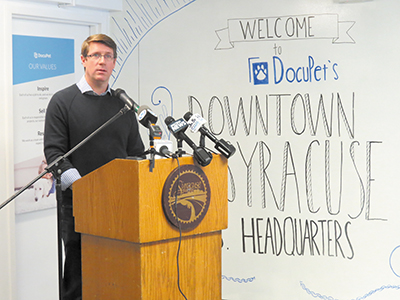
SYRACUSE — DocuPet, a Kingston, Ontario–based pet licensing firm, has opened its U.S. headquarters in Axa Tower II as a tenant of CenterState CEO’s Tech Garden.
“We’ve created a service that is not just for communities and pet shelters, but for pet owners,” Grant Goodwin, CEO of DocuPet, said in his remarks to a gathering at a Nov. 16 formal-opening event at Axa Tower II.
DocuPet currently has two employees in its Syracuse office, who are part of an overall employee count of 25, Goodwin told CNYBJ after the formal-opening event. The company seeks to hire as many as six employees for the Syracuse office.
DocuPet launched its first municipal pet-licensing program in Ontario, Canada in late 2014. Since that time, DocuPet has partnered with more than 30 municipalities and regions.
The City of Syracuse in September had announced that DocuPet would begin processing dog licenses for the city. Syracuse dog owners can register their dogs and renew their pet license online at syracuse.docupet.com.
When asked if pet owners in the Syracuse suburbs can also get them licensed through DocuPet, Goodwin said that, as of now, only Syracuse pet owners can use the service.
DocuPet also has U.S. operations in Boulder, Colorado and will be “launching soon” in Battle Creek, Michigan and Teller County, Colorado. Goodwin expects to launch additional locations in Illinois, Florida, Washington, and Colorado early next year.
The Syracuse office will handle shipping, customer service, and marketing operations for all U.S. jurisdictions, according to a news release from the City of Syracuse.
As a private company, DocuPet doesn’t disclose its revenue information, Goodwin said in an email reply to a CNYBJ inquiry.
START-UP NY participant
SUNY Oswego on Nov. 7 announced that it’s sponsoring DocuPet in the state’s START-UP NY program.
START-UP NY is short for SUNY Tax-free Areas to Revitalize and Transform Upstate NY, per the SUNY website.
DocuPet plans to invest more than $93,000 and create new jobs locally, an investment that “complements the CNY Rising regional strategic plan to revitalize the local economy,” according to a Nov. 7 SUNY Oswego news release.
START-UP NY is Gov. Andrew Cuomo’s offer to new or expanding companies and business ventures to operate completely tax-free in areas on or connected to campuses of the State University of New York.
Companies will have the chance to operate free of state and local taxes on or near academic campuses. Their employees will pay no state or local income taxes for 10 years.
In return, the businesses must add new jobs, providing an “economic lift” to the surrounding community, SUNY Oswego said when the state approved its plan for the START-UP NY program.
About DocuPet
Licensing pets is “extremely important” for animal welfare in North America, Goodwin said in speaking at the Nov. 16 event at the DocuPet office.
He noted that licensing fees help to fund between 60 percent and 70 percent of animal-welfare programs across North America.
“But beyond the financial benefit to the animal-welfare community, it’s the importance of registration,” said Goodwin.
Sometimes, he said, pets will wander off, and “more often than not” they end up in an animal shelter, which can be “overburdened, understaffed, underfunded.”
“So, if we can get registrations, then we can get pets home,” he added.
When people license their pet, they can do it online. They get access to a “home-safe service,” a code that is tied to every tag and is associated with an online profile, said Goodwin.
So when a pet disappears and someone finds it, he or she can look up the pet’s code online and either connect with the DocuPet call center or reach the pet owner directly through the company’s service as well, he added.
Cross-border partnership
CenterState CEO has worked with its economic-development counterparts in Kingston and eastern Ontario, Canada, as well as Queens University [in Kingston] and SUNY Upstate Medical University, to help create “soft-landing sites” to enable companies to expand their markets on both sides of the border,” Robert Simpson, president and CEO of CenterState CEO, said in the city’s news release.
“We are excited that DocuPet is one of the first Canadian companies to utilize this partnership to open a U.S. location in Syracuse. CenterState CEO, in partnership with the City of Syracuse and SUNY Oswego and utilizing the unique startup ecosystem of the Tech Garden, has provided the company with connections to people, customers and resources they need to be successful. In turn, we have connected local firms that are looking to expand into Canadian markets with our counterparts in Ontario. We firmly believe this cross-border partnership will benefit both communities and are already seeing the positive results of this engagement,” said Simpson.
State Archive Site Provides Online Link to the Past
One thing we should be proud of in New York state is our history. And, because of technology, it has never been easier to learn about our past. With the advent of online archives and searchable databases, what once required a trip to the local court house or hours sifting through library archives has, in
Get Instant Access to This Article
Become a Central New York Business Journal subscriber and get immediate access to all of our subscriber-only content and much more.
- Critical Central New York business news and analysis updated daily.
- Immediate access to all subscriber-only content on our website.
- Get a year’s worth of the Print Edition of The Central New York Business Journal.
- Special Feature Publications such as the Book of Lists and Revitalize Greater Binghamton, Mohawk Valley, and Syracuse Magazines
Click here to purchase a paywall bypass link for this article.
One thing we should be proud of in New York state is our history. And, because of technology, it has never been easier to learn about our past. With the advent of online archives and searchable databases, what once required a trip to the local court house or hours sifting through library archives has, in many cases, been replaced with simple keystrokes. However, knowing what to search or where to start can still be a challenge.
One resource that can help and is available to the public for free is www.archives.nysed.gov. The New York State Archives maintains a digital collection site which provides access to millions of photographs, artifacts, government documents, manuscripts, and other materials — some of which are more than 350 years old. Most of these items come from the New York State Archives, but the online collection also includes material from the New York State Museum, State Library, and project partners across the state. The website is overseen by the New York State Education Department, with support from the New York State Archives Partnership Trust.
Some archives feature old maps and surveys. Some are pictures of past farm operations and old ledgers and others feature flyers or advertisements from days gone by. Each archive is specifically sourced and includes the date (if known), the collection from which it was preserved, and additional information to provide more context for the reader.
One archive preserved an essay written by a young student in 1918 who was assisting in the war effort by working on a farm in Central Square. According to the site, in 1917, the New York State Education Department began a program that allowed students between the ages of 16 and 18 to sign up and become farm cadets. Many teens jumped at the chance to become a farm cadet, and to leave their homes in the cities and towns to assist with the war effort by replacing the laborers who had enlisted in the military. From April to September, students worked on farms throughout the state and, in order to receive academic credit for their contribution, wrote essays about their experience. The essay archived is the cadet’s final report.
All archives can be downloaded or shared directly from the site on social media. They can also be expanded in size so the images can be easily seen in full screen. For educators, there are short tutorials on how to incorporate primary sources and other historic sources into classroom instruction. A video features an archivist at the New York State Archives and a county clerk providing research tips on searching county records and describing all that is housed at a county clerk’s office. You can see it at: www.archives.nysed.gov/education/video/finding-records-county-clerk. The site also offers information on how the archives can be tied to curriculum for each grade level.
Additionally, you’ll find extensive resources for those interested in genealogy at http://www.archives.nysed.gov/research/featured-topic-genealogy. While records were not archived for the purpose of genealogical research, many archives are helpful to genealogy research because they include naturalization papers, land records, census information, birth, marriage, and death certificates. In addition, the state has made a subscription to ancestry.com available for free to New York State residents. Images and archives of interest can be stored online through the service. In recent years, the state has added more records to the searchable databases on ancestry.com including New York Civil War enlistments, 1861-1900; New York town clerks’ registers of men who served in the Civil War; New York marriages 1600-1784; and New York military equipment claims, War of 1812.
Those interested in creating their own account on New York ancestry.com should visit http://www.archives.nysed.gov/research/how-to-video-ancestry for directions for the free subscription.
William (Will) A. Barclay is the Republican representative of the 120th New York Assembly District, which encompasses most of Oswego County, including the cities of Oswego and Fulton, as well as the town of Lysander in Onondaga County and town of Ellisburg in Jefferson County. Contact him at barclaw@assembly.state.ny.us or (315) 598-5185.
New chances for bipartisanship in the new Congress
The results of [the recent mid-term] election are in — Americans delivered a split decision on the makeup of the next Congress. In the House, Democrats won control from the Republicans and now hold the majority. In the Senate, Republicans maintained power and even [likely] added [two] seats to their majority. This means that we’ll be
Get Instant Access to This Article
Become a Central New York Business Journal subscriber and get immediate access to all of our subscriber-only content and much more.
- Critical Central New York business news and analysis updated daily.
- Immediate access to all subscriber-only content on our website.
- Get a year’s worth of the Print Edition of The Central New York Business Journal.
- Special Feature Publications such as the Book of Lists and Revitalize Greater Binghamton, Mohawk Valley, and Syracuse Magazines
Click here to purchase a paywall bypass link for this article.
The results of [the recent mid-term] election are in — Americans delivered a split decision on the makeup of the next Congress. In the House, Democrats won control from the Republicans and now hold the majority. In the Senate, Republicans maintained power and even [likely] added [two] seats to their majority. This means that we’ll be operating under divided government for the next two years. But it doesn’t mean that nothing will get done.
Throughout our history, the U.S. Chamber of Commerce has worked with all types of majorities to advance a pro-growth policy agenda. We’ve notched wins with Congress under Republican control, under Democrat control, and everything in between.
Even in today’s hyper-partisan environment, there are still areas where consensus exists in the middle. And we’re calling on our new and reelected leaders from both parties to claim that middle ground and reject the extremes on both sides. We will work with Democrats and Republicans to focus on the art of the possible — those issues that are most likely to attract bipartisan support and the president’s signature.
Here are two examples of priorities that are ripe for progress.
First, infrastructure. Members on both sides of the aisle have long agreed on the need to modernize the physical platform of our economy. They’ll have to make some trade-offs, but there is a real chance to finally do it. Republicans are going to have to accept that we need more revenue from dedicated user fees. Democrats are going to have to accept that private investment must be a big part of the solution. Both sides should look at this as an investment in our nation’s long-term competitiveness and future prosperity.
Second, immigration, which can help address our nation’s worker shortage. Employers must be able to hire the workers they need at every skill level — when and where they need them. So we must fix America’s broken immigration system. If lawmakers find the middle ground, work through the tough issues, and finally address this long-simmering challenge, they will help solve the people gap in our country and reaffirm our legacy of welcoming the world’s best talent and hardest workers.
We’ll also push our leaders to strengthen the U.S. workforce, adopt smart trade policies, advance energy, and support other pro-growth priorities. We’ll fight against efforts to roll back important policy gains from the previous two years, including tax reform and regulatory relief. Unraveling those policies would undermine our economy.
The bottom line is that while the composition of Congress may change, our objectives never do. We’re focused on working with both political parties to push for policies that grow the American economy, create good jobs, and advance free enterprise.
Thomas J. Donohue is president and CEO of the U.S. Chamber of Commerce.
Get our email updates
Stay up-to-date on the companies, people and issues that impact businesses in Syracuse, Central New York and beyond.