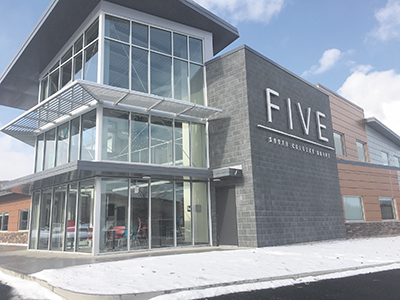
ONEONTA — SUNY recently announced a partnership with the Dormitory Authority of the State of New York (DASNY) and NYSERDA to start its first zero-net carbon-ready retrofit project on a campus for SUNY Oneonta’s Ford Hall. The project seeks to advance Gov. Andrew M. Cuomo’s statewide clean-energy goal of 100 percent carbon-free energy by 2040. […]
ONEONTA — SUNY recently announced a partnership with the Dormitory Authority of the State of New York (DASNY) and NYSERDA to start its first zero-net carbon-ready retrofit project on a campus for SUNY Oneonta’s Ford Hall.
The project seeks to advance Gov. Andrew M. Cuomo’s statewide clean-energy goal of 100 percent carbon-free energy by 2040.
“We will build upon this first zero-net carbon retrofit at Oneonta to other campuses to send a strong message of not just words but action that SUNY is using the latest technology available to eliminate our carbon footprint and provide a sustainable clean energy environment for all our students,” SUNY Chancellor Kristina M. Johnson contended in a Feb. 7 news release.
SUNY issued a request for qualifications (https://www.dasny.org/opportunities/rfps-bids) seeking design-build teams capable of completing the zero-net carbon-ready retrofit project. Ford Hall, which can house 300 students, will be renovated as “zero-net carbon-ready,” meaning in addition to exceeding existing energy codes, the building will make use of future off-site renewable-energy sources as they become available to meet building operations’ energy consumption needs.
The project will be the “first of its kind” for the SUNY residence-hall program and will serve as a “proof-of-concept,” demonstrating that an affordable residence-hall renovation can achieve zero-net carbon performance, the state says.
The team selected to renovate the residence hall will utilize design-build, with both design and construction services provided through a single contract to further project delivery, provide savings, and integrate construction-process knowledge into the design effort for a high level of quality, the release stated.
“This retrofit pilot will offer energy efficiency solutions that can be adopted across the entire SUNY system to help create a cleaner, more comfortable environment for students and help reduce energy costs for SUNY while affirming New York’s commitment to lead by example in the fight against climate change,” Alicia Barton, president and CEO of NYSERDA, said.
The project is expected to begin construction in the summer of 2020 and be completed by the start of the fall 2021 semester.
Chancellor Johnson plans to retrofit and renovate SUNY’s 64-campus system to achieve greenhouse-gas emissions reductions. This plan includes SUNY purchasing 100 percent of its grid-sourced electricity from zero-carbon sources, including renewables and energy storage, and requires all new SUNY buildings to be designed to be capable of zero-net carbon emissions. Making these improvements at SUNY’s 2,346 buildings — which represent 40 percent of the state-owner building infrastructure in New York — is expected to reduce New York’s carbon footprint by more than 400,000 tons of CO2 equivalents per year, the release stated.
The residence-hall project will be financed through a combination of DASNY’s SUNY Dormitory Facilities tax-exempt bonds supported by student residence-hall fees and funding from NYSERDA.
The New York State Energy Research and Development Authority (NYSERDA) recently announced it has made a total of $1 million available to qualified home energy contractors and home inspectors through a four-phase, multi-year home energy ratings pilot. The pilot which is targeted to one- to four-family homes, seeks to help homeowners who are “ready to
The New York State Energy Research and Development Authority (NYSERDA) recently announced it has made a total of $1 million available to qualified home energy contractors and home inspectors through a four-phase, multi-year home energy ratings pilot.
The pilot which is targeted to one- to four-family homes, seeks to help homeowners who are “ready to invest in their homes” and are looking for “independent, trustworthy energy performance information,” NYESRDA said in a Feb. 20 news release.
Once approved through a competitive selection process, qualified contractors and home inspectors will provide those homeowners with home energy performance ratings including opportunities for improving their energy performance.
The announcement is part of the state’s efforts to meet Gov. Andrew Cuomo’s 2025 energy-efficiency target to reduce energy consumption by 185 trillion BTUs (British thermal units) below forecasted energy use in 2025.
The new energy-efficiency target will set New York state on a path to achieve annual electric-efficiency savings of 3 percent of investor-owned utility sales in 2025, the release stated.
Home energy ratings are similar to a miles-per-gallon rating on a car, providing visual reports on how a home performs in areas such as insulation, air sealing, heating and cooling efficiency, and hot-water heating. Each rating comes with a list of recommendations or an improvement plan that helps the homeowner plan upgrades to increase the efficiency, comfort, and value of their home.
NYSERDA says two home energy rating systems will be piloted: the U.S. Department of Energy’s “Home Energy Score” and the “Pearl Home Certification” from Pearl, a private residential energy-efficiency certification firm. Six locations across the state (including two in Central New York) were selected to evaluate the impact the rating systems will have on consumer awareness and demand for energy efficiency services in different geographic areas.
The Home Energy Score will be offered in Queens, Broome County, and the Town of Tonawanda.
The Pearl Home Certification will be offered in Staten Island, Tompkins County, and the Town of Irondequoit.
Editor’s Note: CNY Executive Q&A is a feature appearing periodically in The Central New York Business Journal, authored by guest writer Jeff Knauss, who is co-founder of his own digital-marketing firm. In each edition, Knauss chats with a different executive at a Central New York business or nonprofit, with the interview transcript appearing in a
Editor’s Note: CNY Executive Q&A is a feature appearing periodically in The Central New York Business Journal, authored by guest writer Jeff Knauss, who is co-founder of his own digital-marketing firm. In each edition, Knauss chats with a different executive at a Central New York business or nonprofit, with the interview transcript appearing in a conversational Q&A format.
In this issue, I speak with Kimberly Townsend, CEO of Loretto, a nonprofit network of elder-care providers. It serves nearly 10,000 individuals annually in Central New York. Loretto employs 2,500 people and says it is the sixth largest employer in Central New York. It is the fourth largest health-care provider in the region.
KNAUSS: Tell me about your background, where you grew up, where you attended school, and how did you get to where you are today?
TOWNSEND: I grew up in New Hampshire. I was the caboose of my family. I have two siblings that are in their 70s. Essentially an only child, I initially went to Boston University School of Public Communication for two years and dropped out of school, got married, and started a family. For a period of 13 or 14 years, I stayed home, raised my kids — homeschooled my children for nine years.
When I saw that I was going to be a single parent, I went back to school. I started at Onondaga Community College and transferred to Syracuse University’s University College, [and] got half a semester worth of credits for my two years’ worth of school. In a period of 6 ½ years, I was able to get my bachelor’s degree, my MBA, and my law degree, and was hired by Welch Allyn at the end of my first year of law school.
I spent 14 years there, which was great. I was associate general counsel, senior director of government affairs. I got to work all over the world and was able to work with fascinating people. But when the opportunity at Loretto opened to be a leader here, that was always my goal. So, I came to Loretto about five years ago.
KNAUSS: Tell me how you got connected to Loretto when you were working at Welch Allyn?
TOWNSEND: At one point, there was a 40 under 40 conference that was held in town and my oldest daughter and I were the poster children for it because I was literally like 39 and she was 20. We both went to the conference, but part of that conference was trying to connect young professionals with not-for-profit board positions.
Loretto was one of the organizations. It was looking for a board member. I connected with Loretto and was recruited onto the parent company board. I spent 14 years on the parent company board and served as the chair of the parent company board for about 2 ½ years before I was asked to become CEO here.
KNAUSS: What made you decide to go back to school and what was it like to go from being a stay-at-home mom back into the workforce again?
TOWNSEND: Well, I really didn’t have a choice because I knew that I was going to need to be able to support my children. As difficult as it was starting back in school, and being in school with 19 and 20-year-olds while I was in my early 30s, that was just what I had to do. I picked a practical field, which was accounting. I’m a CPA, but quickly, I saw that the really interesting work was being done by lawyers — so my goal was to be a tax lawyer.
I started law school but then drifted into corporate law instead and the rest was history. I always believed that people can do whatever they need to do in order to take care of their children. As I speak to our employees here, I’m constantly amazed and inspired by what people do to better their children’s lives and that was what it was for me.
KNAUSS: What was it about Loretto that made you decide to take the leap?
TOWNSEND: Well, I was always really passionate about the mission of Loretto both from the perspective of people who they care for in the community and the role it serves in the community, but also just the fact that it’s really an anchor employer for so many people from the city of Syracuse. We know the city has challenges, and it’s something that Loretto was proud of — being an anchor employer.
From my perspective, personally, I’m always most fulfilled when I’m able to make a difference in people’s lives and even more so if it’s in a direct way. When you’re a CEO, you get to make a direct difference in people’s lives. That was what was appealing to me about Loretto even though I have to say I really enjoyed my time at Welch Allyn and wasn’t really looking to leave there. It was just a unique opportunity at the right time.
KNAUSS: How many people does Loretto currently employ?
TOWNSEND: Loretto has 2,500 employees. We say that roughly 1,800 of our employees are frontline caregivers and so that might be people in food service and dining, CNAs, home health aides, housekeeping. And 65 percent of our frontline caregivers are single women of color, head of household, and coming from the City of Syracuse.
KNAUSS: How do you find the best talent? What characteristics do you try to look for when you’re recruiting new talent for Loretto?
TOWNSEND: Well, I think we always look for people who are passionate, particularly about care giving. I would say everyone who works here is dedicated to the mission to deliver exceptional care to people. That’s first and foremost. You really can’t train mission and passion. It has to be there. Then I think we look for people who are creative and don’t mind challenges because health care is a challenging place to be. It’s challenging emotionally and it’s challenging intellectually. It’s so dynamic.
KNAUSS: What’s your philosophy on building a culture for your organization? What do you do as a CEO to help implement that culture?
TOWNSEND: I think we’ve really shifted the culture here at Loretto in the five years that I’ve been here, but it all starts with some foundational work that we describe as dialogue. My personal opinion is that health care is a point-of-service business. The care you receive is only as good as the person standing in front of you and if they feel valued, respected, and effective, you’re going to get great care and if they don’t, you won’t receive good care.
When I came in, one of the first things that we did was we engaged in a process of dialogue. Across Loretto, we would bring groups of employees together to discuss the hard things, the difficult things to discuss, things like what does it feel like to work at Loretto? What does Loretto value? If you could change one thing about Loretto, what would it be and how would that feel?
I think by engaging our employees in that dialogue, they really saw that we were committed to listening to them. We were committed to acting on the things that they brought forward and it just really changed the culture to one where people understood that they were able to make a meaningful difference. I think that’s what everybody wants to do particularly in caregiving professions. Everybody wants to make a difference.
KNAUSS: You’ve had a very successful career. What are some of the characteristics that you feel have led you to where you are today?
TOWNSEND: I would say that I’ve had some strong mentors and sponsors and I’ve always been receptive to what people have shared with me — the good, bad, and the ugly; but I think by nature, I’m self-reflective. I think I’m self-aware and I think I’m good at self-managing, and really, those are kind of the three areas that help people become effective leaders.
If you’re missing any of those pieces, your leadership isn’t going to be as successful as you want it to be. I think it’s really important to know what you’re good at and what you’re not good at, and to be open and responsive to criticism — both criticism that’s delivered well and criticism that’s not delivered well. I just try to be open and I trust people inherently. I try to empower the people around me because I trust them.
KNAUSS: How do you think your employees would respond if I asked them, “What kind of leader is Kim?”
TOWNSEND: I think people would respond that I’m inclusive, that I ask good questions, but in a non-confrontational way. I’m curious and I’m supportive. I’m not a person who tries to blame shift. I accept responsibility because I feel strongly that as the leader of the organization, I’m ultimately responsible for what happens here. When we’ve had things that didn’t go as planned, I’m the person who is willing to take responsibility, but likewise when things go well, I’m happy to give credit to the team.
KNAUSS: What do you think is one of the largest challenges that Loretto faces in the coming year?
TOWNSEND: Talent. I mean, we’re in a, what, four percent unemployment rate environment, highly competitive in health care. There’s a clinical shortage in general across the country and so when I lay awake at night, it’s over talent related issues — recruiting the right people, retaining the right people, developing people that are already here to be the leaders of tomorrow because I won’t be here forever.
KNAUSS: What are you doing to offset that challenge?
TOWNSEND: At Loretto, we work hard to support our employees and we have a number of programs that are unique that we do in order to support our employees. For example, we have a car-buying program with two federal credit-union partners for individuals who maybe don’t have any credit or maybe have bad credit. We help them repair that credit, backstopping their loans so they can get a car.
We have a free diaper program so we give out 12,000 diapers a month to employees, about half of those are grandparents raising their grandchildren for various reasons. We offer free urgent care on site. Our employees have great health benefits, but sometimes, people are taking public transportation, can’t get to the doctors, or can’t afford the co-pay.
We also have an emergency fund, our WeCare fund, which the balance of the WeCare fund is always zero because there are so many challenges that some of our employees face — evictions, health issues, even burying children who have been killed. We’re looking at other programs, so we have a food pantry in our Auburn location and we’re looking to maybe partner with the Food Bank here to offer that to our employees.
We’re looking potentially to expand our partnership on car buying to home buying and we’re part of a community conversation both in Onondaga and Cayuga County around the fact that Central New York is a daycare desert, so 75 percent of people with children 0-3 cannot find quality, affordable daycare.
We believe that we, as an employer, can take a huge stake in that so we’re part of those conversations, really trying to solve the daycare crisis from 0-3 until universal pre-K. Part of the reason why children are coming to kindergarten and only a third of them are ready is because they’ve lost the first three years. That’s important.
At Loretto, we take a multigenerational perspective, so by helping our employees, we’re changing the trajectory for their families into the future.
KNAUSS: What do you feel is the biggest opportunity for Loretto in the next year?
TOWNSEND: I think we have several advantages. I think that our three new projects are spot on in meeting community needs. We’re building a dedicated memory care facility at the Nottingham, state-of-the-art design, with everything we know in terms of evidence-based practices and caring for people who are living with Alzheimer’s.
We are also expanding our PACE Program. We know in the future, people want to stay home. They don’t want to be in institutional settings and the PACE Program is like skilled nursing without walls, so it allows us to maintain people in their homes. We have our restorative care unit that we opened here in collaboration with our hospital partners, which is popular.
It allows us to reduce the length of stay in the hospital by shifting people here safely. Unlike other parts of the country, Syracuse hospitals are full most of the time, so reducing that length of stay allows them to take care of more people. I think we’ve done a number of things. I think from employee initiatives, we’re going to continue to explore offering new services such as home buying, child care, and free legal services.
I think we’re good at listening to what the community needs, listening to what our hospital partners need, and then listening to what our employees need. As large as we are, we’re nimble in meeting those needs. That’s why we’re here.
KNAUSS: What do you do to unwind?
TOWNSEND: I work out every day and that’s at minimum six days, usually seven days a week. I work out really hard because it’s a good stress reliever, right? I also try to be thoughtful and meditative. I think it’s important to be reflective every day in terms of the things that are going well and the things that aren’t going well. I really enjoy doing things with my family. We have a large family. I have three grandchildren and one on the way. There is never a lack of things going on. Big families are fun. They are crazy, but they are fun.
KNAUSS: You recently wrote a book, tell me about that experience.
TOWNSEND: I did. I got my doctorate about 1 ½ years ago and took some of the principles from it and our leadership philosophy here at Loretto. It’s called “Lifecircle Leadership: How Exceptional People Make Every Day Extraordinary.” That came out in November 2018. People have just been so generous about buying the book and positively reviewing the book. The proceeds for the book go into our “WeCare” emergency fund. It’s all for a good cause.ν
About the article author: Jeff Knauss is co-founder of the digital marketing agency, Digital Hyve, and has always had a passion for learning about successful executives and their stories. For more on Knauss, check out www.digitalhyve.com.
SALINA — Community Bank System, Inc. (NYSE: CBU) in early January acquired a Salina–based financial-services firm as it continues to add to its non-banking business portfolio. On Jan. 2, the DeWitt–based banking company — through its subsidiary, Community Investment Services, Inc. (CISI), which is part of Community Bank Wealth Management — completed its acquisition of
SALINA — Community Bank System, Inc. (NYSE: CBU) in early January acquired a Salina–based financial-services firm as it continues to add to its non-banking business portfolio.
On Jan. 2, the DeWitt–based banking company — through its subsidiary, Community Investment Services, Inc. (CISI), which is part of Community Bank Wealth Management — completed its acquisition of certain assets of Wealth Resources Network, Inc. That firm provides wealth-management services including financial, retirement, and estate planning.
Community Bank System paid $1.2 million in cash to acquire the assets of Wealth Resources Network, according to Community Bank’s Form 10-K filed with the U.S. Securities & Exchange Commission on March 1. The banking company recorded a $1.2 million customer-list intangible asset on its balance sheet in conjunction with the acquisition.
Wealth Resources Network (WRN) is headquartered at 406 Old Liverpool Road. The firm’s president is Jeffrey Layhew.
A total of six WRN employees joined CISI, including Layhew. “Everyone was retained,” Paul A. Restante, president and CEO of Community Bank Wealth Management, tells CNYBJ in an email.
All clients have transitioned over to CISI, but they continue to be serviced by the WRN team. No WRN buildings or equipment were purchased in the acquisition, he says.
“Community Bank Wealth Management is always looking for acquisition or affiliation opportunities with financial firms that have a similar business and growth model as we have, if it is additive for all involved,” Restante says in explaining the rationale for the acquisition. “We have been engaged in conversations with WRN for some time but, both parties felt that joining together best served their clients using a calendar year move,” he adds, explaining the timing of the deal, at the start of 2019.
The acquisition increases Community Bank Wealth Management’s concentration in the Central New York marketplace, he says.
The company plans to continue using the Wealth Resources Network name “to avoid client confusion,” and will evaluate it after year one, per Restante.
WRN joins the Community Bank Wealth Management umbrella, which consists of Community Investment Services (brokerage), Community Bank Trust Services (trust administration and investment management), Nottingham Advisors (RIA and money manager), One Group Retirement Advisors (401(k) and retirement-plan consulting firm) and, Carta Group (fee-based planning and executive benefits firm), he explains.
The WRN acquisition came a year after Community Bank System, through, CISI, paid $700,000 in cash to acquire a customer list from Styles Bridges Associates, a financial-services business headquartered in Canton, according to the 10-K filing.
Community Bank System says the acquisition of financial-services businesses is part of its objective to increase the noninterest component of its revenue.
UTICA — Hotels in Oneida County were less full in January compared to a year ago, according to a recent report. The hotel occupancy rate (rooms sold as a percentage of rooms available) in the county declined 3.6 percent to 38.8 percent in January from 40.2 percent in the year-ago month, according to STR, a
UTICA — Hotels in Oneida County were less full in January compared to a year ago, according to a recent report.
The hotel occupancy rate (rooms sold as a percentage of rooms available) in the county declined 3.6 percent to 38.8 percent in January from 40.2 percent in the year-ago month, according to STR, a Tennessee–based hotel market data and analytics company. That broke a string of 10 straight months of occupancy-rate increases in the county.
Revenue per available room (RevPAR), a key industry indicator that measures how much money hotels are bringing in per available room, fell 2 percent to $39.04 in January from $39.86 in January 2018. Oneida County’s RevPAR had increased for 10 months in a row before this decline.
Average daily rate (or ADR), which represents the average rental rate for a sold room, gained 1.6 percent to $100.70 in January from $99.12 a year prior, per STR.
UTICA — ConMed Corp. (NASDAQ: CNMD), a Utica–based medical-device maker, recently announced that its board of directors has declared a quarterly cash dividend of 20 cents per share for the first quarter. The dividend will be payable on April 5 to all shareholders of record as of March 15. At the company’s current stock price,
UTICA — ConMed Corp. (NASDAQ: CNMD), a Utica–based medical-device maker, recently announced that its board of directors has declared a quarterly cash dividend of 20 cents per share for the first quarter.
The dividend will be payable on April 5 to all shareholders of record as of March 15.
At the company’s current stock price, the dividend yields just over 1 percent.
ConMed says it’s a medical technology company that provides surgical devices and equipment for minimally invasive procedures. The firm’s products are used by surgeons and physicians in specialties including orthopedics, general surgery, gynecology, neurosurgery, and gastroenterology. ConMed has a direct selling presence in 19 countries, and international sales make up about half of its total sales. The company employs about 3,100 people globally.
DeWITT — Community Bank System, Inc. (NYSE: CBU) recently announced that it has declared a quarterly cash dividend of 38 cents a share on its common stock. The dividend will be payable on April 10, to shareholders of record as of March 15. The dividend yields 2.5 percent on an annual basis, based on the
DeWITT — Community Bank System, Inc. (NYSE: CBU) recently announced that it has declared a quarterly cash dividend of 38 cents a share on its common stock.
The dividend will be payable on April 10, to shareholders of record as of March 15. The dividend yields 2.5 percent on an annual basis, based on the bank’s current stock price.
Community Bank also paid out a quarterly dividend of 38 cents per share in each of the last two quarters. Before that, it paid 34 cents.
DeWitt–based Community Bank System has more than $10 billion in assets and over 230 branches across upstate New York, northeastern Pennsylvania, Vermont, and western Massachusetts.
ITHACA — Ithaca College announced that its president, Shirley M. Collado, has been named to the Board of Trustees of the Commission on Independent Colleges and Universities of New York (CICU). CICU represents the public-policy interests of more than 100 private, not-for-profit colleges and universities in New York State and advocates for programs that help
ITHACA — Ithaca College announced that its president, Shirley M. Collado, has been named to the Board of Trustees of the Commission on Independent Colleges and Universities of New York (CICU).
CICU represents the public-policy interests of more than 100 private, not-for-profit colleges and universities in New York State and advocates for programs that help students access higher-education opportunities.
“As an innovator and expert on collaborations, President Collado will be an asset to our board,” CICU President Mary Beth Labate said in a news release. “Her commitment to increasing access, diversity, and equity in higher education aligns with CICU’s mission, and we look forward to adding her dynamic perspective to our board.”
The CICU board has 24 members, all chief executives of a member college or university. Collado will attend her first meeting with the group on May 2.
Collado has held a range of executive leadership positions during her 17 years in higher education. She served as executive vice chancellor and chief operating officer at Rutgers University-Newark and professor of psychology, dean and VP of student affairs at Middlebury College. Collado has also taught at George Mason University, Georgetown University, Lafayette College, the New School, and New York University.
Collado is a first-generation college graduate who received a bachelor’s degree in psychology from Vanderbilt and earned master’s and doctorate degrees in clinical psychology from Duke University.
Some recent tweets that came across the @cnybj Twitter feed, offering various small business, tech, HR, career, and personal tips. Sherylhardin @sherylhardinEncore Entrepreneurship for Women. Are you interested in pursuing a second career? Take @SBA’s FREE self-paced training course designed for women over the age of 50 who are interested in starting a business. https://buff.ly/2GDrI0j SBA
Some recent tweets that came across the @cnybj Twitter feed, offering various small business, tech, HR, career, and personal tips.
Sherylhardin @sherylhardin Encore Entrepreneurship for Women. Are you interested in pursuing a second career? Take @SBA’s FREE self-paced training course designed for women over the age of 50 who are interested in starting a business. https://buff.ly/2GDrI0j
SBA @SBAgov Be your own boss. The SBA provides resources to help women start, grow, expand or recover a business — http://ow.ly/USAD30nXtEU .
MARK BRITZ@britz Providing Employees Flexibility in Workplace Tools Doesn’t Mean It’s a Free-For-All http://bit.ly/2tZ86ya via @chieftech /Tolerance for Change
Staff One HR, an Oasis Outsourcing company @staffonehr A great lesson in emotional intelligence from employer Trader Joe’s. http://ht.ly/GvRQ30nM1PJ #culture #emotionalintelligence #HR
Hannah Morgan @careersherpa Wondering How To Use Instagram for Job Search? Here are some ideas for status updates, plus more helpful tips on optimizing your profile / @careersherpa https://buff.ly/2SeThlj #jobsearch
Keyrus @Keyrus_group “Career management isn’t just the employee’s job” @mitsmr https://bit.ly/2H2HdRS
Jacob Burke@jacobburke “Obsessed is a word that the lazy use to describe the dedicated.” —Unknown
Sven @SvenRoyalChef Kitchen #Tips for #HealthyEating – Make Frozen Cubes – Instead of watching the bunch of parsley go bad, chop it up and mix with a tiny bit of oil and then freeze as ice cubes that you can throw into soup later. Or sauces for quick, individual meals
Kevin Watts @KevinWattss A #delicious #balance of #cooking #tips and have #nutrition #features, https://amzn.to/2UlEeaT
UNION — Companies interested in helping in the redevelopment of the former BAE site in the town of Union have until April 22 to make their interests known. The Agency on March 8 released a request for expressions of interest (REI) for the redevelopment of the property at 600 Main St. Those interested can download
UNION — Companies interested in helping in the redevelopment of the former BAE site in the town of Union have until April 22 to make their interests known.
The Agency on March 8 released a request for expressions of interest (REI) for the redevelopment of the property at 600 Main St. Those interested can download the document at the “News & Resources” page of the Agency’s website.
The Agency is the entity that governs the Broome County Industrial Development Agency and the Broome County Local Development Corporation.
The Agency has issued the REI in order to identify “one or more” private development partners to move the redevelopment forward. Agency representatives view the site as a “critical gateway” to planned investment in both Johnson City and Endicott.
“We are very excited to begin this next critical phase of the redevelopment of 600 Main St,” Stacey Duncan, deputy director at the Agency, said in a news release. “Redeveloping this site demonstrates the physical and economic resilience of Broome County and will serve as a wonderful gateway into the continued investment in our urban corridor.”
The Agency took title of the 27-acre property in 2018. The U.S. Air Force in 2017 demolished the BAE building, which was devastated by flooding from Tropical Storm Lee in 2011, according to the Agency.
The Agency at that time announced that Saratoga–based Elan Planning, Design and Landscape Architecture would complete a redevelopment study on the property. Elan representatives feel “confident” about the redevelopment of this site based on a number of “attractive” site characteristics, the Agency said.
“After a careful analysis of existing conditions and potential market opportunities, our team was able to prepare a master plan that illustrates the opportunity to redevelop this site as a mixed-use development offering a product that is not found elsewhere in the Triple Cities area. The proximity of this site to Interstate 86 and NY Route 201, the Binghamton Health Science Campus and UHS Wilson Hospital only strengthens the opportunity for redevelopment,” Lisa Nagle, principal with Elan Planning, Design, & Landscape Architecture, said in the Agency’s news release.
The Town of Union has recognized the redevelopment of 600 Main St. as a priority in its ability to bring new tax revenue and potential jobs to the community. In addition, the site serves as one of the last large parcels available for redevelopment in Broome County’s urban corridor.
“The Town is committed to bringing a renaissance to our community. It is our hope that in repurposing this vacant site, we are beginning a rebirth of commerce and good fortune for the area and its residents,” Rick Materese, supervisor of the Town of Union, said.
About the study
The Elan study included participation and input from the Town of Union; Broome County Department of Planning and Economic Development; and a “number” of community stakeholders including Binghamton University; UHS, a Binghamton–based health system; and the Greater Binghamton Convention and Visitors Bureau. The study’s goal was to “identify potential redevelopment uses garnering the greatest opportunity for tax generation, economic impact and job creation,” the Agency said.
The conceptual site plan also included requirements to bring the development site out of the flood plain to prevent a future flooding event from impacting development. The Agency anticipates the need for assistance in addressing the overall site-development costs and is seeking a private developer to create a public-private partnership.
The U.S. Department of Defense’s Office of Economic Adjustment provided grant assistance to help pay for the redevelopment study, the Agency said. U.S. Senate Minority Leader Charles Schumer (D–N.Y.) helped secure the grant funding.
The Agency credits Schumer’s help as “vital” to the redevelopment of this site.
“Today the former BAE moves from a story of loss and inactivity to a clean redevelopment site brimming with potential energy and job growth. That is why I fought to make sure the feds helped Broome County in its time of need, cleaned up this site and provided assistance to plan for its redevelopment. Today’s news means we are one step closer to a vibrant project and I am proud to have been part of this effort,” Schumer said in the release.
Get our email updates
Stay up-to-date on the companies, people and issues that impact businesses in Syracuse, Central New York and beyond.