Stay up-to-date on the companies, people and issues that impact businesses in Syracuse, Central New York and beyond.

WellNow Urgent Care adds VA carrier TriWest to list of accepted insurance plans
CLAY — WellNow Urgent Care announced it has added TriWest — which administers health plans for the U.S. Department of Veterans Affairs (VA) — to its network of accepted insurance plans. TriWest Healthcare Alliance is headquartered in Phoenix, Arizona, per its website. Through this partnership, WellNow Urgent Care has been named a VA-authorized urgent-care provider […]
Become a Central New York Business Journal subscriber and get immediate access to all of our subscriber-only content and much more.
Click here to purchase a paywall bypass link for this article.
CLAY — WellNow Urgent Care announced it has added TriWest — which administers health plans for the U.S. Department of Veterans Affairs (VA) — to its network of accepted insurance plans.
TriWest Healthcare Alliance is headquartered in Phoenix, Arizona, per its website.
Through this partnership, WellNow Urgent Care has been named a VA-authorized urgent-care provider where veterans can receive treatment for non-life-threatening injuries and illnesses, per a Sept. 5 WellNow news release.
WellNow, which has locations across upstate New York, describes itself as “one of New York State’s fastest-growing urgent care providers.” It was formerly known as Five Star Urgent Care.
The VA had decided to allow urgent-care visits for some veterans who had VA insurance, says Dr. John Radford, president of WellNow Urgent Care.
WellNow Urgent Care learned about the development through the Urgent Care Association, he recalled. Warrenville, Illinois–based Urgent Care Association is a trade group for urgent-care workers.
“Prior to this, [veterans] were only able to go to a VA hospital [for treatments] and they are allowing them …up to four walk-in visits a year that the VA would reimburse for folks that just had VA insurance,” says Radford, who spoke with CNYBJ on Sept. 10.
The Trump Administration this year finalized rules that increase veterans’ access to private doctors and health-care facilities, using their government-funded benefits.
WellNow began pursuing TriWest as an insurance carrier in July, according to Radford.
TriWest Healthcare Alliance was founded in 1996 to provide active duty service members, retirees and their families access to health care under the U.S. Department of Defense TRICARE program, per the TriWest website. TriWest no longer administers the TRICARE program, the website says.
Under their agreement, veterans can walk into any WellNow Urgent Care facility with no appointment or prior authorization needed for treatment. WellNow will facilitate all coverage confirmation and billing logistics with the VA, WellNow said.
To be eligible, veterans must be enrolled in the VA health-care system and have received care through the VA or a community provider in the past 24 months. To confirm eligibility, veterans can contact their local VA medical facility.
All WellNow facilities provide treatment for non-life-threatening injuries and illnesses, such as sprains, strains, colds and the flu, while also providing on-site X-rays, lab testing and physicals.
In addition to TriWest, WellNow accepts most insurance, including Medicare, Medicaid, and Fidelis, the company said.

NYSDOT to hire more than 500 workers for winter season
The New York State Department of Transportation (NYSDOT) is preparing for the upcoming winter season and is seeking to fill more than 500 positions as permanent and seasonal maintenance staff across upstate New York and Long Island. Each September, the department begins to hire and train staff on equipment and best practices, with the aim
Become a Central New York Business Journal subscriber and get immediate access to all of our subscriber-only content and much more.
Click here to purchase a paywall bypass link for this article.
The New York State Department of Transportation (NYSDOT) is preparing for the upcoming winter season and is seeking to fill more than 500 positions as permanent and seasonal maintenance staff across upstate New York and Long Island.
Each September, the department begins to hire and train staff on equipment and best practices, with the aim of having them ready to plow snow as soon as winter weather begins, per an Aug. 26 news release from the department.
Employees can expect a base salary plus likely overtime pay, training provided by experienced equipment operator instructors and storm managers, and an allowance for footwear.
“Our maintenance workers are the heart and soul of everything we do at DOT, especially during New York’s harsh winter season,” Marie Therese Dominguez, NYSDOT Commissioner, said in the release. “They play a vital role during and after winter storms, clearing snow and ice to enhance highway safety, maintaining access for first responders and, in smaller storms, allowing businesses to remain open so the public can get the goods and services they need. We are seeking hard-working, dedicated professionals to join our team who take pride in what they do and positively impact the traveling public.”
The department is accepting applications for positions as highway maintenance worker trainees. To apply, a candidate must be at least 18 years old, pass a physical and drug test, have a valid, clean class A or B commercial driver license, and be certified to operate DOT heavy dump trucks within two weeks after start of employment, the department said.
The DOT will train and evaluate those hired on “several” pieces of equipment and the department expects those hired to “perform productive work while gaining experience.” Physical labor is required, as is work with backhoes, front-end loaders, stump grinders and other heavy equipment, while being trained on more complex equipment.
Returning seasonal employees and retirees qualify for the highway maintenance worker 1 position. The DOT expects those employees to operate a variety of equipment, including hydraulic excavators, graders, bulldozers, and more, and are required to perform other maintenance activities, such as mounting and dismounting plows, making small equipment repairs and changing oil. Temporary employment “often” leads to a permanent position for the right candidates, the DOT said.
During the winter, maintenance workers primarily assist in snow and ice removal, but the department also expects them to perform general highway repairs and maintenance such as cold patching. Shifts vary depending on location, but run from early morning to early afternoon, and from early afternoon to late evening. During storms, those eight-hour shifts can be extended to form two, 12-hour shifts to ensure 24 hour a day, seven day a week snow and ice response, the DOT said.
The DOT employs about 3,700 full time snow and ice operators and supervisors, as well as an estimated 300 seasonal operators. They are responsible for pre-treating, plowing, and removing ice from more than 36,000 miles of roadway.
The department also intends to hire permanent and temporary maintenance workers across the state, including 34 in Central New York, 36 in the Mohawk Valley, 38 in the Western Southern Tier, 38 in the Eastern Southern Tier, 60 in the North Country, and 60 in the Finger Lakes region.
Qualified candidates can find more information about the positions available and how to apply at https://www.dot.ny.gov/jobs/perm_positions/highway-maintenance-worker.
Generation Next to Support Diverse Professionals in CNY
The ability to attract and retain highly skilled talent is a pervasive challenge often shared by CenterState CEO members. In response to this growing demand for talent across multiple industry sectors, we partnered with the Central New York Regional Economic Development Council and the New York State Department of Labor to launch a talent task force to
Become a Central New York Business Journal subscriber and get immediate access to all of our subscriber-only content and much more.
Click here to purchase a paywall bypass link for this article.
The ability to attract and retain highly skilled talent is a pervasive challenge often shared by CenterState CEO members. In response to this growing demand for talent across multiple industry sectors, we partnered with the Central New York Regional Economic Development Council and the New York State Department of Labor to launch a talent task force to gather data and recommend strategies for our community to adopt.
As part of its research, the talent task force found that 100 percent of surveyed Central New York employers say that, while they’re growing, they have difficulty filling positions. Notably, 40 percent said that attracting diverse professionals to Syracuse is especially challenging. And recent and potential hires surveyed cited a lack of diversity and amenities in Syracuse among their concerns about moving to the area.
A diverse, highly engaged, and welcoming community strengthens our local workforce and supports regional attraction and retention efforts. Companies with diverse and inclusive teams are also consistently more successful.
With this in mind, CenterState CEO and the Downtown Committee, with $10,000 in seed funding generously provided by M&T Bank, have launched Generation Next. This new initiative seeks to foster social engagement, job placement, and career advancement among diverse young professionals in Central New York. Generation Next will work to provide targeted grants to increase diverse ownership of small businesses in an effort to create a community that is attractive to a broad range of young professionals. Generation Next will create content for Good Life CNY, a new quality of life and talent attraction initiative coming soon for the region. It will also provide a platform for diverse young professionals to connect with business and community leaders in an effort to cultivate a new generation of leadership. Additionally, Generation Next will support employers by making representatives available to meet with prospective job candidates or trailing spouses.
There are several ways [CenterState CEO members] can be involved in this effort, including following M&T Bank’s lead in contributing to this important initiative by donating to the Generation Next fund. Those supporting Generation Next will help enable the creation of social programs and spaces that reflect the diversity of our community. Businesses and organizations can also host or sponsor networking and engagement events, or connect their employees to this effort. To find out how, contact Dr. Juhanna Rogers or Heather Schroeder at GenerationNext@centerstateceo.com.
Robert M. (Rob) Simpson is president and CEO of CenterState CEO, the primary economic-development organization for Central New York. This viewpoint is drawn and edited from the “CEO Focus” email newsletter that the organization sent to members on Sept. 5.

Benefits account for roughly one-third of total employee compensation in the U.S.
Benefits account for 31.4 percent of the total compensation of American civilian workers, according to data released in June of this year by the U.S. Bureau of Labor Statistics (BLS). The BLS defines “benefits” as forms of compensation apart from wages and salaries that include paid leave, supplemental pay, insurance, retirement and savings contributions, and
Become a Central New York Business Journal subscriber and get immediate access to all of our subscriber-only content and much more.
Click here to purchase a paywall bypass link for this article.
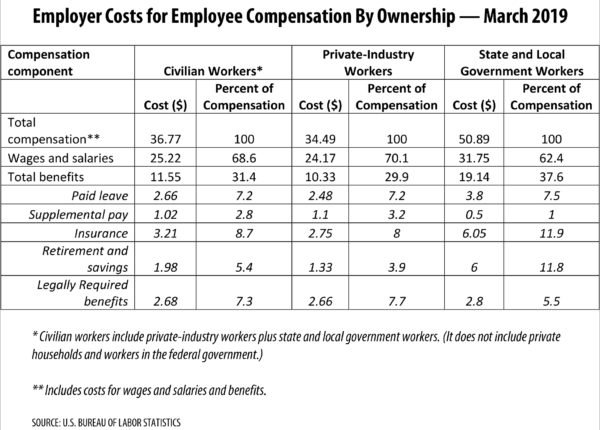
Benefits account for 31.4 percent of the total compensation of American civilian workers, according to data released in June of this year by the U.S. Bureau of Labor Statistics (BLS).
The BLS defines “benefits” as forms of compensation apart from wages and salaries that include paid leave, supplemental pay, insurance, retirement and savings contributions, and legally required benefit contributions such as Social Security, Medicare, workers’ compensation, and unemployment insurance.
The BLS release was the bureau’s report on Employer Costs for Employee Compensation (ECEC), which is a product of the National Compensation Survey. The findings reflect data from March 2019.
The release notes that, “The ECEC covers the civilian economy, which includes data from both private industry and state and local government. Excluded from private industry are the self-employed, agricultural workers, and private household workers. Federal government workers are excluded from the public sector.”
Among private-industry workers, benefits make up 29.9 percent of total compensation, while for state and local-government workers, the total is 37.6 percent.
State and local-government employees receive both higher total benefits (85 percent more) and wages and salaries (31 percent higher) than private-industry workers. As a result, total compensation costs are also higher for the state and local-government sector with an average cost of $50.89 per hour, almost 48 percent more than the average of $34.49 an hour for private-industry workers.
The largest single benefit-cost category is health insurance, which accounts for 8.3 percent of compensation of civilian workers, followed by legally required benefits at 7.3 percent, and then paid leave of all types combined (vacation, holiday, sick, and personal time) at 7.2 percent.
The ECEC release also includes data for compensation costs by occupational and industry group. Benefits as a percentage of total compensation ranges from a low of 21.4 percent among workers in the private industry “Accommodation and Food Services” category to a high of 42.5 percent in the state and local government “Service” category.
We are All “Right” and That’s Why We are Missing One Another
Absent pathology, we all wake up in the morning with the best of intentions to do good things. Sure, we all entertain and even act on the occasional devious thought — a prank on a colleague or spouse, or a few choice words lobbed at the TV news — but for the most part, we
Become a Central New York Business Journal subscriber and get immediate access to all of our subscriber-only content and much more.
Click here to purchase a paywall bypass link for this article.
Absent pathology, we all wake up in the morning with the best of intentions to do good things. Sure, we all entertain and even act on the occasional devious thought — a prank on a colleague or spouse, or a few choice words lobbed at the TV news — but for the most part, we are decent people.
And we are often, as well, correct in our own minds. We know what we would like done and how to go about doing it — with the resultant corollary: if you’re doing it differently, you must be wrong.
I believe that self-righteousness is at the heart of our differences and keeps us from getting along better. The divide in “right/wrong” thinking keeps us from connecting with others at deeper levels, and it builds and reinforces the divide in our homes and workplaces, at the polls, and between houses of worship, alike.
There isn’t a leader or team immune to being self-righteous, and equally true, we are all prone to the binary thinking that divides us.
Let’s back up for a moment. Let’s look at self-righteousness from a fundamental definition:
self-right·eous
adjective
having or characterized by a certainty, especially an unfounded one, that one is totally correct or morally superior.
“self-righteous indignation and complacency”
synonyms: sanctimonious, holier-than-thou, self-satisfied, smug, priggish, complacent, too good to be true, pious, pietistic, moralizing, unctuous, superior, mealy-mouthed, hypocritical;
I find it interesting that there’s an inherently negative connotation with the term and definition. I wonder if this is because in comparison to righteousness, self-righteousness seems more subjective and thus more likely to be disagreed with or judged negatively. It could also be simply a function of the “unfounded certainty” element of the definition — those who believe they’re right with no grounded evidence to support that belief. That conviction leaves little room for other points of view.
I suggest that to be an effective leader, we need to be aware of the distinction between self-righteous and confident; we must hold a sense of self-worth that is high-bar, and know we are worthy without it being problematic. I want to challenge leaders who stray toward self-righteousness to recognize, instead, when they have true confidence behind knowing how to reach strategic goals and create relationships. That confidence will allow them to also invite and consider other viewpoints and belief systems — it will allow them to bring out the best in others, which of course is the goal of a true leader.
That confidence, I believe, also has two other major benefits. First, it allows for compassion — compassion that can reduce the binary thinking tendencies that tend to divide us on multiple levels. When we are confident in our knowledge — or confident that we need more knowledge — we are able to be more compassionate toward others in their circumstances and the viewpoints that arise in part from those circumstances.
Second, and flowing freely from the aforementioned compassion, that confidence makes it easier to rein in our inherent tendencies to judge — yet another tendency that contributes to division. While judgment is often necessary at some point for decision making, it can also serve to put a stop to our processing. Judgment is an ending, and it is often relied on too — effectively ending processes prematurely when there is still more discovery and experimentation available to us.
As leaders, we can be too quick to denigrate other points of view. Johnathan Hait makes this point in his book, “The Righteous Mind,” when he discusses moral-foundation theory and its application in politics and suggests Americans and other Western leaders tend to quickly close themselves off to other points of view. This is the essential point of awareness where we turn righteousness and confidence (knowing we have valid and correct perspectives) into the negative form of self-righteousness (smug, pious and holier-than-thou). Awareness of that point — and the knowledge and confidence that come from that awareness — enable us as leaders to allow for others to contribute and achieve on their own paths to being leaders.
Remaining open in the face of new ideas, other points of view, and even adversity while holding onto what we know is right is the oft-taught and ever-difficult key to being an effective leader. But as long as we continue to wake up each morning with the intention to do good things, we can continue to practice that key and lead others to a mindset of confident, compassionate, and judgment-free leadership.
Bill Berthel is a partner with Emergent, L.L.C., a provider of executive coaching and leadership training, based in Syracuse. Contact him at Bill@GetEmergent.com

Abraham House to formally open new Rome location on Sept. 19
ROME, N.Y. — Abraham House Inc., a nonprofit provider of end-of-life care, will formally open its new Rome location on Sept. 19. The new six-bed Abraham House Rome facility, located at 417 N. Washington St., will hold an official grand opening and ribbon-cutting event with the Greater Utica Chamber of Commerce and Rome Area Chamber
Become a Central New York Business Journal subscriber and get immediate access to all of our subscriber-only content and much more.
Click here to purchase a paywall bypass link for this article.
ROME, N.Y. — Abraham House Inc., a nonprofit provider of end-of-life care, will formally open its new Rome location on Sept. 19.
The new six-bed Abraham House Rome facility, located at 417 N. Washington St., will hold an official grand opening and ribbon-cutting event with the Greater Utica Chamber of Commerce and Rome Area Chamber of Commerce at 5 p.m. Abraham House staff and volunteers will also be on hand to conduct tours of the home.
Abraham House says it provides its “terminally ill guests and their families a safe and loving home, with all the support needed for dignified end of life care, free of any financial burden,” according to a Greater Utica Chamber news release.
The organization has operated a two-bed home for end-of-life care in Utica for 21 years. The Utica home is located at 1203 Kemble St.
Five Star Bank parent to pay quarterly dividend of 25 cents in early October
WARSAW, N.Y. — Financial Institutions, Inc. (NASDAQ: FISI), parent of Five Star Bank, will pay a quarterly cash dividend of 25 cents a share per common share outstanding for the latest quarter. The banking company said it will pay the dividend on Oct. 2, to shareholders of record on Sept. 13. Five Star Bank, based
Become a Central New York Business Journal subscriber and get immediate access to all of our subscriber-only content and much more.
Click here to purchase a paywall bypass link for this article.
WARSAW, N.Y. — Financial Institutions, Inc. (NASDAQ: FISI), parent of Five Star Bank, will pay a quarterly cash dividend of 25 cents a share per common share outstanding for the latest quarter.
The banking company said it will pay the dividend on Oct. 2, to shareholders of record on Sept. 13.
Five Star Bank, based in Warsaw in Wyoming County, has more than 50 branches throughout Western and Central New York. Its CNY branches include offices in Auburn, Geneva (2), Seneca Falls, Elmira (2), and Horseheads.
Financial Institutions and its subsidiaries employ about 700 people.
CNY Tweets – September 16, 2019
Some recent tweets that came across the @cnybj Twitter feed, offering various small business, technology, HR, and career tips. SBA @SBAgov3 Simple Things to Protect Against Cyberattacks: https://content.govdelivery.com/accounts/USSBA/bulletins/25d6128 Angel Biz Advisors @AngelBiz3 Cost Savings Every Small Business Should Look For – http://ow.ly/m0Up30puINr #finance #cost #smallbiz Pocket of Money, LLC @PocketofMoneyHow to Determine What Should Be Free
Become a Central New York Business Journal subscriber and get immediate access to all of our subscriber-only content and much more.
Click here to purchase a paywall bypass link for this article.
Some recent tweets that came across the @cnybj Twitter feed, offering various small business, technology, HR, and career tips.
SBA @SBAgov
3 Simple Things to Protect Against Cyberattacks: https://content.govdelivery.com/accounts/USSBA/bulletins/25d6128
Angel Biz Advisors @AngelBiz
3 Cost Savings Every Small Business Should Look For – http://ow.ly/m0Up30puINr #finance #cost #smallbiz
Pocket of Money, LLC @PocketofMoney
How to Determine What Should Be Free Content https://buff.ly/2L3P8ij #Entrepreneur #smallbiz #SmallBusiness
Jumbiz @JumbizNews
How to Help Your Licensee Sell More Product http://dlvr.it/RCbpk5 #Entrepreneur #SmallBiz
NFIB @NFIB
Thanks to deregulation within the #EndangeredSpeciesAct, ranchers, farmers, homebuilders, and #SmallBiz owners are now less likely to lose the use of their property: https://www.nfib.com/content/news/environmental-regulations/changes-to-endangered-species-rule-a-win-for-small-business/
City of Syracuse @Syracuse1848
SOARING SUCCESS AT SYR World class terminal. More flights to more places. Recording breaking passengers. Mayor Walsh was on hand at the @SyracuseAirport Annual Meeting this week. Much progress to celebrate! New annual report here https://bit.ly/2k8rmIv
Simon Gibbard @simon_t_gibbard
Can you tell a scam URL from a legitimate one? Scammers are using Vietnamese characters to create look-a-like #scam website addresses to trick us into clicking. Always give the URL a good going over before clicking
@VFConsulting @vfconsulting
This list goes to 11. #AI stats you need to know from leading research. By Preston Galla, tech author. https://oal.lu/oRYiK #data
Business Club @Business__Club
4 Steps to Monetize Your Social Media Following http://dlvr.it/RCP5Nt #SmallBiz #Marketing #BusinessGrowth #SmallBusiness #Entrepreneur
Inc. @Inc
4 ways to build a strong remote workforce @johnhall: https://www.inc.com/john-hall/4-ways-to-build-a-strong-remote-workforce.html?cid=sf01001
Evan Kirstel @evankirstel
How to prepare for a career in machine learning and artificial intelligence: https://www.techrepublic.com/article/how-to-prepare-for-a-career-in-machine-learning-and-artificial-intelligence/
Mark C. Crowley @MarkCCrowley
Malcolm Gladwell says leaders must demonstrate that they are #truthtellers & the starting point is to accept that it’s OK to be wrong. “Just say, ‘I blew it. Let’s try to figure out a better way.’ There’s such a longing for grace & clarity in our leaders.”
Mitch Mitchell @Mitch_M
4 Ways To Know If You Need To Be A Better Leader https://ttmitchellconsulting.com/Mitchblog/4-ways-to-know-if-you-need-to-be-a-better-leader/ #leadership
Hannah Morgan @careersherpa
If you think the #executive hiring process has been dehumanized by #ATS systems, you need to read this by @LisaRangel: http://chamres.com/433T

Upstate Medical University adds Cardiovascular Group of Syracuse
SYRACUSE — Now that the Cardiovascular Group of Syracuse is affiliated with Upstate Medical University, the medical school sees the relationship as a “key step” in developing the Upstate Heart Institute. The move to add the practice, which includes eight cardiologists, also increases Upstate’s number of outpatient cardiology sites to six locations. Upstate Medical University
Become a Central New York Business Journal subscriber and get immediate access to all of our subscriber-only content and much more.
Click here to purchase a paywall bypass link for this article.
SYRACUSE — Now that the Cardiovascular Group of Syracuse is affiliated with Upstate Medical University, the medical school sees the relationship as a “key step” in developing the Upstate Heart Institute.
The move to add the practice, which includes eight cardiologists, also increases Upstate’s number of outpatient cardiology sites to six locations.
Upstate Medical University on Sept. 3 announced it has forged an agreement for the Cardiovascular Group of Syracuse to be affiliated with Upstate and have its cardiologists join the medical school’s faculty.
The move went into effect Sept. 1.
The Cardiovascular Group of Syracuse had been affiliated with St. Joseph’s Health since Feb. 1, 2017.
“We are very excited about our affiliation with Upstate Medical University,” Dr. Mark Charlamb, speaking for the new Upstate cardiologists, said in the release. “Joining the faculty provides our cardiologists and our patients access to advancements in care and the availability of experts that only the setting of an academic medical center can provide.”
Upstate Heart Institute
The Upstate Heart Institute “unites the expertise and advanced technologies” of cardiac surgeons, and cardiovascular and cardiology specialists, “set within the resources of the region’s only academic medical university,” Upstate Medical contends.
For patients, the addition of the new cardiologists at Upstate means an “expanded medical team to create streamlined care,” with “greater access” to other experts and treatments as needed, it adds.
Upstate’s work on building a heart program started with its 2017 appointment of Dr. G. Randall Green as division chief of cardiac surgery and director of the Upstate Heart Institute. In building the multidisciplinary institute, Green has helped to expand cardiology and cardiac services and has brought new cardiac intervention and surgical modalities to Upstate, the medical school said.
No change for patients
Charlamb said there will be no change in care or service for the Cardiovascular Group’s more than 20,000 patients, and a letter detailing the relationship with Upstate Medical University was sent to them.
The Cardiovascular Group of Syracuse sites newly affiliated with Upstate Medical are at located at 5112 W. Taft Road in Clay and 510 Towne Drive in the town of Manlius. These join existing Upstate Medical outpatient cardiology sites at 90 Presidential Plaza in Syracuse, 5700 West Genesee St. in Camillus, 102 West Seneca St. in Manlius, and 138 E. Genesee St. in Baldwinsville.
The Cardiovascular Group of Syracuse has served Central New York for more than three decades. It contends it “brings strength” in interventional cardiology, watchman and TAVR (transcatheter aortic valve replacement) procedures, and performs nuclear stress testing, echocardiography (transthoracic, stress, dobutamine stress), carotid ultrasound, ankle-brachial index, pacemaker maintenance and provides additional sites for coumadin clinics.
New York egg production rises in July
New York farms produced 143.2 million eggs in July, up 0.8 percent from 142.1 million eggs in the year-earlier period, the USDA’s National Agricultural Statistics Service (NASS) recently reported. The number of layers in the Empire State averaged 5.59 million in July, off slightly from 5.6 million layers in the year-ago month. July egg production per
Become a Central New York Business Journal subscriber and get immediate access to all of our subscriber-only content and much more.
Click here to purchase a paywall bypass link for this article.
New York farms produced 143.2 million eggs in July, up 0.8 percent from 142.1 million eggs in the year-earlier period, the USDA’s National Agricultural Statistics Service (NASS) recently reported.
The number of layers in the Empire State averaged 5.59 million in July, off slightly from 5.6 million layers in the year-ago month. July egg production per 100 layers totaled 2,561 eggs, up almost 1 percent from 2,537 eggs in July 2018.
In neighboring Pennsylvania, farms produced 721.7 million eggs during July, up nearly 3 percent from 701.5 million eggs a year earlier.
U.S. egg production totaled nearly 9.41 billion eggs in July, an increase of 1.8 percent from 9.24 billion eggs produced a year ago.
Stay up-to-date on the companies, people and issues that impact businesses in Syracuse, Central New York and beyond.