Stay up-to-date on the companies, people and issues that impact businesses in Syracuse, Central New York and beyond.

Upstate University Hospital opens adolescent psychiatric unit
SYRACUSE — Upstate University Hospital has opened its first inpatient unit for adolescents requiring acute psychiatric care. It will focus on the treatment of children 12 to 17 years of age. The hospital expects the average length of their stay to last five to seven days. After a formal ribbon-cutting event on Jan. 17, the […]
Become a Central New York Business Journal subscriber and get immediate access to all of our subscriber-only content and much more.
Click here to purchase a paywall bypass link for this article.
SYRACUSE — Upstate University Hospital has opened its first inpatient unit for adolescents requiring acute psychiatric care.
It will focus on the treatment of children 12 to 17 years of age. The hospital expects the average length of their stay to last five to seven days.
After a formal ribbon-cutting event on Jan. 17, the unit officially opened Jan. 21, Kathleen Froio, manager of media relations at Upstate Medical University, tells CNYBJ.
Upstate University Hospital will staff the eight-bed unit with child and adolescent psychiatrists, nurses, and mental-health therapists.
The total cost to build the unit is $3.8 million, partially funded by capital dollars from Upstate, in addition to support from the Advocates for Upstate and the Upstate Foundation.
An increase in the number of inpatient adolescent psychiatric beds in Central New York was one of 17 recommendations included in the final report of the youth mental health task force that U.S. Rep. John Katko (R–Camillus) and New York State Assemblyman William Magnarelli (D–Syracuse) created in April 2015.
“The unit is a small step in addressing a critical need here in Central New York for mental health services for our youth,” Dr. Mantosh Dewan, interim president of Upstate Medical University, said. “Our commitment to this pressing need does not end with this unit’s opening. Upstate will continue to be part of the community discussion moving this important issue forward with great urgency.”
About the unit
The adolescent psychiatry inpatient unit, designed for acute admission and stabilization, will use dialectal-behavioral therapy (DBT) as the key component of treatment.
“DBT can treat patients with suicidal and self-destructive behaviors, aggression and psychiatric disorders such as depression, anxiety, and post-traumatic stress disorder,” Dr. Wanda Fremont, professor of psychiatry and vice chair of child psychiatry at Upstate Medical University, said in a statement.
Fremont also noted that 20 percent of U.S. children suffer from mental-health problems and the suicide rate among people ages 10 to 24 increased by 56 percent between 2006 and 2017.
“Suicide is now the second-leading cause of adolescent death. Research shows that DBT helps patients cope with distressing emotions leading to changes in unhealthy behaviors, lower rates of readmission and reduced suicide attempts,” said Fremont.
The 7,500-square-foot unit includes a comfort room where patients can “deescalate and reduce agitation and anxiety” with items like weighted blankets, comfortable chairs, music, muted lighting, and quiet activities. The activity room will focus on individual and group activities focusing on art therapy and music.
The unit will also have a dedicated art and recreation therapist, and two occupational therapists, Upstate said.
Whenever possible families will be included in the treatment plan for patients, with unlimited visitation during visiting hours, as family involvement is an expectation of this unit and program. Patients will have their own rooms and the unit will be locked for safety, a standard protocol for similar inpatient settings.
Patients will be discharged to outpatient child and adolescent mental-health resources in the community, including mental-health clinics and private mental-health clinicians.

Upstate, statewide consumer sentiment climb in Q4
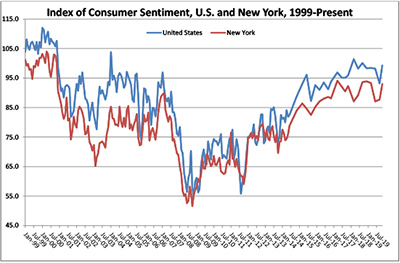
Consumer sentiment in upstate New York rose 7.1 points to 92.4 in the fourth quarter of 2019, up from the last measurement of 85.3 in the year’s third quarter. That’s according to the latest quarterly survey of Upstate and statewide consumer sentiment that the Siena College Research Institute (SRI) released Jan. 7. Upstate’s overall sentiment
Become a Central New York Business Journal subscriber and get immediate access to all of our subscriber-only content and much more.
Click here to purchase a paywall bypass link for this article.
Consumer sentiment in upstate New York rose 7.1 points to 92.4 in the fourth quarter of 2019, up from the last measurement of 85.3 in the year’s third quarter.
That’s according to the latest quarterly survey of Upstate and statewide consumer sentiment that the Siena College Research Institute (SRI) released Jan. 7.
Upstate’s overall sentiment of 92.4 was 0.6 points below the statewide consumer-sentiment level of 93.0, which rose 5.3 points from the third quarter.
The statewide figure was 6.3 points lower than the fourth-quarter figure of 99.3 for U.S. consumer sentiment, which rose 6.1 points from the third-quarter reading generated from the University of Michigan’s consumer-sentiment index.
Consumer sentiment, both nationally and in New York state, is at or within a couple of points of the highest readings we’ve seen in the last 10 years, Don Levy, director of the Siena College Research Institute (SRI), said in the SRI report.
“The decade dawned with consumers pessimistic and reluctant to spend. By the end of 2014, New Yorkers had crossed the breakeven point and displayed growing optimism and now for the last three years, consumers have been strongly optimistic. Today’s index reading is 17 points above the breakeven point, 9 points above the end of 2014 and over 27 points higher than where the decade began. We still have serious concerns, but it is helpful to look back,” said Levy.
In the fourth quarter of 2019, buying plans were up 3.6 percentage points since the third-quarter measurement to 52.4 percent for consumer electronics; and up 0.5 points to 11.1 percent for homes.
Buying plans fell 5 percentage points to 21.6 percent for cars and trucks, declined 0.7 points for furniture, and dipped 0.1 points to 25.2 percent for major home improvements.
“Buying plans remain strong and are up between 17 and 63 percent from 2014, and for cars, homes, furniture and home repairs, between 75 and 177 percent since the end of 2019,” said Levy.
Gas and food prices
In SRI’s quarterly analysis of gas and food prices, 42 percent of upstate New York respondents said the price of gas was having a serious impact on their monthly budgets, up from 41 percent in the third quarter but down from 49 percent in the second quarter.
In addition, 41 percent of statewide respondents said the price of gas was having a serious impact on their monthly spending plans, up from 40 percent in the third quarter but down from 43 percent in the second quarter.
When asked about food prices, 56 percent of upstate respondents indicated the price of groceries was having a serious impact on their finances, unchanged from the third quarter and down from 57 percent in the second quarter.
At the same time, 58 percent of statewide respondents indicated the price of food was having a serious impact on their monthly finances, down from 60 percent in the third quarter and 64 percent in the second quarter.
“Concern over gasoline prices and food costs have varied across the decade with average concern over gas prices affecting 46 percent and food affecting 63 percent. Today, worries over affording those staples are below the decade average but above the lows of 27 percent for gas and 52 percent for food,” Levy said.
SRI conducted its survey of consumer sentiment between Nov. 19 and Nov. 22 by telephone calls to 402 New York resident adults via landline and cell phones and 400 responses drawn from a proprietary online panel of New Yorkers.
It has an overall margin of error of plus or minus 3.6 percentage points, according to SRI.

Ansco Lofts development in Binghamton includes residential, commercial space
BINGHAMTON — The Ansco Lofts, a development located at the site of the former Ansco Camera Factory in Binghamton, has opened following a $25 million renovation project. Paulus Development of Syracuse renovated the property into a mixed-use development that offers 100 new lofts and nearly 35,000 square feet of commercial space on the building’s ground
Become a Central New York Business Journal subscriber and get immediate access to all of our subscriber-only content and much more.
Click here to purchase a paywall bypass link for this article.
BINGHAMTON — The Ansco Lofts, a development located at the site of the former Ansco Camera Factory in Binghamton, has opened following a $25 million renovation project.
Paulus Development of Syracuse renovated the property into a mixed-use development that offers 100 new lofts and nearly 35,000 square feet of commercial space on the building’s ground floor, the Community Preservation Corp. announced.
Paulus Development is a Syracuse–based, real-estate development and management firm. The Community Preservation Corporation (CPC) is a nonprofit affordable housing and community revitalization finance company. CPC is based in New York City and operates a regional office in Syracuse.
Hueber-Breuer Construction Co. Inc. of Syracuse and Empire State Development (ESD) were also involved in the project.
CPC provided a nearly $20 million construction loan for the redevelopment. Empire State Development provided a $2 million Southern Tier Soaring Upstate Revitalization Initiative grant, and the project received an equity investment from Chase Community Equity, as the project qualified for federal and state historic rehabilitation tax credits.
CPC serves communities throughout New York state, providing construction financing for all types of multi-family housing, including units involved in downtown revitalization, adaptive reuse, affordable and supportive housing, acquisition and rehabilitation of distressed properties, and ground-up construction.
About Ansco Camera Factory
The building was opened in 1928 by the General Cigar Company and purchased in 1937 by the Ansco Camera Factory, which operated from the building until 1977. The Ansco Camera Factory was placed on the National Register of Historic Places in 2012. The redevelopment of the factory preserved its “historic, recognizable” features including its “custom oversized” factory windows, steel beams, and building signage.
“The former Ansco Camera Factory is one of many buildings in this community with great history,” Matthew Paulus, president of Paulus Development, said in a statement. “Not only have thousands of people in this community worked at this building over the course of its life, but it has also served as the manufacturing hub for two of the most notable industries in Binghamton history. When we learned about this great history, we wanted to help preserve and chronicle it for the community. For us, as a community developer, that meant going the path of a public-private partnership and using historic preservation. We are grateful for the opportunity to come into this community and preserve this building and for all the public and private institutions that have played major roles in helping us make this project come to fruition.”

Adirondack North Country Association appoints three new board members
The new members are: J. Daniel Mohr, executive VP and chief financial officer at Utica–based Adirondack Bank; Kevin Richardson, executive VP of sales and operations at Sackets Harbor–based Agbotic Inc.; and Noah Shaw, a partner with Buffalo–based Hodgson Russ Attorneys LLP and co-chair of the firm’s renewable-energy practice, working from its Saratoga Springs office. The
Become a Central New York Business Journal subscriber and get immediate access to all of our subscriber-only content and much more.
Click here to purchase a paywall bypass link for this article.
The new members are: J. Daniel Mohr, executive VP and chief financial officer at Utica–based Adirondack Bank; Kevin Richardson, executive VP of sales and operations at Sackets Harbor–based Agbotic Inc.; and Noah Shaw, a partner with Buffalo–based Hodgson Russ Attorneys LLP and co-chair of the firm’s renewable-energy practice, working from its Saratoga Springs office.

The three new board members join ANCA as the regional economic-development nonprofit begins implementing its new five-year strategic plan. The plan, which the organization will roll out in February, will support new and existing programs in ANCA’s 14-county service area that advance clean-energy adoption and energy savings, expand local food access and markets, provide support and development opportunities for small businesses and entrepreneurs, and advocate for North Country residents, businesses, and communities at the state and federal levels.

“ANCA’s strategic plan is ambitious, based on our vision — a New Economy that works for all — and our mission to build prosperity across Northern New York,” Kate Fish, the nonprofit’s executive director, said in a statement. “Dan, Kevin and Noah bring a wide range of experience to the ANCA team though their work in the small business, agriculture and clean energy sectors. Their combined knowledge and experience will help inform our strategies moving forward.”
The new members
Mohr, who took on his current role at Adirondack Bank in 2017, has more than 20 years of senior-level financial and operational-management experience in banking. He holds a bachelor’s degree in accounting from Binghamton University. Mohr was born and raised in Binghamton and now lives in Utica.
Richardson is co-founder of Agbotic, a venture-backed leader in the ag tech sector. Agbotic builds year-round, organic, and environmentally restorative “SmartFarms” that utilize robotics with machine learning and artificial intelligence. The company’s first SmartFarm project is located in Sackets Harbor.
“Agbotic has been fortunate to work with ANCA over the last several years through their farm to school and clean energy initiatives,” Richardson said. “ANCA’s mission is spot on with their focus on creating strong systems for local food, agriculture, small businesses and renewable energy. I feel my own interest and experience in these areas will complement and strengthen ANCA’s programs and networks.”
Shaw comes to the ANCA board with more than 17 years of experience in law and legal advising with private law firms as well as state and federal agencies. Prior to Hodgson Russ, he served as general counsel and board secretary for the New York State Energy Research and Development Authority (NYSERDA). Shaw also worked as senior advisor to the general counsel for the U.S. Department of Energy during the Obama administration.
“ANCA continues to be on the leading edge of clean-energy outreach in the North Country region,” Shaw said. “I’m excited to lend my own passion for the North Country and energy policy to the board as ANCA and partners bring clean energy planning and programming into the next decade.”
“When you walk with someone, something unspoken happens. Either you match their pace or they match yours.” — Sidney Poitier, American-Bahamian actor, film director That’s a good quote from Sir Sidney. It got me thinking about this marketing-communications business I’m in. Maybe you do some marcom too, either on your own or with an agency? The
Become a Central New York Business Journal subscriber and get immediate access to all of our subscriber-only content and much more.
Click here to purchase a paywall bypass link for this article.
“When you walk with someone, something unspoken happens. Either you match their pace or they match yours.”
— Sidney Poitier, American-Bahamian actor, film director
That’s a good quote from Sir Sidney. It got me thinking about this marketing-communications business I’m in. Maybe you do some marcom too, either on your own or with an agency?
The parallelism between walking and communicating, I think, comes in the unspoken part inherent in both activities — it’s an implied contract if you will. Poitier saw it in a stroll. I now see it in the negotiated meaning that is communication.
Essentially, is there an alignment between the marketing communications being produced and the way they are subsequently consumed?
When the sender aligns with the receiver, that’s when we get the “aha moments,” light bulbs go on, and minds are moved to either buy or, in the absence of alignment, reject the marketer’s latest communiqué. As a message sender, either we match the receiver’s pace and headspace or we don’t. In the marketing and advertising “dance,” the onus of making that match resides squarely on the shoulders of the sender.
So, fellow communicators, here are a handful of key questions we should be asking ourselves before we even put pen to paper or fingers to keyboard.
1. What is the message we’re trying to convey?
Advertising 101 says it better be about a benefit and not a feature. An ad should show how the product or service will make life better, rather than list a bunch of attributes or facts. Facts are fine, make no mistake. But benefits are better.
2. What is the proper pace of the message?
Do we really want to be spewing words as fast as we can? Yes, we are often limited to 30 or even fewer seconds, 280 characters, or other such throttles. But might the product, say a $40,000 car or other sizable investment, be better represented by a slower, more thoughtful, and deliberate delivery?
3. Is our audience receiving the message in the way we intended?
These days, I watch a lot of video with the sound turned off. I might be chatting with someone or listening to music. If I’m doing that, chances are others are too. Maybe a lower third of the screen should be used for subtitles. It has worked for foreign movies all these years. Why not in marketing, too?
4. Are we even on the same page with our audience?
Have we talked — recently — to enough of our customers to know what drives them? What keeps them up at night? Or what their buy-buttons are? Market research is a great way to find out. Profile past customers, survey prospective buyers, or convene a focus group of both. It costs less to find out the answers up front than it does not to know. Undoing and redoing an entire marketing campaign is never cost effective.
5. Does our product or service walk our talk?
If the performance does not match the promise, everyone will be disappointed. Think about how that last online shopping experience went. If we order large and receive medium, sure, it’s easy enough to go through the return process. But we’ll certainly think twice now before ordering from that company again. Especially when the competition is just a click away. Or what about that new-to-town, unscrupulous health-care provider whose marketing is better than its medicine. Or whose bedside manner is worse yet. We all have choices. Today’s patients don’t have patience.
My marketing-communications tip of the day: Take a long walk with a good agency and see if its pace matches up well with yours.
Steve Johnson is managing partner of Riger Marketing Communications in Binghamton. Contact him at sdjohnson@riger.com
Contrarian thinking can put us on the right track
It makes business more interesting when there are a few contrarians around. For example, a Jeff Bezos, a Steve Jobs, or an Elon Musk, those who challenge commonly accepted assumptions. They stir our placid mental waters to get the creative juices flowing. As it turns out, the start of a new decade is a good
Become a Central New York Business Journal subscriber and get immediate access to all of our subscriber-only content and much more.
Click here to purchase a paywall bypass link for this article.
It makes business more interesting when there are a few contrarians around. For example, a Jeff Bezos, a Steve Jobs, or an Elon Musk, those who challenge commonly accepted assumptions. They stir our placid mental waters to get the creative juices flowing.
As it turns out, the start of a new decade is a good time for a little contrarian thought —for looking at things differently. In fact, it may be helpful since we’re entering a period that will present us with far-reaching changes and daunting challenges. In other words, a time when we can benefit from getting tougher with ourselves.
Here are four contrarian thoughts about taken-for-granted ideas that may be tried but, as it turns out, are not necessarily true.
1. Keep your head down and go with the flow
Never raise your hand. Don’t do anything to call attention to yourself. Keep a low profile. Go along to get along. Whatever else may be said about the need for new ideas, these remain the mantras for success. Those who dare to wander off the path do so at their own peril.
All of it may have worked when the goal was having managers lead organizations. Their mission was to make sure things ran like well-oiled machines. It’s no surprise that surveys indicate that a high percentage of employees (one puts it as high as 83 percent) are bored, want new challenges, and are actively looking for new jobs.
Today, the term manager is fading and being replaced by leader, someone who is charged with the responsibility of assuring an enterprise meets challenges by helping people succeed.
2. Everything’s going down the drain
In spite of an abundance of bad news and unspeakable horrors, nothing seems to stop us from hitching our wagons to a star, as the saying goes. Even though we’re faced with mountainous problems, nothing seems to curtail optimism, that tomorrow will be a better day.
To be sure, there are good reasons why the idea of progress holds sway over us. Indicators over the last two centuries paint a bright picture of the future — improved health, longer lives, technological advancements, a better-educated citizenry, income growth, and dozens more.
All this is wonderful, except it’s not always the way it plays out in our individual lives: loved ones die, promises are broken, jobs are lost, and dreams don’t come true, even when we work hard. As someone has said, “Bad things happen to good people.” They do, so it’s easy to be bitter, angry, and just plain negative.
Not long ago, I spoke with a man receiving palliative care after surgery for stage 4 pancreatic cancer, which was discovered weeks after his long-anticipated retirement. To keep busy following surgery, he took a part-time job. After a few minutes on the phone, he told me he needed to get ready for work, and added, “I love it!” That’s when I came to understand the awesomeness of resilience and optimism.
3. Don’t sweat the small stuff
This is good advice since our lives seem to be plagued with endless amounts of irritating, time-consuming, and inexcusable stuff that drives us crazy. This is why it’s helpful to take a “water off a duck’s back” approach as a way to keep our sanity.
But (and here it comes), not about everything. In a client memo, an attorney used “onerous” (it means burdensome) instead of “onus” (it means responsibility or duty), small stuff? Just a mistake. Perhaps, but when you’re preparing a legal document that impacts someone’s life, it can be a big deal.
This is why a “Don’t worry about it” attitude simply won’t cut it in a business environment, one that requires (and rewards) accuracy, clarity, and focus. Vocabulary may not save the world, but it may save your next sale, deal, or even your job.
4. I’m a good judge of people
Most of us take pride in being good at figuring out others. If asked, we would probably say, “I sure like to think I’m a good judge of character.” But, if you’re like me, it’s easy to forget about the times you were wrong about someone when it came to telling the truth. Then, we wonder why we missed it. But it still doesn’t stop us from thinking we’re a pretty good judge of people.
This is more than a personal issue, since it has implications in business for hiring, selecting people for promotions, and evaluating written communications and presentations, as well as working with consultants, vendors, and co-workers.
Yet, I struggled with why it’s so hard to know when someone is lying. I found the answer when reading Malcolm Gladwell’s book, “Talking to Strangers.” He discussed the “Theory of Truth Default,” a concept developed by communications researcher Timothy R. Levine, Ph.D. We’ve all criticized others for failing to spot a liar, even though there were plenty of reasons or “red flags” to alert us to a problem. But, as Gladwell says, we should be asking something else — “The right question is: were there enough red flags to push you over the threshold of belief? If there weren’t, then by defaulting to truth, you were only being human.”
Here is an example. A board of realtors hired a marketing consultant to help with announcing the hiring of a new president, who was set to arrive shortly from another state. That was even though at the last minute, several executive board members expressed concerns about the individual’s qualifications at a meeting.
Sensing the situation, the consultant asked if he could be of help. The board agreed. Within 36 hours, he turned up sufficient negative information to push the executive committee over the edge of belief. The employment offer was withdrawn, avoiding a potentially disruptive situation.
Dr. Levine holds that defaulting to truth is human, which can be the easy way out. So, when we have doubts, it’s not time to remain silent but to dig deeper.
While some contrarian thinking can be damaging, it can also be helpful in clarifying thinking and making better decisions.
John Graham of GrahamComm is a marketing and sales strategy consultant and business writer. He is the creator of “Magnet Marketing,” and publishes a free monthly eBulletin, “No Nonsense Marketing & Sales Ideas.” Contact him at jgraham@grahamcomm.com or johnrgraham.com

T-N-T Contractors of CNY buys Teall Ave. property for $159,000
SYRACUSE — T-N-T Contractors of CNY, Inc. recently bought the 10,224-square-foot office and mixed-use property at 1937 Teall Ave. in Syracuse for $159,000 from Ralph Ringo. Elaina Pirro of Cushman & Wakefield/Pyramid Brokerage Company exclusively marketed the property and represented the seller in this transaction, according to a news release from the real-estate firm. T-N-T
Become a Central New York Business Journal subscriber and get immediate access to all of our subscriber-only content and much more.
Click here to purchase a paywall bypass link for this article.
SYRACUSE — T-N-T Contractors of CNY, Inc. recently bought the 10,224-square-foot office and mixed-use property at 1937 Teall Ave. in Syracuse for $159,000 from Ralph Ringo.
Elaina Pirro of Cushman & Wakefield/Pyramid Brokerage Company exclusively marketed the property and represented the seller in this transaction, according to a news release from the real-estate firm.
T-N-T Contractors specializes in panelized framing, commercial-roof installation, commercial-roof maintenance, hardie board siding, custom homes, renovations, decks, and additions, according to the LinkedIn profile of Terrence Scott, owner and president.
WorkTrain Expands programs in 2020 to support job growth
Central New York’s job growth is the strongest in decades. In October, year-over-year job growth in Syracuse was nearly 2 percent, compared to 0.4 percent growth in the combined regions of Albany, Rochester, and Buffalo. While this job growth is an important indicator of the strength of our regional economy, it also drives talent challenges
Become a Central New York Business Journal subscriber and get immediate access to all of our subscriber-only content and much more.
Click here to purchase a paywall bypass link for this article.
Central New York’s job growth is the strongest in decades. In October, year-over-year job growth in Syracuse was nearly 2 percent, compared to 0.4 percent growth in the combined regions of Albany, Rochester, and Buffalo. While this job growth is an important indicator of the strength of our regional economy, it also drives talent challenges for many area employers. In response, CenterState CEO has targeted efforts to attract talent through programs like the Good Life CNY, and connect unemployed or underemployed individuals with career opportunities through Work Train.
It is not an accident that the fastest growing sectors of our economy — construction, health care, and manufacturing — also align with our workforce-development efforts. Currently, we are working with 53 employer partners across these key industries to place graduates from Work Train into career pathways. Employees gain the preparation they need to succeed, while employers get access to qualified workers, ultimately contributing to employer stability. Since 2014, nearly 1,000 people have been placed in jobs through Work Train. As of September, nearly 150 people have been placed at employers including, Loretto, Raymond Corporation, ICM, and HP Mile.
In the coming year, we will continue to expand and strengthen these efforts, establishing new partnerships and programs in other high-growth industries. Through our work with JPMC AdvancingCities and other grants, we have identified opportunities to create work-readiness programs for tech-related careers, including digital customer service.
Starting in January, as part of a larger Syracuse Build initiative, Work Train, Syracuse Educational Opportunity Center (SUNY EOC), and the City of Syracuse began partnering with Home Leasing of Rochester to support their conversion of the historic St. Antony’s school, located in Syracuse’s South East Gateway, into 54 senior housing units. Along with CNY Works and neighborhood partners, this team will work to ensure there is a pool of job-ready candidates from within the community to staff this project.
As Central New York’s economy continues to grow, we are committed to ensuring this progress reaches all in our community. We encourage our members to connect with us to discuss their individual workforce needs so we can continue to convene partners around solutions that create access to good jobs for members of the community. To learn more about the program, contact Alissa Tubbs, Work Train strategic operations manager, at atubbs@centerstateceo.com
Robert M. (Rob) Simpson is president and CEO of CenterState CEO, the primary economic-development organization for Central New York. This viewpoint is drawn and edited from the “CEO Focus” email newsletter that the organization sent to members on Dec. 19.
So, who do you trust? Do you trust the people involved in Jeffrey Epstein’s death? They tell you he committed suicide. Despite any number of bizarre coincidences that suggest he was done in by someone. So, do you trust the officials who tell you otherwise? Do you trust your FBI? If you say you don’t, I
Become a Central New York Business Journal subscriber and get immediate access to all of our subscriber-only content and much more.
Click here to purchase a paywall bypass link for this article.
So, who do you trust?
Do you trust the people involved in Jeffrey Epstein’s death? They tell you he committed suicide. Despite any number of bizarre coincidences that suggest he was done in by someone. So, do you trust the officials who tell you otherwise?
Do you trust your FBI? If you say you don’t, I can’t blame you. An entire level of top guys there have been booted. More have resigned under a cloud. You have seen any number of accusations of sleazy FBI behavior flung against the proverbial wall. Many have stuck.
You maybe saw director James Comey on TV a few times. You maybe have heard him tell one story, then an opposite story at a later date. You maybe followed his convoluted reasoning regarding Hillary Clinton’s email problems.
You maybe read how Comey’s team gave unprecedented soft treatment to Clinton and her staff. Would you trust him again at the head of our FBI? Do you trust the FBI to give equal treatment to all under our laws? Will they treat you the same way they will treat a politician or big government official?
You know our intelligence agencies dropped the ball leading up to 9/11. You know they got wrong the question of Saddam Hussein’s weapons of mass destruction. You should know by now they were knee-deep in the sludgy surveillance of Donald Trump’s campaign. You maybe have seen former CIA director John Brennan openly lie to the public. (He totally contradicted himself on a few occasions.)
You may also remember that James Clapper, the former head of our NSA, assured us his agency was not collecting our phone data wholesale — until he later admitted it was.
So, do you trust the birds that run these agencies to always tell us the truth? Do you trust the intel agencies to get things right?
How about the TSA? The guys who check you through the scanners at airports. They miss about 70 percent of fake weapons. Undercover guys try to sneak guns, knives, and explosives through checkpoints. Try? Better to say that they move these dangerous items past the inspectors. But inspectors catch 30 percent of them.
Hey, this is a big improvement. Used to be TSA missed 95 percent of this stuff.
So, if I ask if you trust TSA to nab bad guys who want to get on your flight, what do you answer?
Then there is the IRS. You must have read or seen how Lois Lerner directed a program that targeted conservative groups. The FBI, looking into this, found a lot of mismanagement, etc., blah, blah. But it saw no political mischief. Oh no. And the IRS denied wrong doing. Lois pled the fifth before the House. She resigned and started collecting her pension.
The IRS also simply refused to cough up all kinds of information that would have made it look bad. It resorted to full cover-up.
So, what do you think? Trustworthy?
How about the Washington, D.C. bureaucracy? We see countless cover-ups. We see foot-dragging when agencies are ordered to produce documents. They take years to find emails or bits of info that would make them look bad.
Trust is an elusive thing, isn’t it? My friend, now in his 60s, told me he trusts no one. No one. Why is that? He is Jewish. “When I was a kid, at every family gathering, my relatives talked about the horrors Jews suffered in World War II. They talked about neighbors and best friends betraying Jews, helping to send them to the death camps. Do you blame me for trusting no one?”
Ronald Reagan told us to: “Trust but verify.” He said this when he talked about nuclear agreements with the Soviets. How ironic. It was an old Russian rhyme. “Overlay, no proveryai.”
Russia’s Lenin voiced similar sentiments. Brutal dictator Stalin built upon them. He said, “A healthy distrust is a good basis for working together.”
Yeah, nice words. But who in hell trusts the evil, lying, villainous, colluding Russians? After all, Stalin also said, “I trust no one, not even myself.”
Now that is more than a little mind-boggling. Trust me.
From Tom…as in Morgan.
Tom Morgan writes about political, financial, and other subjects from his home in upstate New York. You can write to Tom at tomasinmorgan@yahoo.com, read more of his writing at tomasinmorgan.com, or find him on Facebook.

LAWRENCE T. (TOM) GILROY, IV has joined Gilroy Kernan & Gilroy Inc. (GKG) as strategic business advisor. In this role, Gilroy will work with a broad spectrum of businesses in Central New York and the New York City metro area to address their overall exposure to risk with a targeted focus on expanding the firm’s
Become a Central New York Business Journal subscriber and get immediate access to all of our subscriber-only content and much more.
Click here to purchase a paywall bypass link for this article.
LAWRENCE T. (TOM) GILROY, IV has joined Gilroy Kernan & Gilroy Inc. (GKG) as strategic business advisor. In this role, Gilroy will work with a broad spectrum of businesses in Central New York and the New York City metro area to address their overall exposure to risk with a targeted focus on expanding the firm’s focus on succession, estate, and executive planning. Gilroy marks the fourth generation to join the firm, which was founded in 1904. Prior to joining GKG, Gilroy worked at BNY Melon and HSBC, most recently serving as a VP within the global banking and markets division. Gilroy is a graduate of the University of Rochester. Born and raised in New Hartford, he currently resides in New York City.
Stay up-to-date on the companies, people and issues that impact businesses in Syracuse, Central New York and beyond.