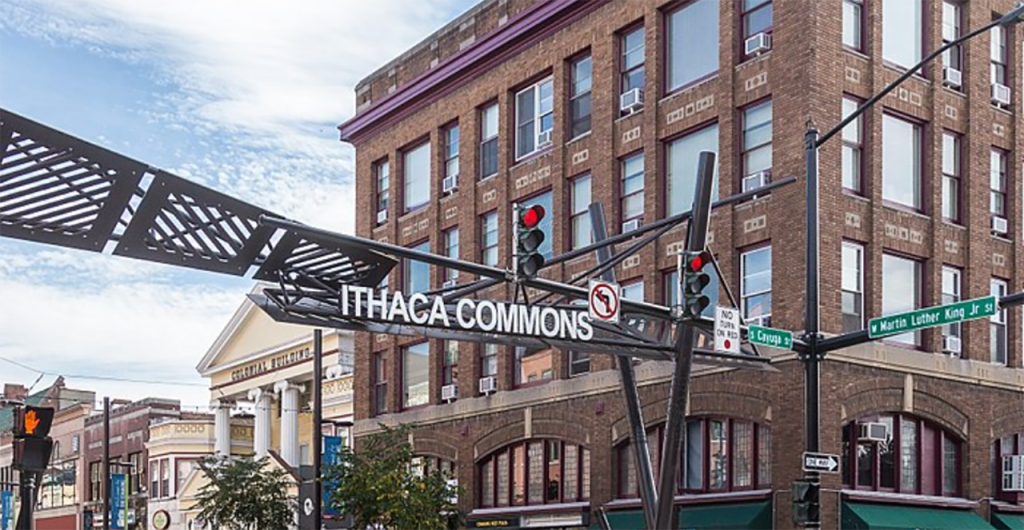
The Ithaca Commons is among the focus areas in a new study detailing a retail strategy for the Tompkins County community.
PHOTO CREDIT: DOWNTOWN ITHACA ALLIANCE WEBSITE
ITHACA, N.Y. — Downtown Ithaca needs a retail mix that focuses on the merchandising of arts and crafts products, along with marketing campaigns to position Ithaca as a must-visit destination for the arts and artisan culture. Those are among the recommendations in a new study that focuses on a retail strategy for the City of […]
ITHACA, N.Y. — Downtown Ithaca needs a retail mix that focuses on the merchandising of arts and crafts products, along with marketing campaigns to position Ithaca as a must-visit destination for the arts and artisan culture.
Those are among the recommendations in a new study that focuses on a retail strategy for the City of Ithaca.
The Downtown Ithaca Alliance (DIA) and the City of Ithaca see the study as a “critical step” toward revitalizing Ithaca’s retail landscape, per the Aug. 7 DIA announcement.
MJB Consulting handled the work on the preliminary retail analysis and strategy. MJB, which is based in New York City and Berkeley, California is a national retail planning and real-estate consultancy focused on urban and downtown business districts.
With phase I nearing completion, MJB is now finalizing its findings and recommendations into a written report to be released later this fall. The DIA and the City of Ithaca have already contracted MJB for phase II implementation, The second phase will focus on the creation of leasing materials that “reframe the opportunity” in the minds of prospective tenants. It’ll also focus on the training of an in-house prospector to support local landlords and brokers in attracting businesses that correspond to the recommendations of the strategy.
The recommendations complement DIA’s ongoing work in placemaking, marketing, and economic development to “create and sustain an environment conducive to a thriving retail sector and further investment.”
“This retail study provides a comprehensive roadmap for strengthening Ithaca’s business districts citywide,” Ithaca Mayor Robert Cantelmo said in the Downtown Ithaca Alliance announcement. “From Collegetown to the West End, the insights and recommendations recognize that our community’s economic vitality depends on thoughtful, place-based strategies that reflect the character of each district while uniting us through shared values and aspirations. I’m grateful to the Downtown Ithaca Alliance, City staff, and MJB Consulting for their collaborative work, which will help ensure Ithaca remains a dynamic and inclusive place to live, work, and visit.”
Retail strategy
Commissioned in 2023, the study focuses on creating a “cohesive,” citywide retail strategy for Ithaca’s key business districts. They include downtown Ithaca, centered on the Commons pedestrian mall; the West State Street corridor; the West End, including the waterfront; and Collegetown, adjacent to Cornell University.
MJB’s work “responds to the city’s unique position as a university town with a broader regional trade area of over 100,000 people and a robust tourism draw,” per the DIA announcement.
Rather than viewing Ithaca’s market through the traditional lenses of “town and gown” or local versus out-of-towner, MJB proposed a “more unifying approach” focused on shared psychographics — common lifestyles, values, and aspirations. The shift in perspective allowed MJB to identify retail opportunities that resonate with both residents and visitors alike, DIA said.
Specifically, MJB identified an opportunity to market Ithaca, and downtown Ithaca in particular, to the “yupster” psychographic — well-educated, well-off households that celebrate the artistic and creative lifestyle — which predominates among both Ithacans as well as tourists.
Preliminary recommendations
The MJB study recommends curating a retail mix in downtown Ithaca that focuses on the merchandising of arts and crafts products as well as handmade goods more generally, complemented by other synergistic tenants like bookstores, vintage/consignment shops, cafes, eateries and wine bars.
It also recommends providing support for landlords and brokers to recruit tenants that align with this positioning, including the creation of leasing materials that tell Ithaca’s and downtown Ithaca’s “unique” story.
In addition, the report recommends developing targeted marketing campaigns to position Ithaca as a must-visit regional “(if not national)” destination for the arts and artisan culture, aligning with the “Ithaca is Gorges” brand.
MJB also recommends enhancing downtown’s role as a regional hub for the creative ecosystem by fostering collaborations between local makers, galleries, theaters, and other entrepreneurial platforms.
Beyond downtown Ithaca, MJB also emphasized the need for Cornell University, with its roughly 27,000 students, to assume a proactive role in revitalizing the Collegetown district as a selling point for prospective faculty, researchers, and students, pointing to successful models at peer institutions like Yale and the University of Pennsylvania.
MJB also reframed the West State Street corridor as more than just a connector between districts, “with its own psychographic appeal and retail niche that is nonetheless quite fragile and urgently in need of a more robust City response.”
Nan Rohrer
“This much-anticipated strategy taps into what makes Ithaca special and offers us the possibility to turn our unique assets into economic drivers,” Nan Rohrer, CEO of the Downtown Ithaca Alliance, said. “Downtown is more than a shopping district — it’s a creative ecosystem. By centering our retail recruitment around this core identity, we’re creating a destination that is authentic to both locals and visitors, while defining a compelling case for future investors, business owners, and residents.”
Post
Share
Tweet
Print
Email
Get our email updates
Stay up-to-date on the companies, people and issues that impact businesses in Syracuse, Central New York and beyond.