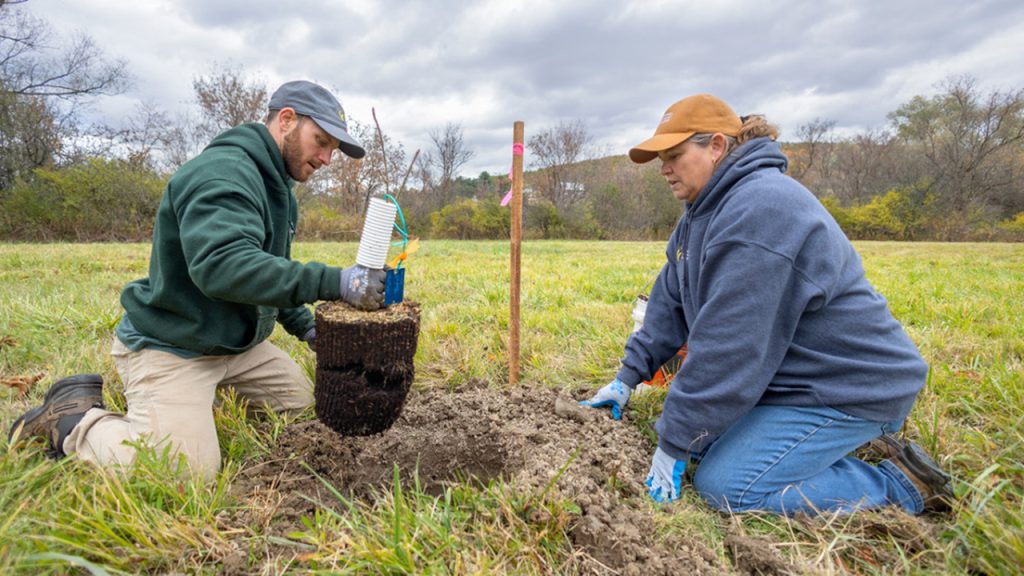
ITHACA — Newly planted ash saplings on Cornell University property are potentially resistant to destructive emerald ash borer insects, making the university the first propagation center in New York state. The planting is part of The Nature Conservancy’s Trees in Peril project, seeking to restore disappearing ash trees across the United States, according to a […]
Already an Subcriber? Log in
Get Instant Access to This Article
Become a Central New York Business Journal subscriber and get immediate access to all of our subscriber-only content and much more.
- Critical Central New York business news and analysis updated daily.
- Immediate access to all subscriber-only content on our website.
- Get a year's worth of the Print Edition of The Central New York Business Journal.
- Special Feature Publications such as the Book of Lists and Revitalize Greater Binghamton, Mohawk Valley, and Syracuse Magazines
Click here to purchase a paywall bypass link for this article.
ITHACA — Newly planted ash saplings on Cornell University property are potentially resistant to destructive emerald ash borer insects, making the university the first propagation center in New York state.
The planting is part of The Nature Conservancy’s Trees in Peril project, seeking to restore disappearing ash trees across the United States, according to a Nov. 20 article on the Cornell Chronicle media relations website. The Nature Conservancy is a global environmental nonprofit founded in 1951 in the U.S.
Emerald ash borers usually kill all the trees in a stand, but studies by the USDA Forest Service have found that sometimes a few healthy trees — called lingering ash — remain, suggesting they have some natural resistance, according to the article.
After finding several resistant trees in its natural areas, Cornell Botanic Gardens is working with other conservation partners to propagate more-resistant trees. If successful, these trees and their progeny could be used to reforest decimated woodlands in New York state and elsewhere.
“Our goal is to propagate and conserve trees from 50 to 60 unique parents of green, white and black ash species, and we are thrilled that our first cohort of lingering ash have been planted out in their conservation banks,” Todd Bittner, director of natural areas for the Cornell Botanic Gardens, said in the article.
Emerald ash borer larvae have devastated black, white, and green ash trees by burrowing and eating the living tissue under the bark, which kills the trees. The insects have wiped out ash trees in 37 states, costing billions of dollars for tree removal, treatment, and replacement.
When emerald ash borer populations are at lower levels, natural resistance will likely protect trees, but when populations and pest pressures are high, the trees will likely need additional protections, or otherwise would still get destroyed the borer, Bittner noted.
The Trees in Peril program includes The Nature Conservancy, the USDA Forest Service, experts from academia, research organizations, and other partners — all of whom are collaborating to monitor, research and breed pest-resistant American beech, Eastern hemlock, and black, white, and green ash.
For more information on this project, check out the Cornell Chronicle article at: https://news.cornell.edu/stories/2025/11/cornell-ash-trees-aim-beat-back-borer-insects