VESTAL — Broome County Transit’s first fully electric buses have been transporting the public for nearly two months after they were placed into service in mid-October. The new zero-emission buses replace older diesel models, “significantly improving” air quality and reducing greenhouse-gas emissions across the community, Broome County said in its announcement. The electric buses are […]
Already an Subcriber? Log in
Get Instant Access to This Article
Become a Central New York Business Journal subscriber and get immediate access to all of our subscriber-only content and much more.
- Critical Central New York business news and analysis updated daily.
- Immediate access to all subscriber-only content on our website.
- Get a year's worth of the Print Edition of The Central New York Business Journal.
- Special Feature Publications such as the Book of Lists and Revitalize Greater Binghamton, Mohawk Valley, and Syracuse Magazines
Click here to purchase a paywall bypass link for this article.
VESTAL — Broome County Transit’s first fully electric buses have been transporting the public for nearly two months after they were placed into service in mid-October.
The new zero-emission buses replace older diesel models, “significantly improving” air quality and reducing greenhouse-gas emissions across the community, Broome County said in its announcement. The electric buses are also quieter, “creating a smoother and more comfortable ride for passengers while minimizing noise pollution in residential neighborhoods.”
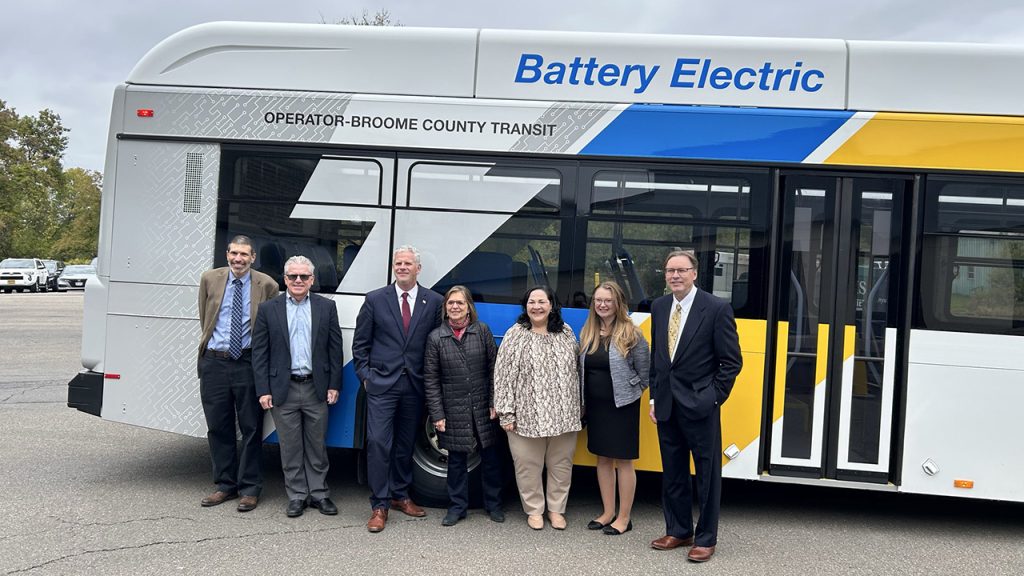
Broome County Executive Jason Garnar, BC Transit Commissioner Greg Kilmer, and Marie Therese Dominguez, commissioner of the New York State Department of Transportation (NYSDOT), gathered for the event announcing the deployment of the electric buses. Broome County sees it as a “major milestone in the county’s efforts to modernize its public transportation system, reduce emissions, and strengthen sustainability,” per its Oct. 14 announcement.
Federal and state grants primarily paid for the six new 40-foot GILLIG battery-electric buses, with nearly 95 percent of the $10.4 million total project cost supported by outside funding sources, Broome County stipulated.
The project received $3.25 million through the Federal Transit Administration’s Low or No Emission Vehicle program, $4.3 million in federal formula funding, $1.54 million from the New York State Truck Voucher Inventive program, and $754,000 in state capital funding.
Broome County contributed just over $540,000, representing only about 5 percent of the total project cost, the county stated.
“Broome County depends on BC Transit to connect our residents to work, school and essential services every day,” Garnar said in the Broome County announcement. “This investment allows us to modernize our fleet while protecting taxpayers. Nearly 95% of this project was funded through state and federal grants, helping us bring cleaner, quieter, and more reliable transit to the people of Broome County.”
To support the new fleet, BC Transit has installed six Heliox/Siemens 180 kW chargers featuring a retractable arm system that keeps charging cables safely overhead inside the transit depot. Charging-infrastructure design and construction was led by PlugIn Stations Online, with site management by the New York Power Authority. Additional plans call for solar panels and on-site battery storage at the Vestal Transit Center by 2027, ensuring service continuity and energy resiliency, Broome County noted.
“These six buses represent the first step in the process of moving to clean air propulsion with seven more buses to come in 2026,” Greg Kilmer, commissioner of BC Transit, said. “This exciting moment is made possible by many talented and dedicated individuals who had the vision to legislate, fund, design and build the future of public transportation. I’m certain all the residents of Broome County will appreciate the clean, quiet and efficient operation as we serve thousands of riders daily.”
The six buses, built in California this summer, arrived in Broome County in August after being driven cross-country along a network of electric-vehicle charging stations.
BC Transit provides more than 2 million rides annually and operates up to 18 hours each day. Students, faculty, and staff at Binghamton University and SUNY Broome Community College ride BC Transit free with their university-issued IDs.