CICERO, N.Y. — The U.S. Patent & Trademark Office has recently issued SRC, Inc. a patent for “Method for Calibrating a Phased Array,” a process that allows for accurate calibration measurements of a phased array. The company was also awarded a patent for “Pattern Compression and Modal Beamforming,” a technique that uses a compression algorithm […]
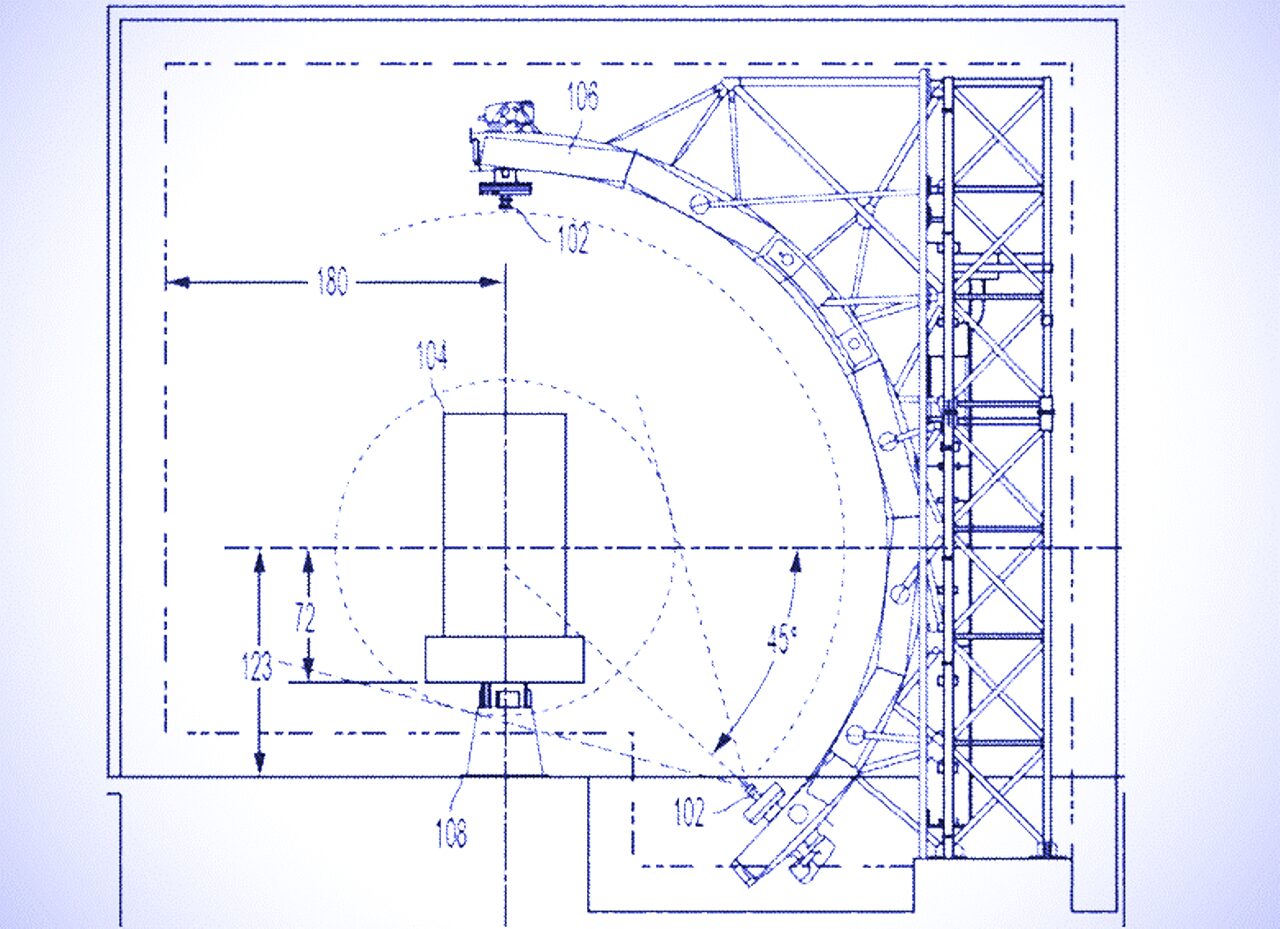
CICERO, N.Y. — The U.S. Patent & Trademark Office has recently issued SRC, Inc. a patent for “Method for Calibrating a Phased Array,” a process that allows for accurate calibration measurements of a phased array.
The company was also awarded a patent for “Pattern Compression and Modal Beamforming,” a technique that uses a compression algorithm to minimize memory usage while supporting complex beamforming operations.
image Credit: SRC / U.S. PATENT & TRADEMARK OFFICE
The inventor for both patents is Lance Bradstreet, senior principal radiofrequency engineer at SRC. His role includes working with various programs to perform antenna-related activities, ranging from design to modeling to taking measurements. He also oversees the operation of the spherical near-field antenna range and planar/cylindrical near-field antenna range. Bradstreet has published multiple papers, holds three additional patents and was named Young Technologist of the Year by the Technology Alliance of Central New York in 2017.
“SRC’s ability to innovate at the forefront of technology is key to our success,” Kevin Hair, president and CEO of SRC, said in an Aug. 11 company announcement. “Lance’s work has been instrumental in developing methods that ensure our products perform with the precision and reliability our customers depend on to keep America and our allies safe and strong.”
The phased-array calibration method uses a specialized spherical near-field chamber to measure each component of the radar array. By measuring various angles and positions, the chamber gathers comprehensive data across the entire array surface. Used successfully across various radar products at SRC, this process accommodates a wider range of radar shapes and offers enhanced flexibility for synthesizing beam patterns. As radar systems advance and become more digitally controlled, this approach is critical to maintaining high performance and accuracy, SRC said.
Bradstreet’s method for “Pattern Compression and Modal Beamforming” uses spherical-wave expansion coefficients to represent the element patterns, allowing operations to be performed on the compressed data instead of the full antenna pattern.
The full antenna pattern can later be reconstructed from these coefficients, reducing memory requirements while preserving accuracy and performance.
SRC, a Cicero–based nonprofit research and development company, says it combines information, science, technology, and ingenuity to solve “impossible” problems in the areas of defense, environment, and intelligence. Founded in 1957, SRC today has more than 1,400 employees, including engineers, scientists, and other professionals.
Post
Share
Tweet
Print
Email
Get our email updates
Stay up-to-date on the companies, people and issues that impact businesses in Syracuse, Central New York and beyond.