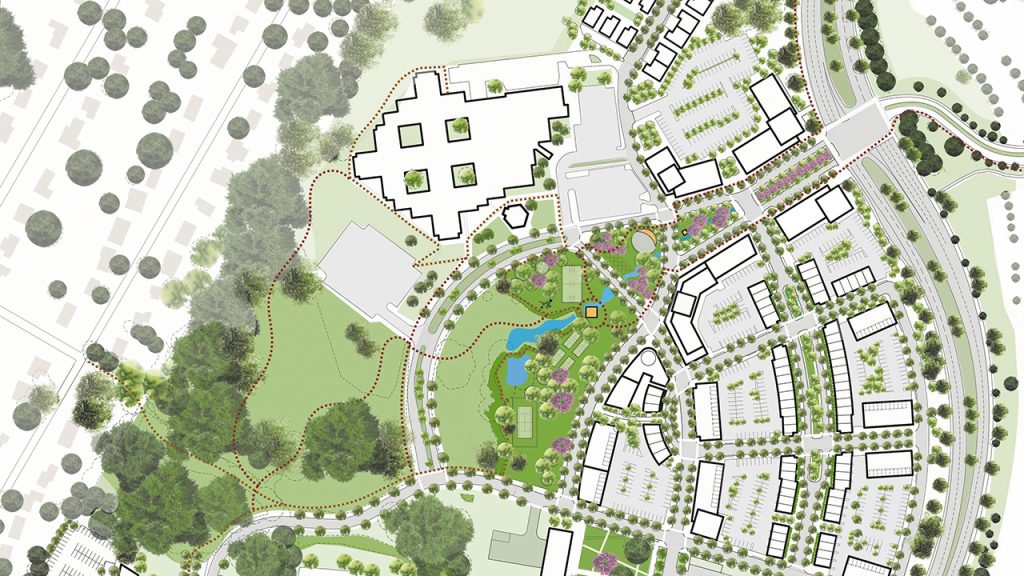
NEW HARTFORD — It’s been almost two years since St. Luke’s Hospital closed and the new Wynn Hospital opened. While people may be wondering what is to become of the former hospital’s campus, government and economic-development officials are still hard at work figuring out those next steps. Dubbed Reimagine St. Luke’s, the project is a […]
Already an Subcriber? Log in
Get Instant Access to This Article
Become a Central New York Business Journal subscriber and get immediate access to all of our subscriber-only content and much more.
- Critical Central New York business news and analysis updated daily.
- Immediate access to all subscriber-only content on our website.
- Get a year's worth of the Print Edition of The Central New York Business Journal.
- Special Feature Publications such as the Book of Lists and Revitalize Greater Binghamton, Mohawk Valley, and Syracuse Magazines
Click here to purchase a paywall bypass link for this article.
NEW HARTFORD — It’s been almost two years since St. Luke’s Hospital closed and the new Wynn Hospital opened.
While people may be wondering what is to become of the former hospital’s campus, government and economic-development officials are still hard at work figuring out those next steps.
Dubbed Reimagine St. Luke’s, the project is a cooperative effort between Mohawk Valley Health System (MVHS), which still owns the former St. Luke’s Hospital property, along with Oneida County, the town of New Hartford, and Mohawk Valley EDGE.
Throughout 2024, organizers held a series of workshops with the community and various stakeholders to gather individuals’ ideas for reusing the property, which spans 128 acres.
“We had a ton of engagement from the public meetings,” CJ Hanrahan, VP of marketing and business engagement at Mohawk Valley EDGE, says. Working with Fu Wilmers Design, organizers took in all that information and evaluated community wants versus community needs.
The result was a master concept plan, presented last October.
“The master plan outlined a diverse type of neighborhood that had mixed-use housing, green space, park space,” Oneida County Executive Anthony J. Picente, Jr. says. It also included space for light manufacturing, retail, or even a hotel, with much of the development focusing on the 53 acres where the hospital and multiple other buildings sit.
“The layout of the site presents a lot of opportunity,” Picente says. The location is also a prime one, situated near several major roadways with easy access into Utica, Rome, and neighboring suburbs. It’s also right across the street from Utica University.
Currently, Reimagine St. Luke’s is finalizing a facilities study that took a look at the existing buildings and evaluated whether they could be reused or torn down.
Unfortunately, the county executive says, the best course of action appears to be tearing the buildings down to make way for new development.
“We’re looking at upwards of $10 million to $15 million in demolition costs,” he adds. “There’s not a lot of money out there for demolition.”
While the main hospital isn’t viable for reuse, there are three other buildings that are feasible, Hanrahan notes. Mohawk Valley EDGE is also exploring funding sources for demolition costs including U.S. Environmental Protection Agency loans or grants as well as U.S. Housing and Urban Development Community Development Block Grants.
Oneida County is working to develop initiatives and incentives for new housing development, which Picente hopes will make the property attractive to developers. The plan calls for 450 housing units, which will help Oneida County begin to address its need for 6,000 units over the next decade, according to a housing inventory study conducted last year.
The goal is to have all necessary studies completed so any potential developer has all the necessary information, Hanrahan says.
“It’s an exciting opportunity for our generation to build the next thing,” he adds.