Saab, in collaboration with Helsing, on June 11 announced the successful completion of the first three flights integrating Helsing’s artificial intelligence (AI) agent Centaur into a Gripen E fighter jet, which Saab manufactured. Saab is a defense and security company headquartered in Sweden. Saab, Inc., which is based in DeWitt, is a wholly owned subsidiary. […]
Already an Subcriber? Log in
Get Instant Access to This Article
Become a Central New York Business Journal subscriber and get immediate access to all of our subscriber-only content and much more.
- Critical Central New York business news and analysis updated daily.
- Immediate access to all subscriber-only content on our website.
- Get a year's worth of the Print Edition of The Central New York Business Journal.
- Special Feature Publications such as the Book of Lists and Revitalize Greater Binghamton, Mohawk Valley, and Syracuse Magazines
Click here to purchase a paywall bypass link for this article.
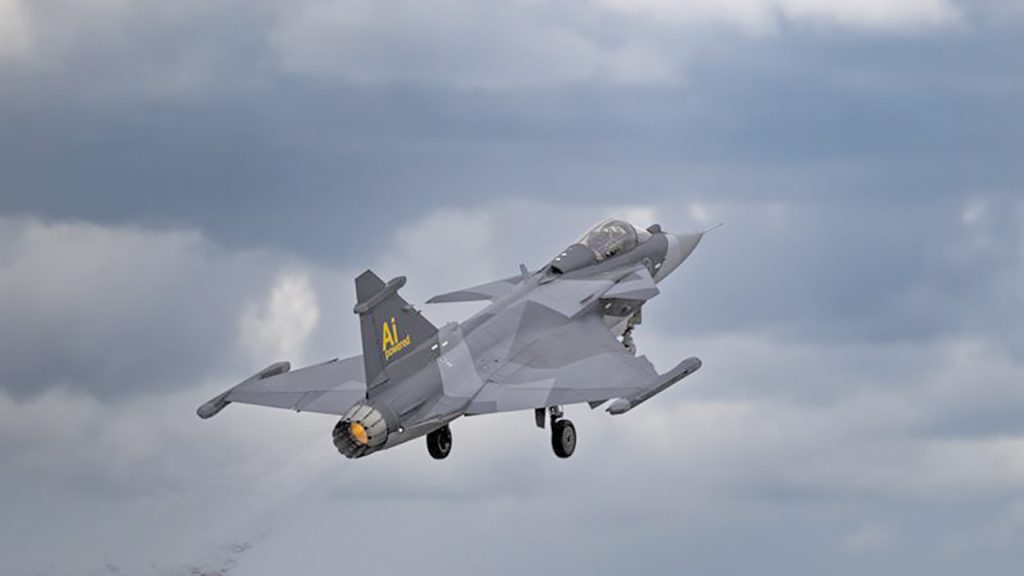
Saab, in collaboration with Helsing, on June 11 announced the successful completion of the first three flights integrating Helsing’s artificial intelligence (AI) agent Centaur into a Gripen E fighter jet, which Saab manufactured.
Saab is a defense and security company headquartered in Sweden. Saab, Inc., which is based in DeWitt, is a wholly owned subsidiary. Helsing SE is a German defense technology company based in Munich.
As part of Saab’s ‘Project Beyond’, the flights mark a “significant advance” in bringing AI capabilities to military aircraft. It is also “yet another proof point” of Gripen E’s “unparalleled ability” to rapidly update software without disregarding safety requirements, per the Saab announcement.
During the flights, the Gripen E gave control to Centaur which successfully autonomously executed complex maneuvers in a beyond visual range (BVR) combat environment and cued the pilot to fire.
“This is an important achievement for Saab, demonstrating our qualitative edge in sophisticated technologies by making AI deliver in the air. The swift integration and successful flight testing of Helsing’s AI in a Gripen E exemplifies the accelerated capability gain you can get from our fighter,” Peter Nilsson, head of advanced programs from Saab’s aeronautics business area, said in the announcement. “We are excited to continue developing and refining how this and other AI agents can be used, while once again showing how our fighters will outperform faster than the opponent can evolve,”
Saab points to the “unique design” of Gripen E, in which the fighter can fly with the AI software onboard and fully integrated without being restricted to solely military test ranges or having to rely on an experimental X-plane to do flight trials with the software.
The third flight, conducted June 3, focused specifically on Centaur’s performance, pitting it against a real Gripen D aircraft in a series of dynamic BVR scenarios with real-time data integration using sensor data to track the target aircraft.
The team tested Centaur’s adaptability by varying starting distances, speeds, aspects, and even disabling C2 data to “assess its robustness.”
Saab’s and Helsing’s joint Project Beyond team was set up using Gripen E to explore how trustworthy AI can be used against future threats. The team will now analyze the flight data and continue training the AI agent to further enhance its BVR capabilities, with a further series of flights throughout the remainder of the year.