ITHACA, N.Y. — The companies Seen Nutrition of Ithaca and Renewal Mill of Canandaigua are among the 20 finalists in the 7th round of the Grow-NY food and agriculture business competition that annually awards $3 million in prize money. The finalists also include four companies from New York City and international businesses that include two […]
ITHACA, N.Y. — The companies Seen Nutrition of Ithaca and Renewal Mill of Canandaigua are among the 20 finalists in the 7th round of the Grow-NY food and agriculture business competition that annually awards $3 million in prize money.
The finalists also include four companies from New York City and international businesses that include two from Canada, two from Argentina, and firms from Israel and Kenya.
Empire State Development (ESD) and Cornell University’s Center for Regional Economic Advancement (CREA) announced the 20 finalist startups on Aug. 26.
The Grow-NY competition, funded through New York State’s Upstate Revitalization Initiatives — Finger Lakes Forward, CNY Rising, and Southern Tier Soaring — and Empire State Development’s Division of Science, Technology and Innovation (NYSTAR), was created to “catalyze economic growth” in upstate New York.
Finalist startups are required to commit to growing jobs, partnerships, or operations in this 22-county region.
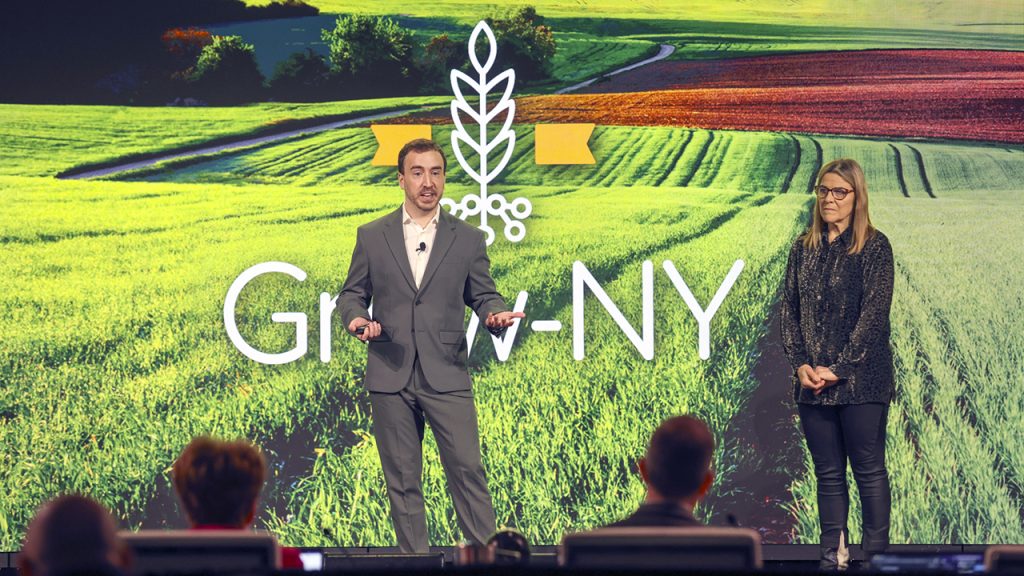
“The Grow-NY competition operates at the intersection of innovation, agriculture, and economic development,” Jenn Smith, program director of Grow-NY, said in the announcement. “Our team spends months searching for novel food and ag startups making valuable changes to our food systems that could thrive and create opportunity in Upstate NY. We’re excited to facilitate their deep connections in the region over the next couple of months and look forward to sharing their pitches with the public in November.”
This year’s Grow-NY Food and Ag Summit is set for Nov. 12–13 in Canandaigua, bringing together global innovators, investors, farmers, entrepreneurs, and researchers in the heart of the Finger Lakes to spotlight the future of food and agriculture.
Grow-NY will award a total of $3 million in prize money to seven winners. The disbursement includes a $1 million top prize, two $500,000 awards, and four $250,000 prizes. The program will announce winners during the summit’s closing ceremony.
Finalists
The 20 Grow-NY finalists are:
• Brekland of Brooklyn, N.Y., which is building a novel, biodegradable foam coating that brings new, in-field functionality to crop-frost protection products.
• DeepAgro of St. Louis, Missouri, a firm that is developing artificial-intelligence (AI) solutions for selective agrochemical spraying, sowing, and monitoring and diagnostics.
• Ergo Bioscience of Sunchales, Argentina, which “pioneers” plant-cell culturing via a proprietary platform combining AI, genetic engineering, and automation to create plant-based proteins, per a description provided by ESD.
• Finger Foods Farm of Bloomfield, N.Y., a company that produces a line of vertically integrated, health-forward frozen soups, made with local ingredients, processed at regional businesses, and branded to celebrate New York’s bounty.
• Frost Methane of Juneau, Alaska, which partners with livestock farmers to neutralize methane from manure ponds, earning carbon-credit revenue and preventing water ingress.
• Full of Beans Kitchen of New York City, a firm that is building a vertically integrated fava-bean platform, starting with regenerative New York-grown crops and ending with high-protein, ready-to-eat foods.
• Knead Technologies of Calgary, Alberta, Canada, which has a software platform that leverages technology to streamline food-rescue operations, enabling businesses to redirect surplus food to those in need while quantifying environmental impacts.
• Living Ink Technologies of Berthoud, Colorado, a company that repurposes renewable biomass waste, like algae, into sustainable black printing inks and pigments.
• Medium Well Technological Solutions of Tel Aviv, Israel, a firm whose BioResin and BioBags are made from biodegradable materials, offering scalable and sustainable solutions for food and pharma.
• Mothership Materials of New York City, which transforms agricultural waste into carbon-negative feedstocks — such as glucose and cellulose — that power the foods, fuels and fabrics of the future, per the ESD announcement.
• Picketa Systems of Fredericton, New Brunswick, Canada, a company that offers real-time plant analysis for precision nutrient management.
• PollenSmartHiveLtd of Nairobi, Kenya, which ESD described like this: “Pollen Patrollers empowers small-scale farmers and beekeepers through AI-powered smart hive technology and precision pollination services.”
• Renewal Mill of Canandaigua, which creates premium, gluten-free, vegan, and upcycled baking ingredients and snacks by transforming nutritious byproducts from food manufacturing into delicious, sustainable products.
• Roca of Alameda, California, a company that has developed an electrochemical system that removes ammonium from wastewater and recovers it as nitrogen fertilizer, helping farms and food processors reduce pollution and lower fertilizer costs.
• Seen Nutrition of Ithaca is a food-tech startup in the menopause market, initially focused on bone health, with a patented dietary calcium chew made with dairy produced in Central New York.
• Shire’s Naturals of Peterborough, New Hampshire, which offers clean-label, dairy-free foods made entirely from whole-food, plant-based ingredients.
• ThermoShade of Los Angeles, California whose shade panels absorb radiated body heat, making outdoor spaces feel up to 20°F cooler than under standard awnings.
• Trebe Biotech of Pergamino, Argentina, which uses insect larvae to produce faster, more scalable, and cost-efficient bioproducts for animal health, such as recombinant proteins and vaccines.
• Whipnotic of New York City, which ESD described like so: “With a patented nozzle technology, Whipnotic creates whipped creams infused with all-natural fruit juices and flavor essences.”
• ZILA BioWorks of Renton, Washington, a company that converts vegetable oils into high performance, low carbon, recyclable bio-epoxy resins for use in industrial composites, coatings, and adhesives.